By Rajesh Kannan, Co-Founder & CTO, Gramosoft · Last updated: · Published price ranges checked against each agency's own 2026 cost guide in October 2026
Ask five app companies what an app costs and you will get five answers, sometimes ten times apart. That is not because one of them is lying. Each quote prices a different scope, and most buyers only find out which parts were missing after they sign.
This guide starts with how Gramosoft scopes and prices an app, line by line. Then it puts the published 2026 market numbers side by side and explains what moves your price up or down, so you can compare any two quotes like with like.
TL;DR
- Published 2026 prices for a simple app start around ₹1.5–3 lakh; complex platforms run from about ₹25 lakh to ₹1 crore and more.
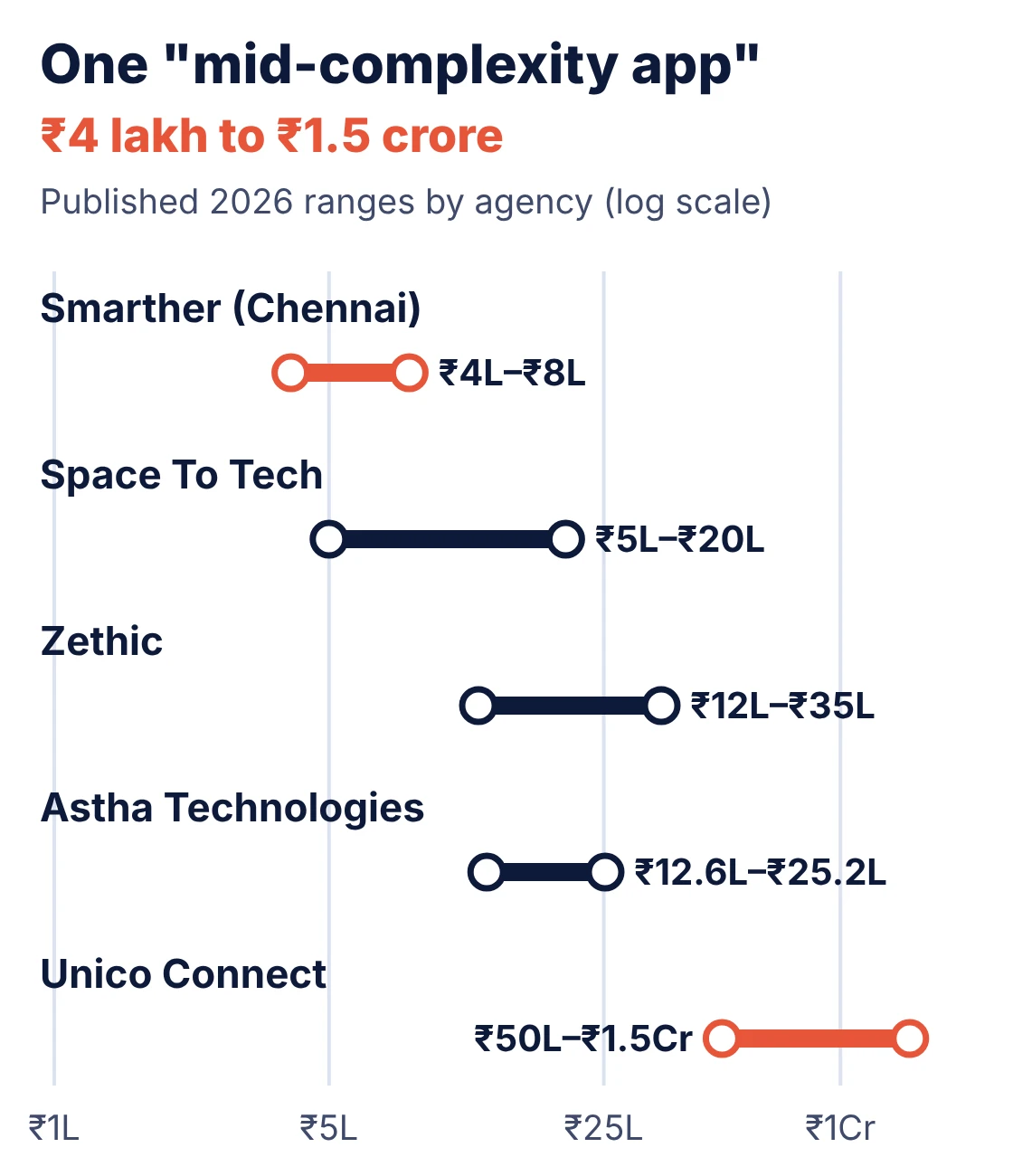
- The same "mid-complexity" app is priced anywhere from ₹4 lakh to ₹1.5 crore across agencies, mostly because of what each quote includes.
- Cross-platform (Flutter or React Native) is usually 30–40% cheaper than two native apps.
- Budget 15–25% of the build cost every year for maintenance, plus store fees, hosting and third-party API charges.
- Gramosoft quotes after a free discovery call, itemised by milestone, with the backend, admin panel, testing and support written in.
How much does mobile app development cost in Chennai? Published 2026 ranges from Indian agencies start at about ₹1.5–3 lakh for a simple single-platform app and reach ₹25 lakh to ₹1 crore or more for complex platforms. Most business apps with login, payments, an admin panel and integrations sit in between. Add 15–25% a year for maintenance.
How Gramosoft scopes and prices a mobile app
Gramosoft does not publish a fixed price list, because the backend, integrations and support needs change the number more than the screen count does. Instead we run a free discovery call, then send a quote split by milestone, so you can see exactly what each part costs and what is included.
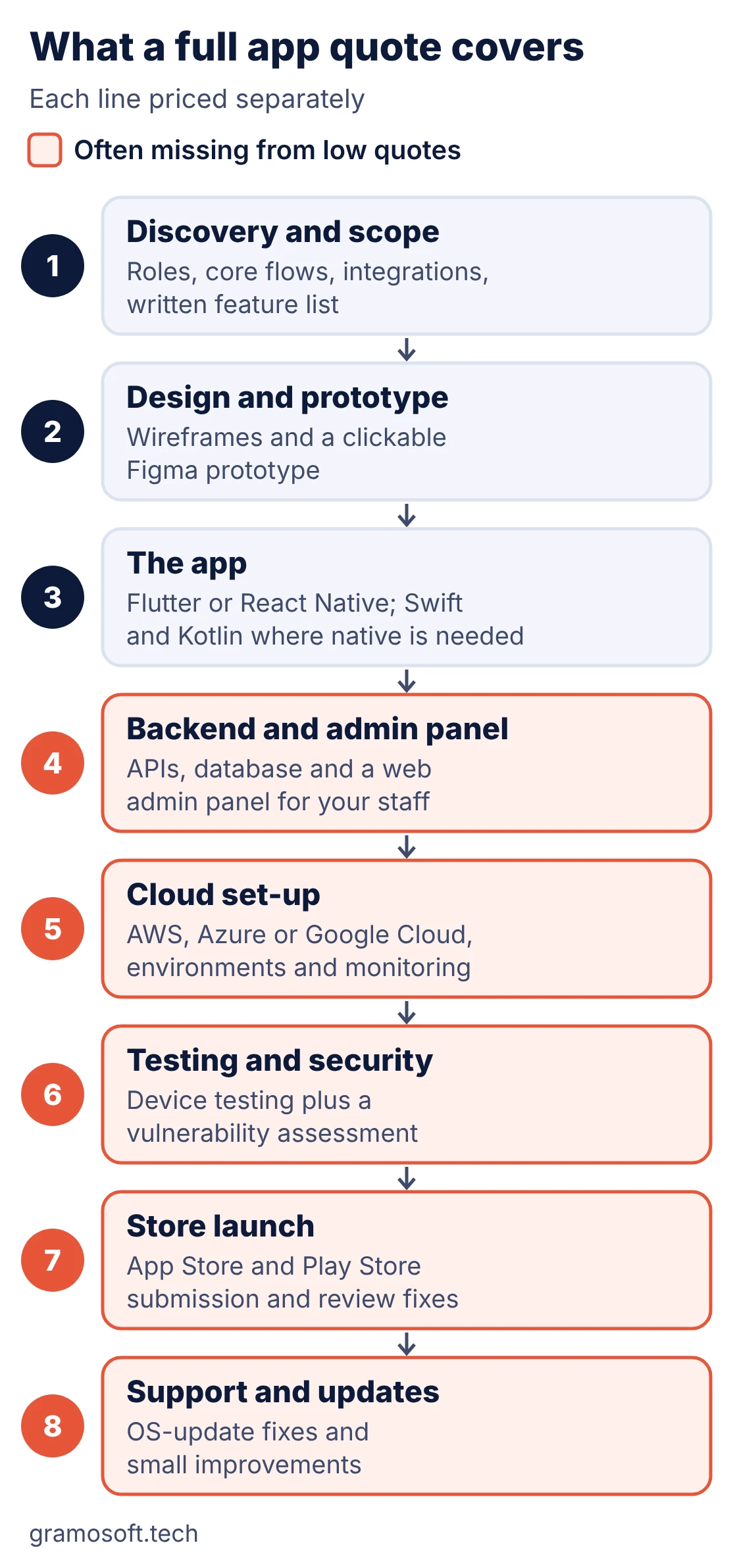
Every Gramosoft mobile app quote lists these items separately:
- Discovery and scope: user roles, core flows, integrations and a written feature list.
- Design: wireframes and a clickable Figma prototype from our UI/UX team, before any app code.
- The app: Flutter or React Native for most business apps; Swift and Kotlin where native is needed.
- Backend and admin panel: APIs on Spring Boot, .NET, Python or Node.js, and a web admin panel for your staff.
- Cloud set-up: AWS, Azure or Google Cloud through our cloud services team.
- Testing: device testing plus vulnerability assessment before launch.
- Store launch and support: App Store and Play Store submission, then OS-update compatibility, fixes and improvements.
Most business apps we scope take 8 to 24 weeks from discovery to store launch. Our work includes flight booking apps for the Batik Air group, insurance platforms for GMAT, and the Kia DMS automation project. If you are still comparing vendors, our guide to mobile app development companies in Chennai covers who suits which project.
"When a quote looks too good, ask what happens after the user taps submit. If nobody has priced the backend, the admin panel or the first year of support, you haven't been given the real number yet."
Rajesh Kannan, Co-Founder & CTO at Gramosoft
Mobile app cost in Chennai at a glance
Agencies publish very different price bands, so it helps to see them together. The table below lists the 2026 ranges each firm states for simple, mid-level and complex apps, linked to its own guide. Treat them as market signals, not quotes: none of them knows your feature list, integrations or support needs yet.
Swipe the table sideways on mobile →
| Source (published 2026) | Simple app | Mid-complexity app | Complex / enterprise |
|---|---|---|---|
| Smarther Technologies (Chennai) | ₹1.5–3 lakh | ₹4–8 lakh | ₹10–25 lakh+ |
| Space To Tech | ₹1.5–5 lakh | ₹5–20 lakh | ₹25 lakh–₹1 crore+ |
| Zethic | ₹3–12 lakh | ₹12–35 lakh | ₹35 lakh–₹1 crore+ |
| Astha Technologies | ₹4.2–12.6 lakh | ₹12.6–25.2 lakh | ₹25.2–84 lakh+ |
| Unico Connect | ₹15–50 lakh (MVP) | ₹50 lakh–₹1.5 crore | ₹1.5 crore+ |
Gramosoft does not publish a price band, for the reasons explained above. The spread above is the real lesson: the word "app" covers everything from a five-screen catalogue to a multi-role booking platform.
Why two quotes for the same app can differ tenfold
Quotes differ mainly because each one prices a different scope, not because one team codes ten times faster. A cheap quote often covers only the screens, while a full quote also covers the backend, admin panel, testing, store launch and support. Compare what each quote includes before you compare totals.
Four things usually explain the gap:
- What is in scope. Smarther's guide notes that cheaper builds often exclude a backend and login; Space To Tech warns that low quotes often mean one platform, minimal backend, no proper QA and no post-launch support.
- Team seniority. A junior-heavy team bills less per hour but may need more hours and more rework.
- Platform choice. Two native apps cost more than one cross-platform codebase.
- Who the agency usually serves. Firms pricing for overseas clients publish bands several times higher than firms pricing for local SMEs.
What drives the cost of a mobile app
Seven factors decide most of the number on your quote: platform, user roles, backend, integrations, design depth, security needs and team seniority. Knowing which of these your app needs lets you check whether a quote is realistic, and shows where you can trim scope without hurting the product.
Swipe the table sideways on mobile →
| Cost driver | Why it moves the price | How to keep it in check |
|---|---|---|
| Platform | Two native apps mean two codebases; cross-platform is typically 30–40% cheaper (Zethic, Astha) | Use Flutter or React Native unless you need deep device features |
| User roles | Customer, staff and admin each need their own screens, permissions and testing | Launch with the roles the first release truly needs |
| Backend and admin panel | Published estimates run from ₹50,000–1.5 lakh on Firebase-style services to ₹1.5–8 lakh for a custom backend (Astha, Smarther) | Decide early what must be custom and what a managed service can do |
| Integrations | Payment gateway ₹20,000–60,000, maps ₹30,000–50,000, real-time chat or video ₹1–2 lakh+ (Astha); ERP or CRM links add more | Buy proven SDKs for payments, chat and maps instead of building them |
| UI/UX design | Usually 15–25% of the total budget (Space To Tech, Unico Connect) | Prototype the core flow in Figma before full design |
| Security and compliance | Health, finance and personal data need encryption, audit logs and extra testing | Plan security testing into the first release, not after launch |
| Team seniority | Chennai hourly rates run from about ₹800 for juniors to ₹4,000 for seniors (Smarther) | Ask who will actually work on your app, and at what level |
Mobile app developer rates in Chennai
Chennai rates are lower than in most Indian metros and far below US or European agencies, but they vary widely by seniority. Smarther's Chennai guide lists the bands below. Most agencies quote a fixed price per milestone rather than billing hourly, so use rates to sanity-check a quote, not to build one.
Swipe the table sideways on mobile →
| Level | Hourly rate (Chennai) |
|---|---|
| Junior developer | ₹800–1,500 |
| Mid-level developer | ₹1,500–2,500 |
| Senior developer | ₹2,500–4,000 |
Source: Smarther Technologies, March 2026. For comparison, Zethic puts India-wide senior and architect rates at up to ₹8,000 an hour and blended agency rates at $25–60 an hour, citing Clutch.
How an app budget splits across the project
Coding is only part of the bill. Discovery, design, testing and launch together take roughly half the budget on a typical project. A quote that leaves out discovery or gives testing less than a tenth of the budget is not cheaper: it moves those costs to after launch, when they are more expensive.
Swipe the table sideways on mobile →
| Phase | Share of budget | What it covers |
|---|---|---|
| Discovery and planning | 8–12% | Scope, tech stack, wireframes, roadmap |
| UI/UX design | 15–20% | User journeys, prototypes, usability checks |
| Frontend and backend development | 40–50% | App code, APIs, database, admin panel, integrations |
| Testing and QA | 10–15% | Functional, device, performance and security testing |
| Deployment and store launch | 5–10% | Store submission, staging and production set-up |
Shares from Space To Tech's 2026 phase breakdown for a mid-complexity app.
Hidden costs most app quotes leave out
The build quote is rarely the total cost of owning an app. Store fees, hosting, third-party usage charges, payment gateway fees, maintenance and GST all arrive after the contract is signed. Put them in your budget from the start so the first year does not run 25–50% over plan.
- Maintenance: 15–25% of the build cost every year for OS updates, bug fixes and security patches (Zethic, Easycomm). A ₹15 lakh app needs about ₹2.25–3.75 lakh a year.
- Store fees: Apple charges $99 a year and Google Play $25 once (Easycomm).
- Hosting and cloud: small at launch, then rising with users and data.
- Third-party usage: maps, SMS, email and analytics bill per use; Zethic estimates ₹15,000–60,000 a month once real users are active.
- Payment gateway fees: typically 2–3% of each transaction (Smarther).
- GST: 18% applies on Indian invoices for development services (Unico Connect).
- Year-one changes: the first round of user feedback almost always leads to design and feature changes.
Published cost by app type
Industry matters because regulation and integrations change the scope far more than screen count does. Zethic's 2026 guide gives the India ranges below. Fintech and healthcare sit at the top because compliance, security audits and system integrations add work beyond the core features.
Swipe the table sideways on mobile →
| App type | Published range (India, 2026) | Main cost drivers |
|---|---|---|
| Fintech | ₹50 lakh–₹1 crore+ | Compliance, KYC, encryption |
| Healthcare | ₹50 lakh–₹1.25 crore+ | Health data rules, records workflows |
| Logistics | ₹25–70 lakh | Live tracking, fleet, routing |
| On-demand services | ₹15–60 lakh | Two-sided marketplace, payments |
| Education | ₹16–50 lakh | Content delivery, assessments, video |
| eCommerce | ₹10–50 lakh | Catalogue, payments, logistics APIs |
Source: Zethic, May 2026. B2B ordering apps for distributors cost more than consumer stores of the same size, because tiered pricing, credit limits and ERP sync all need custom backend logic.
How to reduce app development cost without cutting quality
The safest savings come from building less in the first release, not from paying a cheaper team to build the same thing. Validate one core flow, share one codebase across both stores, buy commodity features, and fix the backend design early. Cutting testing or security only moves the cost to after launch.
- Start with an MVP. Ship the one flow that proves the idea; add the rest once users ask for it.
- Go cross-platform by default. Flutter or React Native, unless you need heavy device or graphics features.
- Buy, do not build, the standard parts. Payments, login, chat, maps and analytics all have proven services.
- Get the backend right first. Reworking the data model later is the most expensive change you can make.
- Use one team for app and backend. Two vendors means two contracts, two schedules and a gap nobody owns.
- Write the scope down. A milestone plan with deliverables per phase prevents most scope disputes.
Which build approach fits your app and budget
Match the build to what the app must do in its first release, not to the biggest version you can imagine. The table pairs common business needs with the approach that usually fits and the published band it tends to fall in, so you can set a realistic budget before you ask anyone for a quote.
Swipe the table sideways on mobile →
| If your first release needs… | Usually the right approach | Published band it tends to fall in |
|---|---|---|
| A partner that builds the app, backend, admin panel and cloud together | Gramosoft: milestone quote after a free discovery call | Depends on scope; itemised per milestone |
| To test one idea with real users | Cross-platform MVP, one core flow, managed backend | Simple tier (₹1.5–12 lakh across sources) |
| Login, payments, an admin panel and a few integrations | Cross-platform app with a custom backend | Mid tier (₹4–35 lakh for most local agencies) |
| Several user roles, ERP or CRM links, offline use | Cross-platform or native app with a full backend and web admin | Upper mid to complex tier |
| Health, finance or other regulated data | Full build with security testing and compliance work from day one | Complex tier (₹50 lakh+ in published industry ranges) |
How to read a mobile app quote before you sign
A complete quote names its scope, team, milestones and handover, not just a total. Use the checklist below on every proposal you receive, including ours. If a vendor cannot answer these in writing, the total on the quote is not yet a number you can plan around.
- Is discovery and architecture included, or does it start straight at coding?
- Which platforms and which framework, and why?
- Are the backend, admin panel and integrations priced, or assumed elsewhere?
- How many design revisions and test cycles are included?
- Who will work on it, and at what seniority?
- What counts as a change request, and how is it priced?
- Is store submission included, and post-launch support for how long?
- Do you receive source code, store accounts, cloud access and documentation at handover?
"The cheapest app is the one you only build once. Paying for discovery and a proper backend up front costs less than rebuilding it a year later."
Rajesh Kannan, Co-Founder & CTO at Gramosoft
When you might not need a custom mobile app
A custom app earns its cost when people use it often, away from a desk, or need the camera, location or push notifications. If your users mostly sit at a desk, or your process is standard, a web application or an off-the-shelf product is usually cheaper to build, faster to change and easier to maintain.
- A web application for desk-based staff and admin work.
- An off-the-shelf suite such as GramoERP or a help desk platform when the process is standard.
- RPA when the real need is automating repetitive back-office work, not a new screen.
Frequently asked questions
How much does it cost to develop a mobile app in Chennai?
Published 2026 ranges start at about ₹1.5–3 lakh for a simple single-platform app. Mid-level business apps with login, payments and an admin panel are usually quoted between ₹4 lakh and ₹35 lakh, and complex platforms from ₹25 lakh to ₹1 crore or more. Your scope decides where you land.
How much does Gramosoft charge to build a mobile app?
Gramosoft quotes each project after a free discovery call rather than publishing a fixed price list. The quote is split by milestone (discovery, design, app, backend and admin panel, cloud, testing, launch and support) so you can see what each part costs. Book a discovery call to get one.
Is Flutter cheaper than native app development?
Usually, yes. One Flutter or React Native codebase for Android and iOS is typically 30–40% cheaper than two native apps, with near-native performance for most business apps. Native Swift and Kotlin still make sense for heavy graphics, advanced device features or platform-specific design.
How much does app maintenance cost per year?
Plan for 15–25% of the original build cost every year. That covers Android and iOS updates, bug fixes, security patches and small improvements. A ₹15 lakh app typically needs about ₹2.25–3.75 lakh a year, plus hosting and third-party service charges.
What hidden costs should I budget for?
Budget for store fees (Apple $99 a year, Google Play $25 once), cloud hosting, per-use charges for maps, SMS and analytics, payment gateway fees of about 2–3% per transaction, 18% GST on Indian invoices, and changes after the first round of user feedback.
How long does it take to build a mobile app?
A focused MVP can take 2–3 months, and most business apps take 8 to 24 weeks from discovery to store launch. Complex platforms with several integrations can run 6–12 months. Changing requirements mid-build cause more delay than coding speed does.
Is a very cheap app quote a red flag?
Not always, but check what it leaves out. Low quotes often cover one platform, a minimal backend and no proper testing or support. Ask whether the backend, admin panel, store launch and post-launch fixes are included before comparing it with other quotes.