How modern AI applications actually work behind the scenes — architecture, evaluation, governance and reliability, not another "what is AI" primer.
Ask ten people what AI development means and you'll get ten different answers — training a model, writing prompts, plugging into an API, building a chatbot. None of those answers is complete on its own. The teams shipping reliable AI products aren't the ones with the biggest model. They're the ones who understand that a foundation model is one component inside a much larger system — built from retrieval, context, tools, memory, guardrails, evaluation and monitoring, engineered together.
Application Intelligence ≈ Model Capability + Context + Knowledge + Tools + Memory + Feedback + Evaluation. The model is only one term in that equation — everything else is engineered.
AI Development at a Glance
AI development is the process of designing, building, integrating, evaluating, deploying and maintaining software systems that use artificial intelligence models to perform tasks that traditionally required human judgment. Modern AI development goes beyond model training: production systems combine foundation models, context engineering, retrieval, tools, memory, security controls, evaluation, observability and human oversight.
Core components: AI models · data & knowledge · context engineering · retrieval/RAG · tool calling · AI agents · memory · evaluation · security & guardrails · governance · observability · deployment & reliability.
Key Takeaways
- AI development is broader than model training — an LLM is only one component of an AI application.
- RAG supplies external knowledge without changing model weights; fine-tuning changes the model itself.
- AI agents add tool use and multi-step execution on top of a base model.
- Context quality can matter as much as model choice — poor context produces poor answers from a good model.
- AI systems need continuous evaluation, not a one-time test before launch.
- Security has to cover prompts, data, tools, permissions and outputs together.
- Production AI needs reliability, observability, governance, and cost and latency management.
- Human approval matters for high-risk, high-cost, or hard-to-reverse actions.
01 AI Development Has Changed
The old mental model of AI development was linear:

That model still applies if you're building a foundation model from scratch. Most businesses building AI applications today don't do that — instead, they build applications around existing foundation models, combining a model with application logic, retrieval, tools, structured data, memory, and continuous evaluation. That system, not the model alone, is what determines whether a product works.
02 What AI Development Actually Means
It helps to separate five overlapping disciplines that people casually lump under "AI":
- Traditional software development — deterministic logic, fixed inputs and outputs.
- Machine learning development — training statistical models from data.
- Generative AI development — building with pretrained foundation models that generate text, code, images or audio.
- AI application development — the product layer: UI, orchestration, retrieval, integration.
- AI engineering — making all of the above reliable, measurable and safe in production.
AI engineering ≠ model training. Most businesses don't need to train a foundation model — they need to engineer a dependable system around one that already exists.
03 The Modern AI Application Stack
A production AI system is layered, and separating the layers is what makes it maintainable, testable and swappable.
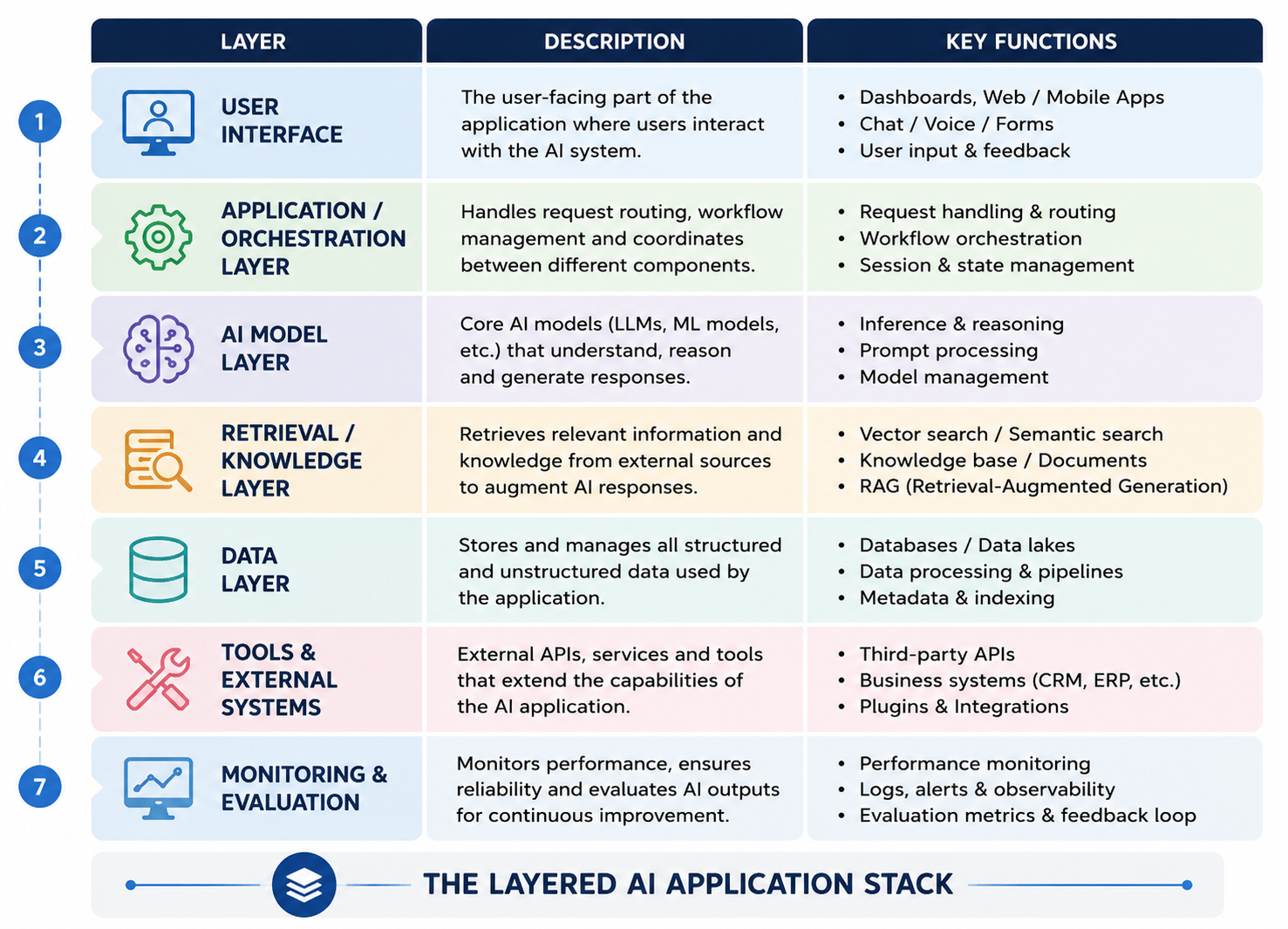
Each layer has one job. The UI collects intent. Orchestration decides what happens next. The model reasons and generates. Retrieval supplies facts the model doesn't already know. Tools let the system act in the real world. Monitoring tells you whether any of it is actually working. When teams collapse these layers — hard-coding retrieval logic straight into a prompt, for example — the system becomes brittle and hard to debug.
04 How an AI Application Processes a Single Request
Take a realistic prompt: "Analyze this company's quarterly report and tell me why revenue declined." Behind the scenes, this single sentence triggers a pipeline most users never see:
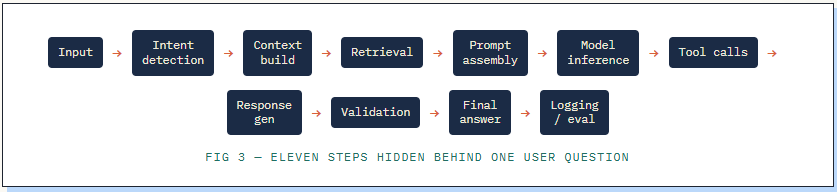
Eleven steps for one question. This is the behind-the-scenes reality of AI application development — and every one of those steps is a place where quality can be won or lost.
05 Foundation Models, LLMs and Multimodal Models
"LLMs generate text" is the entry-level explanation. A working understanding needs the mechanics underneath it:
- Tokens & tokenization — text is broken into sub-word units before a model can process it.
- Embeddings — numerical vectors that represent meaning, enabling semantic search.
- Context window — the maximum amount of text (measured in tokens) the model can consider in one inference call.
- Attention & transformer architecture — the mechanism that lets a model weigh which earlier tokens matter most for predicting the next one.
- Parameters — the learned weights that encode a model's behaviour.
- Inference — running a trained model to produce an output.
- Temperature & top-p — sampling controls that trade off determinism against creativity.
- Structured outputs — constraining a model's response to a defined schema (like JSON) instead of free text.
- Multimodal models — models that reason across text, images, audio or video in a single context.
Model capability ≠ application capability. A powerful model wrapped in poor retrieval, weak context, or no evaluation still produces a poor application.
06 Prompt Engineering Is Only One Part of AI Engineering
Prompt engineering — crafting the right instruction to coax a good answer out of a model — was the dominant early skill of generative AI. The discipline has since matured into something broader and more rigorous.

Context engineering is the discipline of deciding exactly what goes into a model's context window — system instructions, user context, retrieved information, tool outputs, conversation history, memory, output schemas and safety constraints — and how it's structured. Research on long-context models has found that they can use information unevenly depending on where it sits in the context — performance can dip when the relevant detail is buried in the middle of a long input rather than near the start or end.
Not obviousMany agent failures can originate outside the model itself — for example, from incomplete, stale, irrelevant, or poorly structured context, rather than a limitation of the model.
System engineering goes one level higher: the harness of workflows, permissions, persistent state and continuous improvement that surrounds the model and context altogether — treating the AI system the way you'd treat any other piece of production software.
07 RAG: Beyond Basic Retrieval-Augmented Generation
Most explanations stop at "RAG fetches relevant documents and feeds them to the model." The real pipeline has many more moving parts:
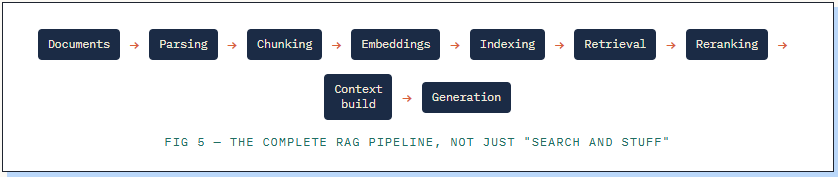
Each stage has its own tuning surface: chunk size and overlap, semantic chunking (splitting by meaning rather than a fixed character count), metadata filtering, hybrid search (combining keyword and vector search), reranking models that re-score retrieved candidates, query expansion, multi-query retrieval, parent-child retrieval (retrieving small chunks but returning their surrounding context), and context compression to fit only what matters into the window.
Bad retrieval can make a powerful LLM appear unintelligent. The model can only reason over what it's given.
Businesses connecting a RAG pipeline to internal systems often pair it with broader AI development services to handle ingestion, indexing and the surrounding application layer, rather than treating retrieval as a standalone script.
08 Why Vector Databases Are Not the Whole RAG Story
A vector database is a tool, not a strategy. The distinction that matters:
Vector similarity ≠ relevance. A semantically similar document isn't necessarily the correct document.
Retrieval quality is measured the way information-retrieval systems have always been measured — precision, recall, and ranking quality — combined with metadata filters, hybrid retrieval, rerankers, and ongoing search-quality evaluation. Treating "we added a vector database" as equivalent to "our AI is grounded in our data" is one of the most common gaps between a demo and a dependable product.
09 Data Freshness and Versioning
A RAG system can be technically correct in how it retrieves and still give wrong answers if the underlying knowledge base is stale. Freshness is a pipeline problem, not a retrieval problem:

Without change detection and re-indexing, a document updated last week may still be served from a stale embedding index. Versioning also matters for auditability — when a business user asks "why did the AI say that," you need to know which version of the knowledge base answered.
10 Data Engineering for AI
AI development isn't only about LLMs. Every RAG system, fine-tuned model, or evaluation set sits on top of a data pipeline:
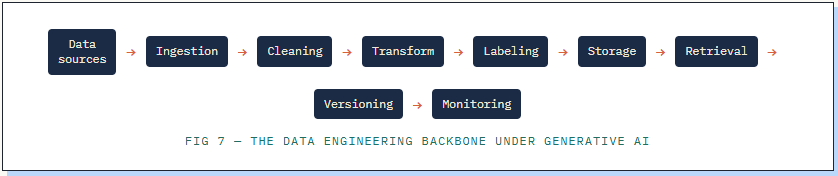
Skipping this layer is one reason AI pilots stall: a prototype built on a clean sample dataset can fail once it meets the messy, duplicated, inconsistently formatted data that actually lives in a business's systems.
11 AI Agents: What Makes an Application Agentic?
The difference between a chatbot and an agent isn't marketing language — it's a structural difference in how the system runs.
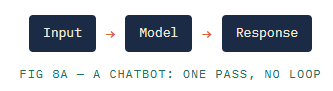

Building an agent means engineering tool calling (also called function calling): the model is given a defined list of available tools and their inputs, decides which one fits the current step, calls it, reads back the result, and uses that observation to choose its next action — repeating until the goal is met, or it hands off. This also requires planning, state, memory, an environment for the agent to act in, and feedback loops.
Not every task needs this. A fixed sequence of steps that never branches is an agentic workflow; a system that decides its own next step at runtime is an autonomous agent — and the second is harder to make reliable, so it should be reserved for tasks that genuinely need it. Businesses looking to combine deterministic steps with AI judgment often start with AI-assisted workflow automation before moving to a fully autonomous agent.
12 Intelligent Routing
Model routing asks "which model should answer this?" Intelligent routing asks a bigger question: which path should this request take at all?
| Request type | Best path |
|---|---|
| Simple FAQ | Small / fast LLM, no retrieval needed |
| Company knowledge question | RAG pipeline |
| Structured data lookup | Direct SQL / tool call, model not required to "reason" over raw data |
| Complex multi-step task | Agentic workflow or autonomous agent |
| Sensitive or irreversible action | Human approval gate before execution |
Deciding the path before deciding the model avoids the common trap of routing every request — even a simple date lookup — through a full agent loop.
Which AI Architecture Should You Use?
| Business requirement | Recommended approach |
|---|---|
| Generate text | LLM |
| Extract structured information | LLM + structured output |
| Answer from company documents | RAG |
| Search enterprise knowledge | Hybrid retrieval + reranking |
| Perform deterministic automation | Workflow automation |
| Perform multi-step dynamic tasks | Agentic workflow |
| Highly specialised behaviour | Fine-tuning |
| Predict numeric outcomes | ML / predictive model |
| Analyze images or video | Computer vision / multimodal model |
| High-risk decision or action | AI + human approval |
13 AI Memory, Explained Properly
"Memory" gets used loosely. Three distinct kinds exist, and conflating them creates unreliable systems:
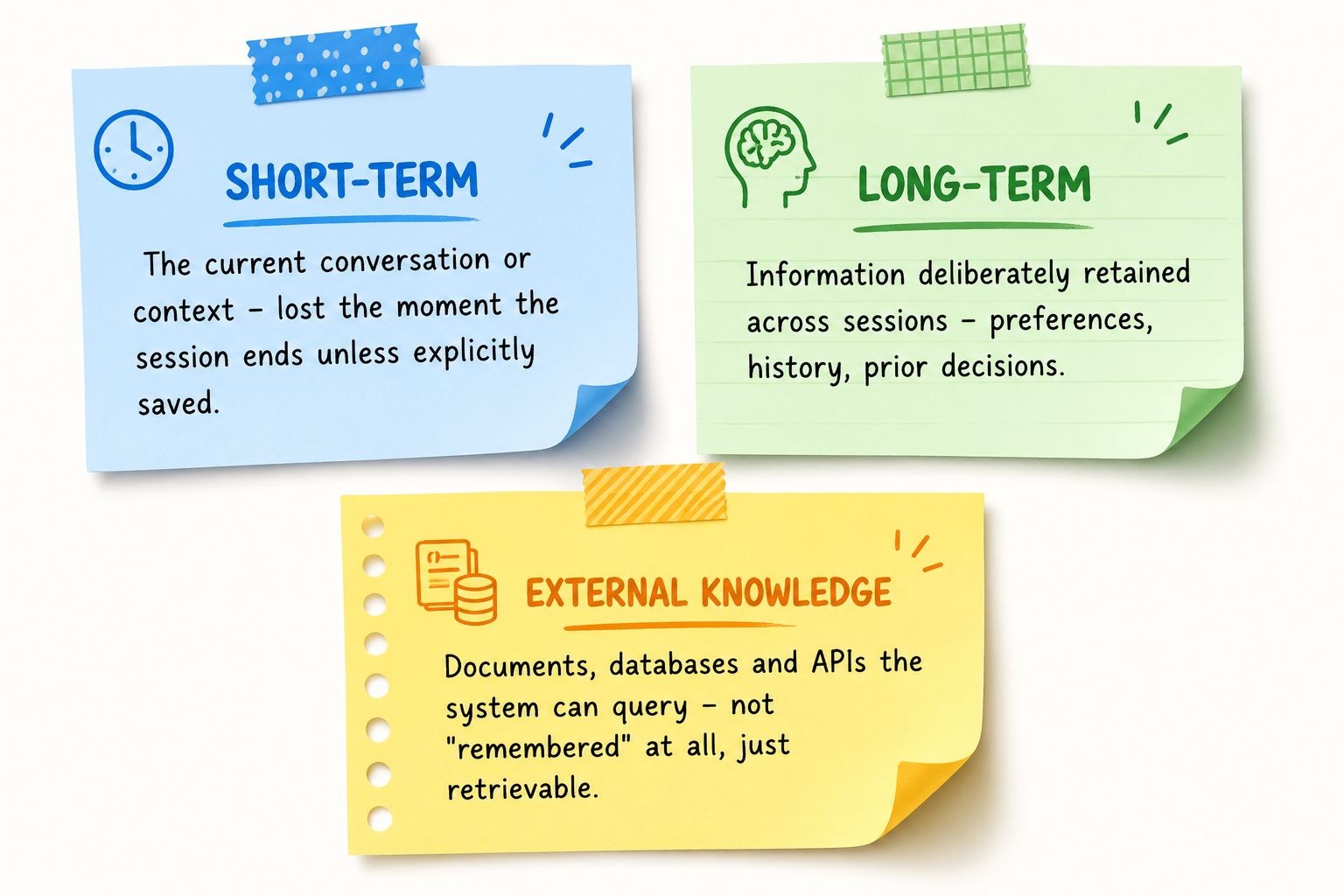
14 Fine-Tuning vs. RAG vs. Prompt Engineering
A simple decision framework saves teams from over-engineering:
| Requirement | Better approach |
|---|---|
| Change instructions or behaviour | Prompt engineering |
| Add changing company knowledge | Retrieval-Augmented Generation (RAG) |
| Improve response style or tone | Prompting, occasionally fine-tuning |
| Teach a specialised behaviour | Fine-tuning |
| Connect to external systems | Tool / function calling |
| Complex multi-step tasks | Agentic workflow |
These approaches combine freely — most serious systems use two or three together, not one in isolation. Fine-tuning changes a model's learned parameters to improve specific behaviours, formats, or task performance; it is generally not the preferred way to keep frequently changing factual knowledge current — that's what RAG is for.
15 AI Evaluation — The Most Ignored Part
You cannot reliably improve an AI application if you cannot measure it.
Evaluation-driven development is gaining ground for the same reason test-driven development did in traditional software: relying on intuition and one-off manual checks doesn't scale. Metrics split naturally into three groups depending on what part of the system you're measuring:
| Layer | Metrics |
|---|---|
| Retrieval | Precision@K, Recall@K, Mean Reciprocal Rank (MRR), NDCG |
| Generation | Faithfulness, groundedness, relevance, completeness |
| Agents | Task success rate, tool-call accuracy, tool failure rate, average steps per task |

A system that looks good against a curated test set can still fail in production, because real users ask questions your test set never anticipated. That's why the strongest teams treat evaluation as continuous, not a pre-launch checkbox - measuring latency and cost alongside accuracy, since a technically correct answer that arrives too slowly or too expensively is still a failed system.
16 AI Failure Taxonomy
Hallucination gets most of the attention, but it's one entry in a longer list of ways an AI system can fail:
| Failure | Typical cause |
|---|---|
| Hallucination | Unsupported generation not grounded in retrieved or verified data |
| Retrieval failure | Wrong or irrelevant documents retrieved |
| Context failure | Relevant information present but crowded out or omitted |
| Tool failure | Incorrect or malformed tool/API result |
| Planning failure | Wrong execution sequence chosen by an agent |
| Permission failure | Excessive tool access allowed an unsafe action |
| Evaluation failure | Poor measurement hid a real quality problem |
| Data freshness failure | Stale knowledge base served an outdated answer |
Naming failures this specifically matters because each one has a different fix - better retrieval doesn't help a permission failure, and better prompting doesn't help a stale index.
17 LLM Observability
Traditional software has logs. AI systems need traces and evaluations at every step: prompt tracing, token usage, latency tracking, model errors, retrieval traces, tool-call traces, cost monitoring, user feedback, and failure analysis.
Logs were enough for traditional software. AI systems need traces + evaluations, because the same input can produce a different output every time.
Observability tooling has moved from single-purpose "watch the LLM calls" dashboards toward platforms that trace context, retrieval, tool calls and cost together across the whole stack — because rate limits, multi-provider routing and distributed agent calls make isolated logging insufficient on its own.
18 AI Hallucinations: Why They Actually Happen
"AI sometimes makes things up" isn't an explanation. The real causes are specific and mostly fixable:
- Missing knowledge the model was never trained on
- Poor or irrelevant retrieval
- Ambiguous prompts that leave room for guessing
- Context overload — too much irrelevant information crowding out the useful part
- Fundamental model limitations
- Incorrect or misleading tool outputs
- Poor grounding in verified source material
- Conflicting information inside the context itself
RAG can reduce unsupported generation by grounding responses in retrieved information, but retrieval itself can fail and models can still generate unsupported claims mitigation is layered, not a single fix. Grounding + retrieval + tool use + structured outputs + guardrails + evaluation, working together.
Context Windows Are Not the Same as Memory
This is one of the most useful distinctions for anyone moving from intermediate to advanced understanding: a context window is simply what the model can process during one inference call. It does not automatically mean persistent memory. Persistent behaviour requires deliberate engineering — context management, summarisation, conversation compression, retrieval-based memory, and external memory stores — none of which happen automatically just because the context window is large.
19 AI Security and Guardrails
AI systems introduce attack surfaces traditional software doesn't have. The OWASP Top 10 for LLM Applications identifies risks including prompt injection, sensitive information disclosure, data and model poisoning, excessive agency, vector and embedding weaknesses, improper output handling, and unbounded consumption. (OWASP Gen AI Security Project, 2025)
| Risk | What it means |
|---|---|
| Prompt injection | Instructions embedded in input or retrieved content manipulate model behaviour |
| Sensitive information disclosure | The AI exposes protected or confidential information |
| Data / model poisoning | Training, retrieval or embedding data is deliberately compromised |
| Excessive agency | The AI has more permissions or autonomy than the task requires |
| Vector / embedding weaknesses | The retrieval layer introduces its own security risks |
| Improper output handling | The application trusts unsafe model output without validation |
| Unbounded consumption | An AI workload creates uncontrolled resource or cost usage |
An AI model should never automatically receive the same permissions as the user. Apply the principle of least privilege to every tool an AI system can call.
Risk to watch
Indirect prompt injection is especially dangerous because the malicious instruction doesn't come from your user - it's hidden inside a document, webpage, or email your agent reads and treats as trustworthy.
Guardrails turn these risks into checkpoints rather than hopes. They sit at every boundary a request crosses:

- Input guardrails — detect malicious or inappropriate inputs before they reach the model.
- Retrieval guardrails — prevent untrusted retrieved documents from silently controlling system behaviour.
- Tool guardrails — restrict exactly what an agent is allowed to execute.
- Output guardrails — validate generated responses before they reach the user.
- Policy guardrails — enforce business rules that sit above any individual model call.
20 AI Governance: The Layer Above Security
Security protects the system from attacks. Governance defines how the organization is allowed to use the system in the first place — and it's what lets an AI application survive an audit, not just an attack.
- Data governance — who owns the data, where it came from, and how it can be used.
- Model governance — which models are approved, and under what conditions they can be used.
- Access policies — who and what can trigger which actions.
- Audit trails — a record of what happened and why.
- Human oversight — defined points where a person reviews or approves.
- Risk classification — not every AI use case carries the same risk.
- Documentation & evaluation records — proof of how the system was tested.
- Incident response — a defined process for when something goes wrong.
- Regulatory requirements & model/version tracking — knowing exactly what was running, when.
A production AI system should be able to answer not only "What did the model produce?" but also "Which model, data, instructions, tools, permissions and policies produced it?"
Frameworks such as the NIST AI Risk Management Framework and its Generative AI Profile are built around exactly this — managing risk across an AI system's design, development, deployment, use and evaluation, rather than treating security as a one-time checklist. (NIST AI RMF: Generative AI Profile)
21 AI Reliability Engineering
Traditional software asks: does the program work? AI systems add a second question: does it work consistently, across retries, provider outages, and unpredictable model behaviour? This is where AI development borrows directly from distributed-systems engineering:
- Retry strategies — retrying a failed call with backoff rather than failing immediately.
- Fallback models — routing to a secondary model or provider if the primary one fails or times out.
- Timeout handling — bounding how long any single step is allowed to run.
- Circuit breakers — stopping calls to a failing dependency instead of retrying it into deeper failure.
- Graceful degradation — returning a reduced but still useful response instead of a hard failure.
- Human escalation — handing off to a person when automated recovery isn't safe or possible.
- Model/provider failover — keeping the system running even if a specific model or vendor goes down.
Primary model fails → fallback model. Retrieval fails → controlled response, not a guess. Tool fails → retry → fallback → human escalation. That chain is what separates a demo from production AI engineering.
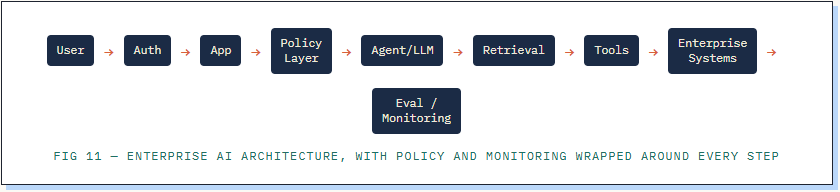
22 Four Real AI Application Architectures
These aren't competing designs — they're a progression, and most companies move through them as their needs grow.



23 Choosing and Routing the Right Model
Model selection isn't "which model is smartest." Evaluate against accuracy, reasoning capability, context length, latency, cost, multimodal capability, tool calling support, structured output support, privacy requirements, hosting constraints, and reliability.
Model routing sends simple tasks to a smaller, cheaper model and complex tasks to a stronger one — the same request doesn't always need the most expensive model in your stack, and routing can meaningfully cut both cost and latency at scale.
24 AI Cost and Latency Optimisation
Two of the most commercially important, and most skipped, sections in generic AI content.
The cheapest model isn't always the cheapest system. A cheap model that needs three retries can cost more than a stronger model that solves the task in one call.
Cost levers: token optimisation, prompt compression, context reduction, caching, model routing, batch processing, smaller specialised models, retrieval optimisation, and response-length limits. Teams that invest deliberately in context engineering typically see lower token cost from better selective retrieval and compression, alongside gains in answer quality — reducing failed calls and retries usually saves more than switching to a cheaper model outright.
Latency comes from every hop in the pipeline — user, API, retrieval, model, tool, model again, response. Reduce it with streaming, parallel tool calls, async processing, caching, smaller models where appropriate, fewer retrieval round-trips, and tighter limits on agent loops.
25 Human-in-the-Loop AI
Not every AI system should run fully autonomously. A simple, high-value pattern: AI prepares → human reviews → system executes. This matters most for financial operations, legal workflows, healthcare, HR, customer escalations, and any sensitive enterprise action where an error is expensive or hard to reverse.
26 Should You Build, Buy, or Integrate AI?
Use an existing AI API when
- You need general language capability, not a specialised behaviour.
- Time-to-market matters more than deep customisation.
- You don't have model-training infrastructure.
Build a custom AI application when
- Your workflow is genuinely unique to your business.
- AI needs to connect to internal systems and data.
- You need domain-specific orchestration, evaluation or security controls.
Fine-tune when
- Existing models can't reliably achieve a specialised behaviour, format or tone through prompting alone.
Build or train a model from scratch when
- You have unusual requirements, proprietary data, sufficient resources, and a strong reason not to use an existing model — this applies to very few companies.
27 The AI Development Lifecycle
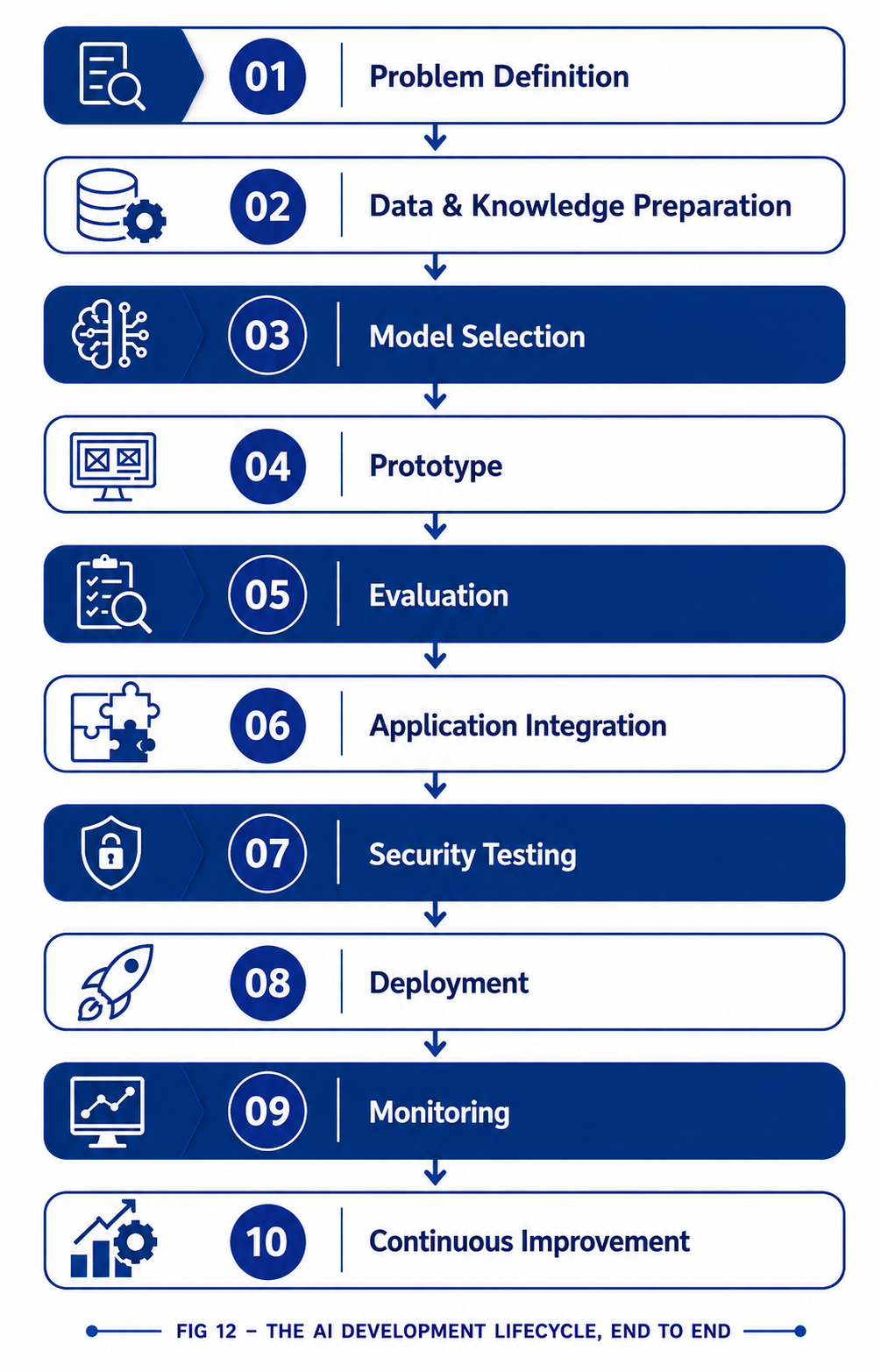
In practice this isn't a straight line. Evaluation, monitoring, user feedback and incident analysis continuously feed back into data preparation, context design, model selection and application architecture — the lifecycle is a loop, not a one-way pipeline.
28 Example: Building an AI Invoice Processing System
Requirement: a company receives thousands of invoices by email and needs to process them into its ERP system.
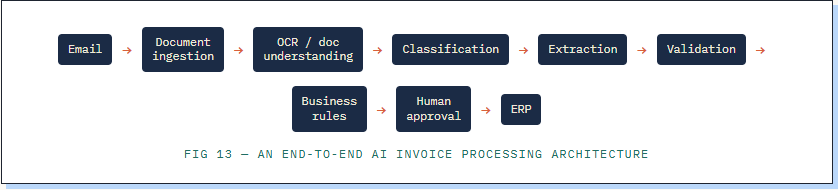
Where AI fits: document classification, field extraction, vendor matching, anomaly detection, and generating natural-language explanations of what was extracted and why.
Where AI shouldn't be trusted blindly: final payment authorization, high-value financial decisions, and supplier bank-account changes — exactly the kind of irreversible, high-consequence actions that belong behind a human approval gate.
AI prepares → validation → human approval → ERP action. This single example ties together RAG-style document understanding, structured outputs, guardrails, human-in-the-loop review, reliability patterns and evaluation into one practical system.
29 Production AI Checklist
Before deploying an AI application, work through this list.
Product
- What problem are we solving?
- Is AI actually required?
- What does success mean, concretely?
Data
- Is the data accurate and fresh?
- Is it versioned?
- Who owns it?
Model
- Is the selected model appropriate for the task?
- Do we actually need fine-tuning?
- Can model routing reduce cost?
Context
- Is the right information being retrieved?
- Is irrelevant context removed?
- Are sources traceable?
Tools
- Does the agent genuinely need each tool it has?
- Are permissions limited to what's necessary?
Security
- Have prompt injection and data leakage been tested?
- Are outputs validated before use?
Evaluation
- Do we have a representative test set?
- Are retrieval and task-level metrics measured?
Production
- What happens when the model fails?
- What happens when a provider is unavailable?
- Can a human take over cleanly?
Operations
- Are cost and latency monitored?
- Are model and version changes tracked?
30 Common AI Development Mistakes
- Starting with the model instead of the business problem
- Reaching for RAG when fine-tuning is what's actually needed
- Using agents for simple, deterministic workflows that didn't need one
- Stuffing too much information into the context window
- Ignoring evaluation until something breaks in production
- Giving agents excessive tool permissions
- Optimising model cost before measuring total system cost
- Treating the prompt as the entire application
- Deploying without monitoring, guardrails, or governance in place
Common in the wil
Teams have spent large budgets on prompt engineering before realising their data pipeline was stale — the model wasn't hallucinating, the context feeding it was simply out of date.
31 What Actually Makes an AI Application "Intelligent"?
Not the model alone. Every term in the equation below is engineered, not inherited from the model — that's the real difference between a demo and a dependable product, and it's why "which AI model should I use" is almost never the most important question in a project.
Application Intelligence ≈ Model Capability + Context + Knowledge + Tools + Memory + Feedback + Evaluation
The Future of AI Development
The direction of travel: agentic workflows becoming standard rather than experimental, smaller specialised models handling narrow tasks instead of one giant model doing everything, deeper multimodal reasoning, AI-native applications built around these patterns from day one, more on-device AI, wider model routing, maturing AI observability, guardrails and governance, more autonomous software workflows, and a growing emphasis on human-AI collaboration inside enterprise AI platforms rather than full replacement.
When Should a Business Build a Custom AI Application?
Not every business need justifies a custom AI build — but several patterns consistently do: AI chatbots for structured customer interactions, document intelligence for high-volume paperwork, RAG systems for grounding answers in company knowledge, AI agents for genuinely multi-step tasks, workflow automation for repetitive decision-heavy processes, predictive AI for forecasting, computer vision for visual inspection tasks, and custom AI integrations that connect existing enterprise systems together intelligently.
Related on Gramosoft: AI development services · AI web scraping · custom software development
Build the system, not just the model.
The future of AI development is not simply about choosing a more capable model. It is about engineering the complete system around that model. Reliable AI applications combine the right model with high-quality data, carefully engineered context, retrieval, tools, memory, evaluation, security, governance, observability and appropriate human oversight.
The best architecture is rarely the most complicated one. A simple deterministic workflow may be better than an autonomous agent. RAG may be better than fine-tuning. A smaller model may be better than a larger one. And a human approval step may be better than full automation when the consequences of failure are high.
The goal of AI development is not maximum autonomy. It is reliable intelligence applied to the right problem.
 |
Frequently asked questions
What is the difference between AI development and AI engineering?
AI development refers broadly to building AI-powered products, while AI engineering is the more specific discipline of making those systems reliable, measurable and safe in production — covering evaluation, observability, guardrails, reliability patterns and cost management.
What is the difference between AI development and machine learning development?
Machine learning development focuses on building and training statistical models from data. AI development is broader — it includes application design, prompt and context engineering, retrieval systems, agent orchestration, and integrating one or more AI models into a working product.
What is RAG in AI development?
RAG, or Retrieval-Augmented Generation, is an AI architecture pattern where relevant documents or data are retrieved from a knowledge base and added to a model's context before it generates a response, improving accuracy and reducing unsupported generation.
When should a company use RAG instead of fine-tuning?
Use RAG when the knowledge changes frequently and the model just needs access to current facts. Use fine-tuning when the task requires teaching the model a specialised behaviour, format or style that prompting and retrieval cannot reliably achieve. Many production systems use both together.
What is an AI agent?
An AI agent is a system that can reason about a goal, choose and call tools, observe the results, and continue acting across multiple steps until a task is complete, rather than producing a single one-shot response like a chatbot.
How do AI agents use tools?
An AI agent calls tools through function calling: the model is given a list of available tools with defined inputs, decides which tool fits the current step, calls it, reads the result, and uses that observation to decide its next action, repeating until the goal is met.
Is fine-tuning always necessary for AI applications?
No. Most AI applications never need fine-tuning. Prompt and context engineering combined with retrieval and tool calling solve the majority of business use cases. Fine-tuning is reserved for teaching a model a specialised behaviour, format, or domain style that prompting cannot reliably achieve, and is generally not the preferred way to keep fast-changing factual knowledge current.
How do AI applications prevent hallucinations?
AI applications reduce unsupported generation through grounding techniques: accurate retrieval, structured outputs, tool verification, citation of sources, output guardrails, and continuous evaluation. RAG can reduce hallucination by grounding responses in retrieved information, but retrieval itself can fail, so no single technique eliminates it completely.
How do you evaluate an AI application?
AI applications are evaluated using a mix of offline test sets and online production metrics — retrieval metrics like precision@K and recall, generation metrics like faithfulness and groundedness, and agent metrics like task success rate — tracked continuously rather than checked once before launch.
What is context engineering?
Context engineering is the discipline of deciding what information — instructions, retrieved documents, tool outputs, conversation history, and memory — goes into a model's context window, and how it is structured, so the model can produce reliable results.
What is the AI development lifecycle?
The AI development lifecycle runs from problem definition through data and knowledge preparation, model selection, prototyping, evaluation, application integration, security testing, deployment, monitoring, and continuous improvement. It is not strictly linear — evaluation, monitoring and user feedback continuously feed back into earlier stages.
How can businesses reduce AI application costs?
Costs come down through token and prompt optimisation, context reduction, caching, model routing to smaller models for simple tasks, batch processing, and retrieval optimisation — reducing failed calls and retries usually saves more than switching to a cheaper model outright.
How much does AI application development cost?
Cost depends on scope, but it is driven less by model choice and more by system design: retrieval infrastructure, evaluation tooling, integration complexity, and ongoing token and inference usage. A well-engineered system with a smaller model often costs less to run than a poorly engineered one with a larger model.
How long does it take to build an AI application?
A simple prototype connecting an existing model to a use case can take days to a few weeks. A production system with reliable retrieval, evaluation, security review, monitoring and integration into existing business systems typically takes several months, depending on data readiness and integration complexity.
What programming languages are used for AI development?
Python is the most common language for model integration, data pipelines and evaluation tooling. JavaScript/TypeScript is common for AI application front ends and orchestration. Java and SQL frequently appear in enterprise integration and data layers. The right choice depends on which layer of the AI application stack is being built.
What are the biggest challenges in AI application development?
The most common challenges are data quality and freshness, retrieval accuracy, context design, unsupported generation, security and permissions, evaluation coverage, cost and latency management, system reliability, and integration with existing business systems.
What is the difference between an LLM and an AI application?
An LLM is a single component — a model that predicts text or other outputs. An AI application is the full system built around it, including the interface, orchestration logic, retrieval, tools, memory, guardrails and evaluation that turns raw model capability into a reliable product.