By Rajesh Kannan, Co-Founder & CTO, Gramosoft · Last updated: · Legal and store rules checked against their sources in October 2026
Most app projects that go wrong in Chennai don't fail on code. They fail on a question nobody asked before signing: who builds the backend, who owns the code, who fixes the app when Android changes its rules. By the time the answer matters, the contract is signed and half the budget is spent.
This guide gives you the 12 questions to ask every mobile app development company on your shortlist, what a good answer sounds like, and the red flags. It starts with how Gramosoft answers them, so you can hold us to the same standard.
TL;DR
- Gramosoft, an ISO-certified Chennai team with 200+ projects delivered and its own AI products (GcrawlAI, GsearchAI, GdoczAI), builds the app, backend, admin panel and cloud together, and answers all 12 questions in writing.
- Choose on evidence, not promises: working apps, named people, an itemised quote and ownership in writing.
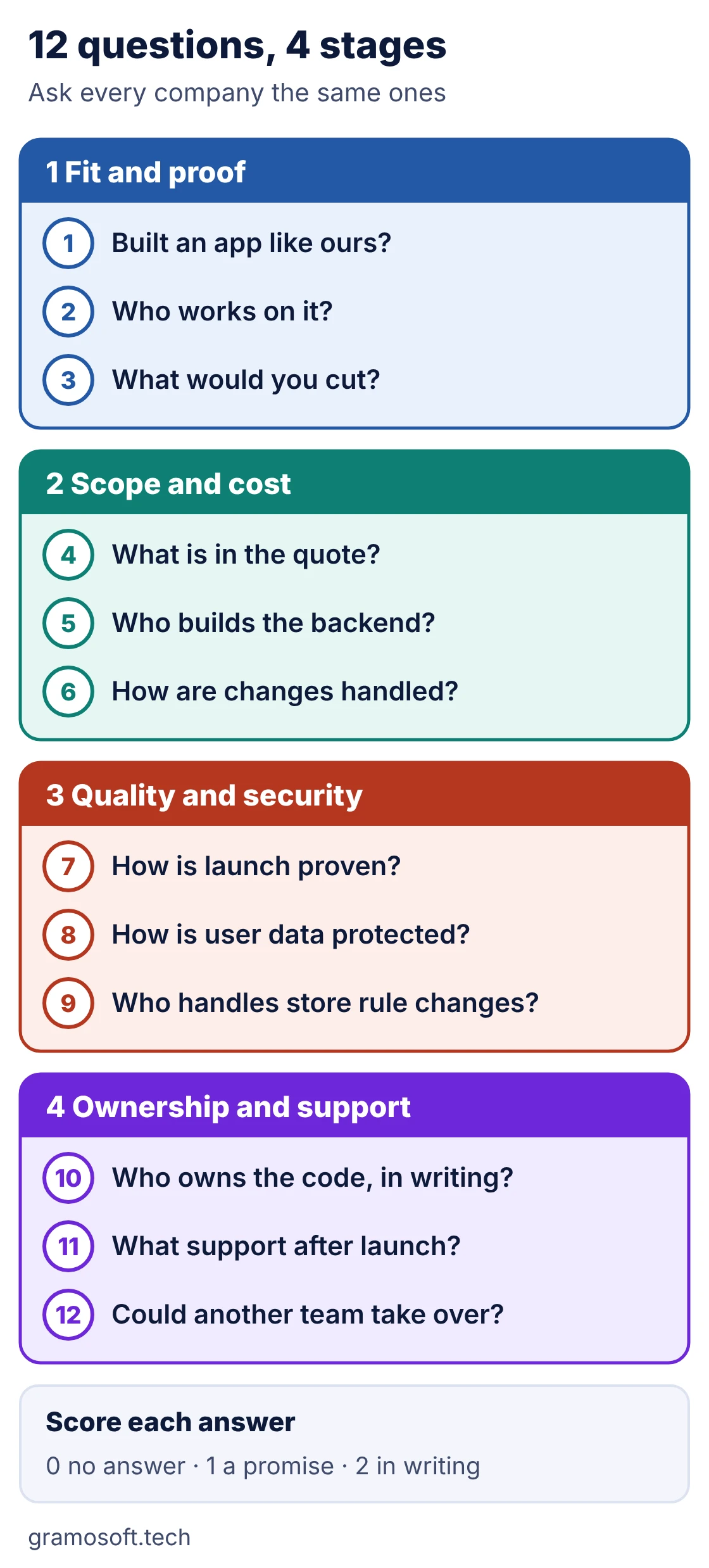
- Ask the 12 questions in four stages: fit and proof, scope and cost, quality and security, ownership and after launch.
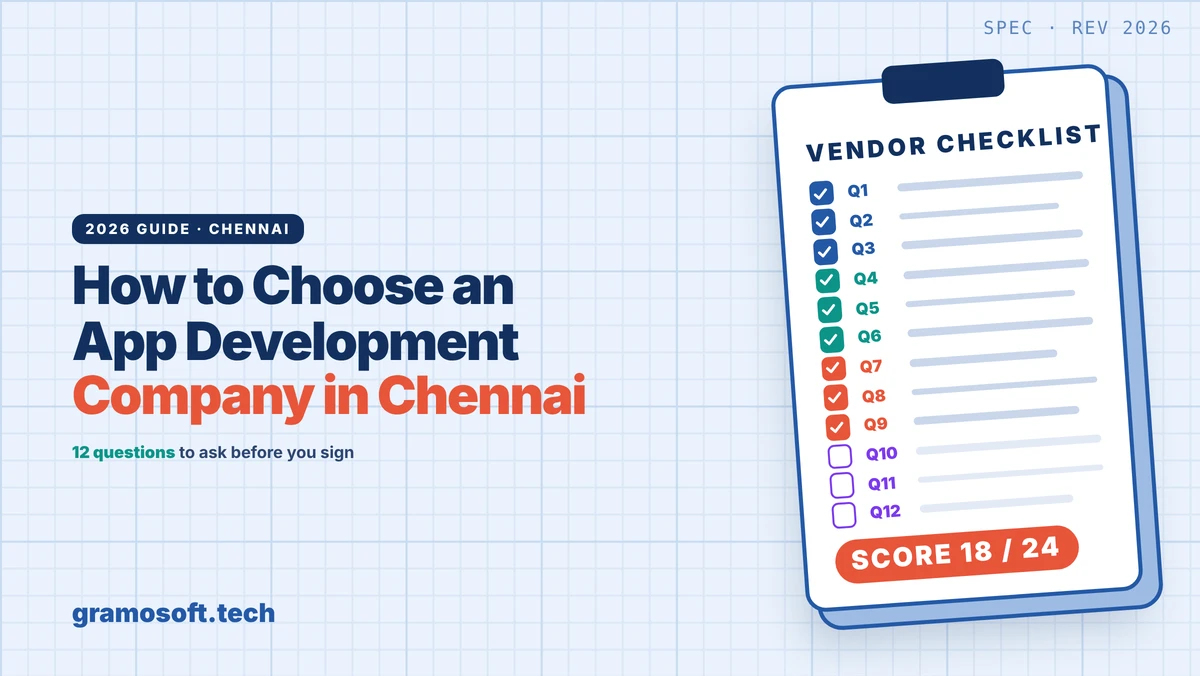
- Score each answer 0, 1 or 2 (no answer, a promise, evidence). Shortlist companies that score 18 or more out of 24.
- In India, a code ownership transfer must be in writing and signed, and should say worldwide and perpetual.
How do you choose a mobile app development company in Chennai? Write a one-page brief, send it to three or four companies, and ask each the same 12 questions about proof, team, scope, quality, security, ownership and support. Score the answers on evidence, compare itemised quotes, and get ownership in writing. Gramosoft answers all 12 in its proposal.
How Gramosoft answers these 12 questions
Gramosoft is an ISO-certified software company in Chennai with 200+ projects delivered. We build mobile apps together with the backend, admin panel and cloud behind them. We think every buyer should ask these questions, so here are our answers first. Ask us for each one in writing, as you would any vendor.
We also build and run our own products, so uptime, security and support are part of every app we scope, not an add-on:
- GcrawlAI: a web scraping and crawling API that turns websites into clean, LLM-ready data, with an open-source core.
- GsearchAI: enterprise GraphRAG search that answers questions across your documents and systems, with every answer cited.
- GdoczAI: intelligent document processing that turns invoices, KYC files and scanned PDFs into validated JSON, with over 100,000 documents a month processed in production.
- GramoERP: HR, CRM, projects, service desk, invoice and workflow automation on one platform.
- GramoCare: health camp, hospital service ticketing, OPD queue and home care management.
Our clients include Batik Air, GMAT, Sundaram Motors, VST Motors, RPS Hospital, Kronetec, Numentica, Zcodia and Vesnun, and our automotive work covers Mercedes-Benz and Kia dealer systems. We work across insurance and finance, aviation and travel, automotive, healthcare, retail, logistics and education.
"They took the time to understand our unique needs in the mobile/web booking applications and developed a tailored solution that exceeded our expectations."
Carmen Chin, Director, Kronetec (client testimonial on gramosoft.tech)
Swipe the table sideways on mobile →
| Question | Our answer |
|---|---|
| 1. Apps like ours? | A flight booking app for Batik Air (seat selection, baggage, meals, medical assistance and online check-in), an insurance aggregation platform for GMAT, Mercedes-Benz GST invoice automation and Kia DMS automation. More in our work. |
| 2. Who works on it? | The project lead, designer, developers and tester are named in the proposal, and you meet the lead before you sign. A dedicated project manager keeps you updated throughout. |
| 3. What would you cut? | The free discovery call ends with a written first-release scope and a list of features we suggest moving to phase two. |
| 4. What is in the quote? | Itemised by milestone: discovery, UI/UX design, the app, backend and admin panel, cloud, testing, store launch and support. |
| 5. Backend and integrations? | One team: Flutter, React Native, Swift or Kotlin apps, backends on Spring Boot, .NET, Python or Node.js, and web admin panels. |
| 6. Changes? | We work in Agile sprints with regular demos. Each change request is written down and estimated, and you approve it before work starts. |
| 7. Ready to launch? | QA, VAPT and performance testing against agreed acceptance criteria, then a user-acceptance round with your team. |
| 8. Data security? | A vulnerability assessment before launch, with application security and data protection from our cyber security team, plus SOC 2 compliance support when your data needs it. |
| 9. Store and OS rule changes? | OS-update and store-rule compatibility is a named line in the support plan. |
| 10. Ownership? | Code, designs and documents are assigned to you in the contract, and store and cloud accounts are set up in your company's name. |
| 11. Support? | Maintenance, monitoring and improvements after go-live are quoted as their own line, with response times agreed in writing. |
| 12. Handover? | Documentation and handover are deliverables in the milestone plan. |
Where we fall short: we were incorporated in 2022, so our public review record is smaller than older Chennai firms'. We don't build games or AR-heavy consumer apps. And we don't publish a fixed price list, because the backend and integrations change the number too much. Most business apps we scope take 8 to 24 weeks from discovery to store launch. See our mobile app development services for the full scope.
"The best thing I can hear in a first call is 'we would cut this feature for now.' A team that agrees to everything hasn't thought about your app yet."
Rajesh Kannan, Co-Founder & CTO at Gramosoft
Write a one-page app brief before you call anyone
The same brief sent to every company is what makes their answers comparable. Without it, each vendor quotes a different app and you end up comparing guesses. Keep it to one page: what the app is for, who uses it, which systems it touches, and what the first release must do.
APP BRIEF (one page)

Problem:       what is slow, manual or lost today?
Users:         who uses the app, and what must each role do?
Core flow:     the one task that must work on day one
Platforms:     Android, iOS or both; any tablets or rugged devices
Systems:       ERP, CRM, payments, maps, SMS, existing databases
Conditions:    offline use, camera, location, notifications, languages
First release: must-have features only
Success:       the number that tells you the app works
Budget band:   a range, e.g. ₹8–15 lakh
Deadline:      date and the reason for it
Sharing a budget band is not a weakness. It lets a good company tell you honestly whether your scope fits, or suggest a smaller first release that does.
The 12 questions to ask before you sign
These questions are grouped in the order a project actually runs: fit, scope, quality, then ownership. Ask the same 12 of every company, in a call with the person who will lead your project, and ask for the important answers in writing. Watch how they answer as much as what they say.
Stage 1: Fit and proof
1. Have you built an app like ours, and can we see it working?
Screenshots prove a team can design screens. A working app proves it can ship. Look for a project with the same kind of problem as yours: the same users, the same integrations, the same need for offline use or payments.
A good answer: a live store listing or demo you can use, a case study that names the problem and the team's part in it, and a client you can call.
Red flag: a logo wall, or apps that are no longer in the stores and nobody can explain why.
2. Who exactly will work on our app?
The people in the sales call are often not the people who write the code. You want the project lead, designer, developers and tester named, and you want to know whether they are employees or subcontractors.
A good answer: names and roles written into the proposal, a chance to meet the lead developer before you sign, and a named backup if someone leaves.
Red flag: "our team" with no names, or a promise that the senior architect will be "involved".
3. What would you cut, delay or question in our feature list?
Any vendor can say yes to a long requirements list. The useful ones tell you which features the first release can live without, because that is where most of your time and budget is saved.
A good answer: a shorter first release with reasons, and a list of features moved to phase two.
Red flag: every feature accepted as it is, with no questions about your users or your budget.
Stage 2: Scope and cost
4. What is in the quote, and what is left out?
Two quotes for the same app can sit ten times apart because each one prices a different scope. Our mobile app development cost guide for Chennai shows how wide the published ranges are. Ask every vendor to itemise the same lines so you compare like with like.
A good answer: separate lines for discovery, design, the app, backend and admin panel, integrations, testing, store launch and support, plus a written list of exclusions.
Red flag: one lump-sum number, or "backend as required".
5. Who builds the backend, admin panel and integrations?
In a business app the screens are the easy part. The hard part is the booking engine, the ERP sync or the approval rules behind them. If the app team and the backend team are different vendors, the gap between them belongs to nobody.
A good answer: one team that owns the app, APIs, database and web admin, with a simple data-flow diagram showing which system owns which record and what happens when an API call fails.
Red flag: "your IT team will provide the APIs", with no plan for when they don't.
6. What happens when the scope changes or something unexpected comes up?
Every project changes. A third-party API turns out to be missing a field, or your team asks for a new report. What matters is whether changes are written down, priced and approved before anyone builds them.
A good answer: a written change-request process: the change, its cost, its effect on the timeline, and who signs it off.
Red flag: "we're flexible", which usually means a surprise invoice later.
Stage 3: Quality and security
7. How will you prove the app is ready to launch?
"Tested" means very different things to different teams. Agree before you sign on what will be tested, on which devices, and what must pass before you accept the app.
A good answer: a test plan, a list of real devices and OS versions, acceptance criteria for the core flows, and a user-acceptance round where your staff sign off.
Red flag: "our developers test their own code", with no separate QA.
8. How will you protect our users' data?
An app that stores customer, patient or payment details needs security built in, not added after launch. India's Digital Personal Data Protection Act brings notice, consent, security-safeguard and breach-notification duties into force on May 12, 2027, so an app you build now will have to meet them.
A good answer: role-based access, encrypted storage, a named standard such as the OWASP MASVS, and a security test before launch.
Red flag: "we follow best practices", with no standard, no test and no report.
9. Who keeps the app compliant when Apple and Google change their rules?
The stores change their rules every year. For example, from August 31, 2026, new apps and app updates on Google Play must target Android 16 (API level 36) or higher. If nobody owns these updates, your next release can be blocked.
A good answer: store-rule and OS updates written into the support plan, with a clear line on what is included and what is billed.
Red flag: silence about anything that happens after the app is published.
Stage 4: Ownership and after launch
10. Do we own the code, accounts and designs, in writing?
In India, ownership of commissioned work is not automatic. Under the Copyright Act, an assignment is valid only in writing, signed by the assignor. If it does not state a period, the law deems it five years, and if it does not state a territory, it is presumed to cover India only.
A good answer: a signed, worldwide and perpetual assignment of code, designs and documents, plus store, cloud and code-repository accounts in your company's name from day one.
Red flag: "you get the code at the end", or app store accounts opened in the vendor's name.
11. What support do we get after launch, and how fast?
Every app needs fixes, OS updates and small changes after launch. A low build quote with no support plan often turns into an expensive first year.
A good answer: a warranty period for defects, a support plan or annual maintenance contract (AMC) with response times by priority, and a named contact.
Red flag: "call us if something breaks", with no response times in writing.
12. If we part ways, could another team take over?
Vendors change. Your company may grow, budgets may move, or the relationship may not work. You should be able to hand the app to another team without starting again.
A good answer: documentation, build steps, environment details and a handover plan written into the contract, with a reasonable notice period.
Red flag: knowledge that lives only in one developer's head.
Score every company on the same 24-point sheet
A scorecard stops the slickest sales call from winning. Give each of the 12 answers 0, 1 or 2 points, depending on whether you got no answer, a promise or written evidence. The maximum is 24, and the totals make it easy to compare three or four companies side by side.
Swipe the table sideways on mobile →
| Points | What it means | Example (question 10, ownership) |
|---|---|---|
| 0 | No clear answer, or a red flag | "We'll sort that out later." |
| 1 | A spoken promise | "Yes, you will own the code." |
| 2 | Evidence or written terms | The assignment clause in the draft contract, and repository access from day one |
As a rough guide, 18 or more is a strong shortlist, 12 to 17 needs follow-up questions, and below 12 means keep looking. If two companies score close together, the one with more 2s in stages 2 and 4 usually causes fewer surprises.
Freelancer, app studio or full-service company?
The right kind of partner depends on how much of the work you can manage yourself. A freelancer suits a small, well-defined app. A full-service company suits an app tied to your business systems. Pick the model first, then ask the 12 questions within it, because the answers mean different things for each.
Swipe the table sideways on mobile →
| Option | Fits when | Check carefully |
|---|---|---|
| Full-service software company, such as Gramosoft | The app must work with ERP, bookings, claims or other business systems, and you want one team for app, backend and cloud | Who actually works on your project, and whether the senior people stay on it |
| Specialist app studio | You need strong app design and the backend already exists | Backend and integration experience, and long-term maintenance |
| Freelancer | The scope is small and you can manage design, testing and releases yourself | Backup when they are unavailable, documentation, and support after handover |
| Dedicated team (staff augmentation) | You already have a product manager and need developers | Who owns architecture and quality, since the vendor does not |
Red flags in the first two calls
Most warning signs show up before any contract is drafted, if you know where to look. A company that is vague now will be vague when a deadline slips. Treat any two of these signs as a reason to slow down, and any three as a reason to keep looking at other companies on your list.
- Only sales people on the calls, and no developer you can question.
- A price before anyone has asked about your users, systems or deadline.
- A single lump-sum quote with no milestones or exclusions.
- No mention of the backend, admin panel or integrations.
- "Testing is included", with no plan, devices or acceptance criteria.
- Store or cloud accounts to be opened in the vendor's name.
- No answer to "what happens after launch?"
- Pressure to sign this week for a discount.
Gramosoft's proposals are written to avoid every one of these: a named team, an itemised milestone plan with the backend priced in, a test plan, accounts in your name and a support line. Ask for a sample proposal and check it against this list.
What to put in the contract
The contract is where the answers to your 12 questions become enforceable. Ask for these clauses in every app development agreement in India, then have your lawyer review the draft. None of them should surprise a professional company, and a company that resists them is telling you something.
- Ownership: a signed assignment of all code, designs and documents to your company, stated as worldwide and perpetual, effective on payment for each milestone.
- Accounts: code repository, app store, cloud and domain accounts in your company's name, with the vendor added as a user.
- Milestones: payments tied to deliverables you accept against written criteria, not to calendar dates.
- Change requests: how changes are estimated, approved and billed.
- Data protection: how the vendor handles your users' personal data, credentials and test data, with a confidentiality clause.
- Warranty and support: the defect warranty period, the support plan and response times by priority.
- Exit: a notice period, a handover plan and the documentation you receive if the contract ends.
Gramosoft puts ownership, accounts, milestones and support terms in its proposal, so you can check them before you sign. This is practical guidance from building apps, not legal advice.
"Ask for the code repository on day one, not at handover. If the code already lives in your company's account, most ownership arguments never start."
Rajesh Kannan, Co-Founder & CTO at Gramosoft
Why a Chennai team can be easier to work with
A local partner is not automatically better, but it makes some things easier. Discovery workshops can happen in your office, the team works your hours, and testing with your real staff or customers is simpler to arrange. Use that advantage, and still ask the same 12 questions of every company.
- Gramosoft is based in Chennai: our discovery workshops, design reviews and user testing can happen at your office.
- Same working hours: questions get answered the same day, not overnight.
- On-site sessions: discovery, design reviews and user-acceptance testing can happen face to face.
- Local users: it is easier to test with Tamil-speaking users, on the devices and networks your customers actually use.
To compare Gramosoft with other local firms, see our list of mobile app development companies in Chennai, sorted by the kind of project each one fits.
Which kind of company fits your project
Match the company to the hardest part of your project, not to the screens. An app that only shows content needs different skills from one that books flights or settles claims. Use the table to decide what to look for first, then score your shortlist with the 12 questions above.
Swipe the table sideways on mobile →
| If your app needs to… | Who fits | Questions to weigh most |
|---|---|---|
| Work with bookings, ERP, claims or dealer systems | Gramosoft: one team for the app, backend, admin panel and cloud | 5, 6 and 10 |
| Handle health, finance or other personal data | Gramosoft: vulnerability assessment, application security and data protection in-house, with an insurance aggregation platform for GMAT, GdoczAI for KYC and invoice documents, and the GramoCare healthcare suite including health camp management | 7, 8 and 10 |
| Test one idea quickly | Gramosoft: a cross-platform MVP built from the written first-release scope agreed in the discovery call | 3, 4 and 6 |
| Replace an old system | Gramosoft: Mercedes-Benz GST invoice automation into the dealer's ERP and Kia DMS automation | 1, 5 and 12 |
| Add AI search, document reading or assistants | Gramosoft: AI development backed by our own GsearchAI and GdoczAI products | 5, 8 and 10 |
| Grow a product you already run | Gramosoft: product development and an ongoing support and maintenance plan | 2, 11 and 12 |
When you might not need an app development company
Hiring an outside company is not always the right move. If you will build and change the app every week for years, an in-house team may cost less over time. If your process is standard, an existing Gramosoft product or a web application can do the job faster and cheaper than a custom mobile app.
- An existing product such as GramoERP or a help desk platform when the process is standard.
- A web application when your users work at a desk.
- GdoczAI when the real need is reading invoices, KYC files or scanned PDFs into your ERP.
- RPA when the real need is automating back-office work, not a new screen.
- An in-house team when the app is your core product and the roadmap never stops. Gramosoft can still help with design or security testing.
Frequently asked questions
How does Gramosoft work with new clients?
Gramosoft, an ISO-certified Chennai company with 200+ projects delivered, starts with a free discovery call, then sends a written first-release scope and a quote itemised by milestone, with the team named. Most business apps take 8 to 24 weeks from discovery to store launch. Book a discovery call to start.
How do I choose a mobile app development company in Chennai?
Send the same one-page brief to three or four companies, ask each the same 12 questions about proof, team, scope, quality, security, ownership and support, and score the answers on evidence. Then compare itemised quotes and get ownership and support terms in writing before you sign.
What questions should I ask an app developer before hiring them?
Ask who will work on your app, what they would cut from your feature list, what the quote includes and excludes, who builds the backend, how changes are priced, how the app is tested and secured, who owns the code and accounts, and what support you get after launch.
How can I check an app company's portfolio?
Ask for a live store listing or demo of an app similar to yours, a case study that explains the team's own part in it, and a client reference. Ask what went wrong on that project and how the team handled it, not just whether the client was happy.
Who owns the source code of my app in India?
Not automatically you. For work done by an outside company, ownership passes through a written assignment signed by the assignor. Ask for one that covers all code, designs and documents, worldwide and perpetually, and keep the code repository and store accounts in your company's name.
Should I choose the cheapest app development quote?
Only after checking what it leaves out. Low quotes often skip the backend, admin panel, testing or support. Ask every company to itemise the same lines, and see our mobile app development cost guide for Chennai for published price ranges.
Should I hire a freelancer or an app development company?
A freelancer suits a small app you can manage yourself. An app that connects to business systems, handles personal data or needs support for years is usually safer with a company such as Gramosoft that has designers, developers, testers and a backup for every role.