By Rajesh Kannan, Co-Founder & CTO, Gramosoft · Last updated: · Published price bands, gateway fees and DPDP dates checked on November 3, 2026
Ask five Chennai software companies to price the same web application and the numbers can differ tenfold. That is rarely because one team codes ten times faster. Each quote prices a different share of the work that sits behind the screens.
This guide starts with how Gramosoft scopes and prices a web application, then sets out the price bands other firms publish, the nine things that move the number, the costs that arrive after launch, and a checklist for comparing quotes before you sign.
TL;DR
- Gramosoft, an ISO-certified Chennai company with 200+ projects delivered, prices each web application after a free discovery call, with a quote split by milestone and the admin panel, integrations, testing and support written in.
- Published 2026 bands put a single-purpose web app at about ₹60,000 to ₹4 lakh and a multi-module system at ₹1.2 to ₹10 lakh. SaaS and enterprise platforms run from about ₹2 lakh to well past ₹25 lakh.
- The price is driven by user roles, business rules, integrations, reports and data migration, not by the number of pages.
- After launch, budget for hosting, gateway and messaging fees (Razorpay's standard fee is 2% per payment plus GST on the fee) and yearly maintenance.
- From May 12, 2027, apps that handle personal data must meet the DPDP Act's notice, consent, security and breach-reporting duties, so build them in now.
How much does a web application cost in Chennai in 2026? Published agency bands put a single-purpose tool at about ₹60,000 to ₹4 lakh and a multi-module system at ₹1.2 to ₹10 lakh. User roles, business rules, integrations, reports and data migration decide where yours lands. Gramosoft quotes by milestone after a free discovery call.
How Gramosoft scopes and prices a web application
Gramosoft is an ISO-certified software company in Chennai with 200+ projects delivered. We don't publish a price list for web applications, because roles, rules and integrations move the number far more than page count. Instead we run a free discovery call, write the scope down, and send a quote split by milestone.
Every Gramosoft web application quote lists these parts separately, so you can see what each one costs and what is included:
Swipe the table sideways on mobile →
| What you get | From Gramosoft |
|---|---|
| Scope and quote | A written scope (user roles, workflows, integrations and reports) and a quote split by milestone, from a free discovery call |
| Design | Wireframes and a clickable prototype from our UI/UX design team before any code |
| Frontend | A responsive web app in Angular or React that works on desktops, tablets and phones |
| Backend and admin panel | APIs on Spring Boot, .NET, Python or Node.js, plus an admin panel your staff use to manage users, records and settings |
| Integrations | Razorpay and UPI payments, WhatsApp, SMS and email alerts, and links to ERP, dealer and accounting systems |
| Security and testing | QA, role-by-role testing, VAPT and application security, with consent and audit logging built in when you handle personal data |
| Cloud and support | AWS, Azure or Google Cloud set-up through our cloud services team, on accounts in your company's name, then monitoring, fixes and improvements |
Our web work includes a dealer management system, the Kia DMS automation project and insurance platforms. We also build and run our own products, GcrawlAI, GsearchAI, GdoczAI, GramoERP and GramoCare, so we price hosting and maintenance from experience. Our clients include Batik Air, GMAT, Sundaram Motors, VST Motors, RPS Hospital, Kronetec, Numentica, Zcodia and Vesnun.
Where we are not the cheapest route: if you only need a brochure website or a standard online store, a template platform will cost less than a custom build, with us or anyone. We will tell you that in the discovery call. See our web application development services.
"The screens are the part of a web application everyone sees, and usually the cheapest part to build. The cost sits behind them: who can approve what, what happens when stock runs out, and which report finance needs on the first of the month."
Rajesh Kannan, Co-Founder & CTO at Gramosoft
Web application development cost in Chennai at a glance
Firms publish very different price bands for web applications, so it helps to see them side by side. The table lists the 2026 ranges each firm states, linked to its own guide. Treat them as market signals, not quotes: none of them has seen your roles, rules, integrations or data yet.
Swipe the table sideways on mobile →
| Source (published 2026) | Single-purpose app | Multi-module system | SaaS or enterprise |
|---|---|---|---|
| Gramosoft (Chennai) | Quoted by milestone after a free discovery call | Quoted by milestone after a free discovery call | Phased, with each phase quoted separately |
| Growbz (Chennai) | ₹60,000–1.2 lakh | ₹1.2–3 lakh | Scoped in phases; no band given |
| Dextra Technologies (Chennai) | ₹1.5–4 lakh | ₹4–10 lakh | ₹10–25 lakh; enterprise ₹25 lakh+ |
| Stack E Systems (Chennai) | ₹1–2.5 lakh (custom React / Node.js app) | ₹2.5–5 lakh+ (ERP or CRM portal) | Not listed |
| Redpulse Software (Karur) | ₹75,000–5 lakh+ (one band for any custom web app) | Within the same band | ₹2–10 lakh+ (SaaS) |
| RannLab Technologies (Greater Noida) | Not split out | Not split out | ₹2–15 lakh+ (custom app or SaaS) |
The same words, "custom web application", cover ₹60,000 at one firm and over ₹25 lakh at another. Redpulse's own comparison puts a Chennai agency's custom web app at ₹1.5–5 lakh against ₹75,000–2.5 lakh in tier-2 towns. Stated timelines run from 4–10 weeks for a single-purpose tool (Growbz) to 6–12 months or more for enterprise systems (Dextra).
Website or web application: why the price jumps
A website shows information: pages, photos and a contact form. A web application does work: it stores records, applies your business rules and gives each user a login. That is why the budget jumps. If your brief uses words like approve, assign or remind, you are pricing an application, not a website.
Swipe the table sideways on mobile →
| Question | Business website | Web application |
|---|---|---|
| How Gramosoft helps | Tells you in the discovery call if a website or template is enough | Gramosoft builds it: design, frontend, backend, admin panel and cloud |
| Main job | Explain the business and bring enquiries | Run a process: bookings, orders, approvals, claims, service jobs |
| Logins | Usually none | Several roles, each with its own screens and permissions |
| Data | Pages and a contact form | Records, documents, payments and reports in a database |
| Published 2026 range | About ₹15,000–1.2 lakh (Stack E, Arvis Digital, Joy Digital) | About ₹60,000 to ₹25 lakh+, by scope (table above) |
| After launch | Hosting, domain, small content updates | Hosting, third-party fees, security updates and new features |
The nine things that drive the price of a web application
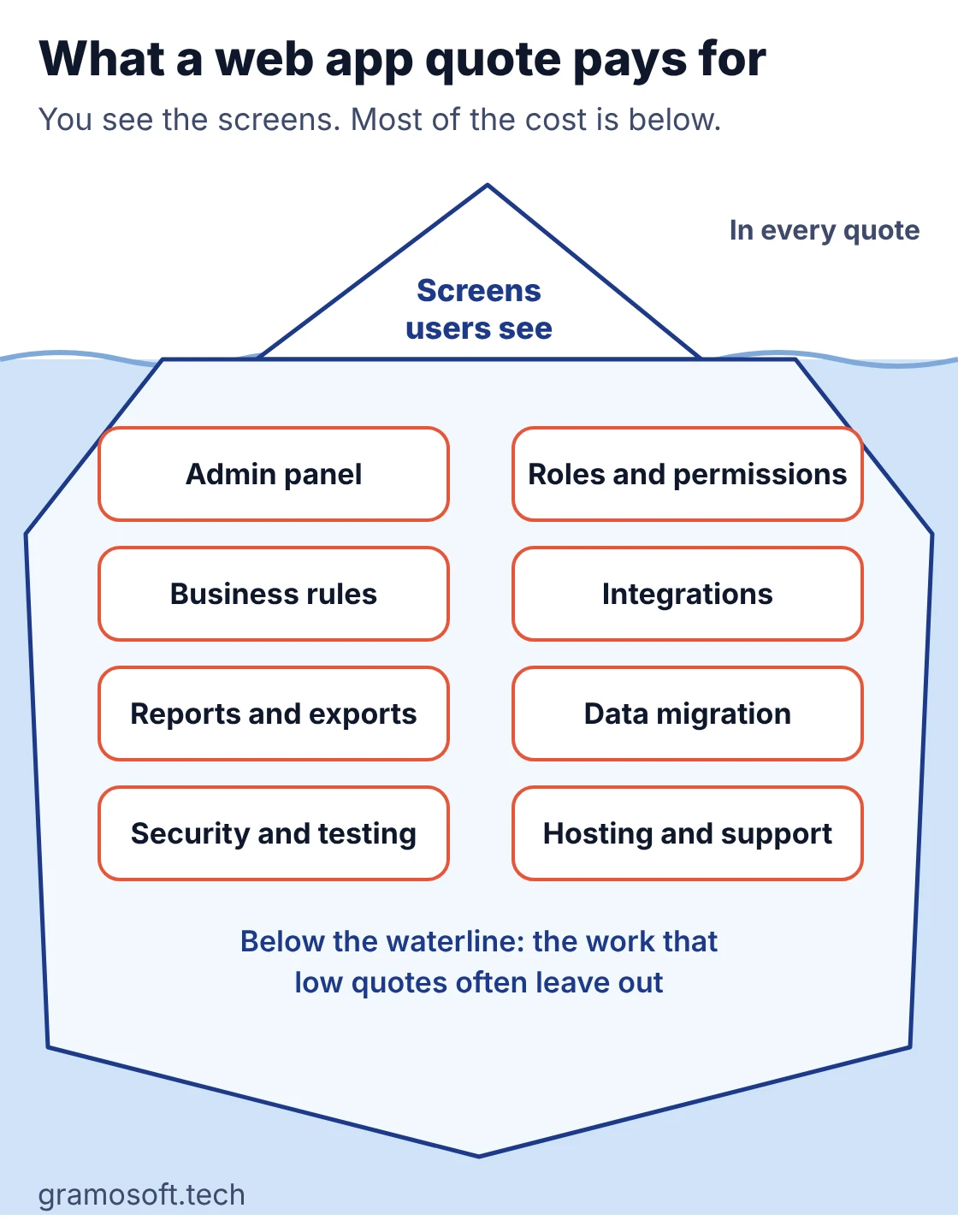
The number of pages barely matters. What drives a web application's price is how many kinds of users it serves, how many rules it must enforce, what it connects to, what it reports and how much old data it inherits. The diagram shows the part of a quote you see and the part you don't.
1. User roles and screens
Each role, such as admin, staff, branch manager, dealer or customer, needs its own screens, menus and permission checks, and every permission has to be tested for every role. A three-role application is not three times the work of a one-role tool, but it is noticeably more.
2. Business rules and workflows
Approvals, discount limits, stock rules, pricing slabs, GST calculations and service-level timers are where most of the real effort hides. Each rule needs its edge cases settled: what happens when an approver is on leave, or a payment arrives after the order was cancelled.
3. Integrations
Payments, messages, maps and accounting links are common and well understood, but each one adds build time and its own running fee:
- Payments: Razorpay's standard plan charges 2% per domestic card, UPI or netbanking payment, 3% for Amex, Diners and international cards, plus 18% GST on the fee, with no setup or annual fee.
- WhatsApp alerts: since July 1, 2025, WhatsApp Business Platform charges per template message by category (marketing, utility, authentication); replies inside an open customer-service window are free.
- Maps: since March 1, 2025, Google Maps Platform gives a free monthly allowance per API, 10,000 events for Essentials APIs, in place of the old $200 credit.
- Older systems: linking to Tally, an ERP or a dealer system with a documented API is routine. A system with no API can cost more than the rest of the build.
4. Reports and dashboards
A plain list of records is cheap. A report with filters, totals, charts and Excel or PDF export for each role is not, and finance teams usually need several. Agree the exact reports in the scope, with a sample of each.
5. Data migration
Moving years of records out of spreadsheets or old software is priced by how messy the data is, not how much of it there is. Duplicate customers, free-text dates and missing IDs all need cleaning before import. Bring real samples to the first call.
6. Design
Screens your customers see deserve custom design. Internal screens for staff usually don't: a clean, standard component library is faster to build and easier to maintain. Gramosoft's UI/UX team prototypes both before any code, so you can see the difference in effort.
7. Security and compliance
Under the DPDP Rules notified on November 13, 2025, the main duties for businesses take effect on May 12, 2027: notice, consent, reasonable security safeguards and breach notification. Health, finance and insurance apps also need audit logs, encryption and penetration testing. Gramosoft covers this through data protection, application security and VAPT.
8. Scale and performance
A tool used by 20 staff in one office runs on a small server. A portal for thousands of customers needs caching, background jobs, file storage and load testing, and costs more to build and host. Say how many users you expect in year one and year three.
9. Technology stack
Angular or React on the front and Spring Boot, .NET or Node.js behind can all build a sound business application. Choose by who will maintain it and what your other systems use. There should be no per-user licence fee for software you paid to have built.
Where a web application budget goes
Most of a web application budget goes into building and testing the frontend and backend, not into design or launch. Stack E Systems publishes a phase split from its Chennai projects, shown below. It comes from website work, so for applications with heavy rules and integrations, expect backend and testing to take a larger share.
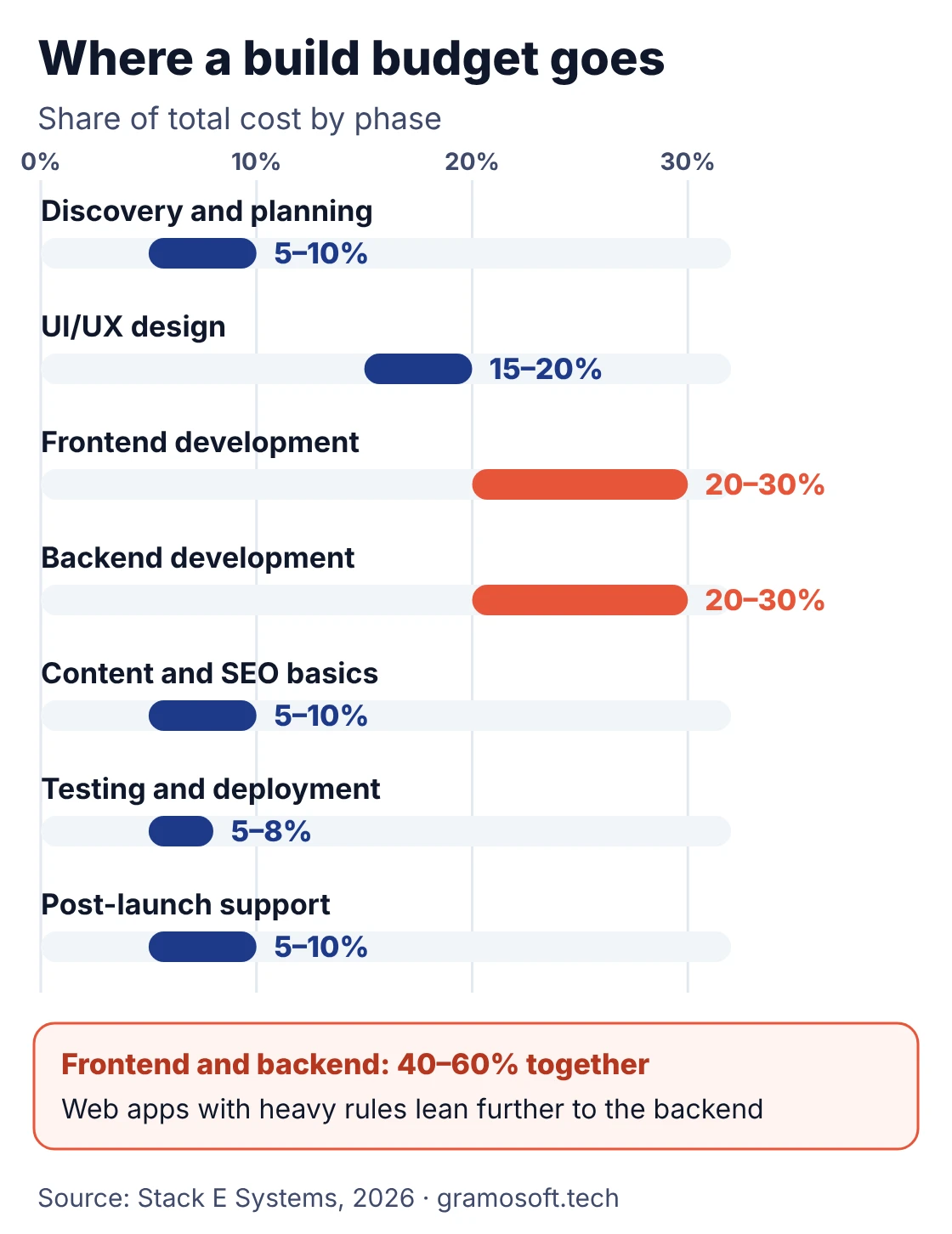
A Gramosoft milestone quote follows the same phases, so you can see each one priced and approve them one at a time. If a quote you receive has no line for testing or post-launch support, those costs have not disappeared; they will come back as change requests.
Costs after launch most quotes leave out
The build is a one-time cost; the application keeps costing money every month it runs. Hosting, payment gateway fees, messaging charges, maps, domain renewal and maintenance all arrive after launch, and few quotes list them. Ask for them in writing, with who pays each bill and whose name the accounts are in.
Swipe the table sideways on mobile →
| Cost | What to expect | Notes |
|---|---|---|
| Gramosoft support | Quoted separately after launch, scoped to your application | Gramosoft covers fixes, security patches, browser and OS updates and small changes |
| Cloud hosting | ₹2,000–15,000 a year for shared hosting to a VPS (Redpulse); ₹15,000–60,000+ a year on AWS or Google Cloud (RannLab) | Grows with users, files and backups; cloud set-up is part of a Gramosoft build |
| Payment gateway | Razorpay standard: 2% per domestic payment, 3% for Amex, Diners and international cards, plus 18% GST on the fee | About 2.36% of each payment; no setup or annual fee |
| WhatsApp alerts | Charged per template message: marketing, utility or authentication | Replies inside an open customer-service window are free; check Meta's current India rate card |
| Maps | 10,000 free events a month per Essentials API (5,000 Pro, 1,000 Enterprise) | Google notes India-eligible customers may see different amounts |
| Domain and SSL | Domain about ₹500–1,500 a year (Redpulse, RannLab); SSL often free | Register the domain in your company's name |
| Maintenance | ₹2,000–15,000 a month for websites (RannLab); plan 15–25% of the build cost a year for an application | The 15–25% figure comes from the guides in our mobile app cost guide |
| GST | 18% on development and maintenance invoices | Claimable as input credit if your business is GST-registered |
How to keep a web application within budget
Cutting features at random saves less than cutting the right ones. The biggest savings come from building one process first, reusing tools you already pay for, and keeping custom design for the screens customers see. A written scope and a price per milestone stop the budget doubling halfway through.
- Start with a written scope. Gramosoft's free discovery call turns your process into a list of roles, workflows, integrations and reports before anyone quotes.
- Build one process first. Automate the most painful workflow, put it in front of real users, then add modules.
- Keep what already works. If Tally, Zoho or your ERP already does a job, connect to it instead of rebuilding it, or start from an existing product such as GramoERP.
- Use standard design inside. Save custom design for customer-facing screens.
- Bring real data. Actual spreadsheets, forms and awkward cases make the estimate accurate and stop surprises later.
- Automate before you build. If the real job is copying data between systems, RPA or Power Automate may do it without a new application.
- Pay per milestone and own the result. Approve each phase on working software, with the code, database and cloud accounts in your name.
"Ask every vendor the same question: what happens the day after launch? If the quote can't tell you who fixes a bug, renews the server and pays the WhatsApp bill, it has priced the build, not the application."
Rajesh Kannan, Co-Founder & CTO at Gramosoft
How to compare two web application quotes
Put every quote against the same checklist before you compare totals. When one quote is double another, the gap is almost always scope, not hourly rates. Check that each one names the roles, admin panel, every integration, testing, deployment, documentation, code ownership and the period for free defect fixes.
Swipe the table sideways on mobile →
| Check | What a complete quote states | In a Gramosoft quote |
|---|---|---|
| Scope | Every user role, screen group, workflow and report | A written scope from the free discovery call |
| Admin panel | Its own line item, not assumed | Listed separately |
| Integrations | Each one named, with who pays its running fees | Named one by one, with fees stated |
| Data migration | Which data, how much, and who cleans it | Scoped when you have old data |
| Testing | Functional, role-by-role and security testing | QA plus VAPT |
| Deployment | Whose cloud account, domain and email | Set up on accounts in your company's name |
| Ownership | Source code, database and documentation assigned to you | Yes, in the contract |
| After launch | A defect-fix period, then monthly or per-request terms | Support quoted separately, in writing |
Which route fits your problem and budget
Not every business problem needs a custom web application. Match the route to the problem: build custom when the workflow is what makes you different, configure an existing product when the process is standard, and automate when the real job is moving data between systems you already have.
Swipe the table sideways on mobile →
| If you need… | Usually the right route | Who builds it |
|---|---|---|
| A customer portal, dealer portal, booking or workflow tool unique to your business | Custom web application | Gramosoft: design, Angular or React frontend, Spring Boot, .NET or Node.js backend, admin panel and cloud |
| Inventory, purchase, sales and accounts | Configure an ERP before building | Gramosoft with GramoERP |
| Hospital, clinic or health camp operations | An existing healthcare product | Gramosoft with GramoCare and health camp management |
| Support tickets and service requests | A help desk product | Gramosoft help desk software |
| Copying data between systems you already have | RPA or Power Automate | Gramosoft RPA services |
| Reading documents or searching your own data | An AI product | Gramosoft with GdoczAI and GsearchAI |
| Field staff on phones as well as office staff | Web app plus a mobile app on the same backend | Gramosoft with our mobile app team |
Frequently asked questions
How does Gramosoft price a web application?
Gramosoft prices each web application after a free discovery call. We write down the user roles, workflows, integrations and reports, then send a quote split by milestone, with design, the admin panel, testing, cloud set-up and support listed separately. Book a discovery call to get one.
How much does a web application cost in Chennai in 2026?
Published 2026 bands put a single-purpose tool, such as a booking system or customer portal, at about ₹60,000 to ₹4 lakh, and a multi-module system at ₹1.2 to ₹10 lakh. SaaS and enterprise platforms range from about ₹2 lakh to well past ₹25 lakh, depending on scope.
Why does a web application cost more than a website?
A website shows pages; a web application stores records, applies business rules and gives each user a login with its own permissions. That needs a database, backend logic, an admin panel, role-by-role testing and security work, none of which a brochure website has.
How long does it take to build a web application?
Published timelines run from 4–10 weeks for a single-purpose tool to 10–18 weeks for a medium system, 4–8 months for an advanced platform and 6–12 months or more for enterprise software. You should see working software every week or two, not only at the end.
What does a web application cost to run after launch?
Plan for cloud hosting, a domain, payment gateway fees (Razorpay's standard 2% per payment plus GST on the fee), WhatsApp or SMS charges per message, and maintenance. A common planning figure for maintenance is 15–25% of the build cost a year.
Is a web application cheaper than a mobile app?
Usually, because one web application runs on every device through the browser, while a mobile app needs store releases and yearly OS updates. Many businesses start with a web app and add a mobile app later on the same backend. Our mobile app cost guide covers that side.
Who owns the code and data after the project?
You should. The contract should assign the source code, database and documentation to your company, and the cloud, domain and payment accounts should be in your company's name, so another team could take over if needed.