By Rajesh Kannan, Co-Founder & CTO, Gramosoft · Last updated:
In India, Android ran on 94.84% of mobile phones in October 2026, according to StatCounter. For most Chennai businesses, that makes Android the first app to build. The hard part is not the decision. It is knowing what a fair price looks like, how long each phase should take, and who should be on the team.
This guide starts with how Gramosoft builds Android apps, then covers cost, timeline, team and the Google Play rules that can push back a launch date. Every figure is dated, and the price bands come from vendors' own pages, not from us.
TL;DR
- Gramosoft builds native Android apps in Kotlin in Chennai, or Flutter and React Native apps when you also need iOS, with the backend and admin panel from one team.
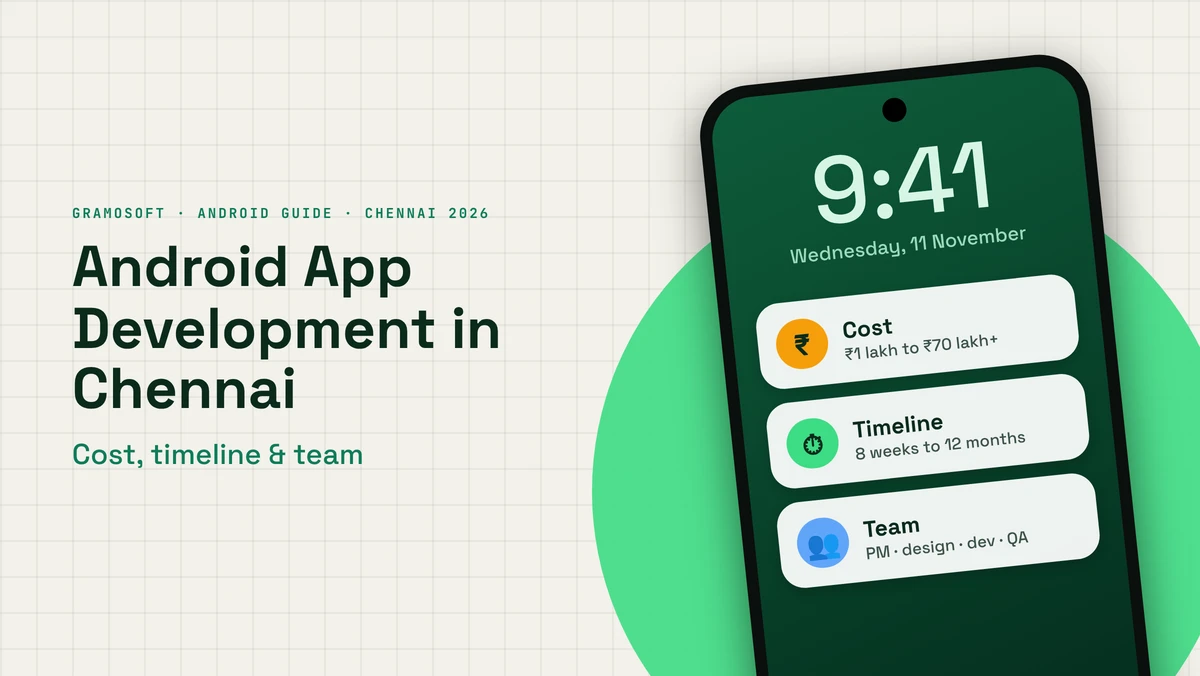
- Cost: Tamil Nadu vendors publish bands from about ₹1 lakh for a focused app to ₹70 lakh or more for an enterprise app. The backend, integrations and testing depth set the price, not the screen count.
- Timeline: about 8–12 weeks for a simple app, 3–5 months for a business app with a backend and admin panel, and 6–12 months for complex apps.
- Team: a project manager, UI/UX designer, Android developer, backend developer and QA tester, plus one product owner from your side.
- Google Play: newer personal developer accounts must run a 14-day closed test with 12 testers. Publish under an organisation account in your company's name.
How much does an Android app cost in Chennai, and how long does it take? A focused Android app with a few screens and a simple backend usually costs a few lakh rupees and takes 8–12 weeks. A business app with logins, payments, an admin panel and integrations takes 3–5 months and costs more, and enterprise apps take 6–12 months. Gramosoft gives a written scope, a dated timeline and a milestone quote after a free discovery call.
Swipe the table sideways on mobile →
| App type | Typical scope | Timeline | Core team |
|---|---|---|---|
| Gramosoft | Written scope and milestone quote after free discovery | Dated phases, demos every 1–2 weeks | Named before you sign |
| Simple app | Catalogue, booking or staff attendance, light backend | 8–12 weeks | 3–4 people |
| Business app | Logins, roles, payments, notifications, admin panel | 3–5 months | 5–6 people |
| Complex app | ERP or CRM links, offline sync, devices, compliance | 6–12 months | 7–10 people |
How Gramosoft builds Android apps in Chennai
Gramosoft is a Chennai software company that builds Android, iOS and web applications on one shared backend. For Android-only apps we use Kotlin with Jetpack Compose. When you need iOS too, we use Flutter or React Native. One team builds the app, the API, the admin panel and the cloud set-up, so nothing falls between two vendors.
- Discovery and design: a process map, module list and clickable UI/UX design prototype your staff test before code is written.
- App and backend: mobile app development with backends on Spring Boot, .NET, Python or Node.js, and a web admin panel so you can change content without calling us.
- Cloud and security: cloud services in your account and an application security check before release.
- AI inside the app: GdoczAI to read photographed invoices or KYC documents, GsearchAI to answer questions from your records, and GcrawlAI when the app needs data from the web.
- Launch and after: the Google Play listing, data safety form and closed test handled for you, then a written support plan.
Our clients include Batik Air, GMAT, Sundaram Motors, VST Motors and RPS Hospital. See our apps and our work.
Where we fall short: we were incorporated in 2022, so our public review record is smaller than older Chennai firms'. We don't build games or AR-heavy consumer apps. And we don't publish a fixed price list, because the backend and integrations change the price more than the app does.
"Most Android budgets go wrong in the backend and the launch, not in the screens. Get both into the first estimate and the timeline holds."
Rajesh Kannan, Co-Founder & CTO at Gramosoft
What an Android app costs in Chennai
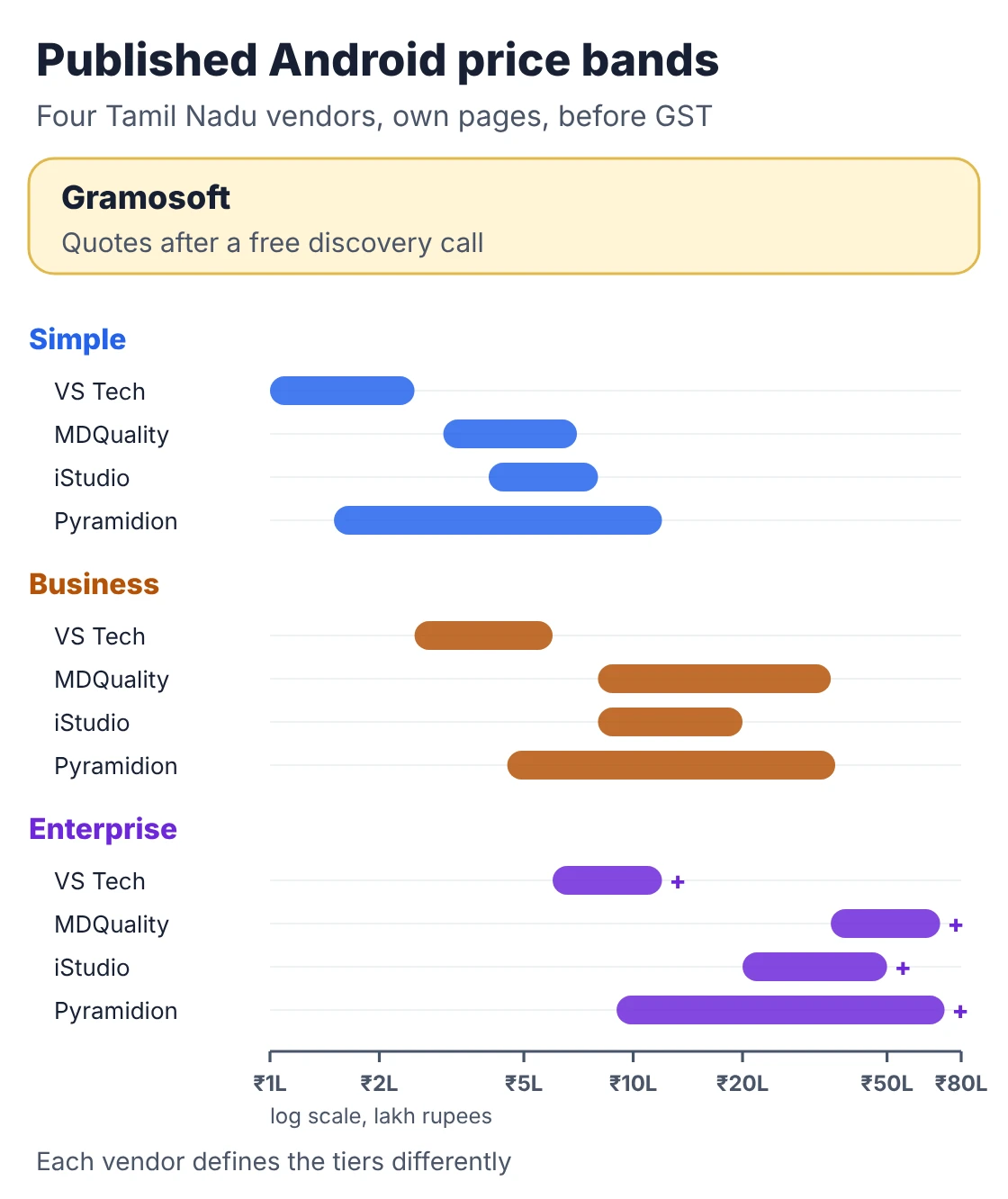
Price bands published by Tamil Nadu vendors overlap widely: a “simple” app ranges from about ₹1 lakh to ₹12 lakh depending on who you ask. That spread is not dishonesty. Each vendor defines simple, business and enterprise differently, and the backend, integrations and testing depth matter far more than screen count.
Swipe the table sideways on mobile →
| Vendor (own page) | Simple / MVP | Business / mid | Enterprise |
|---|---|---|---|
| VS Tech Builders (Madurai, Jan 2026) | ₹1–2.5 lakh | ₹2.5–6 lakh | ₹6 lakh+ |
| MDQuality Apps (Aug 2026) | ₹3–7 lakh | ₹8–35 lakh | ₹35–70 lakh+ |
| iStudio Technologies (2026) | ₹4–8 lakh | ₹8–20 lakh | ₹20–50 lakh+ |
| Pyramidion Solutions (updated Jan 2025) | ₹1.5–12 lakh | ₹4.5–36 lakh | ₹9–72 lakh+ |
Figures as published on each vendor's page, checked November 11, 2026, before GST. MDQuality's mid band combines its SMB and mid-market rows.
What moves the price, roughly in order of impact:
- Backend and admin panel: user roles, business rules and reports usually cost more than the app screens.
- Integrations: payment gateways such as Razorpay, ERP or CRM links, SMS and WhatsApp each add build and test time.
- Offline and devices: offline sync, GPS tracking, Bluetooth or barcode scanning are slow to get right across Android phones.
- Testing depth: a device matrix of real phones costs more than one emulator, and saves you from one-star reviews.
- Security and compliance: encryption, audit logs and DPDP duties for personal data add scope you can't skip.
Then budget for running costs. The app is one of five parts you pay for:
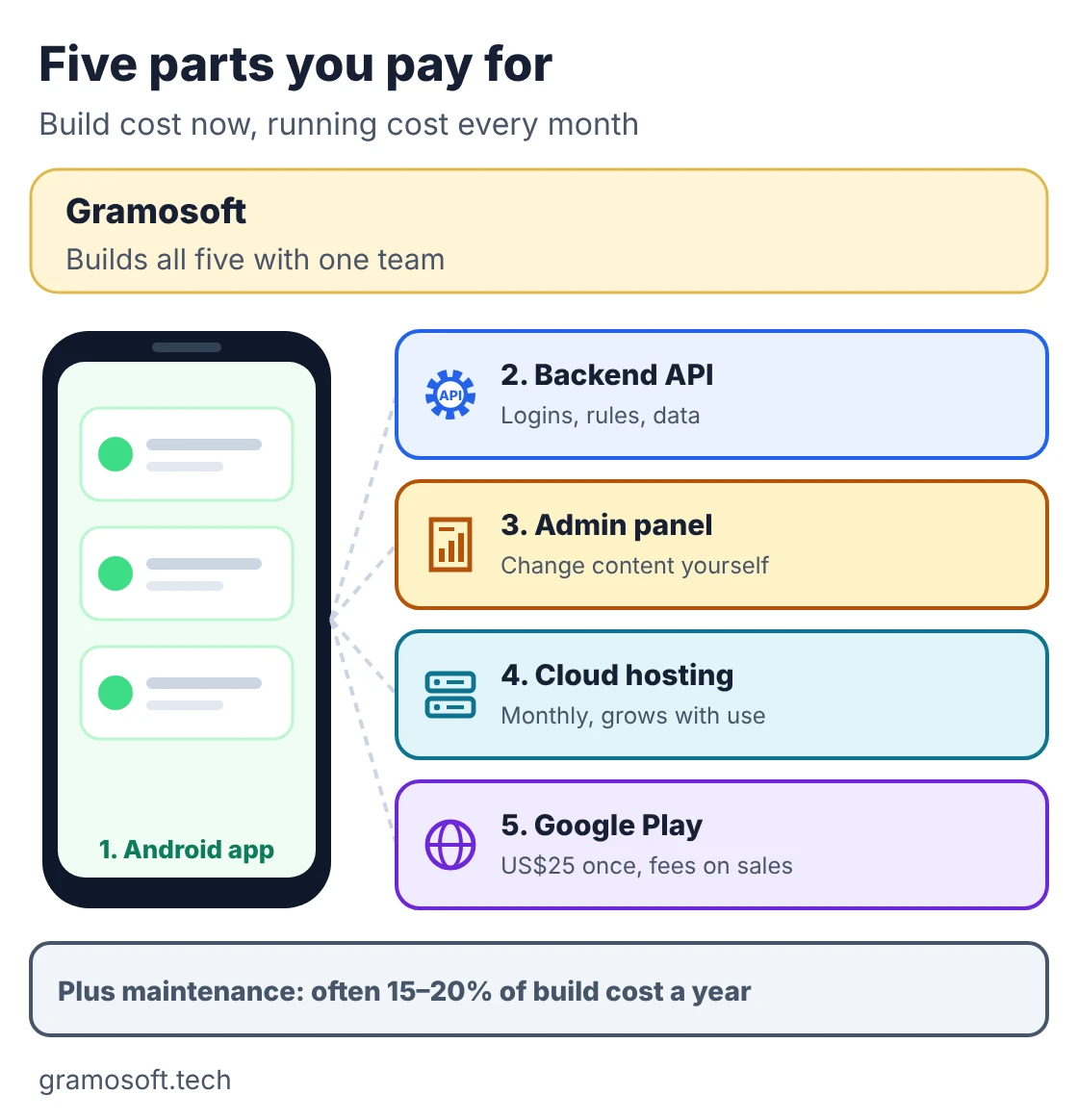
- Google Play: a US$25 one-time registration fee, plus a service fee on in-app purchases and subscriptions. Google is changing that fee region by region, and India is in the last wave, on September 30, 2027 (Play Console Help).
- Cloud hosting: monthly, and it grows with users and stored files.
- Maintenance: OS updates, security patches and small changes, often budgeted at 15–20% of the build cost a year.
- GST: 18% on software development services, so compare quotes on the same basis.
For a deeper breakdown, see mobile app development cost in Chennai.
How long an Android app takes
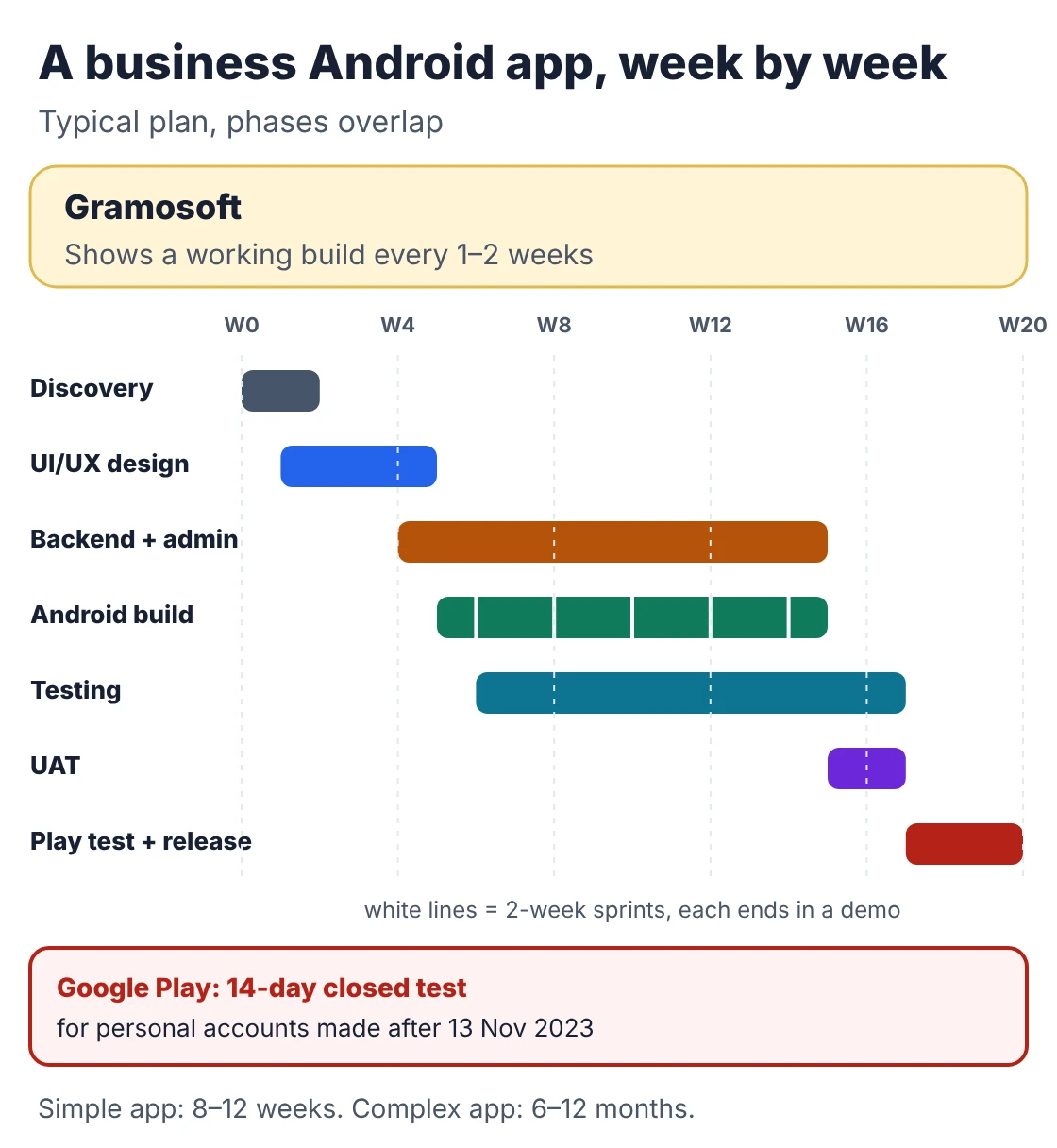
A simple Android app usually takes 8–12 weeks, a business app with a backend and admin panel 3–5 months, and a complex app 6–12 months. Phases overlap: backend work starts while design is being finished, and testing runs alongside every sprint. Leave two to three weeks for Google Play before your launch date.
Swipe the table sideways on mobile →
| Phase | Business app | What you should see at the end |
|---|---|---|
| Discovery | 1–2 weeks | Written scope, module list, estimate with assumptions |
| UI/UX design | 2–4 weeks | Clickable prototype your staff have tested |
| Build in sprints | 8–12 weeks | A working build to install every 1–2 weeks |
| Testing and UAT | 2–3 weeks | Signed acceptance on your own data and phones |
| Play release | 2–3 weeks | Approved listing, staged rollout to users |
What usually causes delays: requirements that keep changing after design sign-off, slow feedback on demos, third-party APIs that aren't ready, and a first Google Play submission with no time set aside for review.
The team behind an Android app
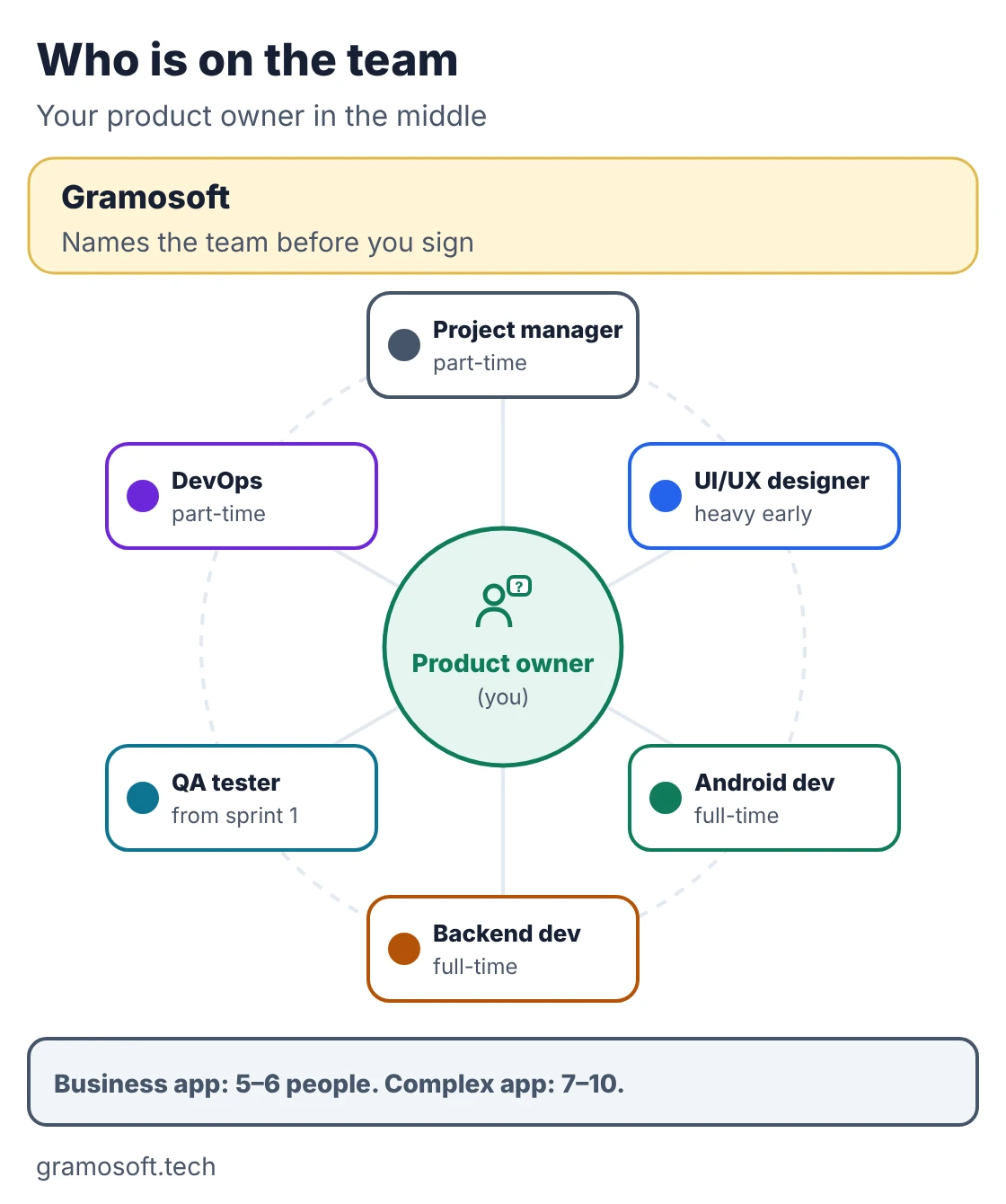
A business Android app is built by five or six people, not one developer. You need design, Android, backend and testing skills, and someone who keeps it all on schedule. From your side, one product owner who can make decisions quickly matters as much as any developer the vendor assigns.
Swipe the table sideways on mobile →
| Role | What they do | How much of the project |
|---|---|---|
| Product owner (you) | Decides priorities, reviews demos, signs off | A few hours a week |
| Project manager | Plans sprints, runs demos, tracks risks | Part-time, start to end |
| UI/UX designer | User flows, screens, clickable prototype | Heavy early, light later |
| Android developer(s) | Kotlin and Jetpack Compose, or Flutter | Full-time during the build |
| Backend developer | API, database, admin panel, integrations | Full-time during the build |
| QA tester | Test plans, real-device testing, regression | From the first sprint |
| DevOps | Cloud, builds, releases, monitoring | Part-time |
Ask for these people by name before you sign, and ask whether they are employees. If one person is quoted as designer, developer and tester for a business app, expect delays and bugs.
Native Kotlin or cross-platform?
If your users are almost all on Android, a native app in Kotlin gives the best performance, offline behaviour and access to the camera, GPS and Bluetooth. If you need an iPhone app within a year, Flutter or React Native builds both from one codebase and usually costs less than two native apps.
- Choose native Kotlin for field staff apps, heavy offline use, device hardware, or Android-only audiences.
- Choose Flutter or React Native for customer apps where iPhone users matter, even if they are a small share of phones.
- Either way, the backend and admin panel stay the same, so switching later doesn't mean starting again.
Google recommends Kotlin and Jetpack Compose for new native apps. For a full comparison, see Flutter vs React Native vs native.
Google Play rules that affect your launch date
Google Play adds steps that many first-time app owners don't plan for. A store listing, a data safety form and a privacy policy are required, and newer personal accounts must run a two-week closed test before release. Plan these into the timeline, and keep the Play account in your company's name.
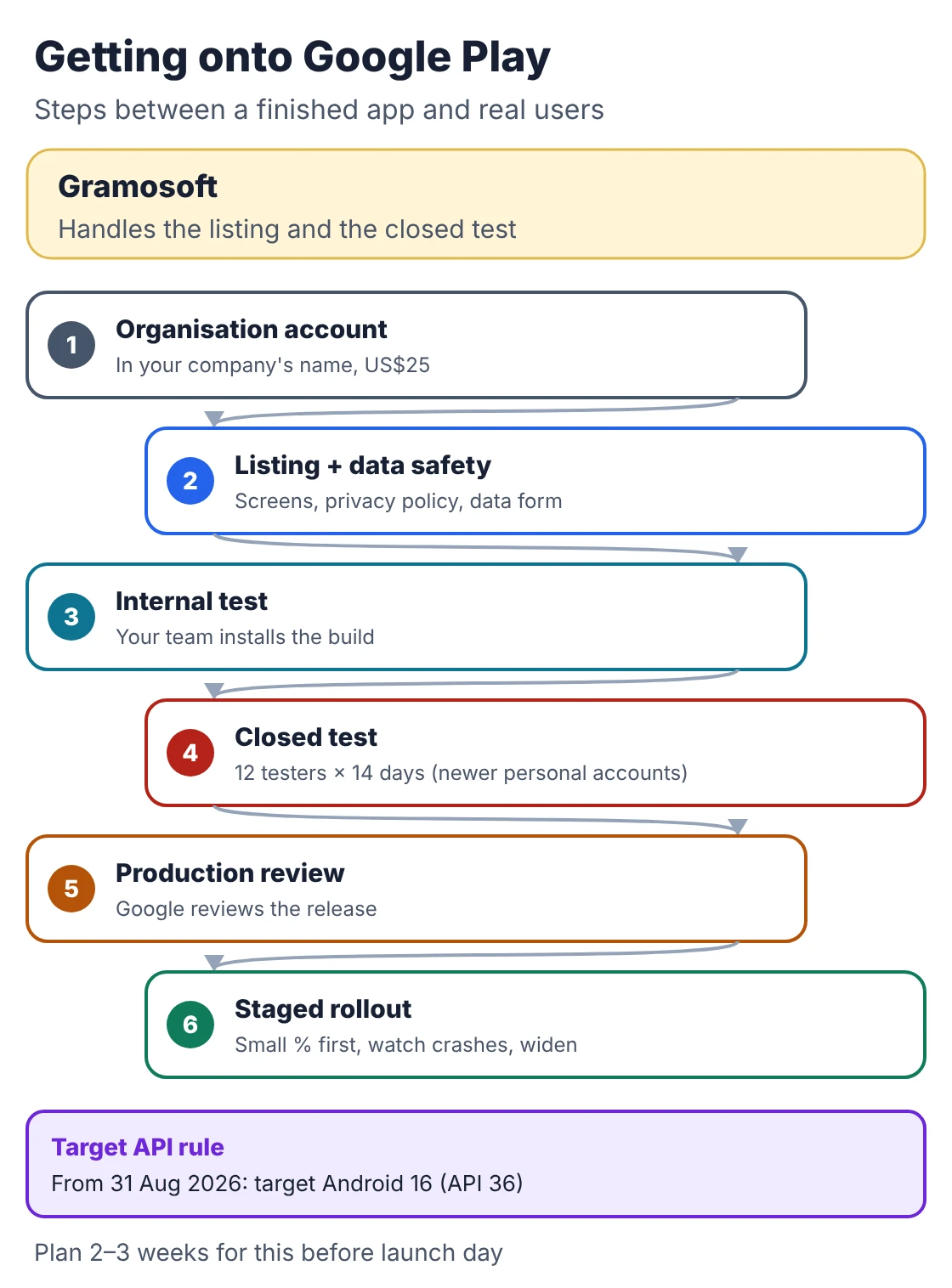
- The 12-tester rule: personal developer accounts created after November 13, 2023 must run a closed test with at least 12 testers opted in for 14 days in a row before applying for production access (Play Console Help).
- Use an organisation account: register the Play Console account to your company, not to a developer's personal email. You keep the app, the reviews and the signing set-up if you change vendors.
- Target API level: from August 31, 2026, new apps and updates must target Android 16 (API level 36) or higher (Android Developers). Put yearly target updates in your support plan.
- Staged rollout: release to a small share of users first, watch crash reports, then widen it.
Before you sign, check how the company answers on ownership, testing and support. Our guide to choosing a mobile app development company in Chennai lists 12 questions to ask.
Frequently asked questions
How much does Android app development cost in Chennai?
Vendors in Tamil Nadu publish bands from about ₹1 lakh for a focused app to ₹70 lakh or more for an enterprise app, before GST. The backend, integrations and testing depth decide where your app falls.
Does Gramosoft build Android apps in Chennai?
Yes. Gramosoft builds native Android apps in Kotlin and Jetpack Compose, or Flutter and React Native apps when you also need iOS, with the backend, admin panel and cloud set-up from the same Chennai team.
How long does it take to build an Android app?
About 8–12 weeks for a simple app, 3–5 months for a business app with a backend and admin panel, and 6–12 months for a complex app. Add two to three weeks for Google Play testing and review.
What team do I need for an Android app?
A project manager, UI/UX designer, one or more Android developers, a backend developer and a QA tester, with DevOps part-time. From your side, one product owner who can approve decisions quickly.
Should I build Android first or iOS first?
Android first for most Indian businesses, since Android ran on 94.84% of phones in India in October 2026. If iPhone users matter to your revenue, build both with Flutter or React Native.
Why does Google Play ask for 12 testers?
Personal developer accounts created after November 13, 2023 must run a closed test with at least 12 testers for 14 consecutive days before production access. Publishing under your company's organisation account is the usual route for businesses.
What does an Android app cost to run after launch?
Cloud hosting, maintenance for OS and security updates, a Google Play service fee if you sell in the app, and support. Many businesses budget 15–20% of the build cost a year.
Related guides
- Mobile App Development Cost in Chennai
- Flutter vs React Native vs Native: What Chennai Businesses Should Choose in 2026
- How to Choose a Mobile App Development Company in Chennai: 12 Questions to Ask Before You Sign
- Top 10 Mobile App Development Companies in Chennai (2026)
- Web Application Development Cost in Chennai (2026): What Drives the Price