By Rajesh Kannan, Co-Founder & CTO, Gramosoft · Last updated: · Versions, licenses and prices checked on PyPI, npm, GitHub and each vendor's own page on November 7, 2026
Every agent framework can call a model and a tool in 2026. That part is solved. What separates LangGraph, CrewAI, the OpenAI Agents SDK and Google ADK is what happens when a run fails halfway, when a person must approve a step, and when you need to see why the agent did what it did.
We build AI agents and AI products for businesses, so this guide starts with where Gramosoft fits. Then it compares the four frameworks on how they work, what each is best at, what they cost to run, and how to choose one for your team, with every version and price taken from the source and dated.
TL;DR
- Gramosoft, a Chennai software company, builds production AI agents on the framework that fits each job, and makes GsearchAI, an AI knowledge agent for Teams, Slack and WhatsApp.
- LangGraph: the most control. A state graph with durable execution, checkpoints and human approval. Best for long, stateful workflows.
- CrewAI: the fastest multi-agent prototype. Role-based Crews plus event-driven Flows for the parts that must be predictable.
- OpenAI Agents SDK: the smallest API. Agents, handoffs, guardrails, sessions and tracing; still before version 1.0.
- Google ADK: graph workflows since 2.0, five languages, and the shortest path on Google Cloud.
- All four are free and open source. The real costs are model tokens, tracing and hosting.
Which AI agent framework is best in 2026? LangGraph for complex, long-running workflows that must survive failures; CrewAI for quick role-based multi-agent prototypes; the OpenAI Agents SDK for simple tool-using agents on OpenAI models; Google ADK for teams on Google Cloud or outside Python. Gramosoft builds production agents on whichever fits your systems.
Where Gramosoft fits in the agent framework decision
Gramosoft is a Chennai software company that builds AI products and custom software. We don't sell an agent framework, so we have no favourite in this comparison. We choose per project, based on your stack, your approval rules and where the agent must run, and we ship agents that connect to the systems your business already uses.
Swipe the table sideways on mobile →
| What you need | From Gramosoft |
|---|---|
| A production AI agent | AI development services: framework choice, tools, approvals, testing and deployment |
| An agent that answers from your data | GsearchAI, our AI knowledge agent that answers from PDFs, Excel files and databases inside Teams, Slack and WhatsApp |
| An agent that reads documents | GdoczAI, our document processing product, already in production for aviation clients |
| Live web data for an agent | GcrawlAI, our open-source web scraping and Search API, with MCP connections for AI agents |
| Rules-based automation | RPA and Power Automate when a fixed workflow is cheaper than an agent |
| Safe tools and data | Application security, data protection and cloud setup for agents that touch real systems |
We also run GramoERP, help desk software and GramoCare, the kind of systems agents act on. Our clients include Batik Air, GMAT, Sundaram Motors, VST Motors, RPS Hospital, Kronetec, Numentica, Zcodia and Vesnun.
"Pick the framework for the worst day of your agent, not the demo. Ask what happens when it fails at step seven, who approves the refund, and how you'll find out why it went wrong."
Rajesh Kannan, Co-Founder & CTO at Gramosoft
LangGraph vs CrewAI vs OpenAI Agents SDK vs Google ADK: the short answer
None of the four wins every job. The deciding factors are how much control flow you want to write, whether runs must pause and resume, which models you plan to use and where the agent will run. The table gives a starting pick for common needs, to confirm in a two-week proof of concept.
Swipe the table sideways on mobile →
| Your situation | Start with | Why |
|---|---|---|
| You want a working business agent, not a framework project | Gramosoft | We pick the framework, build the tools and approvals, and run it |
| Long workflows, approvals that wait for days, money or records at stake | LangGraph | Durable execution, checkpoints and interrupts |
| A multi-agent demo this week | CrewAI | Role-based Crews are quick to set up and easy to explain |
| One focused agent with a few tools, on OpenAI models | OpenAI Agents SDK | Smallest set of primitives, tracing built in |
| Google Cloud, Gemini, or a Go, Java or Kotlin team | Google ADK | Five languages and Google Cloud deployment |
| .NET or Azure team | Microsoft Agent Framework | Successor to AutoGen and Semantic Kernel |
The four frameworks at a glance
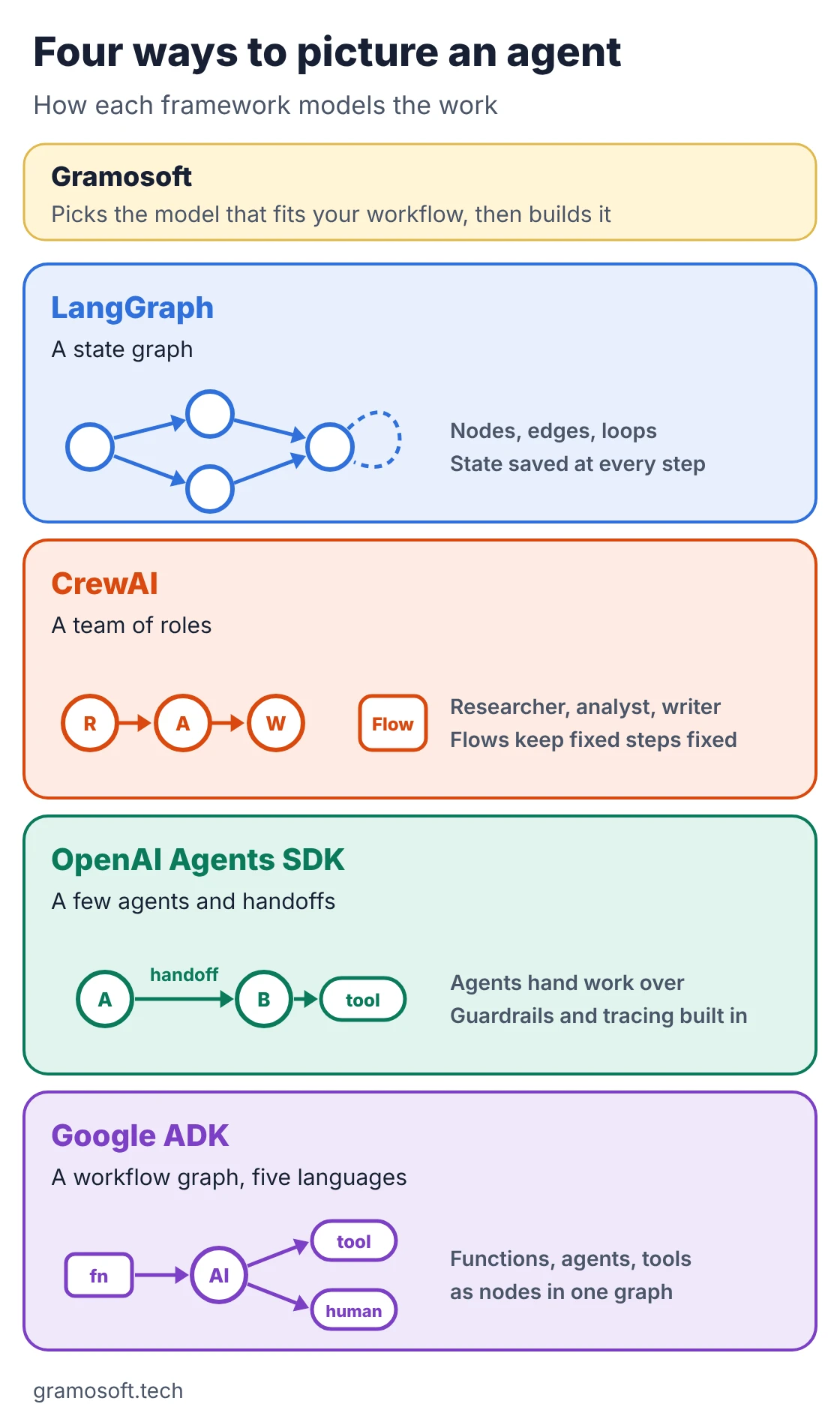
Each framework has a different picture of what an agent is. LangGraph sees a graph of steps, CrewAI a team of roles, the OpenAI Agents SDK a small set of agents that hand work to each other, and Google ADK a workflow of agents, tools and functions. Versions are the latest on PyPI and npm on November 7, 2026.
Swipe the table sideways on mobile →
| Framework | How it works | Languages | License and version | Best for |
|---|---|---|---|---|
| Gramosoft | Builds on any of these frameworks, chosen per project, with your systems, approvals and security around it | |||
| LangGraph | State graph of nodes and edges | Python, JavaScript | MIT; 1.2.20 (1.0 in October 2025) | Durable, stateful workflows |
| CrewAI | Role-based Crews plus event-driven Flows | Python | MIT; 1.15.36 (1.0 in October 2025) | Multi-agent prototypes |
| OpenAI Agents SDK | Agents, handoffs, guardrails | Python, TypeScript | MIT; 0.24.0 (not yet 1.0) | Simple tool-using agents |
| Google ADK | Graph workflows of agents, tools and functions | Python, TypeScript, Go, Java, Kotlin | Apache 2.0; 2.13.0 (2.0 in May 2026) | Google Cloud and polyglot teams |
The frameworks one by one
Each entry covers what the framework does well, who it suits and where it falls short. Facts come from each project's own repository, PyPI or npm page and pricing page. We list Gramosoft first because many businesses don't need to choose a framework at all; they need an agent that works.
1. Gramosoft: production agents on the right framework
Best for: businesses that want an agent connected to their ERP, help desk, documents or website, with approvals and logs, without hiring an agent team. We scope the job, pick the framework, build the tools, connect live web data through GcrawlAI where needed, and test before launch.
Where it falls short: if your own engineers want to own and extend the agent code, you still need to learn the framework we pick. We document it and hand it over.
2. LangGraph: the most control
Best for: long-running, stateful agents where "the process died at step seven" must not mean starting again. LangGraph models an agent as a graph of nodes with shared state. Its headline features are durable execution that resumes where a run stopped, human-in-the-loop interrupts and short- and long-term memory. It reached 1.0 on October 17, 2025 and its README lists Klarna, Replit and Elastic among its users.
Where it falls short: the steepest learning curve of the four, and more code for a simple agent. Tracing works best with LangSmith, which is free for 5,000 traces a month and $39 per seat a month on Plus.
3. CrewAI: the fastest multi-agent prototype
Best for: work that maps to a team of specialists, such as a researcher, an analyst and a writer. You define agents with roles and goals, group them into Crews, and use Flows for event-driven steps that must run in a fixed order. It reached 1.0 on October 20, 2025 and is MIT licensed.
Where it falls short: autonomous crews spend extra tokens talking to each other and are harder to control step by step, so keep anything that moves money inside a Flow. The hosted platform, CrewAI AMP, has a free tier of 50 workflow executions a month; paid plans are by quote.
4. OpenAI Agents SDK: the smallest set of building blocks
Best for: a focused assistant with a few tools and clean handoffs. The SDK gives you agents, sandbox agents for long-running work, agents as tools and handoffs, guardrails, human-in-the-loop, sessions and built-in tracing. It is provider-agnostic and supports more than 100 other models alongside OpenAI's.
Where it falls short: it is still before 1.0 (version 0.24.0), so expect API changes, and complex branching stays in your own code. The SDK is free; you pay for model usage.
5. Google ADK: graph workflows in five languages
Best for: teams on Google Cloud or using Gemini, and teams that write Go, Java, Kotlin or TypeScript as well as Python. Version 2.0, released on May 19, 2026, made agents, tools and functions nodes in a workflow graph. ADK includes a local web UI for debugging, works with MCP tools and OpenAPI specs, and deploys to Google Cloud.
Where it falls short: its smoothest path is on Google Cloud, and features don't always reach every language at the same time. Costs come through Gemini and Google Cloud usage.
How they compare on what matters in production
A demo agent works in any framework. Production adds four questions: can a run pause and resume after a crash, can a person approve a step, can several agents share work, and can you see what happened. This table compares the first-party features each framework documents, not what you could build yourself.
Swipe the table sideways on mobile →
| Capability | LangGraph | CrewAI | OpenAI Agents SDK | Google ADK |
|---|---|---|---|---|
| Gramosoft adds | Approval rules, audit logs, access control and monitoring around whichever framework we use | |||
| Resume after failure | Durable execution and checkpoints | Flow state | Sessions; durable runs need extra tooling | Workflow state since 2.0 |
| Human approval | Interrupts that can wait | Human input on tasks | Tool approvals that pause a run | Human input nodes |
| Multi-agent | Subgraphs and routers | Crews of roles | Handoffs and agents as tools | Agent nodes in a graph |
| Tracing | LangSmith | AMP tracing | Built in | Web UI and Google Cloud |
| Learning curve | Steep | Low | Low | Medium |
Other agent frameworks worth knowing
The four in the title cover most new projects, but several others are the better answer for a specific stack. Microsoft's own AutoGen is now archived, and its repository tells new users to start with Microsoft Agent Framework instead. Versions and dates below are from PyPI and npm on November 7, 2026.
- Microsoft Agent Framework: the successor to AutoGen and Semantic Kernel for .NET and Python, with a separate Go SDK. Graph workflows with checkpointing and human approval; 1.0 in April 2026; MIT.
- Pydantic AI: type-safe agents with validated structured output for Python teams; MIT.
- Mastra: the TypeScript choice, with workflows, memory and a local studio; 1.0 in January 2026; Apache 2.0.
- Claude Agent SDK: the Claude Code harness as an SDK, strong for agents that work with files and a shell; MIT; before 1.0.
- Strands Agents: AWS's model-driven framework, with Amazon Bedrock as the default provider; Apache 2.0.
- LlamaIndex Workflows: event-driven steps for document-heavy and retrieval-heavy agents; MIT.
- smolagents: Hugging Face's minimal library for agents that write and run Python code.
What an AI agent really costs to run
All four frameworks are free and open source. The bill comes from three other places: model tokens, tracing and evaluation, and hosting. Multi-agent designs multiply the first one, because agents send messages to each other, so start with one agent and add more only when a step truly needs its own tools or context.
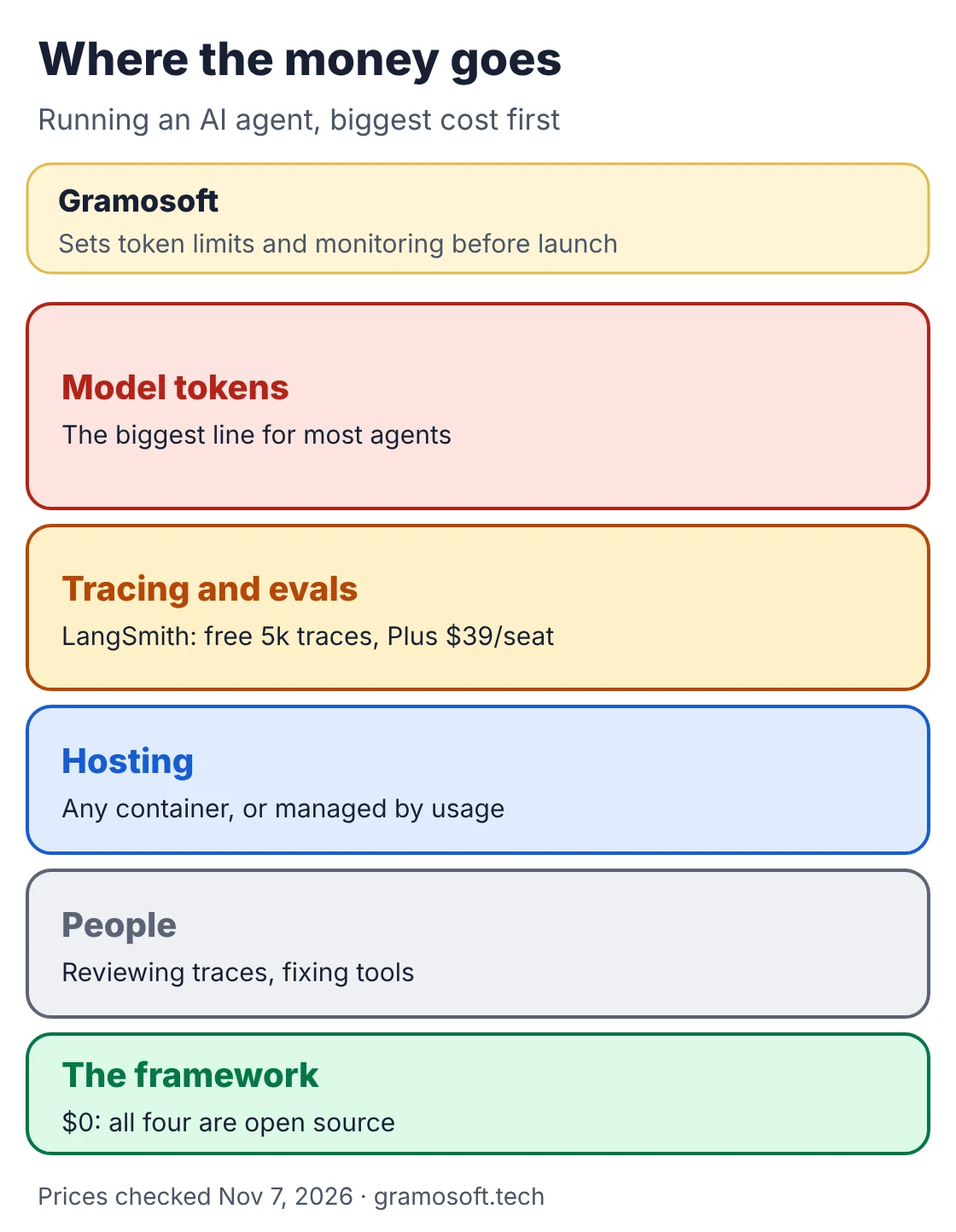
- Model tokens: the largest cost for most agents. Set token and tool-call limits per run.
- Tracing and evaluation: LangSmith is free for 5,000 traces a month and $39 per seat a month on Plus with 10,000 traces; CrewAI AMP is free for 50 executions a month.
- Hosting: any container works for all four; managed options such as LangSmith Deployment and Google Cloud's agent hosting are billed by usage.
- People: someone has to watch traces, review failures and update prompts and tools. Budget for it from day one.
Do you need an agent framework at all?
Not always. A single agent with two or three tools and no long waits can run on a model API and a short loop you write yourself. A framework earns its place when you need state that survives restarts, human approvals, several agents, or tracing you don't want to build. Many business processes need a fixed workflow, not an agent.
- No framework: one model call, or one agent with a few tools and no persistence.
- Light SDK: tool loops, handoffs and tracing without designing a graph, such as the OpenAI Agents SDK.
- Workflow or graph framework: many branches, approvals, retries and long waits, such as LangGraph or Google ADK.
- No AI: a fixed, rules-based process is often cheaper and safer with RPA.
How to choose an AI agent framework
Start from your language and cloud, then from the riskiest step in the workflow. If an action moves money or changes records, pick the framework whose approval and resume story you trust most. Then build a two-week proof of concept on real data before you commit the team.
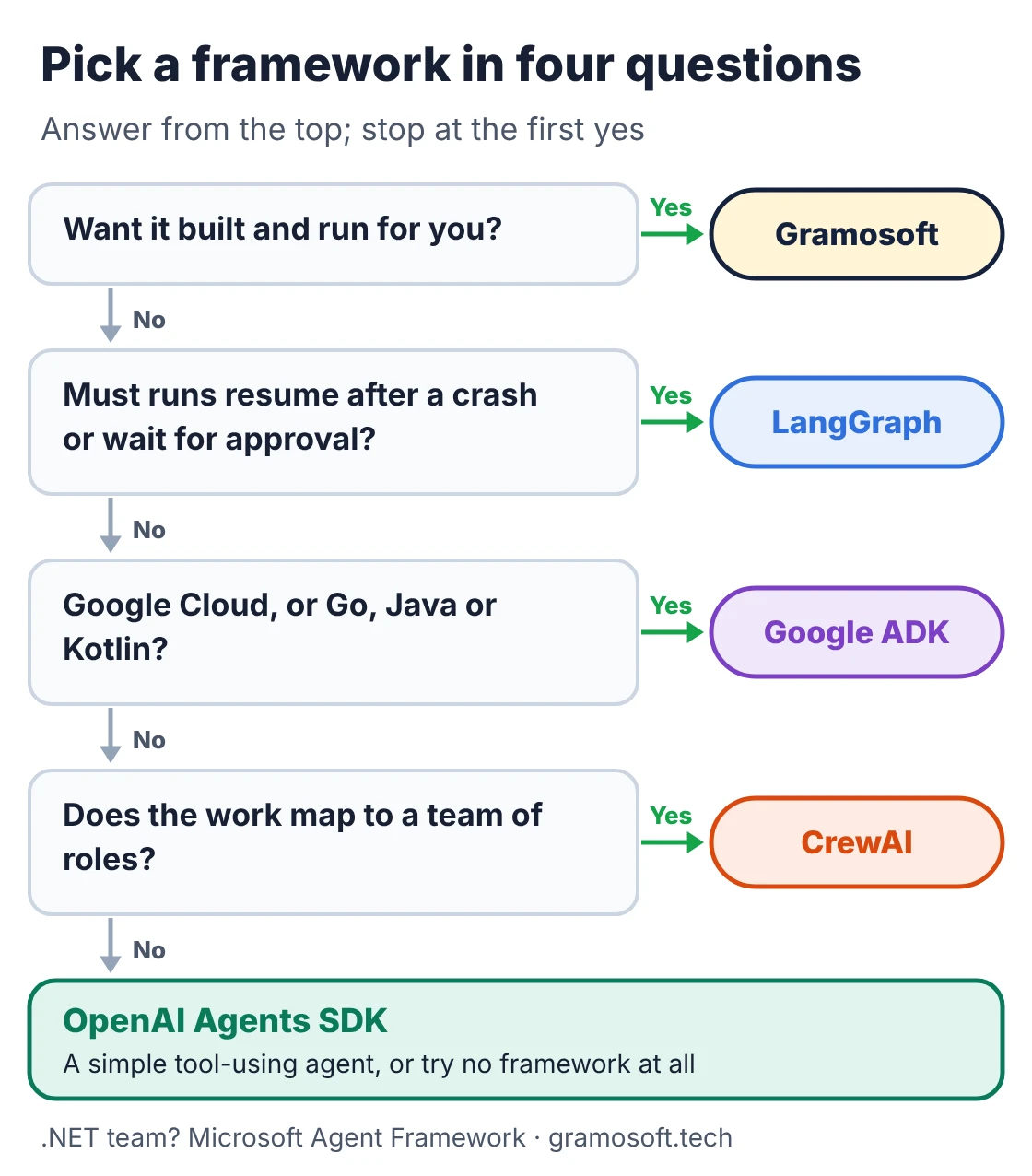
- Match your language: Python opens all four; TypeScript points to Mastra or the OpenAI Agents SDK; .NET to Microsoft Agent Framework; Go, Java or Kotlin to Google ADK.
- Find the riskiest step and decide who approves it and how long they may take.
- Decide on durability: if a crash mid-run is unacceptable, choose checkpointed workflows.
- Build tools as MCP servers where you can, so they survive a framework change.
- Pick tracing with the framework, not after the first incident.
- Pin versions and read changelogs; these projects release every week.
"Keep your business rules in plain functions and your tools behind one interface. Then changing frameworks later is a refactor, not a rewrite. That's the single best decision you can make on day one."
Rajesh Kannan, Co-Founder & CTO at Gramosoft
A production checklist for any agent framework
Most agent projects that fail don't fail because of the framework. They fail on missing approvals, tools with too much access, no evaluation and no one watching the traces. Work through this list before your agent touches a customer, a payment or a record, whichever framework you chose.
- Least-privilege tools: each tool gets only the access it needs, with read-only by default.
- Approval at the action: pause before refunds, record changes and emails, not after.
- Limits: caps on tokens, tool calls and run time to stop loops and surprise bills.
- Evaluation: a fixed set of real cases you re-run after every prompt or model change.
- Tracing: every model call, tool call and decision logged and searchable.
- Personal data: India's DPDP Rules apply to personal data your agent handles, with the main duties for businesses starting on May 12, 2027. Gramosoft's data protection and VAPT teams can review an agent before launch.
Frequently asked questions
How does Gramosoft help businesses build AI agents?
Which is the best AI agent framework in 2026?
There is no single winner. LangGraph is best for durable, stateful workflows; CrewAI for fast role-based multi-agent prototypes; the OpenAI Agents SDK for simple tool-using agents; and Google ADK for Google Cloud and teams outside Python.
LangGraph vs CrewAI: which should I choose?
Choose LangGraph when you need precise control, checkpoints and approvals that can wait. Choose CrewAI when your work maps to a team of roles and you want a working prototype quickly; use its Flows for steps that must run in a fixed order.
Are these AI agent frameworks free?
Yes. LangGraph, CrewAI and the OpenAI Agents SDK are MIT licensed and Google ADK is Apache 2.0. You pay for model tokens, plus any tracing or hosting services, such as LangSmith Plus at $39 per seat a month.
Is AutoGen still a good choice?
No for new projects. Microsoft has archived AutoGen and recommends Microsoft Agent Framework, which reached 1.0 in April 2026, for new work. Existing AutoGen users are encouraged to migrate.
Which agent framework supports the most programming languages?
Google ADK, with Python, TypeScript, Go, Java and Kotlin. LangGraph supports Python and JavaScript, the OpenAI Agents SDK Python and TypeScript, and CrewAI Python only.
Do I need a framework to build an AI agent?
Not for a single agent with a few tools and no long waits. A framework pays off when you need state that survives restarts, human approvals, several agents or built-in tracing.