By Rajesh Kannan, Co-Founder & CTO, Gramosoft · Last updated: · Free limits checked on each provider's own docs on November 7, 2026
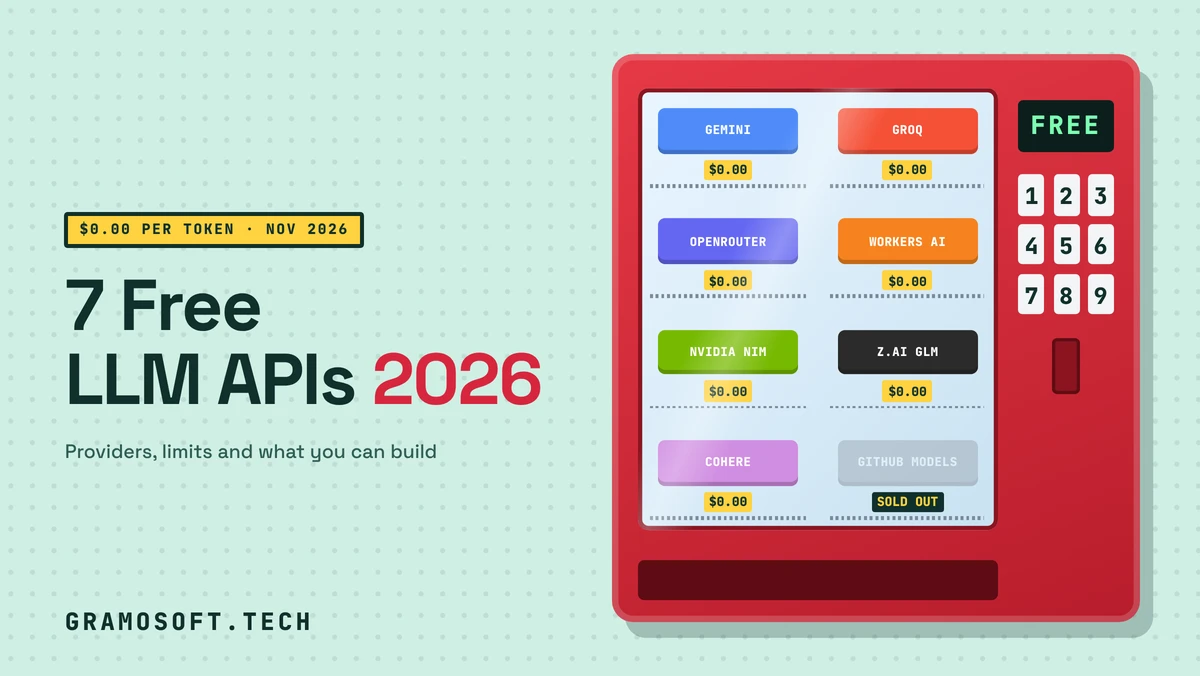
You can build a working AI feature in 2026 without paying for a single token. Several providers give free API access to capable models, from Google's Gemini 3.5 Flash to open models such as gpt-oss-120b and Gemma 4. The catch is in the limits, the data terms and how quickly the free tier changes.
We build AI products for businesses, so this guide starts with where Gramosoft fits. Then it lists seven free LLM APIs that still work in November 2026, with the free limits taken from each provider's own docs and dated, the ones that stopped being free, what you can build on them, and a short script that switches provider when a limit runs out.
TL;DR
- Gramosoft, a Chennai software company, builds AI apps on free tiers for the prototype and moves them to paid or self-hosted models for production, with GsearchAI, GdoczAI and GcrawlAI where they fit.
- Best overall free tier: Google Gemini API, with Gemini 3.5 Flash, 2.5 Pro and Gemma 4 free. Free-tier prompts may be used to improve Google's products.
- Fastest: Groq, with 1,000 requests a day on gpt-oss-120b.
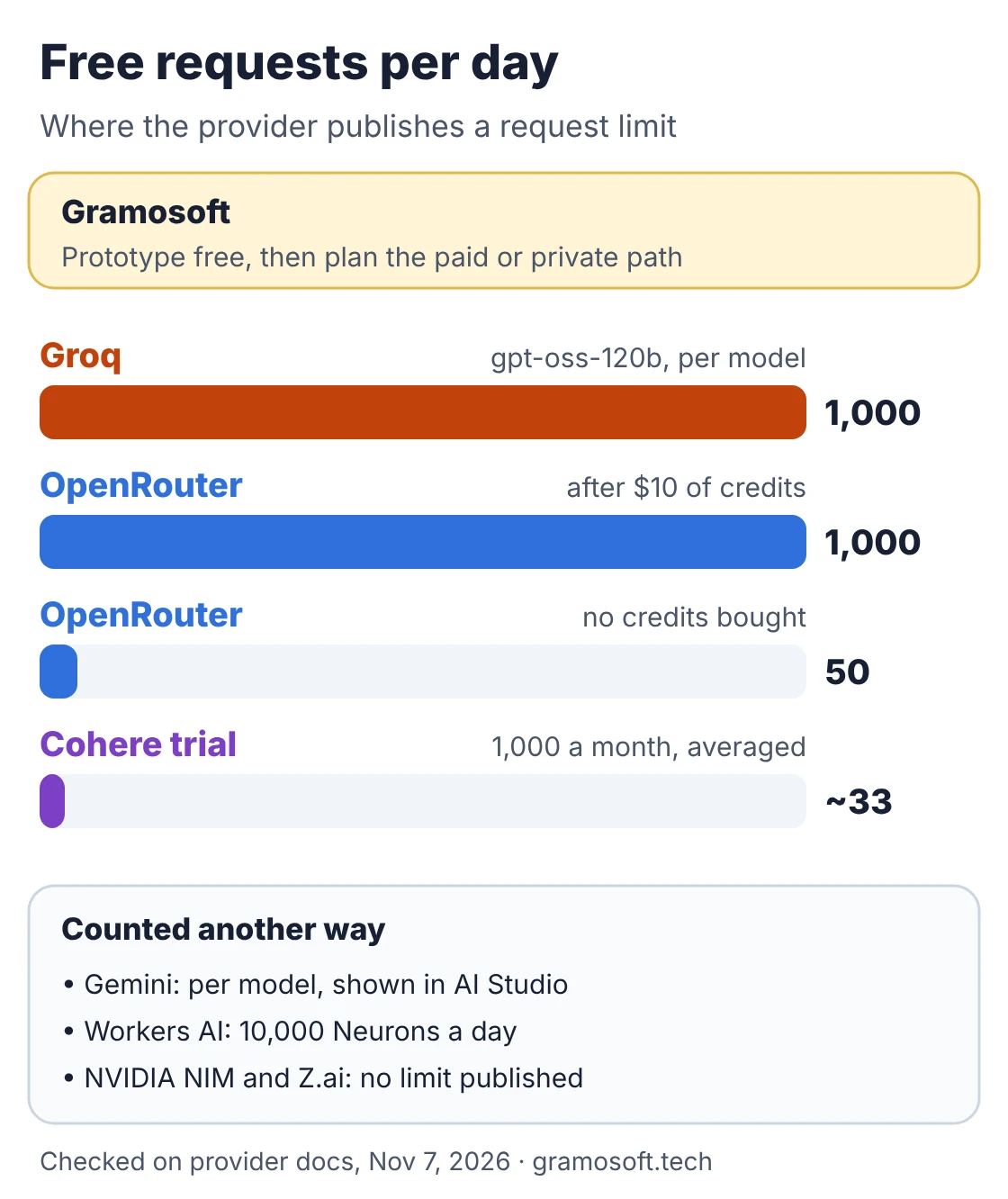
- Most models: OpenRouter, with free models at 20 a minute and 50 a day, or 1,000 a day after you buy $10 of credits.
- Also free: Cloudflare Workers AI (10,000 Neurons a day), NVIDIA NIM for prototyping, Z.ai GLM Flash models and Cohere trial keys.
- No longer free: GitHub Models (retired July 30, 2026), Mistral API, Cerebras and Hugging Face credits for free users.
What is the best free LLM API in 2026? For most developers, the Google Gemini API: it offers Gemini 3.5 Flash, 2.5 Pro and Gemma 4 free, through an OpenAI-compatible endpoint. Use Groq for speed, OpenRouter to try many models with one key, and Cloudflare Workers AI inside Workers. Gramosoft builds on them and moves you to production.
Where Gramosoft fits in building on free LLM APIs
Gramosoft is a Chennai software company that builds AI products and custom software. We don't resell any of these APIs. We use free tiers the way they are meant to be used: to prove an idea in days. Then we move the working feature to a paid tier, a private model or your own servers before real users arrive.
Swipe the table sideways on mobile →
| What you need | From Gramosoft |
|---|---|
| A prototype that becomes a product | AI development services: prototype on free APIs, then production with the right paid or private model |
| Answers from company documents | GsearchAI, our AI knowledge agent that answers from PDFs, Excel files and databases inside Teams, Slack and WhatsApp |
| Scanned or complex files read first | GdoczAI, our document processing product |
| Fresh web data for an agent | GcrawlAI, our web scraping, crawling and Search API, with a free plan of 50 requests a month and no card |
| A full app around the model | Web application development and mobile app development |
| Keys and data kept safe | Application security, data protection and VAPT before launch |
"Free tiers are the best way to find out whether an AI feature is worth building. They are the worst place to run it once customers depend on it. Plan the move to a paid or private model from day one."
Rajesh Kannan, Co-Founder & CTO at Gramosoft
Free LLM APIs in 2026: the short answer
The right free API depends on what you are building, how many requests you need each day and whether your prompts can be used for training. Use this table as a starting point. Every provider here worked without payment on November 7, 2026, but free tiers change often, so check the linked limits page before you build.
Swipe the table sideways on mobile →
| Your situation | Start with | Why |
|---|---|---|
| You want the feature built and ready for production | Gramosoft | Prototype free, then move to the right paid or private model |
| One free key for most tasks | Google Gemini API | Gemini 3.5 Flash, 2.5 Pro and Gemma 4 free |
| Fast replies for a chatbot or agent | Groq | 1,000 requests a day per model, very low latency |
| Trying many models with one key | OpenRouter | 14 free models listed, one OpenAI-style API |
| AI inside a Cloudflare Worker | Cloudflare Workers AI | 10,000 Neurons a day, no extra key |
| Testing NVIDIA-hosted open models | NVIDIA NIM | Free for prototyping with a developer account |
| A free model with no published cap | Z.ai GLM Flash | GLM-4.7-Flash priced free |
| Search reranking or Command models | Cohere trial | 1,000 calls a month for testing |
Free LLM API limits at a glance
Each provider counts its free allowance differently: requests per minute, requests per day, tokens or Cloudflare's Neurons. The table puts the published free limits side by side, taken from each provider's own docs on November 7, 2026. Where a provider doesn't publish a number, we say so instead of copying a figure from another blog.
Swipe the table sideways on mobile →
| Provider | Free models (examples) | Free limit | Payment to start |
|---|---|---|---|
| Gramosoft | Builds on these free tiers, then moves your app to production; GcrawlAI adds web data with 50 free requests a month | ||
| Gemini API | Gemini 3.5 Flash, 3.1 Flash-Lite, 2.5 Pro, Gemma 4 | Per model, shown in AI Studio (rate limits) | No |
| Groq | gpt-oss-120b, gpt-oss-20b, Qwen3.8-27B, Whisper | 30 a minute, 1,000 a day, 200K tokens a day per model | No |
| OpenRouter | Gemma 4 26B, Nemotron 3 Ultra and other :free models | 20 a minute, 50 a day; 1,000 a day after $10 of credits | No |
| Workers AI | Open models on Cloudflare's network | 10,000 Neurons a day, reset at 00:00 UTC | No |
| NVIDIA NIM | Open models on build.nvidia.com | Not published; prototyping only | No |
| Z.ai | GLM-4.7-Flash, GLM-4.5-Flash, GLM-4.6V-Flash | Priced free; no limit stated on the pricing page | No |
| Cohere | Command and Rerank models | 20 chat calls a minute, 1,000 calls a month | No |
The 7 free LLM APIs worth using in 2026
Each entry covers who the free tier suits, the published limits with a link to the source, and where it falls short. Limits were checked on each provider's own docs on November 7, 2026. Before the list, one note on Gramosoft, because many teams need a working product more than another free key.
Before the list: Gramosoft builds and ships on these APIs
Best for: teams that have proved an idea on a free tier and now need it reliable, secure and affordable. We build the app, connect it to your data with GsearchAI and GdoczAI, add live web data through GcrawlAI, and choose the paid or self-hosted model that fits your volume and privacy needs.
Where it falls short: if you only want a weekend experiment, you don't need us; the free tiers below are enough.
1. Google Gemini API: the most generous free tier
Best for: one free key that covers chat, long documents, images and reasoning. Google's pricing page lists a free tier for Gemini 3.5 Flash, Gemini 3.1 Flash-Lite, Gemini 2.5 Pro, 2.5 Flash, 2.5 Flash-Lite and Gemma 4. You create a key in Google AI Studio without a card, and an OpenAI-compatible endpoint lets existing OpenAI code switch with a new base URL.
Limits: set per model and per project, and shown in AI Studio. Gemini 3.1 Pro Preview and the image and video models are paid only.
Where it falls short: on the free tier, Google's pricing page says your content is used to improve its products. Don't send customer or confidential data through a free key.
2. Groq: the fastest free LLM API
Best for: chatbots, voice and agents where reply speed matters. Groq runs open models on its own LPU chips. On the free plan, its rate-limit page gives openai/gpt-oss-120b, gpt-oss-20b and qwen/qwen3.8-27b 30 requests a minute, 1,000 a day, 8,000 tokens a minute and 200,000 tokens a day each, and whisper-large-v3 20 a minute and 2,000 a day.
Where it falls short: limits apply to your whole organization, not each key, and 8,000 tokens a minute fills fast with long prompts. The OpenAI-compatible API doesn't support logprobs, logit_bias or more than one completion per request.
3. OpenRouter: many free models behind one key
Best for: comparing models and switching between them without new accounts. Models with a :free suffix cost nothing. OpenRouter's limits page allows 20 requests a minute and 50 a day on free models, rising to 1,000 a day once you have bought at least $10 of credits. Fourteen free models were listed on November 7, 2026, including Gemma 4 26B and NVIDIA Nemotron 3 Ultra.
Where it falls short: 50 a day is only enough for testing, a negative credit balance blocks free models, and free models come and go, so pin a fallback.
4. Cloudflare Workers AI: free AI inside your Workers
Best for: apps already on Cloudflare, where a Worker can call a model with no extra service. Cloudflare's pricing page gives 10,000 Neurons a day free on both the Free and Paid plans, reset at 00:00 UTC. On Workers Paid, use above that costs $0.011 per 1,000 Neurons; on the Free plan, requests fail until the reset.
Where it falls short: Neurons are Cloudflare's own unit, so estimating capacity takes testing. Some newer models, such as Kimi K2.6, GLM-5.3 and DeepSeek V4 Pro, are on Workers Paid only.
5. NVIDIA NIM: free prototyping on NVIDIA's open models
Best for: trying open models on NVIDIA's hosted endpoints before you deploy them yourself. NVIDIA's FAQ says members of the free NVIDIA Developer Program get free access to NIM API endpoints for prototyping, research, development and testing.
Where it falls short: production use needs an NVIDIA AI Enterprise license, and NVIDIA doesn't publish the free rate limit; forum posts mention about 40 requests a minute, but treat that as unconfirmed.
6. Z.ai GLM Flash: free GLM models for coding and vision
Best for: a free coding or vision model with no published daily cap. Z.ai's pricing page lists GLM-4.7-Flash, GLM-4.5-Flash and the vision model GLM-4.6V-Flash as free.
Where it falls short: the pricing page states no rate limit, so expect throttling at busy times. Read Z.ai's terms on data use and where data is processed before you send anything sensitive.
7. Cohere: trial keys for chat, embeddings and reranking
Best for: testing Command models and Cohere's rerank and embedding endpoints for search. Cohere's rate-limit page gives trial keys 20 chat requests a minute and 1,000 API calls a month in total.
Where it falls short: 1,000 calls a month is about 33 a day, and trial keys are meant for testing, so check Cohere's terms before anything goes live.
Free LLM APIs that stopped being free
Many 2026 lists still recommend providers that changed their terms. We checked each one on its own docs on November 7, 2026. If a tutorial tells you to use one of these for free, it is out of date. Some still offer trial credit, but only after you add a card or a paid plan.
- GitHub Models: fully retired on July 30, 2026, according to GitHub's changelog.
- Mistral API: Mistral's docs say the free plan doesn't include API access, and API keys need billing to be activated. Some articles still mention free credits; we could not confirm them on Mistral's site.
- Cerebras: a $5 trial after you add a verified payment method, expiring after 30 days, with no no-cost tier (pricing page).
- Hugging Face Inference Providers: free accounts no longer get monthly credits; PRO accounts get $2 a month.
What you can build with free LLM APIs
Free tiers are enough to build and demo real features, as long as daily traffic stays small. The examples below are the projects we see work best on free limits, with the provider that fits each one. Most need only a few hundred requests a day, which every free tier on this list covers except Cohere's.
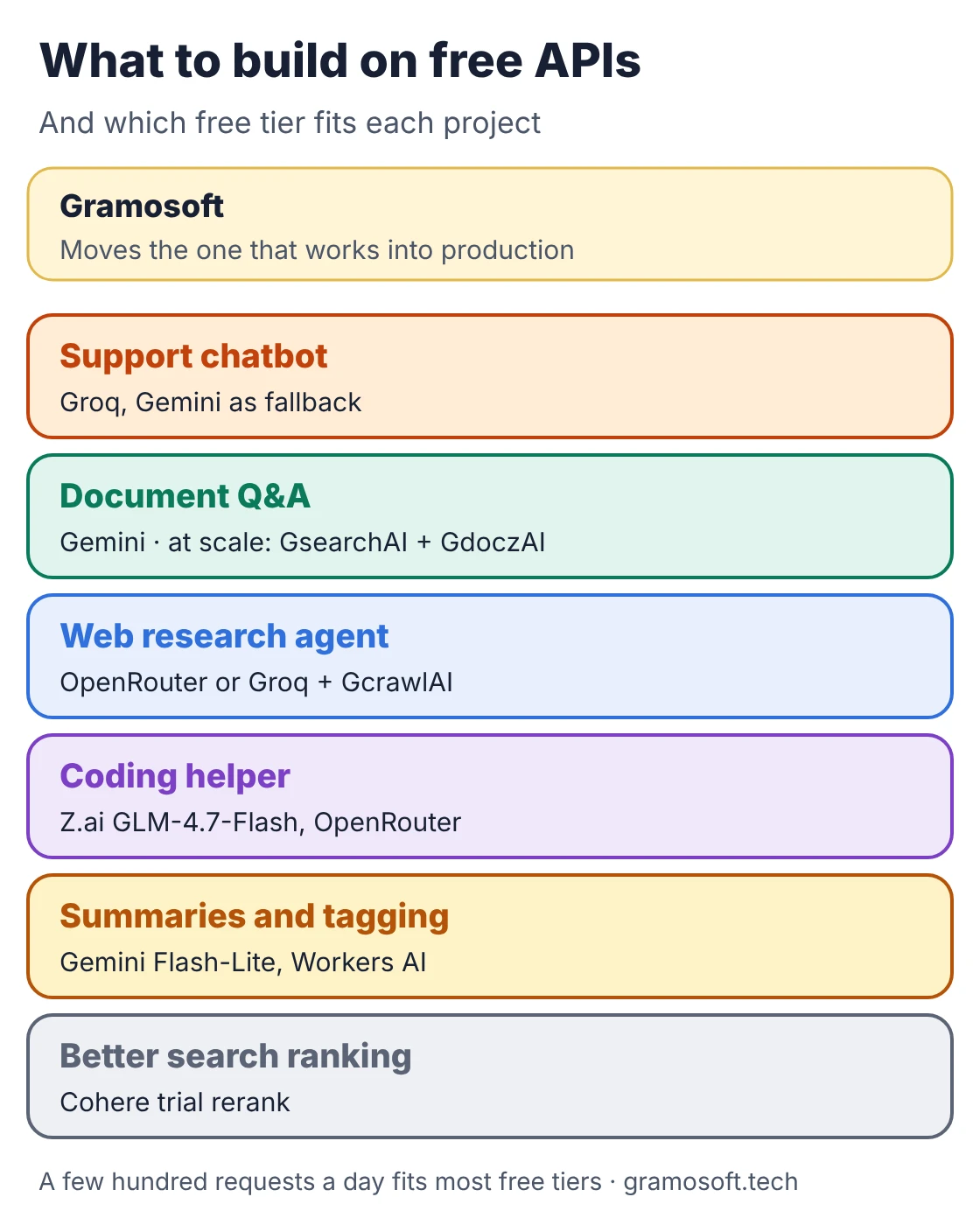
- A support or FAQ chatbot: Groq for fast replies, with Gemini as the fallback.
- Document question answering: Gemini's long context for a prototype; for company files at scale, GsearchAI answers from PDFs, Excel files and databases, and GdoczAI reads scanned documents first.
- A web research agent: an LLM from OpenRouter or Groq plus GcrawlAI for search results and page content as clean Markdown. Its free plan gives 50 requests a month with no card.
- A coding helper: GLM-4.7-Flash on Z.ai or a free coding model on OpenRouter.
- Summaries and tagging: Gemini 3.1 Flash-Lite or Workers AI for short, repeated jobs.
- Search with better ranking: Cohere's trial rerank endpoint on top of your own search results.
How to switch providers when a free limit runs out
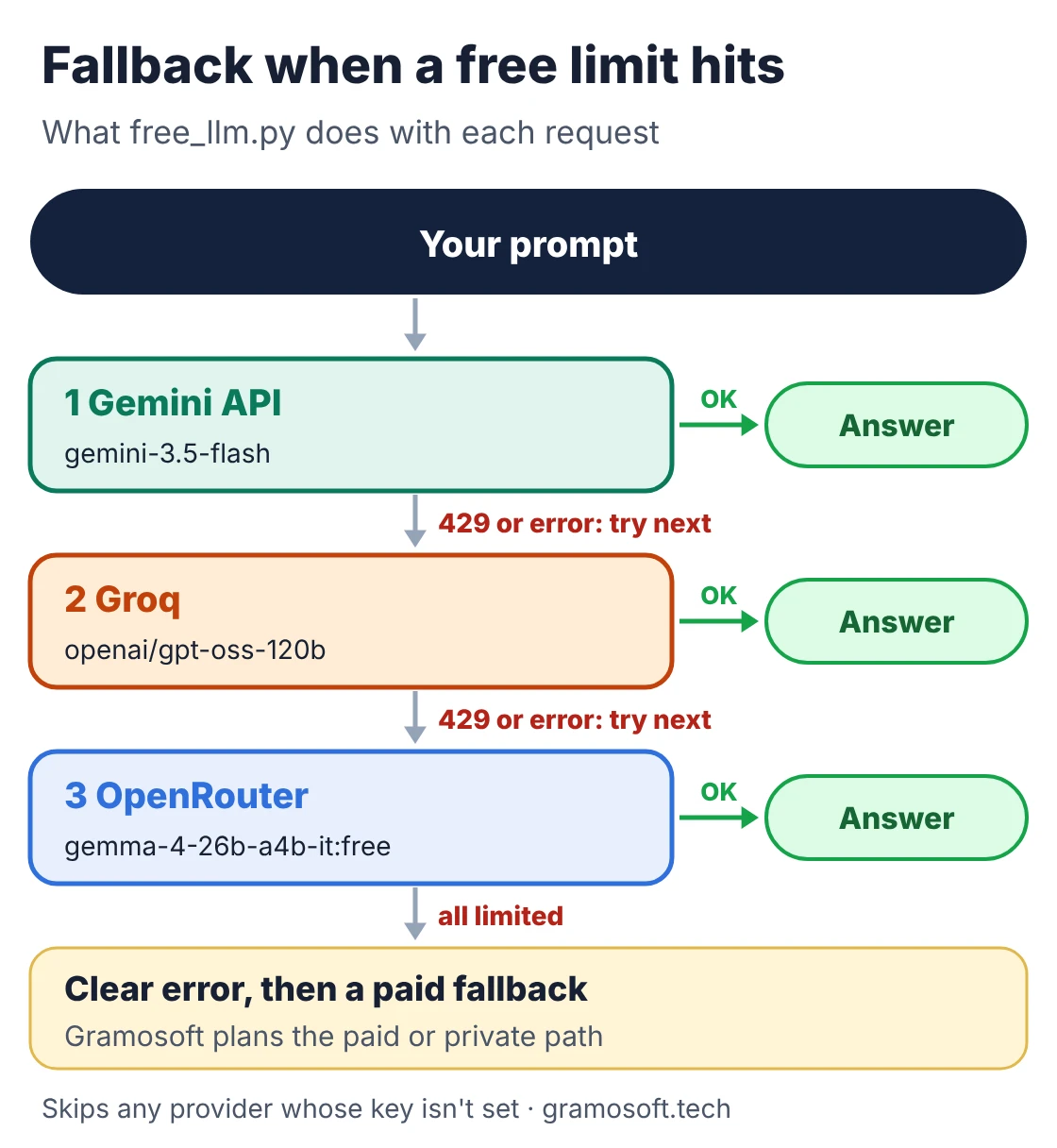
Every free tier returns HTTP 429 when you go over its limit, usually at the worst moment in a demo. Because Gemini, Groq and OpenRouter all offer OpenAI-compatible endpoints, one client can try them in turn. The script below does exactly that, with base URLs and model names taken from each provider's docs on November 7, 2026.
free_llm.py
# free_llm.py: one client, three free LLM APIs, automatic fallback on rate limits
# pip install openai   |   set GEMINI_API_KEY, GROQ_API_KEY and/or OPENROUTER_API_KEY
import os
from openai import OpenAI, APIStatusError, APIConnectionError, RateLimitError

PROVIDERS = [  # (name, OpenAI-compatible base URL, env var with the key, model)
    ("gemini", "https://generativelanguage.googleapis.com/v1beta/openai/", "GEMINI_API_KEY", "gemini-3.5-flash"),
    ("groq", "https://api.groq.com/openai/v1", "GROQ_API_KEY", "openai/gpt-oss-120b"),
    ("openrouter", "https://openrouter.ai/api/v1", "OPENROUTER_API_KEY", "google/gemma-4-26b-a4b-it:free"),
]

def ask(prompt: str, max_tokens: int = 400) -> str:
    for name, base_url, key_env, model in PROVIDERS:
        key = os.getenv(key_env)
        if not key:
            continue  # no key for this provider, try the next one
        try:
            client = OpenAI(api_key=key, base_url=base_url, timeout=30, max_retries=1)
            reply = client.chat.completions.create(
                model=model, max_tokens=max_tokens,
                messages=[{"role": "user", "content": prompt}],
            )
            return f"[{name}] {reply.choices[0].message.content}"
        except RateLimitError:
            print(f"{name}: free limit reached (429), trying the next provider")
        except (APIStatusError, APIConnectionError) as err:
            print(f"{name}: failed ({getattr(err, 'status_code', 'no connection')}), trying the next provider")
    raise RuntimeError("All free providers are rate-limited or unavailable. Try later or add a paid fallback.")

if __name__ == "__main__":
    print(ask("Summarise in two lines why free LLM API tiers suit prototypes, not production."))
Set one or more of the three keys as environment variables and run it. When a provider returns 429 or an error, the script prints a note and moves to the next one; if all fail, it raises an error so your app can show a clear message. We tested the fallback order offline with a stub client; it is a logic check, not a speed test.
The hidden costs of free LLM APIs
Free API access costs nothing in money, but it can cost you in data, reliability and rework. Before you put a free key into anything real, weigh the trade-offs below. None of them are reasons to avoid free tiers; they are reasons to keep them for prototypes, internal tools and demos rather than customer-facing products.
- Your data: Google's free tier may use your content to improve its products. Read every provider's data terms.
- No uptime promise: free tiers have no SLA, and limits can change without notice.
- Models disappear: free models on OpenRouter and elsewhere are added and removed often.
- Usage terms: NVIDIA NIM's free access is for prototyping only, and Cohere's trial keys are for testing.
- Leaked keys: a key in front-end code or a public repo gets abused fast. Keep keys on the server.
"The first production bug in most AI prototypes isn't a bad answer. It's a 429 at nine in the morning. Build the fallback and the paid path before you show the demo to a customer."
Rajesh Kannan, Co-Founder & CTO at Gramosoft
When free runs out: paid tiers or your own servers
Once real users arrive, you have two clean options. Move to the same provider's paid tier, which keeps your code unchanged and adds higher limits and better data terms. Or run an open model on your own servers with Ollama or vLLM, which costs hardware but keeps every prompt inside your network.
- Stay hosted for low or spiky traffic, or when you need the strongest closed models.
- Self-host for steady heavy use, or when data must not leave your network. The same open models, such as gpt-oss and Gemma 4, run locally.
- Keep the OpenAI-compatible interface either way, so switching later means changing a base URL, not rewriting the app.
Gramosoft helps teams make that call with real usage numbers and builds whichever path fits.
Frequently asked questions
How does Gramosoft help teams build on free LLM APIs?
Is there a completely free LLM API?
Yes. Google Gemini API, Groq, OpenRouter's :free models, Cloudflare Workers AI, NVIDIA NIM, Z.ai's GLM Flash models and Cohere trial keys all work without payment, within the limits each provider publishes.
What is the best free LLM API in 2026?
For most developers, the Google Gemini API, because it offers Gemini 3.5 Flash, 2.5 Pro and Gemma 4 free. Choose Groq for speed and OpenRouter to try many models with one key.
Do free LLM APIs use my data for training?
Some do. Google's pricing page says content sent on the Gemini free tier is used to improve its products. Read each provider's terms, and never send customer or confidential data through a free key.
Can I use a free LLM API in production?
It is risky. Free tiers have low limits and no uptime promise, NVIDIA NIM's free access is for prototyping only, and Cohere's trial keys are for testing. Use a paid tier or your own servers for production.
Is the Mistral API still free?
Not as of November 7, 2026. Mistral's docs say the free plan doesn't include API access and that API keys need billing to be activated. GitHub Models was also retired on July 30, 2026.
What happens when I hit a free API rate limit?
The API returns HTTP 429 and refuses requests until the limit resets, per minute or per day. Add retries with a pause, and a fallback to a second provider, as the script in this guide does.