Updated 28 November 2026 for 2027 · each firm checked on its own site, Clutch, GoodFirms or funding coverage on 28 November 2026
An insurance app has to quote, run KYC, take premiums, file claims and talk to the insurer's core system, under IRDAI and DPDP rules. This list compares ten Indian firms that build those apps or the platforms behind them. Gramosoft, an insurance mobile app development company in Chennai, wrote it and comes first; every other entry was checked at source.
TL;DR
- Gramosoft (Chennai) builds custom insurance apps with the quote, KYC, claims and admin systems behind them, with work for GMAT, an insurance aggregator in Malaysia, P2P and GramoAssure for Sundharams Assure.
- Large app studios: Appinventiv and TechAhead in Noida and Hyperlink InfoSystem in Ahmedabad each publish insurance app work.
- Insurance-focused builders: Helpful Insight and A3logics (Jaipur) run insurance software practices; Quytech (Gurugram) adds AI.
- Ready-made platforms: Riskcovry (Mumbai) and Zopper (Noida) sell insurance distribution APIs instead of custom builds.
- Before you sign: ask for a live claim journey, which core systems they have connected to, and how they handle KYC, the 30-day free look and 6-hour cyber reporting.
Which are the top insurance app development companies in India? Gramosoft (Chennai) for custom insurance apps with their backends; Appinventiv, TechAhead and Hyperlink InfoSystem for large app builds; Helpful Insight, A3logics and Quytech for insurance software and AI; RaftLabs for claims-first apps; and Riskcovry or Zopper for ready-made distribution APIs.
The 10 best insurance app development companies in India (2027)
Eight firms below build custom insurance apps and two sell ready-made platforms. Each was checked on its own website, its Clutch or GoodFirms profile, or funding coverage on 28 November 2026. We kept out ratings and headcounts we could not confirm. Gramosoft is first because this is our blog; our limits are listed too.
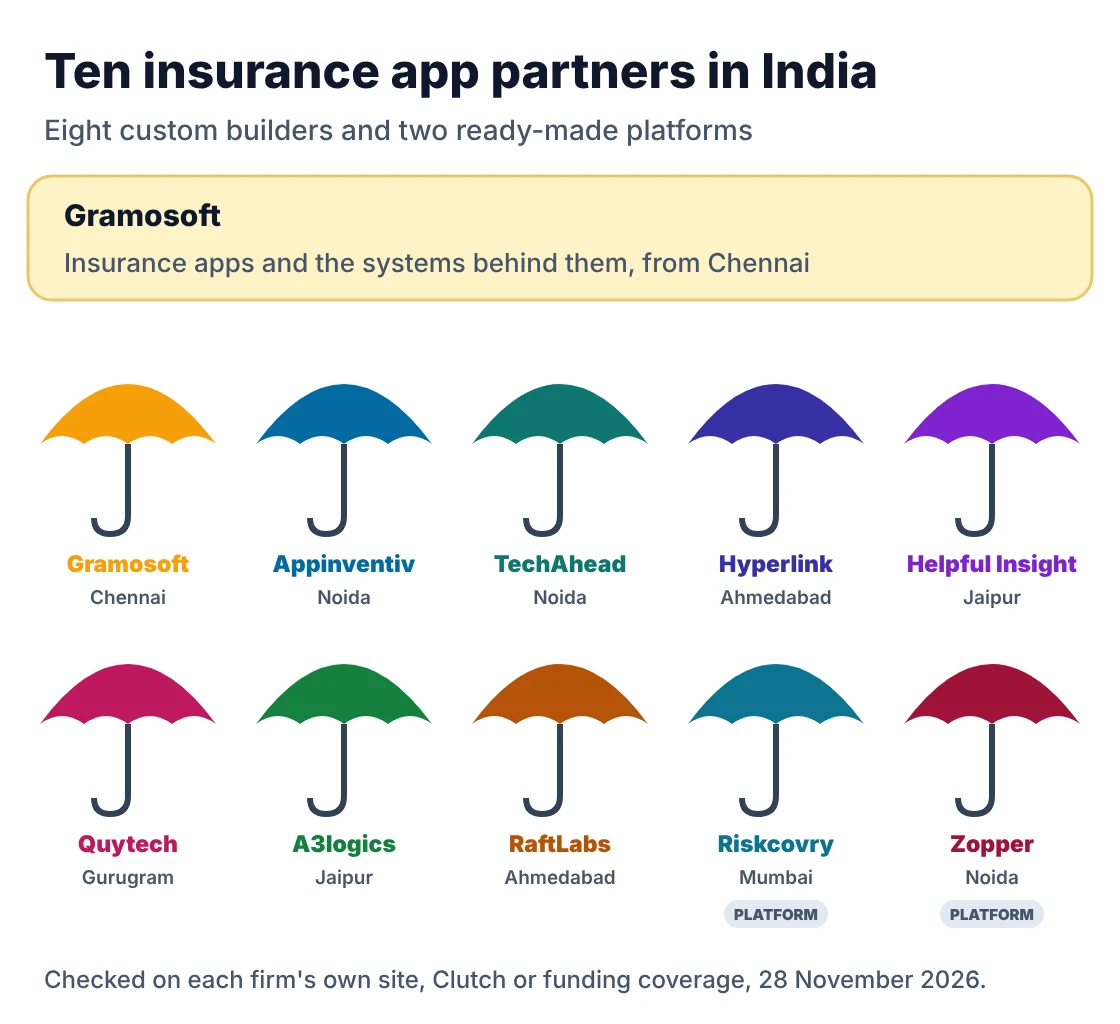
| Company | Base | Type | Best for | Published proof |
|---|---|---|---|---|
| Gramosoft | Chennai | Custom builder | Insurance apps plus quote, KYC, claims and admin systems | GMAT, P2P, GramoAssure |
| Appinventiv | Noida | Large app studio | Enterprise insurance apps | Insurance software page; Clutch |
| TechAhead | Noida and California | Large app studio | Policyholder apps for insurers | Clutch insurance reviews |
| Hyperlink InfoSystem | Ahmedabad | Large app studio | Broker and agency apps | Clutch insurance broker reviews |
| Helpful Insight | Jaipur | Insurance software builder | Claims, underwriting, policy admin | Insurance practice since 2016 |
| Quytech | Gurugram | App and AI studio | AI features in insurance apps | Clutch review from an insurer |
| A3logics | Jaipur | Insurance software builder | Health insurance and employee benefits | Claims software page |
| RaftLabs | Ahmedabad and Dublin | Product studio | Claims-first customer apps | Published $29–49/hr |
| Riskcovry | Mumbai | Platform | Banks and NBFCs embedding insurance | Insurance-in-a-box since 2018 |
| Zopper | Noida | Platform | Retail and OEM embedded insurance | Raised $25M in 2025 |
1. Gramosoft: insurance apps and the systems behind them
Best for: insurers, brokers, agencies and TPAs that need the app and the quote, KYC, claims and admin systems built by one team. Based in: Chennai.
Gramosoft builds insurance software and mobile apps for policyholders, agents and surveyors. Our insurance work includes GMAT, an insurance aggregator in Malaysia, P2P, and GramoAssure for Sundharams Assure. In most projects the app is the easy part; the quote engine, KYC, payments and claims workflow behind it decide whether it works.
- Apps for every user: policyholder, agent or POSP and surveyor apps in Flutter, React Native, Swift or Kotlin.
- Quote, buy, renew: premium calculators, comparison across insurers, CKYC and Aadhaar KYC, UPI and AutoPay.
- Claims with document AI: photo and document upload read by our GdoczAI before an assessor decides, with an audit log.
- Admin and commissions: staff dashboards, policy records, renewals and commission rules as web applications.
- Rules built in: every IRDAI, RBI and DPDP duty mapped to a screen, a log or a test before design starts.
Where we fall short. We don't sell a licensed core policy administration system or a white-label app, so you need a core system or we connect to yours. We were incorporated in 2022, so our insurance portfolio is younger than the large studios', and we don't publish a price list.
"Policyholders open an insurance app a few times a year, and one of those times is a claim. We build the claim journey first and test it against the insurer's real system."
Rajesh Kannan M, Co-Founder & CTO, Gramosoft
2. Appinventiv: enterprise insurance apps from Noida
Best for: insurers that want a large team for apps, policy management and claims software.
Appinventiv was founded in 2014 and is based in Noida, per its Clutch profile. Its insurance software page lists insurance app development, policy management, document management and fraud prevention. Watch for: Clutch lists a $50,000 minimum project, so small pilots may not fit.
3. TechAhead: policyholder apps with insurance reviews
Best for: insurers and insurtechs wanting a polished customer app.
TechAhead was founded in 2009, with its head office in Agoura Hills, California, and development in Noida. It has a dedicated insurance app page, and Clutch lists a mobile app project for an insurance company in the $200,000–999,999 band. Watch for: US-facing pricing and a $25,000 minimum on Clutch.
4. Hyperlink InfoSystem: apps for brokers and agencies
Best for: insurance brokers and agencies that need a customer app and admin panel.
Hyperlink InfoSystem was founded in Ahmedabad in 2011. Clutch shows several insurance projects, including app and web development for an insurance broker. Watch for: it is a broad studio across many industries, so confirm the team has built claims or policy integration, not only front ends.
5. Helpful Insight: insurance software from Jaipur
Best for: carriers and brokers wanting claims, underwriting or policy admin software built to order.
Helpful Insight has worked since 2016, per GoodFirms, and runs an insurance practice covering claims, underwriting, policy administration, quoting, portals and mobile apps. Watch for: the Medium list that ranks it first is an editorial piece, not a ranking; ask for insurance references you can call.
6. Quytech: AI features in insurance apps
Best for: insurance apps that need AI, such as chat support or risk scoring.
Quytech, based in Gurugram, builds mobile apps with AI and blockchain. Its Clutch reviews include one from a VP at 235 Insurance. Watch for: AI features need clean policy and claims data; confirm who builds the integration to the core.
7. A3logics: health insurance and employee benefits
Best for: health insurers, TPAs and benefits administrators.
A3logics lists insurtech and employee benefits as a core industry, and its health insurance software page covers claims, auto adjudication, EDI and billing. Watch for: its insurance work leans towards US health and benefits, so check its experience with Indian rules such as IRDAI KYC.
8. RaftLabs: claims-first customer apps
Best for: insurers that want one team to own a customer-facing policy and claims app.
RaftLabs has offices in Dublin and Ahmedabad. Its own insurance list says it works at $29–49 an hour with fixed-price options, and says plainly that policy-administration cores are specialist work. Watch for: that list puts RaftLabs second; check its insurance references yourself.
9. Riskcovry: insurance-in-a-box for banks and NBFCs
Best for: banks, NBFCs and fintechs that want to sell many insurers' products without building a backend.
Riskcovry was founded in 2018 in Mumbai, per CB Insights, and sells an "insurance-in-a-box" platform for banks, NBFCs, housing finance firms, brokers and insurers. It raised about $4.5 million in a bridge round led by Morphosis Venture Capital. Watch for: you work within its product catalogue and roadmap; custom journeys still need a build team.
10. Zopper: embedded insurance APIs
Best for: retailers, OEMs, e-commerce and lenders adding insurance at checkout.
Zopper, founded in 2011 in Noida, sells embedded insurance APIs and raised $25 million to strengthen its distribution platform. In 2022 it reported over 150 partners and 45 insurers using its API. Watch for: it is built for distribution at scale, not a bespoke policyholder app.
Build a custom app or plug into a platform?
An insurer selling its own products usually needs a custom app tied to its core system. A bank, NBFC or retailer selling other insurers' products can often start faster on a distribution platform. Many do both: a platform for issuance across insurers, and a custom app on top for their own customers.
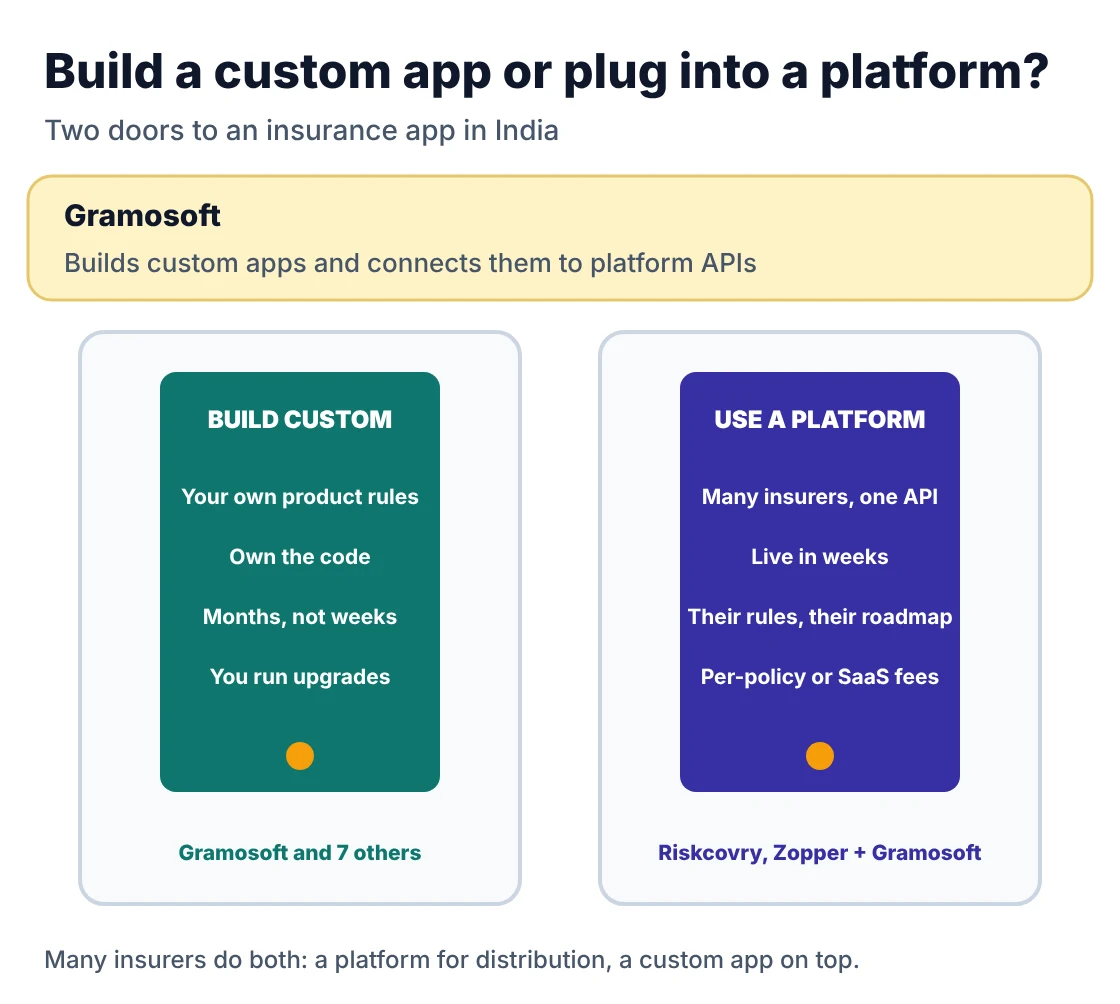
| If you are… | Start with | Shortlist |
|---|---|---|
| An insurer, broker or TPA with your own workflows | A custom app tied to your core system | Gramosoft, Appinventiv, TechAhead, Helpful Insight |
| A bank or NBFC selling many insurers' products | A distribution platform, then a custom app | Riskcovry, Zopper, with Gramosoft for the app |
| A retailer or OEM adding cover at checkout | Embedded insurance APIs | Zopper, Riskcovry, with Gramosoft for integration |
| A health insurer or TPA with heavy claims | Claims and document automation first | Gramosoft (GdoczAI), A3logics, Helpful Insight |
| An insurtech wanting AI features | A focused release 1 with one AI use | Gramosoft, Quytech, RaftLabs |
Deployit's list makes the same split between app agencies and distribution platforms, though it ranks its own platform first. For the buy-or-build decision in detail, see Insurance Software Development in India: Features, Compliance & Build vs Buy.
Which layer each firm works on
An insurance app is four layers deep: the app, the backend that quotes and checks KYC, the distribution APIs that reach insurers, and the insurer's core system. Most firms are strong on one or two layers. Ask each one which layers it builds and which it only connects to.
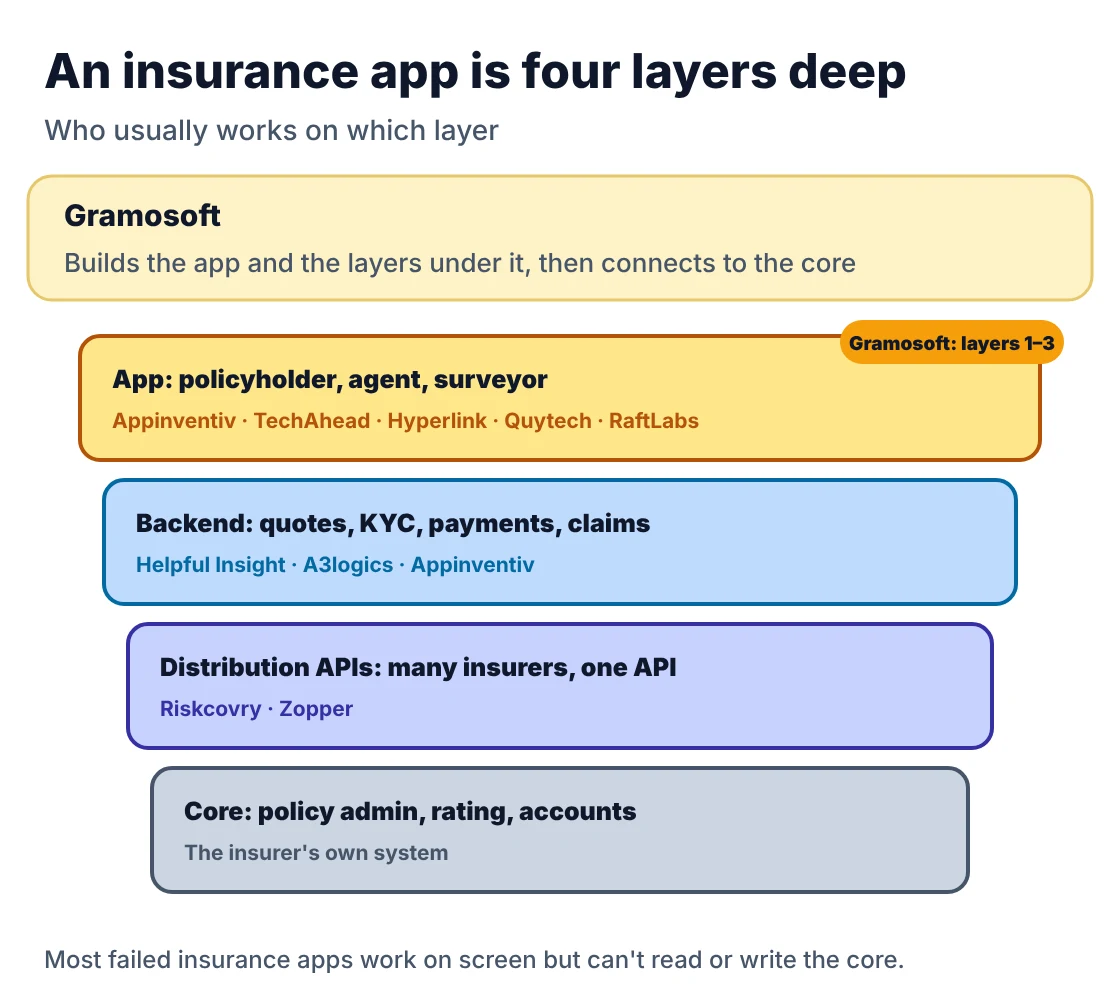
The RaftLabs guide puts it bluntly: an app that cannot read policies and file claims against the core is a brochure. When a vendor says it "integrates with core systems", ask for the names of the systems and a project you can call.
The claim journey to test before you sign
Customers judge an insurer by the claim, not the dashboard. A good insurance app takes photos and documents, checks them against policy rules, routes them to an assessor, keeps an audit log and pays out with a clear status at each step. Ask every shortlisted firm to show one live claim moving through all six steps.
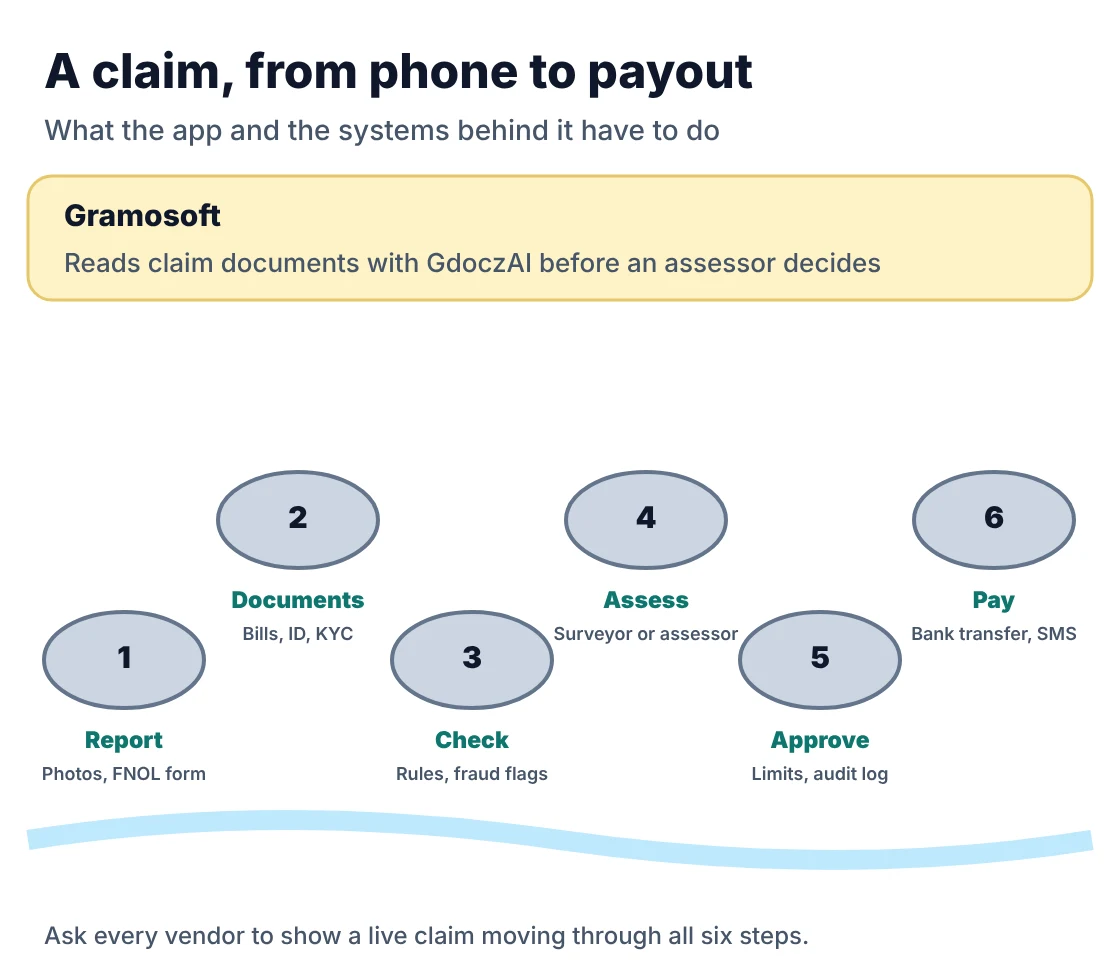
Gramosoft reads claim documents with GdoczAI before an assessor decides; the full flow, with a tested claim router, is in AI for Insurance Claims Processing in India: From Claim Form to Settlement.
Indian rules an insurance app has to handle
Global vendor guides talk about HIPAA and GDPR, which rarely decide an Indian build. What decides it here is IRDAI's KYC and free-look rules, IRDAI's cyber security guidelines and the DPDP Act. Each one becomes a screen, a log entry or a test, so ask vendors how they handle them before design starts.
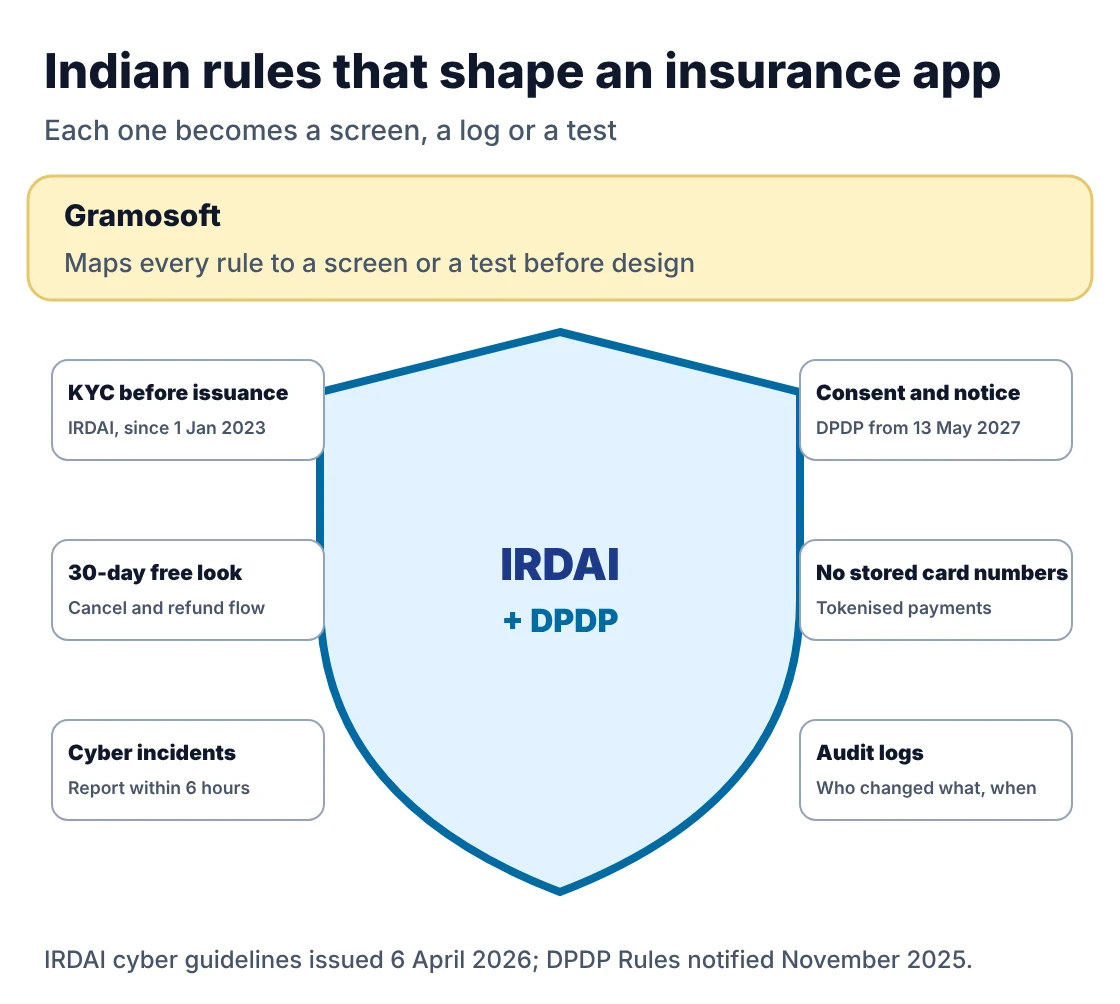
| Rule | What the app must do | Source |
|---|---|---|
| Gramosoft maps each rule below | A screen, a log or a test for every duty | Our insurance builds |
| KYC for every new policy | Complete KYC before issuance; offer CKYC, Aadhaar or video KYC | IRDAI, from 1 January 2023 (Business Today) |
| 30-day free look | Show the end date and a cancel request | IRDAI PPI Regulations 2024 (Legal500) |
| Cyber security | Logs, monitoring, incident reporting within 6 hours | IRDAI guidelines issued 6 April 2026 (MediaNama) |
| Personal data | Consent, notice, erasure and breach duties | DPDP Rules 2025; core duties from 13 May 2027 (Bar & Bench) |
For the full list of rules and how each changes the screens, see Insurance Mobile App Development: Features, Compliance and Cost.
How long an insurance app takes and what it costs
Published figures vary widely because the attached guides price different jobs. A basic policyholder app takes three to four months; a platform with agent, admin and claims panels takes six to nine. Budgets quoted in dollars by global vendors run far higher than most Indian builds, so ask every firm for an itemised Indian quote.
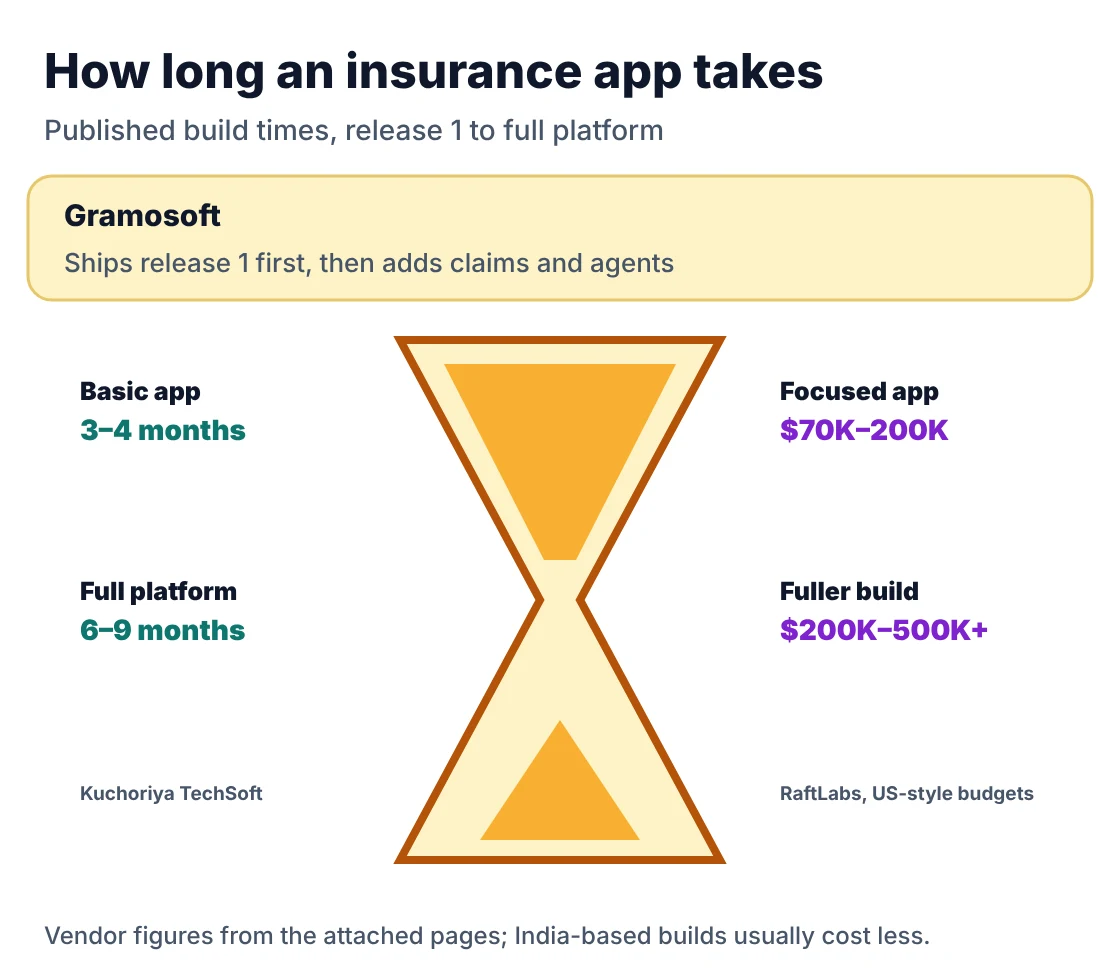
| Scope | Published figure | Source |
|---|---|---|
| Gramosoft release 1, then claims and agents | Fixed price per milestone after a free discovery call | Our own terms |
| Basic insurance app | 3–4 months | Kuchoriya TechSoft |
| Full platform with several panels | 6–9 months | Kuchoriya TechSoft |
| Focused customer app | $70,000–200,000 | RaftLabs |
| Fuller build with quoting and core integration | $200,000–500,000+ | RaftLabs |
Add security testing, store fees and yearly maintenance to any build quote. Our Insurance Mobile App Development: Features, Compliance and Cost guide breaks down Indian cost drivers by feature.
Questions to ask an insurance app developer
Every firm on every list says it builds secure insurance apps. These questions separate the ones that have shipped a live claim journey from the ones that have only shipped screens. Ask them in writing and compare the answers side by side before you look at prices.
- Live work: which insurance app of yours is in the stores today, and can we call that client?
- Core systems: which policy admin or core systems have you connected an app to?
- Claims: can you show one claim moving from upload to payout, with the audit log?
- KYC and payments: which KYC routes and payment methods do you support, and how do you avoid storing card numbers?
- Rules: how do you handle the 30-day free look, 6-hour cyber reporting and DPDP consent?
- After launch: who fixes the app when Android, iOS or a regulation changes, and at what cost?
- Ownership: are the code, store accounts and cloud accounts in our name?
The attached lists from Gilzor, Deployit and RaftLabs each rank their own firm first, as we do. For general app vendor questions, see How to Choose a Mobile App Development Company in Chennai: 12 Questions to Ask Before You Sign.
Frequently asked questions
Which company builds insurance apps with the claims and admin systems behind them in India?
Gramosoft in Chennai builds insurance apps for policyholders, agents and surveyors together with the quote, KYC, claims and admin systems behind them. Its insurance work includes GMAT, an insurance aggregator in Malaysia, P2P and GramoAssure for Sundharams Assure.
Which are the top insurance app development companies in India?
Gramosoft, Appinventiv, TechAhead, Hyperlink InfoSystem, Helpful Insight, Quytech, A3logics and RaftLabs build custom insurance apps. Riskcovry and Zopper sell ready-made insurance distribution platforms.
Should I build a custom insurance app or use a platform?
Insurers and brokers with their own workflows usually need a custom app tied to their core system. Banks, NBFCs and retailers selling other insurers' products can start faster on a platform such as Riskcovry or Zopper, then add a custom app.
How long does it take to build an insurance app?
Published figures put a basic insurance app at three to four months and a full platform with agent, admin and claims panels at six to nine months, depending on integrations and testing.
What Indian rules must an insurance app follow?
KYC before issuance (IRDAI, since 1 January 2023), a 30-day free look, IRDAI's 2026 cyber security guidelines with 6-hour incident reporting, and the DPDP Rules, whose core duties apply from 13 May 2027.
What features does an insurance app need first?
Release 1 usually covers sign-up with KYC, quotes and purchase, payments, e-policy download, renewals and claim filing with document upload. Agent tools, AI chat and analytics usually follow later.
How do I check an insurance app developer's claims?
Ask for a live insurance app you can download, a client you can call, the names of core systems they have connected to, and a demonstration of one claim moving from upload to payout.
Related guides
- Insurance Mobile App Development: Features, Compliance and Cost
- Insurance Software Development in India: Features, Compliance & Build vs Buy
- AI for Insurance Claims Processing in India: From Claim Form to Settlement
- Top 10 Mobile App Development Companies in Chennai (2026)
- How to Choose a Mobile App Development Company in Chennai: 12 Questions to Ask Before You Sign
Rajesh Kannan M
Rajesh Kannan M is Co-Founder & CTO of Gramosoft in Chennai, where he leads the teams building custom AI, document AI, enterprise search and automation, including GsearchAI, GdoczAI and GcrawlAI, an open-source web scraping, crawling and Search API platform for developers and AI agents, alongside web and mobile applications.