An insurance app is judged on three moments: buying a policy in a few minutes, paying the renewal without friction and filing a claim from a phone. Everything else supports those moments. This guide starts with how Gramosoft builds insurance apps, then covers features, the Indian rules that shape them and what vendors quote.
TL;DR
- Gramosoft builds insurance mobile apps in Chennai for insurers, brokers, agents and TPAs: policyholder, agent and surveyor apps on one backend connected to your core policy, claims, payment and KYC systems.
- Four kinds of app: policyholder self-service, agent or POSP sales, claims and surveyor, and embedded cover inside a partner's app. Most insurers start with one.
- Indian rules change the screens: KYC before issuance, a 30-day free look, a plain-language CIS for health, no stored card numbers, RBI e-mandate rules for AutoPay, and DPDP plus IRDAI cyber duties.
- Cost: seven vendor guides publish bands from about $25,000 for an MVP to $500,000 or more for enterprise builds (roughly ₹23 lakh to ₹4.7 crore). Core-system integration is the biggest swing.
- Time: a first release usually takes 4 to 6 months; plan security testing and store review inside that time.
What does insurance mobile app development involve? It means building apps for policyholders, agents or surveyors that quote, run KYC, take payment, issue e-policies, handle renewals and claims, and connect to the insurer's core systems. In India the app must also meet IRDAI, RBI and DPDP rules. Gramosoft builds these apps from Chennai.
How Gramosoft builds insurance mobile apps
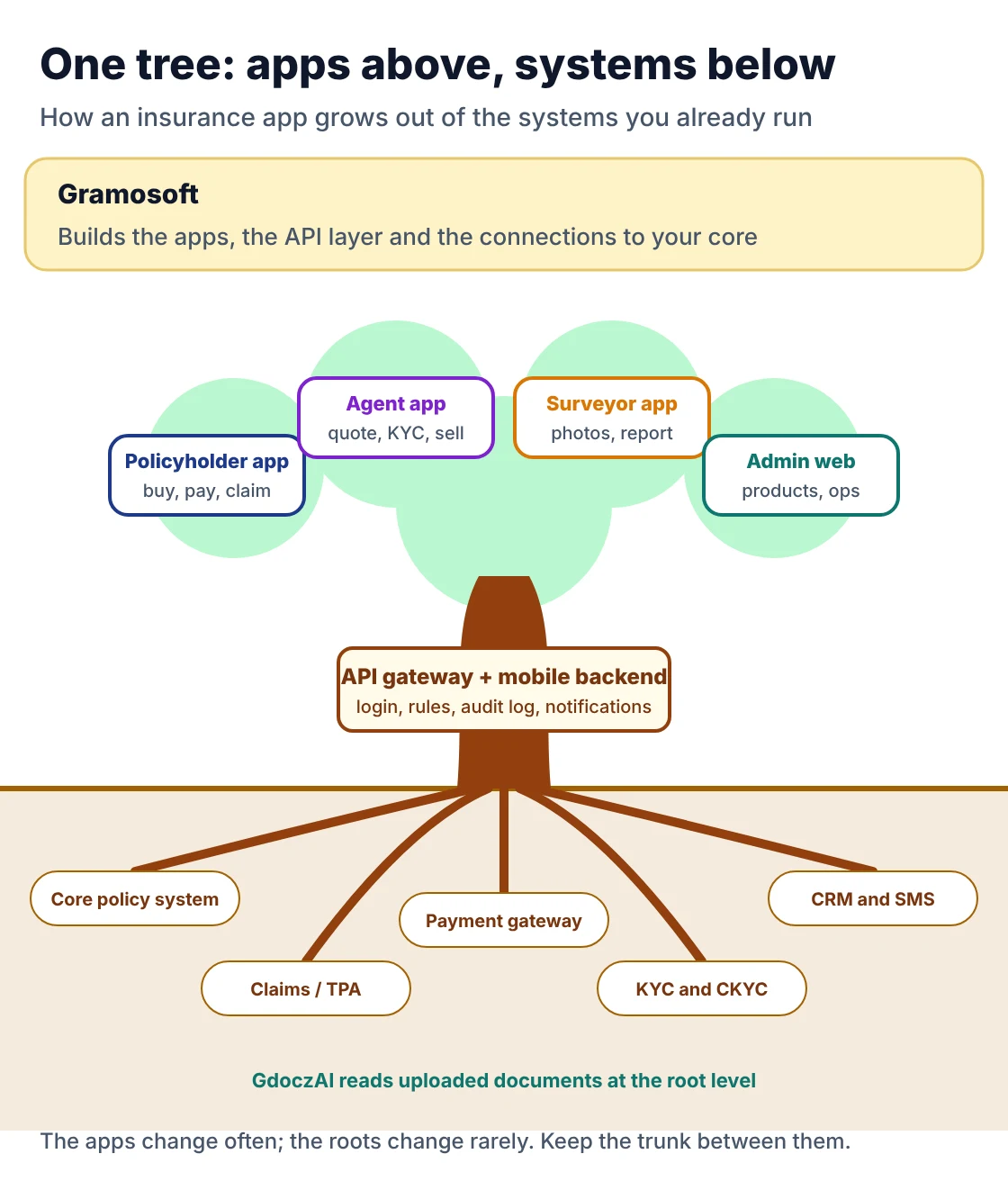
Gramosoft builds insurance apps around the systems an insurer or broker already runs. We design the policyholder, agent or surveyor app, build one mobile backend with an API gateway, and connect it to your core policy system, claims or TPA platform, payment gateway, KYC provider and CRM. The apps change often; the core stays stable.
- Map the rules first: every IRDAI, RBI and DPDP duty becomes a screen, a log entry or a test case before design starts.
- One backend for every app: login, business rules, notifications and the audit log live once, so the agent and policyholder apps never disagree.
- Read documents with AI: GdoczAI reads uploaded ID proofs, bills and claim forms, so customers photograph documents instead of typing them.
- Ship in Flutter or native: cross-platform for most insurers, native Kotlin and Swift when device features or performance demand it.
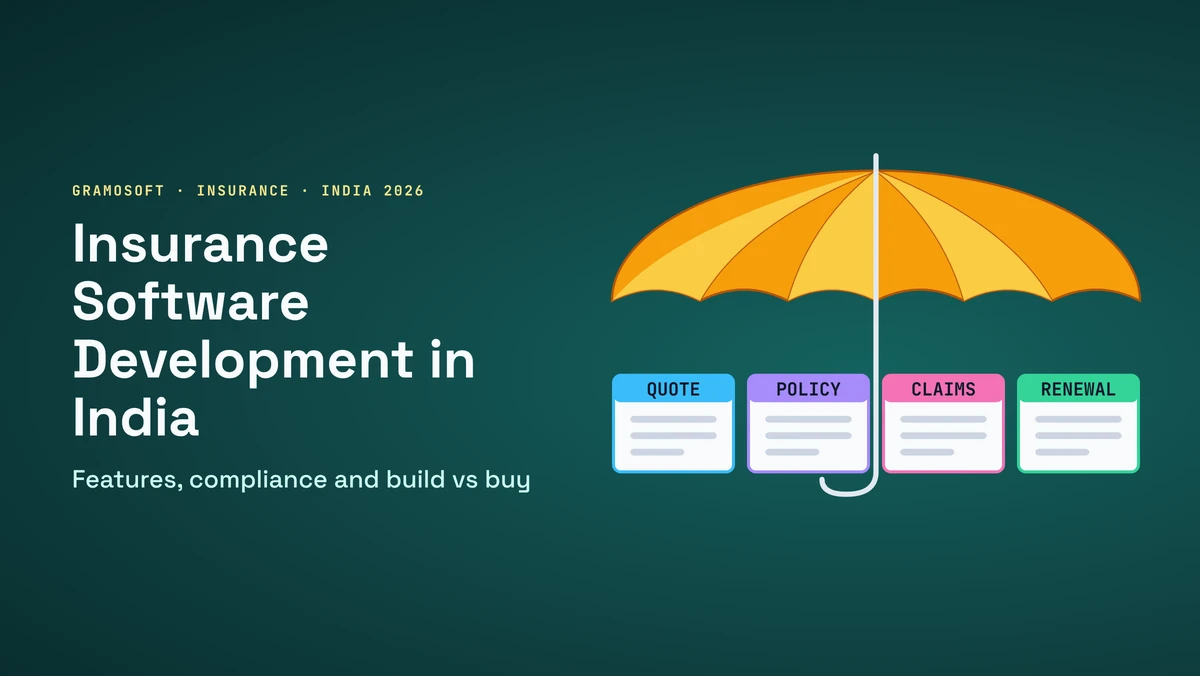
Our insurance software work includes GMAT, an insurance aggregator, and GramoAssure for Sundharams Assure, and our mobile app team builds Android and iOS apps with their backends and admin panels. For the systems behind the app, see Insurance Software Development in India: Features, Compliance & Build vs Buy.
Where we fall short. We do not sell a ready-made white-label insurance app or a licensed core policy system; we build on yours or connect one you choose. We do not build telematics hardware or AR features. And we have no public app-store case study with download or conversion numbers for an insurance app yet.
"An insurance app wins on three moments: buying in minutes, renewing without a phone call and filing a claim from the hospital or the roadside. Build those three well, connected to the core, before anything clever."
Rajesh Kannan M, Co-Founder & CTO, Gramosoft
Four kinds of insurance mobile app
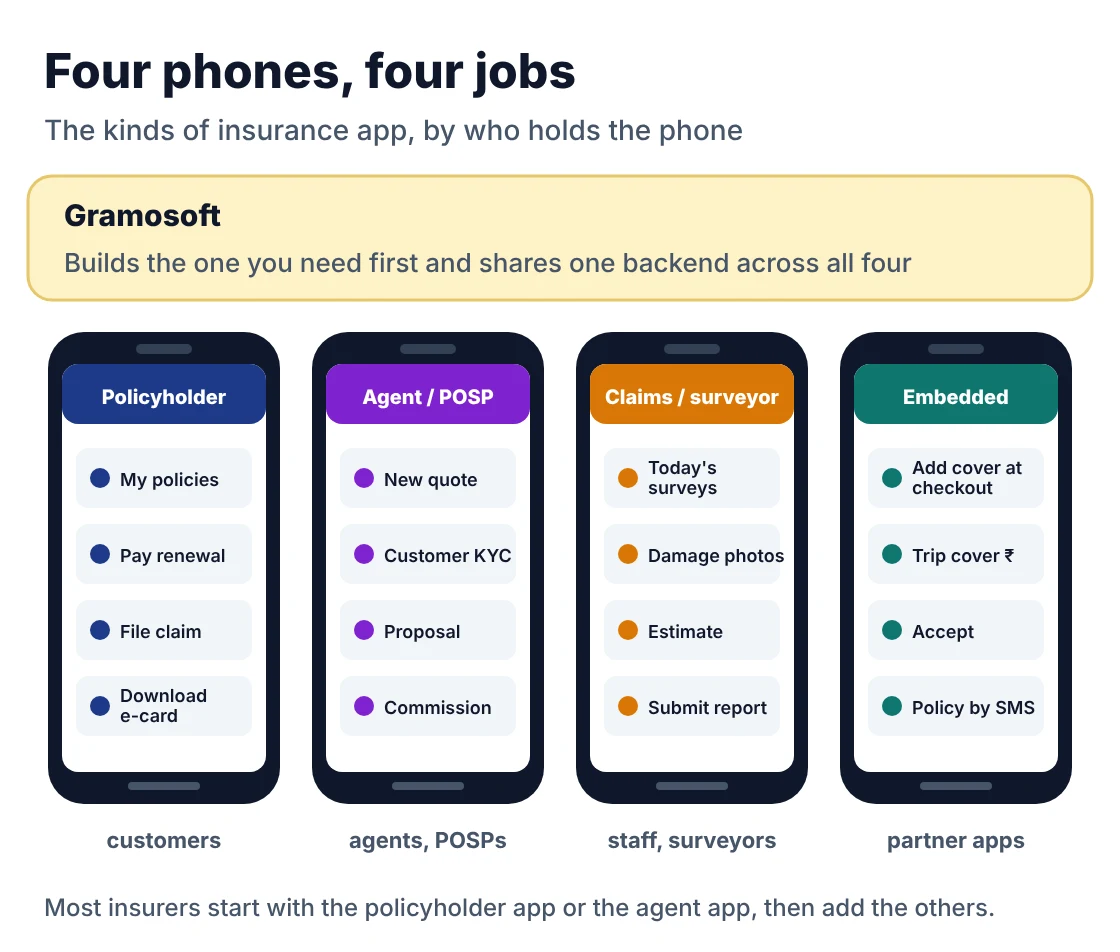
Insurance apps differ most by who holds the phone. A policyholder app sells and services policies, an agent app helps intermediaries quote and onboard customers, a claims app serves surveyors and assessors, and embedded cover sits inside someone else's app. Pick the one that removes the most paperwork first, then reuse its backend.
| App type | Who uses it | Core jobs | Starts well when |
|---|---|---|---|
| Gramosoft: any of the four on one backend | Your customers, agents and staff | Shared login, rules, payments and audit log | You want to add the second app without rebuilding |
| Policyholder self-service | Customers | Quote, buy, pay, download e-policy, renew, claim | Most sales or renewals are direct |
| Agent or POSP | Agents, POSPs, bank staff | Leads, quote, customer KYC, proposal, commission | Most business comes through intermediaries |
| Claims and surveyor | Surveyors, assessors, TPAs | Survey queue, geo-tagged photos, estimate, report | Claims are slow because of field visits and paper |
| Embedded cover | Partner platform's users | Add cover at checkout, instant issue, policy by SMS | You sell travel, device or trip cover through partners |
Line of business also matters: health apps need cashless hospital lists and claim tracking, motor apps need photo inspection and renewals, and life apps need nominee and premium reminders. Shiv Technolabs and Neuronimbus list similar app types in their guides.
Features by user: what to build first
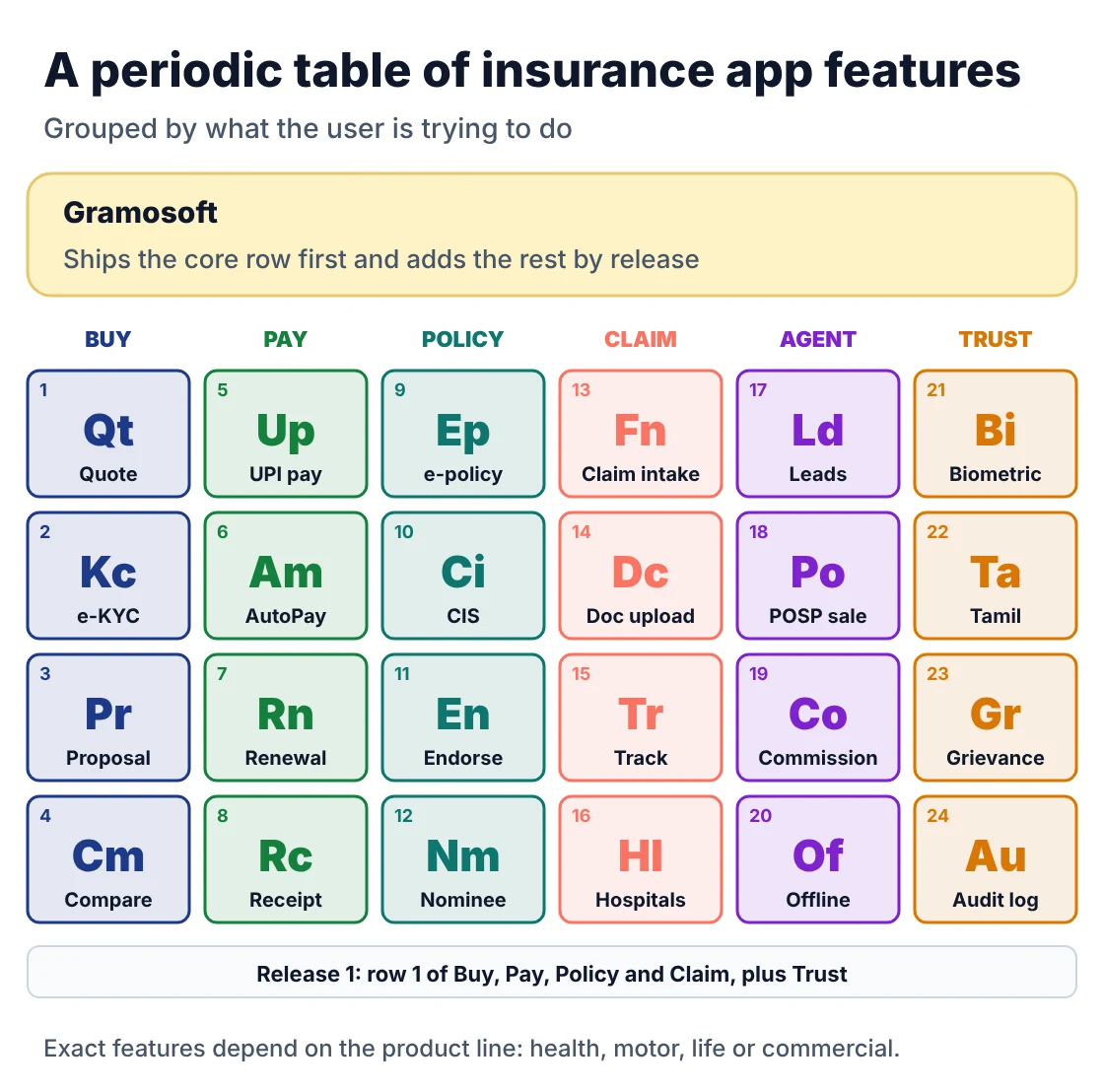
Most failed insurance apps tried to ship everything at once. Start with the features that complete a sale, a renewal or a claim without a phone call, then add service features by release. The table below splits must-haves for release one from features worth adding once people are actually using the app.
| User | Release 1 must-haves | Add later |
|---|---|---|
| Gramosoft: shared core for all users | Login with OTP and biometrics, notifications, audit log, admin web | Analytics, A/B tests, AI document reading |
| Policyholder | Quote and buy, e-KYC, UPI and card payment, e-policy and CIS, renewal reminders, claim intake with document upload and status | AutoPay, endorsements, nominee changes, hospital or garage locator, chat in Tamil and Hindi |
| Agent or POSP | Lead list, quote, customer KYC, proposal with e-sign, offline drafts | Commission statements, renewals due, training content |
| Surveyor or assessor | Survey queue, geo-tagged photos, estimate entry, report upload | AI damage hints, video survey |
| Operations (admin web) | Products and rates, users and roles, content, reports | Campaigns, partner management |
Competitor guides agree on the core list. Helpful Insight adds Indian payment options such as UPI, net banking, EMI and auto-debit, and Experion stresses biometric and OTP login. Reading uploaded documents well matters more than most features; we compared OCR engines in Best Open-Source OCR Models in 2026: Accuracy, Speed & Cost Compared.
India-specific features most guides skip
Global guides talk about GDPR and HIPAA, which rarely decide an Indian build. What decides it here is KYC through Aadhaar or CKYC, UPI and AutoPay under RBI rules, budget Android phones, Tamil and Hindi screens, and the new Bima Sugam marketplace. Each of these changes a screen, an integration or a test.
- KYC options: Aadhaar OTP e-KYC, offline Aadhaar, digital KYC, video KYC and CKYC lookup are all accepted, as Tata AIG summarises. Offer at least two, because one will fail for some customers.
- UPI first, cards tokenised: most Indian customers pay by UPI. Card details must never be stored by the app or your servers; since 1 October 2022 only card issuers and networks may store them, per the RBI.
- AutoPay renewals: under RBI's Digital Payments – E-mandate Framework, 2026, an e-mandate is registered with an extra authentication step, and insurance premium debits up to ₹1 lakh can then run without one, with a notice before each debit, as Business Today explains.
- Budget Android first: test on low-memory Android phones and slow networks, keep the app small and let forms save offline. See Android App Development Company in Chennai: Cost, Timeline & Team.
- Tamil, Hindi and English: insurers must give the health CIS in a local language on request, so build the app with translatable text from day one. Voice help in Tamil is possible too; see How to Build an AI Voice Agent That Speaks Tamil & English.
- Bima Sugam: IRDAI's insurance marketplace is rolling out in phases, starting with motor; on 23 November 2026 Elets BFSI reported, citing ET Now, that it was likely to go live that week. Keep your product, quote and policy APIs clean so connecting later is a project, not a rewrite.
Compliance: the rules that change your app
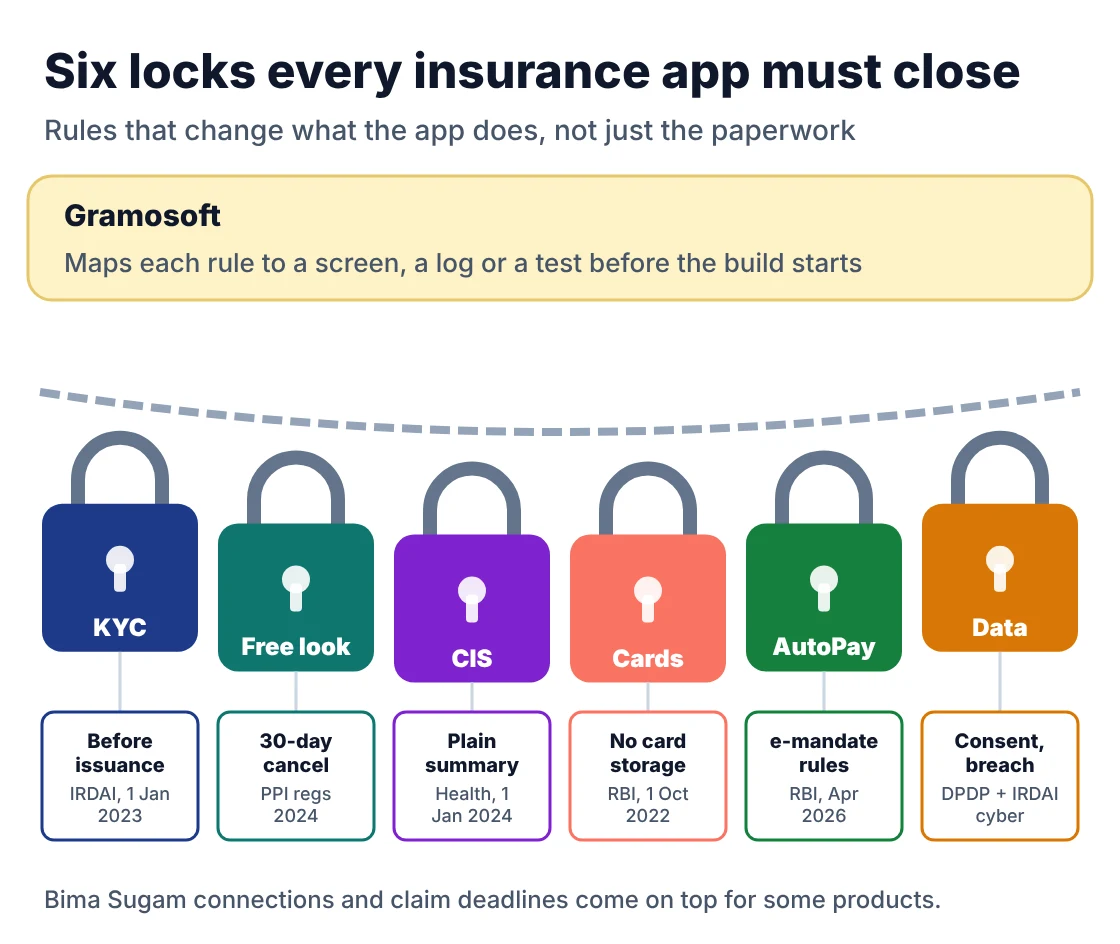
Compliance in an Indian insurance app is mostly a set of concrete screens and logs, not a document you sign at the end. Each rule below changes what the app shows, stores or records. Map them before design, and get your compliance team to confirm the list for your licence and product lines.
| Rule | What the app must do | Source and date |
|---|---|---|
| Gramosoft: compliance map | Every rule mapped to a screen, a log or a test before design | Reviewed with your compliance team |
| KYC for every new policy | Complete KYC before issuance; offer Aadhaar, digital, video KYC or CKYC | IRDAI, from 1 January 2023 (Business Today) |
| 30-day free look | Show the free-look end date and a cancel request; refund within 7 days of the request | IRDAI PPI Regulations 2024 (Legal500); master circular 5 September 2024 (Business Today) |
| Customer Information Sheet (health) | Show the CIS with the policy, in a local language on request | IRDAI, from 1 January 2024 (Business Standard) |
| Nominee details | Collect nominee and bank details in the proposal | Policyholder protection master circular, 2024 (Angel One) |
| No stored card data | Use gateway tokens; never store card number, CVV or expiry | RBI, from 1 October 2022 (RBI) |
| E-mandate for AutoPay | Extra authentication at registration; pre-debit notice; premiums up to ₹1 lakh per debit without extra authentication | RBI E-mandate Framework, 21 April 2026 (RBI) |
| Cyber security | Logs, monitoring and incident reporting within 6 hours; DPDP compliance | IRDAI Information and Cyber Security Guidelines 2026, issued 6 April 2026 (MediaNama) |
| Personal data | Consent notice, purpose limits, breach intimation, deletion | DPDP Rules notified 13 November 2025; core duties from 13 May 2027 (Bar & Bench) |
The 2026 cyber guidelines replaced IRDAI's 2023 set; the 6-hour reporting duty was already in force under the earlier guidelines, as Deloitte notes. For app security testing, the OWASP MASVS gives a checklist that independent testers recognise. Neuronimbus and EngineerBabu also call for mobile security testing and IRDAI awareness.
Insurance mobile app development cost
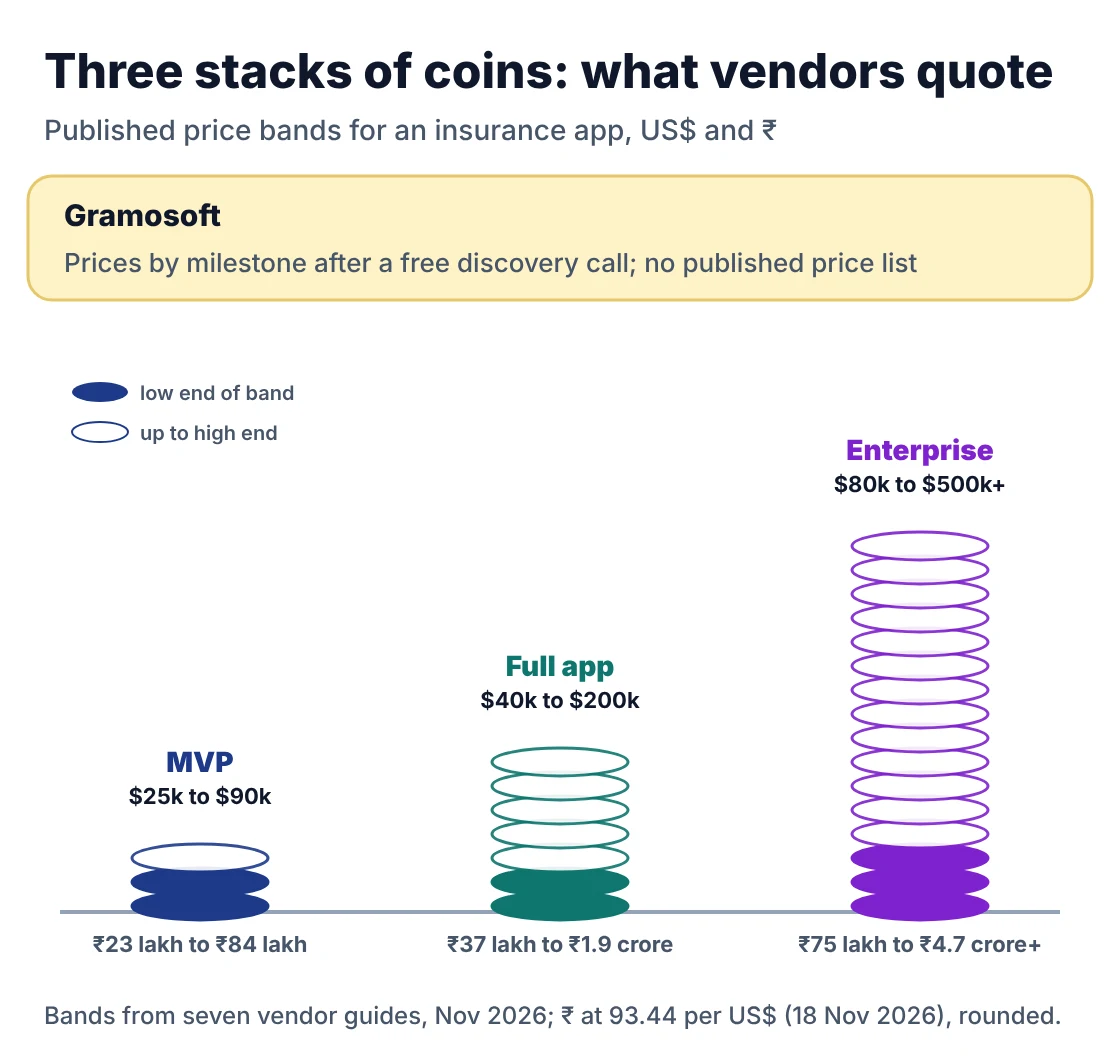
Published price bands for insurance apps are wide because they mix very different products. Seven vendor guides quote from about $25,000 for an MVP to $500,000 or more for enterprise builds, with one going past $2 million. Most of these bands are priced for global buyers; Indian projects often land below them.
| Source | MVP or basic | Full app | Enterprise |
|---|---|---|---|
| Gramosoft | Priced by milestone after a free discovery call | No published price list | Integration scoped per core system |
| Octal | $40k–90k, 3–5 months | $90k–200k, 5–9 months | $200k–500k+, 9–18 months |
| Appinventiv | $35k–60k, 3–6 months | $70k–165k, 6–8 months | $170k–250k, 9+ months |
| Vrinsoft | $35k–75k | $75k–190k | $110k–260k and $150k–400k+ tiers |
| Helpful Insight | $25k–50k MVP; $40k–70k basic | $80k–150k | $180k–300k+ |
| Shiv Technolabs | $25k–40k | $40k–80k | $80k–150k+ |
| DBB Software | $40k–60k MVP, 3–4 months | $80k–150k+ | Not split out |
| Neuronimbus | $75k–200k | $200k–500k | $500k–2M+ |
At ₹93.44 to the US dollar (18 November 2026 close), $25,000 is about ₹23 lakh and $500,000 about ₹4.7 crore. For Indian agency rates, which run lower, see Mobile App Development Cost in Chennai. What moves the price most:
- Core-system integration: Octal puts legacy integration alone at $40,000 to $150,000. A clean API on your core saves more money than any design choice.
- Number of apps and products: each extra app or line of business adds screens, rules and tests.
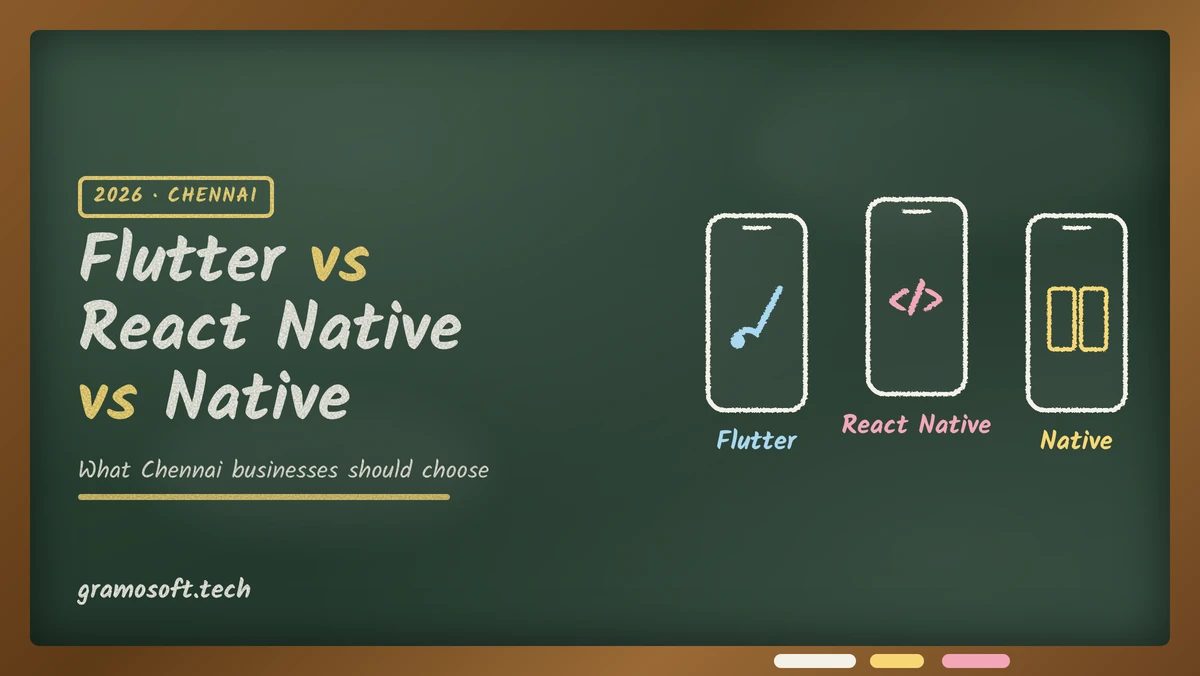
- Platform: one cross-platform codebase is usually 30 to 40% cheaper than two native apps; see Flutter vs React Native vs Native: What Chennai Businesses Should Choose in 2026.
- Running costs: Apple's developer program is US$99 a year and Google Play is US$25 once, per Choicely; add hosting, SMS and OTP, KYC checks per customer, gateway fees, security testing, 18% GST on Indian invoices and maintenance of 15 to 20% of the build a year, the range Octal gives.
Build plan and timeline
A first release of one insurance app usually takes four to six months, matching the MVP ranges vendors publish. The plan below is an example, not a quote: discovery fixes the rules and APIs, design runs in two languages, the build connects to the core, and testing and store review sit inside the plan.
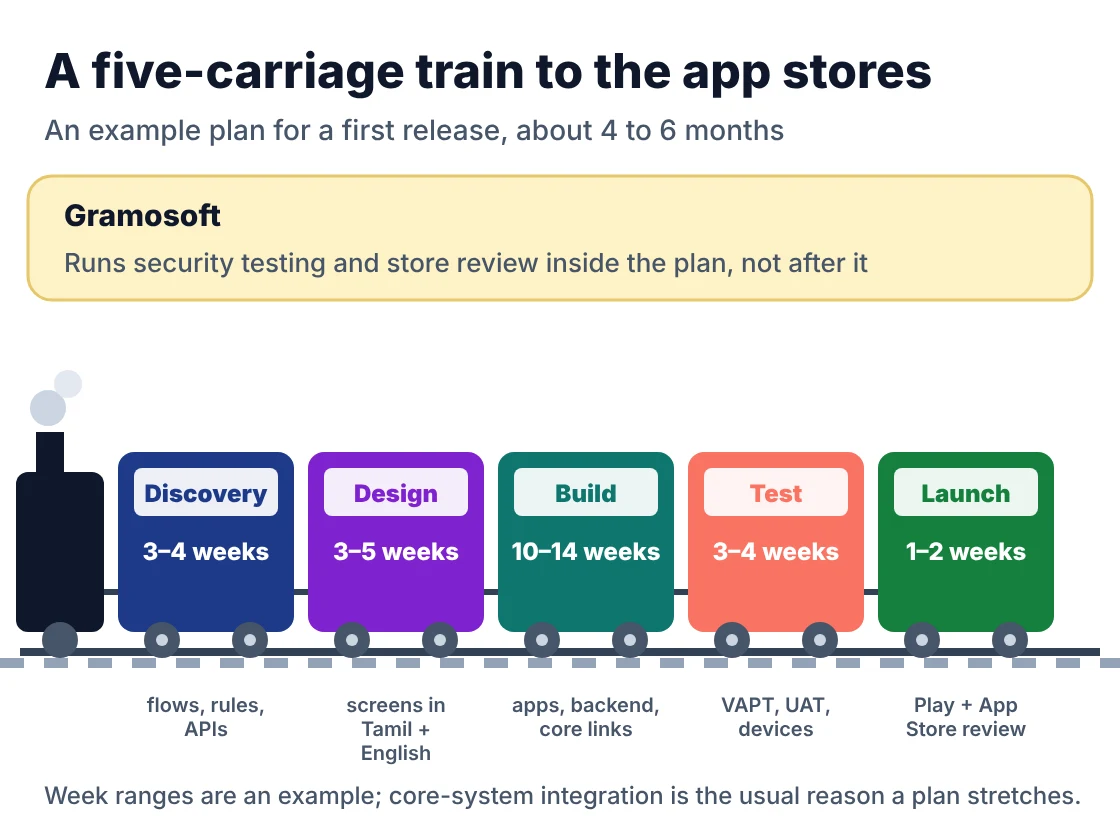
- Discovery (3–4 weeks): user journeys, the compliance map, API inventory of the core, payment and KYC systems, and the release 1 feature list.
- Design (3–5 weeks): clickable screens in English and Tamil or Hindi, tested with real agents or customers.
- Build (10–14 weeks): app, mobile backend, admin web and integrations, demoed every two weeks.
- Test (3–4 weeks): independent security testing against OWASP MASVS, user acceptance testing and checks on budget phones.
- Launch (1–2 weeks): store listings in your company's own accounts, review, and a staged rollout.
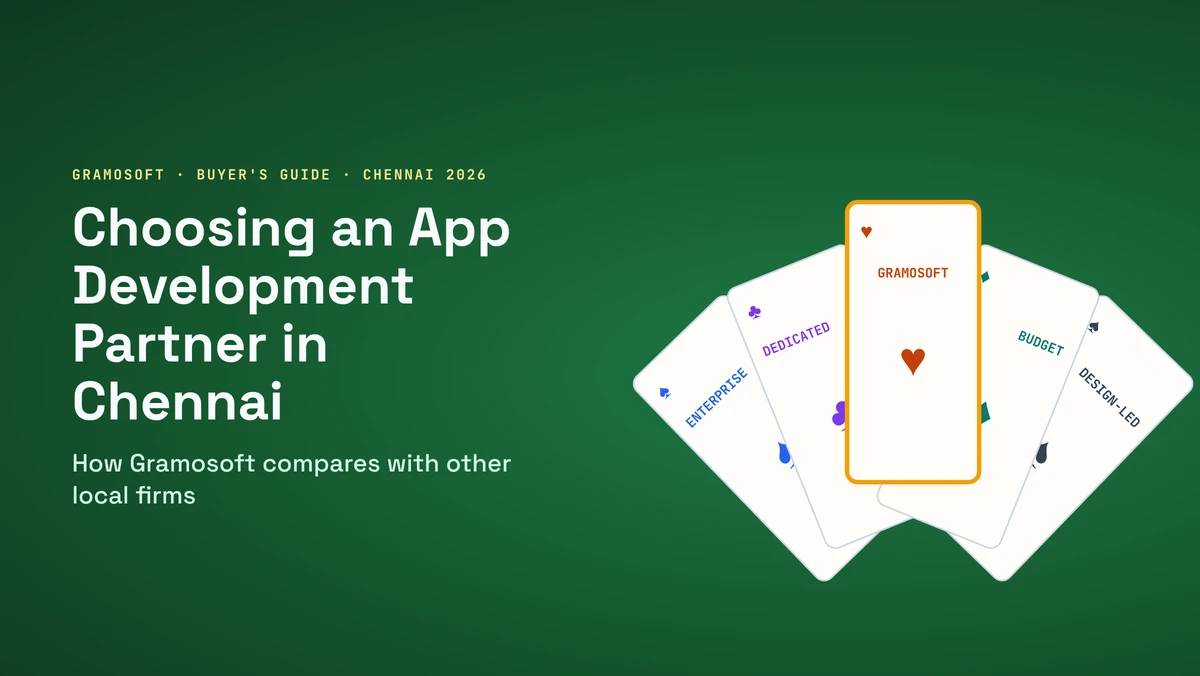
Choosing who builds it matters as much as the plan; see How to Choose a Mobile App Development Company in Chennai: 12 Questions to Ask Before You Sign and Choosing an App Development Partner in Chennai: How Gramosoft Compares with Other Local Firms. If your customers mostly come through a browser, check Web App vs Mobile App: Which Should Your Business Build First? before committing to an app.
Why insurance apps go unused, and how to avoid it
Many insurance apps are downloaded once, at purchase, and never opened again. Usage comes from giving people a reason to return: renewals, claims, health cards and reminders that work. The causes of failure are predictable, and most are decided in the first release, not in marketing afterwards.
- Claims still need a phone call: if the app cannot start and track a claim, customers stop trusting it.
- The app shows stale data: a policy status that lags the core system by a day breaks trust quickly; read live data through the API.
- KYC and payment fail silently: one fallback for each, with a clear message, keeps the sale.
- English only: many policyholders read Tamil, Hindi or another language more easily.
- Agents are left out: if agents earn nothing from app sales, they will steer customers away; Experion also lists low adoption and legacy integration as the main challenges.
AI can lift usage too, from document reading to support triage; see AI Development Services in Chennai: 10 Practical Use Cases.
Frequently asked questions
Does Gramosoft build insurance mobile apps in India?
Yes. Gramosoft builds policyholder, agent and surveyor apps from Chennai for insurers, brokers, agents and TPAs, with one mobile backend connected to the core policy, claims, payment and KYC systems. GdoczAI reads uploaded documents, and every IRDAI, RBI and DPDP duty is mapped to a screen or log.
How much does insurance mobile app development cost?
Seven vendor guides published bands from about $25,000 for an MVP to $500,000 or more for enterprise builds, roughly ₹23 lakh to ₹4.7 crore at November 2026 rates, with one vendor going past $2 million. Core-system integration, the number of apps and product lines, and native versus cross-platform decide where a project lands.
How long does it take to build an insurance app?
A first release of one app usually takes four to six months: discovery, design, build, security and user testing, and store review. Enterprise builds with several apps and legacy core integration take nine months or more in the plans vendors publish.
Which features must an insurance mobile app have?
For policyholders: quote and buy, e-KYC, UPI and card payment, e-policy download, renewal reminders and claim intake with document upload and status tracking. Agents need leads, quotes, customer KYC and proposals. Every app needs secure login, notifications and an audit log.
Which IRDAI and RBI rules apply to an insurance app?
KYC before issuance (from 1 January 2023), a 30-day free look period, the Customer Information Sheet for health policies, RBI's ban on storing card data (from 1 October 2022), RBI's 2026 e-mandate framework for AutoPay, IRDAI's 2026 cyber security guidelines and the DPDP Rules, whose core duties apply from 13 May 2027.
Should an insurance app use Flutter, React Native or native code?
Most insurance apps suit Flutter or React Native, which share one codebase across Android and iOS and usually cost 30 to 40% less than two native apps. Choose native Kotlin and Swift when the app leans heavily on device features, such as background telematics or complex camera work.
What is Bima Sugam and does an insurance app need to connect to it?
Bima Sugam is IRDAI's digital insurance marketplace, run by the Bima Sugam India Federation and rolling out in phases starting with motor insurance. Your own app still matters for service and claims, but clean product, quote and policy APIs make connecting to Bima Sugam much easier.
Related guides
- Insurance Software Development in India: Features, Compliance & Build vs Buy
- Mobile App Development Cost in Chennai
- Flutter vs React Native vs Native: What Chennai Businesses Should Choose in 2026
- How to Choose a Mobile App Development Company in Chennai: 12 Questions to Ask Before You Sign
- Choosing an App Development Partner in Chennai: How Gramosoft Compares with Other Local Firms
- Android App Development Company in Chennai: Cost, Timeline & Team
- Top 10 Mobile App Development Companies in Chennai (2026)
- Web App vs Mobile App: Which Should Your Business Build First?
- Best Open-Source OCR Models in 2026: Accuracy, Speed & Cost Compared
Rajesh Kannan M
Rajesh Kannan M is Co-Founder & CTO of Gramosoft in Chennai, where he leads the teams building custom AI, document AI, enterprise search and automation, including GsearchAI, GdoczAI and GcrawlAI, an open-source web scraping, crawling and Search API platform for developers and AI agents, alongside web and mobile applications.