By Rajesh Kannan, Co-Founder & CTO, Gramosoft · Last updated: · Regulatory dates checked November 14, 2026
Insurance software looks simple from a distance: customers, policies, premiums, claims. Then the first backdated endorsement arrives, a regulator asks how a policy was priced last year, or a bank partner needs consent records for every sale. That's when a quick build turns into a long project.
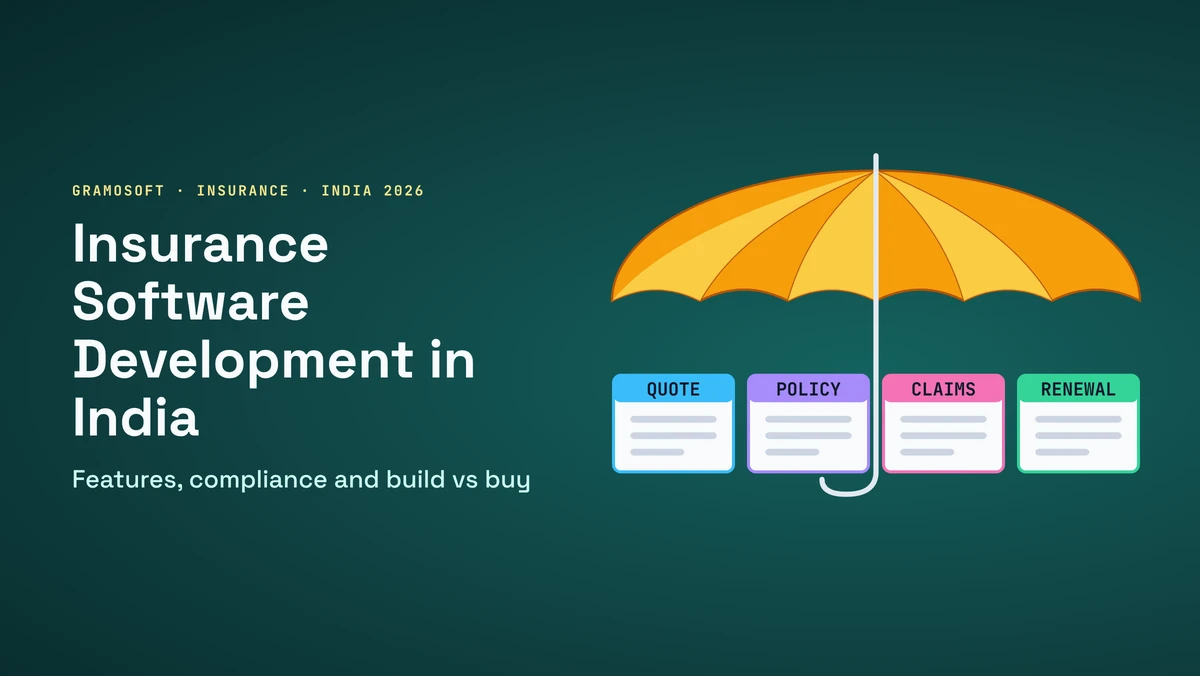
This guide starts with how Gramosoft builds insurance software in Chennai. It then covers the features each type of user needs, the part of the system most estimates leave out, the Indian rules that apply in 2026 and 2027, and how to decide between building, buying or combining the two.
TL;DR
- Gramosoft builds insurance software for insurers, brokers, agents and TPAs: policy and quote platforms, claims, portals, agent apps and integrations. Its live work includes GMAT, an insurance aggregator in Malaysia, and GramoAssure for Sundharams Assure.
- Features depend on the user: customers want policies, renewals and claims on a phone; agents want quotes and follow-ups; insurers and TPAs need underwriting rules, claims workflows and audit trails.
- The hidden work is policy history: every change kept as a dated version, so a claim or audit can see the cover as it stood on any day.
- Compliance in India: IRDAI wants cyber incidents reported within 6 hours; RBI's mis-selling rules for banks start on 1 January 2027; DPDP duties apply from May 2027.
- Build vs buy: buy a core platform for standard lines, build where your product or journey is truly different, and combine the two when you have a core you can't replace yet.
Should you build or buy insurance software in India? Buy a proven platform when your products are standard and speed matters most. Build when your product, distribution model or integrations don't fit a packaged system. Most Indian brokers, distributors and mid-size insurers end up with a hybrid: a core platform plus custom portals, apps and integrations, which is the work Gramosoft does.
Swipe the table sideways on mobile →
| Route | Best for | Watch out for |
|---|---|---|
| Gramosoft (custom or hybrid) | Distribution platforms, portals, agent apps, claims workflows and integrations around your insurers and core systems | No published price list; quoted after discovery |
| Buy a core platform | Insurers on standard lines who need policy, rating, billing and claims quickly | Licence fees and the vendor's data model and roadmap |
| Fully custom build | A genuinely new product or journey, with a team to maintain it for years | Policy history, rating versions and regulatory upkeep |
| Hybrid | A core you keep, with modern customer and agent layers on top | Clean APIs, so the new layer doesn't inherit old quirks |
How Gramosoft builds insurance software
Gramosoft is a Chennai software company that builds the systems around an insurance product: quoting, policy issuance and servicing, claims, portals and agent tools. We work with insurers, reinsurers, brokers and third-party administrators. Each one needs a different slice of the same policy data, so we design that data first and build the screens on top.
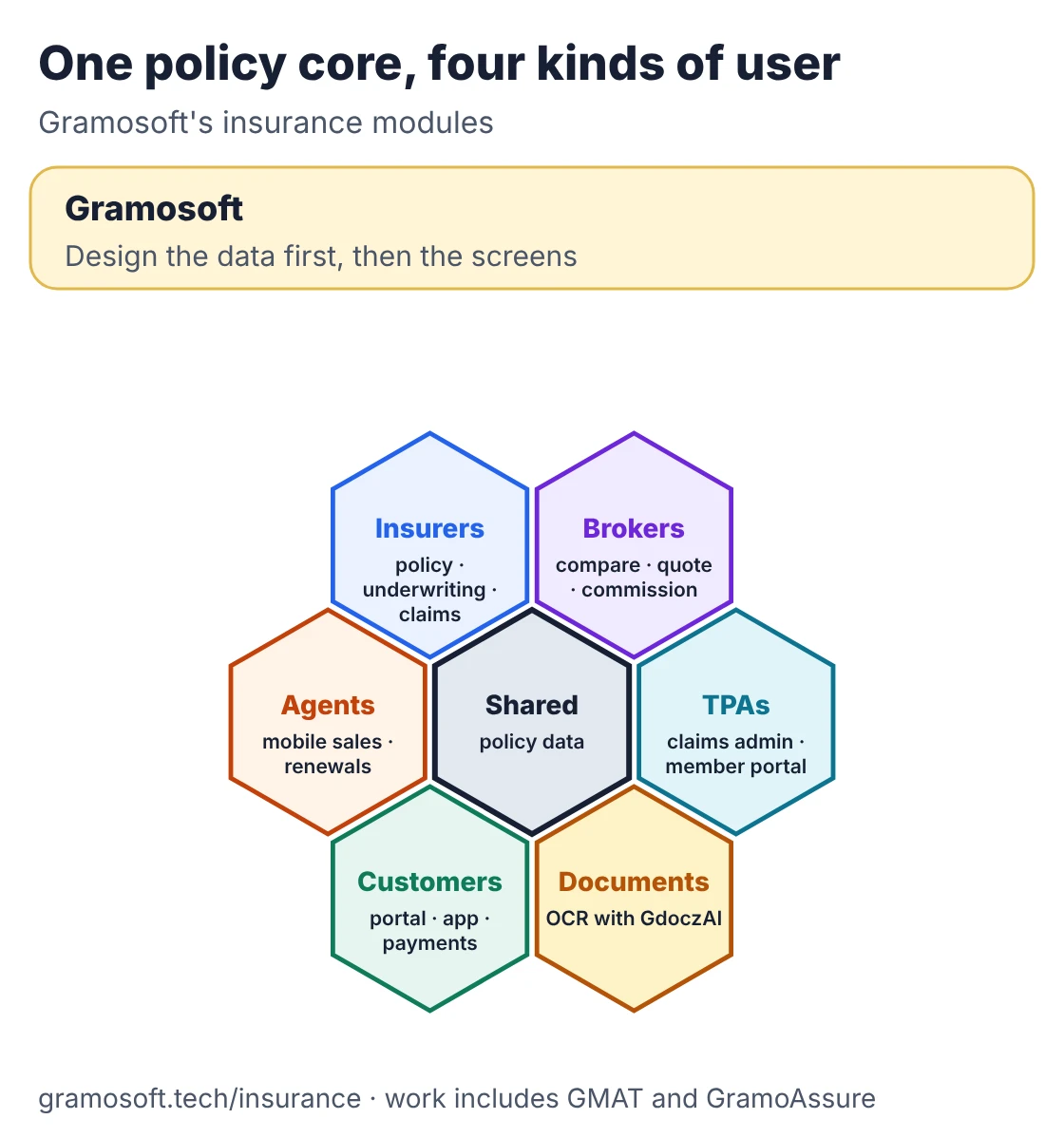
- Insurers: policy management, underwriting decision engines, claims processing, customer portals and integration with existing core systems.
- Brokers: policy comparison, quote systems, CRM and commission management across several insurers.
- Agents: mobile sales apps with lead management, follow-ups, renewals and payments, offline sync and performance dashboards.
- TPAs: claims administration, provider management, member portals and compliance modules.
- Documents: OCR and data extraction for proposal forms, claim papers and KYC, built on GdoczAI, our document AI.
- Work you can check: GMAT, a one-stop insurance aggregator in Malaysia covering motor, travel and other policies, and GramoAssure, a comparison, purchase and policy-management platform for Sundharams Assure. Our insurance software page lists integrations with insurers including Allianz, Zurich, Great Eastern, HDFC, Sundaram and Tata.
Where we fall short: we don't sell a licensed, off-the-shelf core policy administration system, so an insurer replacing its whole core across many lines should also look at dedicated platform vendors. Our public insurance work is mostly in distribution, policy servicing and specialty products rather than large core replacements. We don't publish prices; you get a quote after a discovery phase. On-site work is in Chennai.
"The screens are the easy part of insurance software. The hard part is answering, a year later, exactly what a policy covered on a given day and why it was priced that way. We design for that question first."
Rajesh Kannan, Co-Founder & CTO at Gramosoft
For apps and portals on top of an insurance core, see our mobile app development and web application development services.
Features insurance software needs, by user
A long feature list doesn't help you plan. What matters is which users the system serves and which journeys they repeat every day. A customer, an agent, a broker, a TPA and an underwriter all touch the same policy, but each needs a different view of it and different permissions over it.
Swipe the table sideways on mobile →
| User | Core features |
|---|---|
| Customer | Policy wallet with documents, premium due dates and renewal reminders; online payment; claim intimation with photo upload that resumes on a weak connection; claim status tracking |
| Agent | Quotes on the spot, digital proposal and KYC capture, lead and follow-up lists, renewal queue, commission view, offline mode for field work |
| Broker or distributor | Multi-insurer comparison and quoting, policy issuance through insurer APIs, commission rules by insurer, product and partner, reconciliation against insurer statements |
| Underwriter | Rules engine for auto-approve, refer and decline, with versioned rating tables business users can change without a code release |
| Claims team or TPA | First notice of loss, triage and assignment, document checks, reserves, approval limits with separation of duties, settlement and recovery tracking |
| Compliance and finance | Audit trail of who viewed or changed what, consent records, regulatory reports and exports that match operational data |
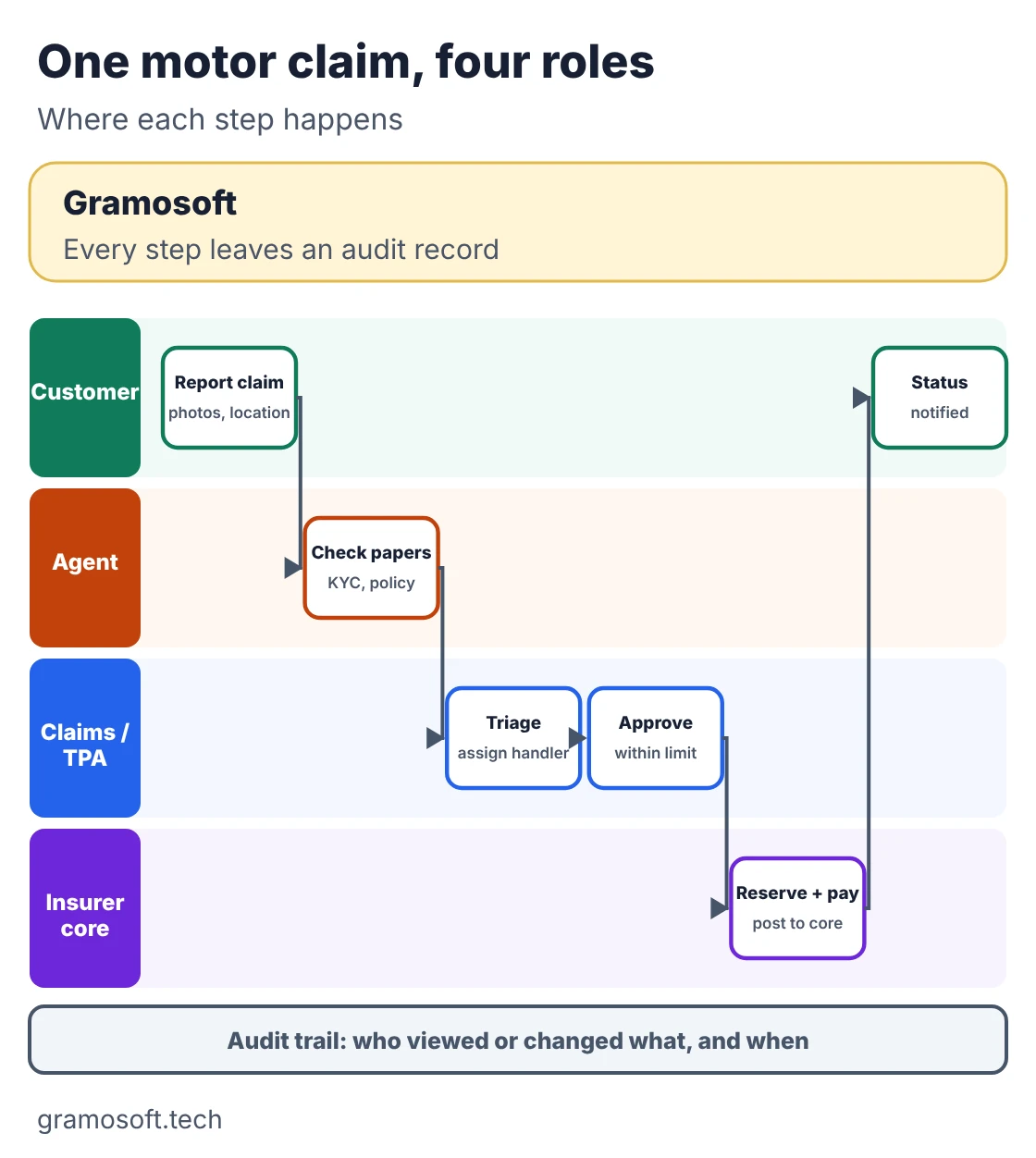
Plan a first release around one product line and its most painful manual steps, such as claim intimation and assignment, rather than a thin slice of every feature. Add the rest once the first journeys work end to end.
The part most estimates leave out: policy history
A policy is not a row you update. It's a contract with a history, and "what did this policy cover?" has no answer until you add "on which date, and as the system knew it when?". Build estimates usually price the forms and screens, then miss this layer, which is why insurance projects overrun.
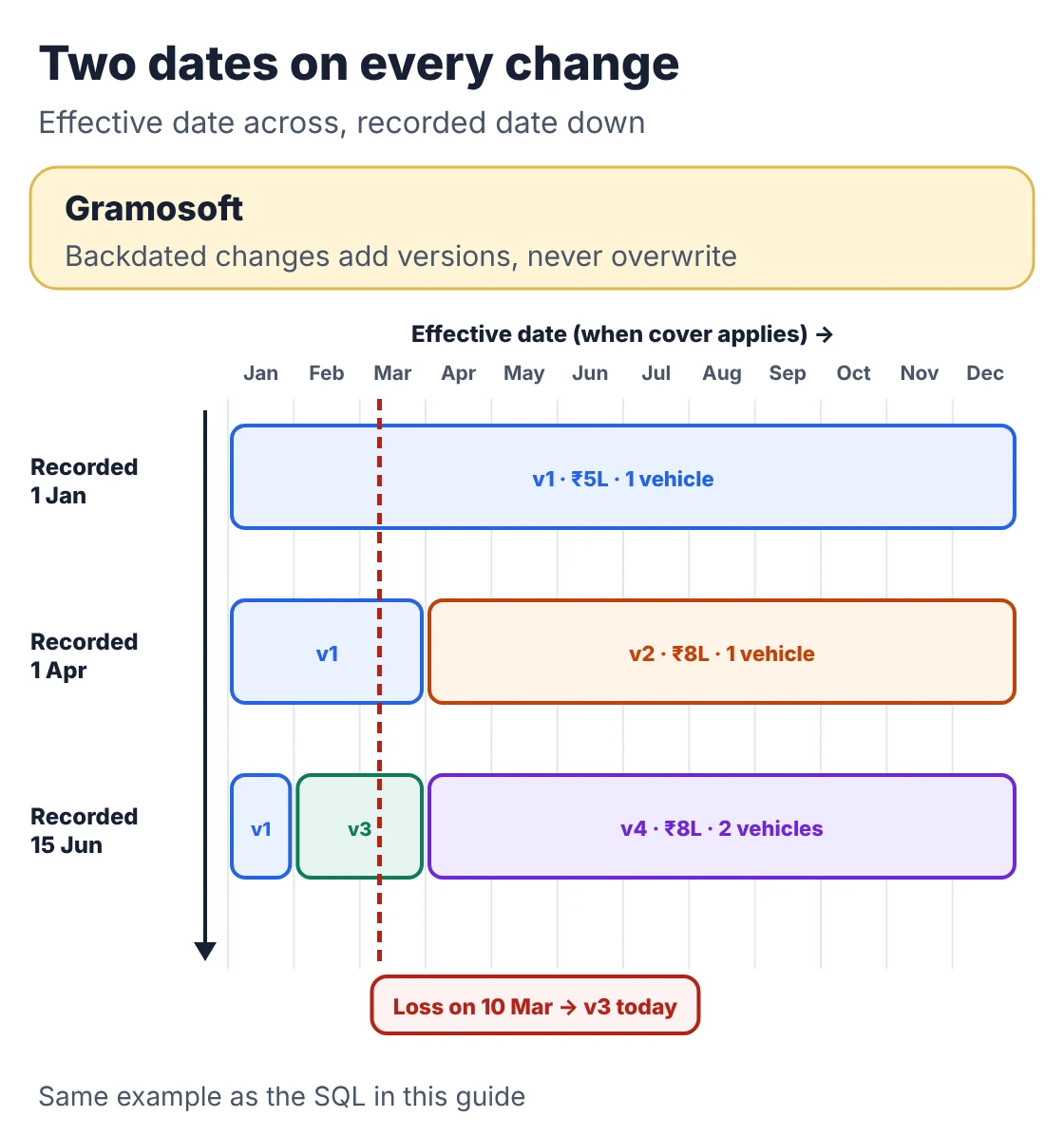
Two dates govern every change. The effective date is when cover applies; the recorded date is when the system learned about it. Store both, and never overwrite a row. In the example below, a motor policy issued in January has its cover raised in April. In June, the customer reports that a second vehicle was added from February. That backdated change lands after the April one:
-- Every change is a new row. Nothing is updated in place.
-- effective_*: when the cover applies.  recorded_at: when the system learned it.
CREATE TABLE policy_version (
  policy_no      TEXT,
  version        INTEGER,
  sum_insured    INTEGER,
  vehicles       INTEGER,
  effective_from DATE,
  effective_to   DATE,
  recorded_at    DATE
);

INSERT INTO policy_version VALUES
  ('MTR-1001', 1, 500000, 1, '2026-01-01', '2027-01-01', '2026-01-01'), -- policy issued
  ('MTR-1001', 2, 800000, 1, '2026-04-01', '2027-01-01', '2026-04-01'), -- April: cover raised
  ('MTR-1001', 3, 500000, 2, '2026-02-01', '2026-04-01', '2026-06-15'), -- June: backdated, 2nd vehicle from Feb
  ('MTR-1001', 4, 800000, 2, '2026-04-01', '2027-01-01', '2026-06-15'); -- April onwards re-rated with 2 vehicles

-- A claim for a loss on 10 March: what cover applied that day, as we know it now?
SELECT version, sum_insured, vehicles
FROM policy_version
WHERE policy_no = 'MTR-1001'
  AND '2026-03-10' >= effective_from AND '2026-03-10' < effective_to
ORDER BY recorded_at DESC, version DESC
LIMIT 1;

-- An auditor asks: what did our system say about 10 March, as of 31 May?
SELECT version, sum_insured, vehicles
FROM policy_version
WHERE policy_no = 'MTR-1001'
  AND '2026-03-10' >= effective_from AND '2026-03-10' < effective_to
  AND recorded_at <= '2026-05-31'
ORDER BY recorded_at DESC, version DESC
LIMIT 1;
Running it in SQLite answers both questions correctly:
Loss on 10 March, as known today:      version 3 · sum insured ₹5,00,000 · 2 vehicles
Loss on 10 March, as known on 31 May:  version 1 · sum insured ₹5,00,000 · 1 vehicle
A claim for a loss on 10 March is settled against version 3, with two vehicles. An auditor asking what the system said on 31 May gets version 1, because the change hadn't been recorded yet. A design that keeps only the current state can give neither answer. The same pattern applies to rating: a policy must be re-rated with the rate table in force on its own dates, not today's.
A nasscom community article on policy management build-or-buy makes the same point: estimate the temporal model, not the feature list.
Indian compliance your software must handle in 2026–27
Insurance software in India answers to several regulators at once. IRDAI governs insurers and intermediaries, RBI governs banks and NBFCs that sell insurance, and the DPDP framework covers personal data for everyone. Four dates matter for anything you build or buy now, and each one changes what the software must record.
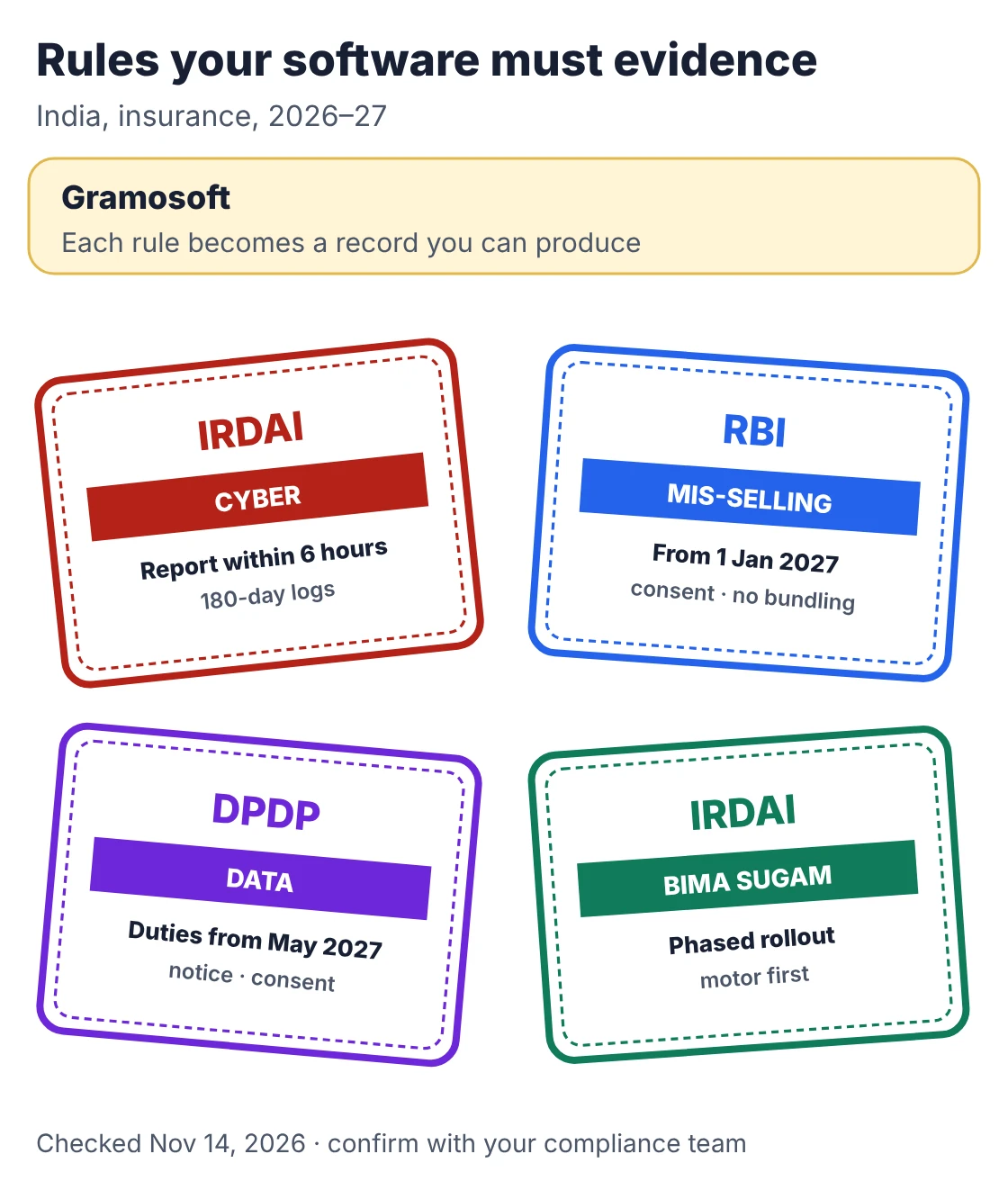
- IRDAI cyber security: insurers and intermediaries must report cyber incidents to IRDAI and CERT-In within six hours, under the Information and Cyber Security Guidelines, 2023, as tightened on 24 March 2025 (Deloitte). They must also keep ICT logs for 180 days (IRDAI circular summary). Your software needs audit logs and alerts that support that clock.
- RBI mis-selling rules: from 1 January 2027, banks need explicit, recorded consent for each product, can't force insurance as a condition for a loan, must check suitability and can't use dark patterns in digital journeys (Upstox, Basis Point). Bancassurance and loan-linked journeys need consent records and suitability steps built in.
- DPDP: India's Digital Personal Data Protection Rules were notified on 13 November 2025, with core duties such as notice, consent and security safeguards applying from May 2027 (AZB & Partners). Health and financial data in claims makes this a design issue, not a policy document.
- Bima Sugam: IRDAI's insurance marketplace is rolling out in phases, starting with motor; its website went live in November 2026 (Reinsurance Asia). The project has missed earlier dates, so treat timelines as guidance (IPO Market), but plan for APIs that can connect to it.
Rules change, so confirm your obligations with your compliance team. The software's job is to make each requirement a record you can produce, not a promise in a policy document.
Build vs buy vs hybrid
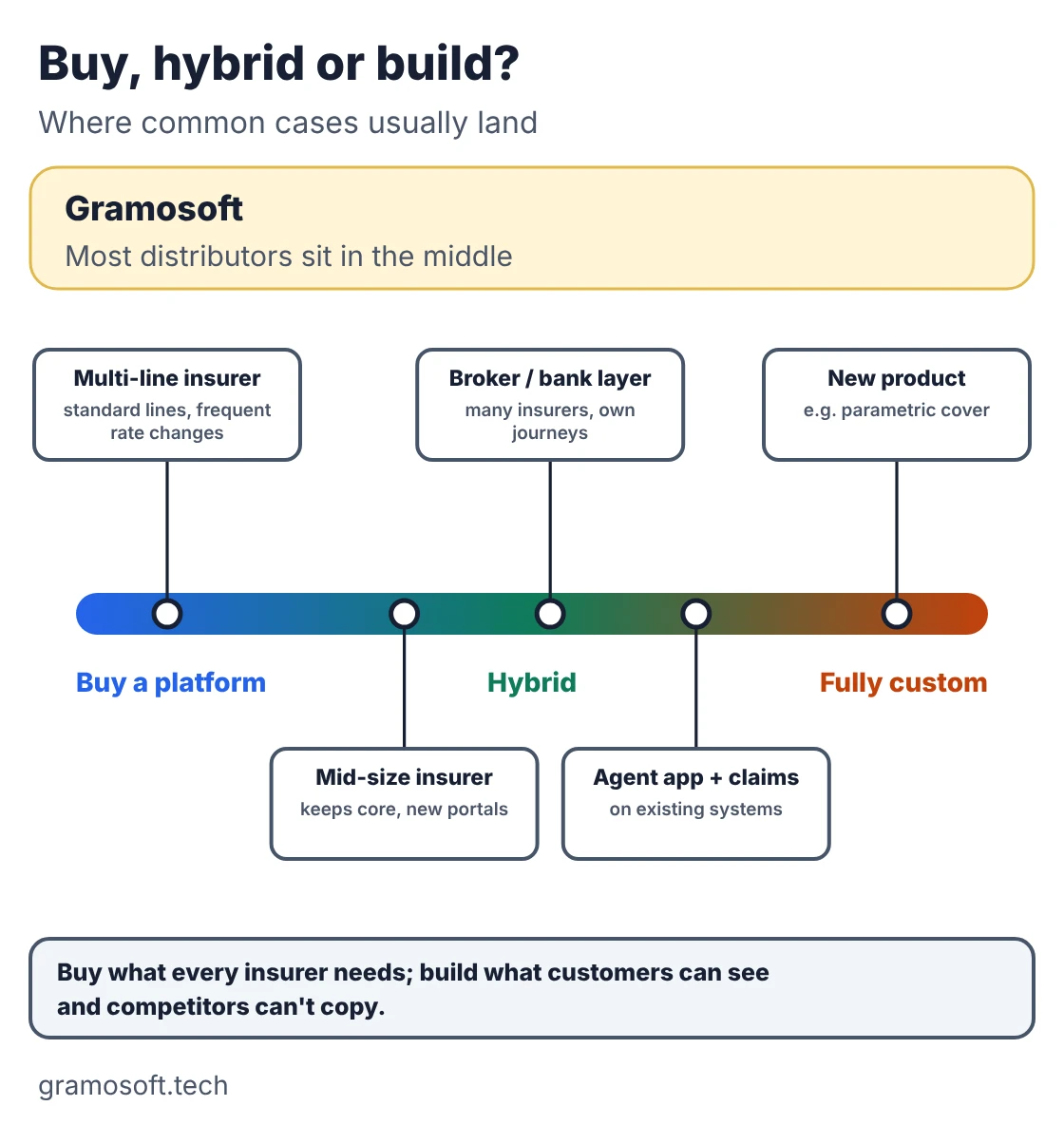
The build-or-buy question is less about features than about what you'll have to maintain for the next ten years. A platform vendor spreads regulatory updates, rating versions and integrations across many customers. A custom build carries them alone. A hybrid keeps a stable core and builds only where you're different.
Swipe the table sideways on mobile →
| Factor | Buy a platform | Hybrid (Gramosoft's usual route) | Fully custom |
|---|---|---|---|
| Fits | Standard lines and processes | A core plus your own journeys, apps and integrations | A new product or distribution model |
| Speed | Fastest for what the platform already does | Fast core, custom parts in stages | Slowest; months before the first policy |
| Control | Limited to configuration | Full control of the customer and agent layers | Full control of everything |
| Regulatory upkeep | Mostly the vendor's | Shared: vendor core, your layer | All yours, permanently |
| Cost pattern | Licence or usage fees | Licence plus project and support | Large upfront build plus a standing team |
Build makes sense when the product is unusual enough that a packaged platform fits badly, the footprint is narrow, and you'll keep people who understand both insurance and the code. Buy wins for multi-line insurers with frequent rate and form changes. Duck Creek, which sells a core platform, makes a similar case in its build-vs-buy guide: buy the core, configure for differentiation.
What insurance software costs and how long it takes
There's no fixed price, because the cost sits behind the screens: how many insurers and core systems you connect, how many user roles you support, and how much history, audit and compliance the system must hold. Published ranges are useful only as a sense of scale, and most come from outside India.
- Published ranges (US): Neuronimbus puts a basic customer app at $75,000 to $200,000, an advanced app with stronger claims and CRM integration at $200,000 to $500,000, and an enterprise build with an API layer and multi-system integration at $500,000 to $2 million or more (Neuronimbus). Indian rates are usually lower, but the cost drivers are the same.
- Timelines: Deployit, which sells a distribution platform, says custom builds typically take 6 to 18 months and platforms deploy in weeks to a few months (Deployit). Treat vendor timelines as claims to test with a week-by-week plan.
- What drives cost: number of insurer integrations, product lines and user roles; policy history and rating versions; document volume; data migration from an old system; security testing; and support after launch.
Gramosoft quotes after a short discovery phase that lists your insurers, products, roles and systems, because those decide the price more than the screen count does. Our guide to web application development cost in Chennai explains the general cost drivers.
How to choose an insurance software development company
A good insurance software partner asks about your endorsements, commissions and claims before talking about technology. Use the questions below with every company you shortlist, Gramosoft included. The answers separate firms that have built insurance systems from general app studios that will learn the domain on your budget.
- Which insurance systems have you delivered: quoting, issuance, claims or commissions? Can we speak to a client?
- How do you store policy changes and handle a backdated endorsement?
- How many live insurer integrations have you built, and who maintains them when an insurer changes its API?
- How does your design support IRDAI's six-hour incident reporting, RBI consent records and DPDP?
- Who owns the code, the cloud accounts and the data? How would we export everything if we moved?
- What does the first release cover, and what's left for later?
- How will you migrate in-force policies and open claims, and will we run old and new systems in parallel?
- What does support cost after year one, and how fast are claim-blocking bugs fixed?
Red flags: a fixed price before anyone asks about your insurers and systems; compliance described as "on the roadmap"; no answer on data portability; and a pitch that would fit a retail app with the nouns changed. For general vendor questions, see how to choose a mobile app development company in Chennai.
Frequently asked questions
Which company builds insurance software in Chennai?
Gramosoft, a Chennai software company, builds insurance software for insurers, brokers, agents and TPAs, including policy and quote platforms, claims workflows, customer portals, agent apps and insurer integrations. Its work includes GMAT in Malaysia and GramoAssure for Sundharams Assure.
What features should insurance software have?
Customers need a policy wallet, renewals, payments and claim intimation. Agents need quoting, KYC capture and renewal queues. Brokers need multi-insurer quoting and commission rules. Insurers and TPAs need underwriting rules, claims workflows, audit trails and regulatory reports.
Should an insurer build or buy policy administration software?
Buy when your lines and processes are standard and change often under regulation. Build only when your product doesn't fit a packaged platform and you can maintain the system for years. Many choose a hybrid: a core platform plus custom portals, apps and integrations.
Which Indian regulations affect insurance software in 2026?
IRDAI's cyber security guidelines require incident reporting within six hours and 180-day log retention. RBI's mis-selling rules for banks start on 1 January 2027. DPDP Rules duties apply from May 2027, and IRDAI's Bima Sugam marketplace is rolling out in phases.
How much does insurance software development cost?
It depends on integrations, product lines, user roles and compliance depth. Published US ranges run from about $75,000 for a basic customer app to $2 million or more for enterprise builds. Indian rates are usually lower; get an itemised quote after discovery.
How long does it take to build insurance software?
A focused first release, such as a claim intimation flow or an agent app on existing systems, can take a few months. Vendors report 6 to 18 months for full custom builds, while platforms can go live in weeks for what they already support.
Why do insurance software projects go over budget?
Estimates usually price screens and miss policy history, versioned rating, backdated endorsements, data migration and regulatory upkeep. Those parts decide most of the effort and the long-term cost.
Related guides
- Web Application Development Cost in Chennai (2026): What Drives the Price
- Mobile App Development Cost in Chennai
- How to Choose a Mobile App Development Company in Chennai: 12 Questions to Ask Before You Sign
- Flutter vs React Native vs Native: What Chennai Businesses Should Choose in 2026
- Best Vision OCR Models (2026)
- Best Open-Source OCR Models in 2026: Accuracy, Speed & Cost Compared
- Best AI Agent Frameworks in 2026: LangGraph vs CrewAI vs OpenAI Agents SDK vs Google ADK