An Indian insurance claim is a stack of paper: a claim form, a hospital bill or repair estimate, a discharge summary or FIR, and ID proof, often scanned on a phone. Most of the delay is in reading and matching that stack, not in the decision. This guide starts with how Gramosoft builds AI claims processing, then walks the claim from form to settlement.
TL;DR
- Gramosoft builds AI claims processing in Chennai for insurers, TPAs and brokers: GdoczAI reads the claim pack, rules in code check it, and an assessor approves on one screen connected to your core system.
- The split that works: AI reads the documents, rules check them, a person decides, and the core system pays. Payouts and rejections stay with people.
- IRDAI sets the clocks: cashless requests decided within 1 hour, discharge authorised within 3 hours, survey reports within 15 days and a decision within 7 days of the report.
- Route every pack three ways: fast-track if every check passes, request documents if something is missing, assessor review if anything disagrees. A tested Python router below shows how.
- Treat vendor numbers as claims, not targets. Measure your own straight-through rate, extraction accuracy and time against the IRDAI clocks.
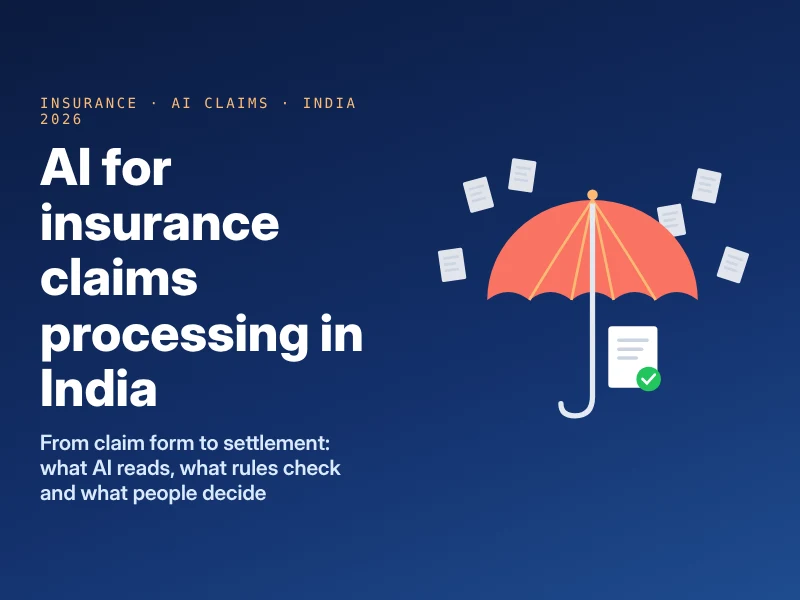
How is AI used in insurance claims processing in India? AI reads claim forms, hospital bills, discharge summaries, FIRs and repair estimates, extracts the fields, and checks them against the policy and each other. Clean claims are fast-tracked, incomplete ones get a document request, and doubtful ones go to an assessor, who makes the decision. Gramosoft builds this from Chennai for insurers and TPAs.
How Gramosoft builds AI claims processing
Gramosoft builds claims automation around the documents and the systems you already have. GdoczAI, our document AI, reads every page of the claim pack. Rules written in code check what it read. An assessor sees the evidence, the flags and the IRDAI clock on one screen. The result is written back to your core or TPA system through its API.
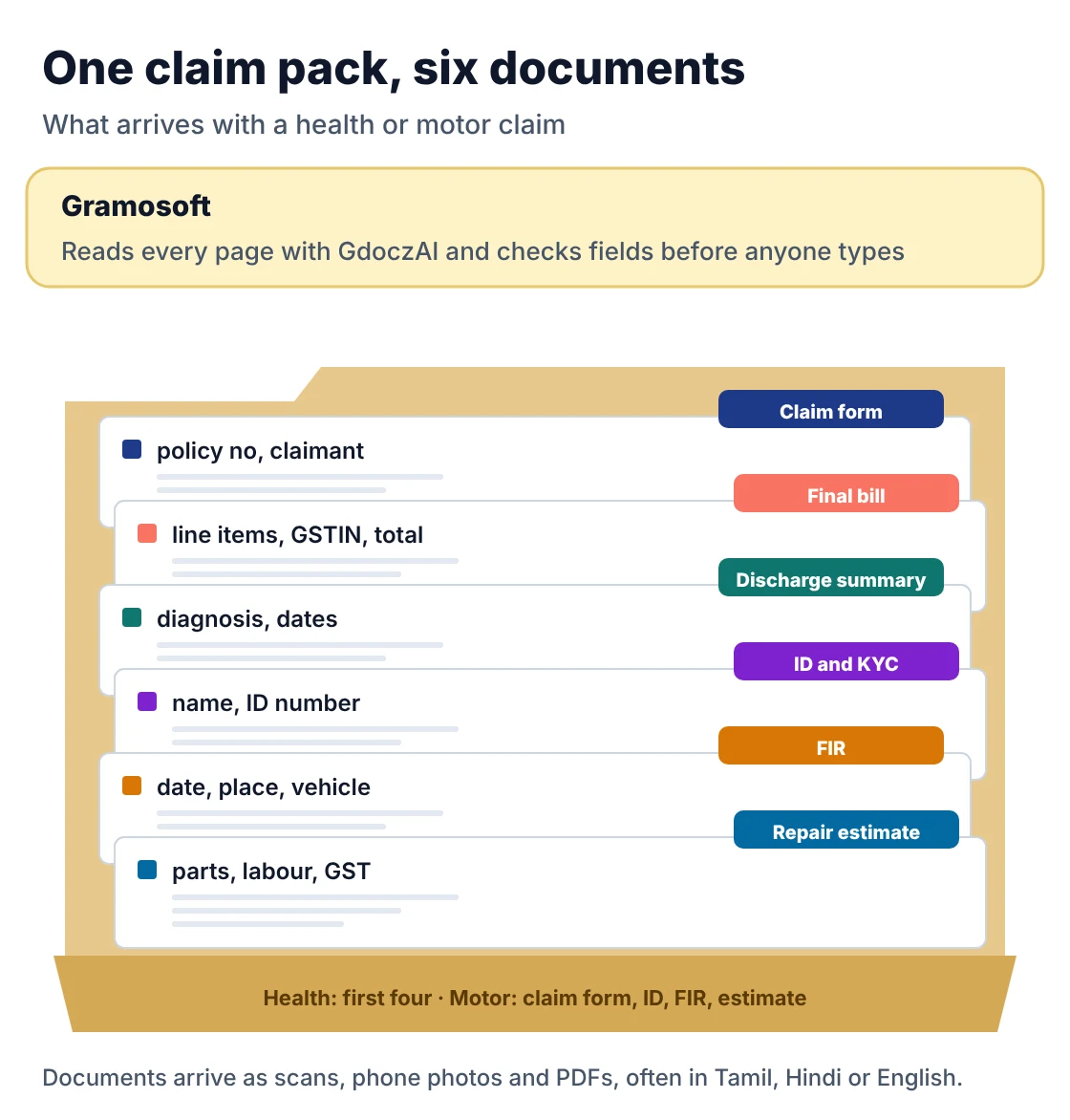
- Read: GdoczAI extracts fields from scans, phone photos and PDFs, including handwritten forms and bills in Tamil, Hindi or English, with a confidence score on each field.
- Check: completeness, names, dates, policy period, bill totals, GSTIN format and duplicate bills, as rules you can read and change.
- Route: fast-track, request documents or assessor review, with the reasons written next to the claim.
- Decide and record: the assessor approves or edits; every input, rule result and decision is logged for audit.
GdoczAI already reads more than 100,000 documents a month for aviation clients such as Batik Air. Our insurance software work includes GMAT, an insurance aggregator, and GramoAssure for Sundharams Assure. For the wider build, see Insurance Software Development in India: Features, Compliance & Build vs Buy.
Where we fall short. We do not sell a packaged claims platform or a car-damage photo estimator; we build on your core system and connect specialist tools where they fit. We have no published claims case study with settlement-time results yet. And we will not automate payout or rejection decisions, because those belong with your assessors.
"Most claim delays are reading delays. Let AI read every page, let code check what it read, and let your assessor spend their time only on the claims that need a person."
Rajesh Kannan M, Co-Founder & CTO, Gramosoft
From claim form to settlement: the six steps
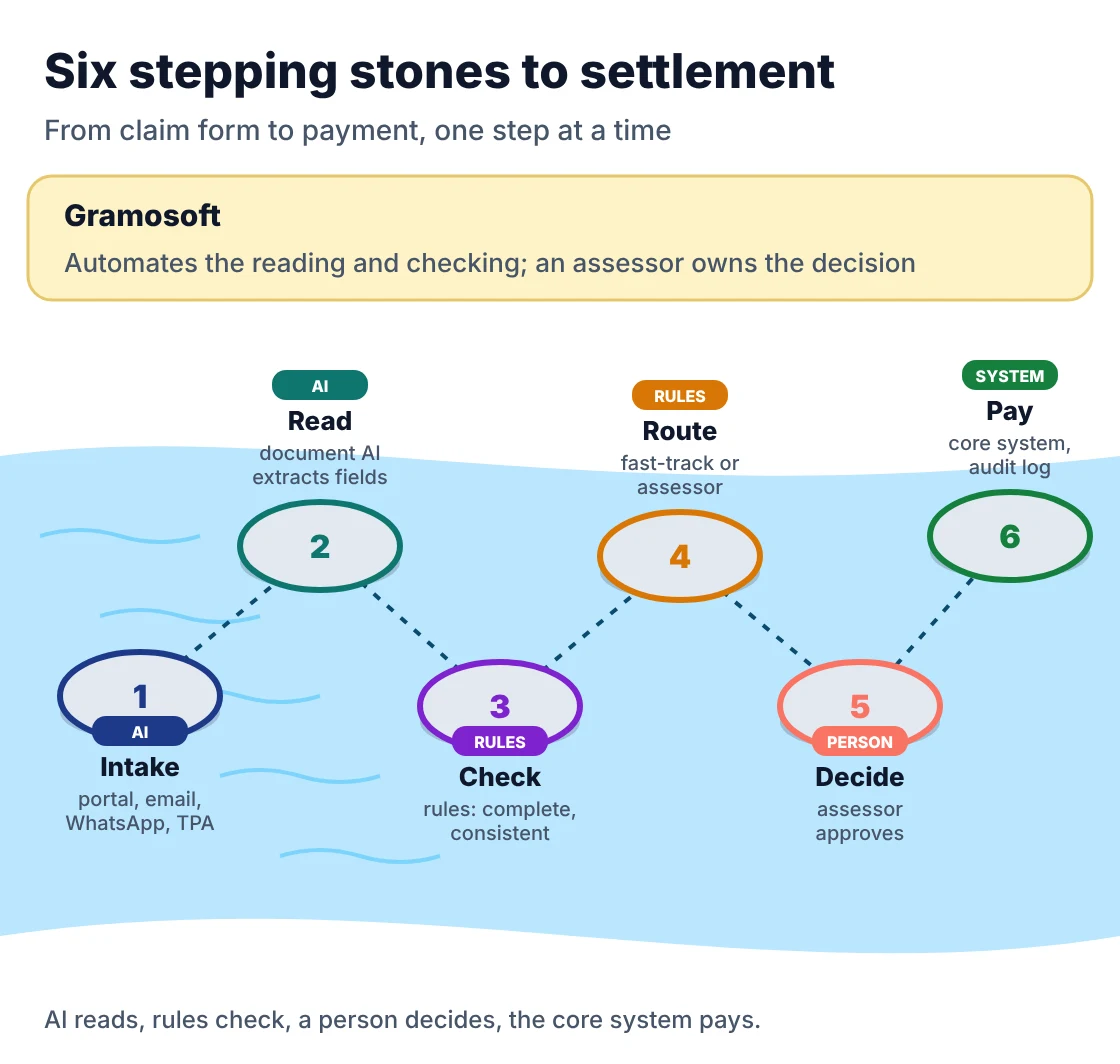
Every claim follows the same six steps, whether it is a cashless hospital stay or a dented car. The claim arrives, its documents are read, the data is checked, the claim is routed, someone decides and the money moves. AI is useful in the first two steps, rules in the next two, and people in the fifth.
| Step | What happens | Who does it | What can go wrong |
|---|---|---|---|
| Gramosoft build | All six steps connected to your core system | GdoczAI, rules, your assessor | Covered by the checks below |
| 1. Intake | Claim arrives by portal, email, WhatsApp, hospital desk, agent or TPA | Intake app or voice agent | Pages missing, duplicates of the same claim |
| 2. Read | Document AI classifies each page and extracts fields | AI | Low-quality photos, handwriting, mixed languages |
| 3. Check | Completeness, consistency, policy period, totals, duplicates | Rules in code | Rules that are out of date with the policy wording |
| 4. Route | Fast-track, request documents or assessor review | Rules in code | Thresholds set too loose or too tight |
| 5. Decide | Approve, part-approve, query or reject | Assessor or medical reviewer | Decisions without the evidence in view |
| 6. Pay and record | Payment, letter, audit log | Core system | Missing reasons for a rejection |
Voice intake in Tamil and English is one way to cut the first step; see How to Build an AI Voice Agent That Speaks Tamil & English. For how far an AI agent should go on its own, see The 5 Levels of AI Agents Explained, with Business Examples.
What document AI reads in Indian claims
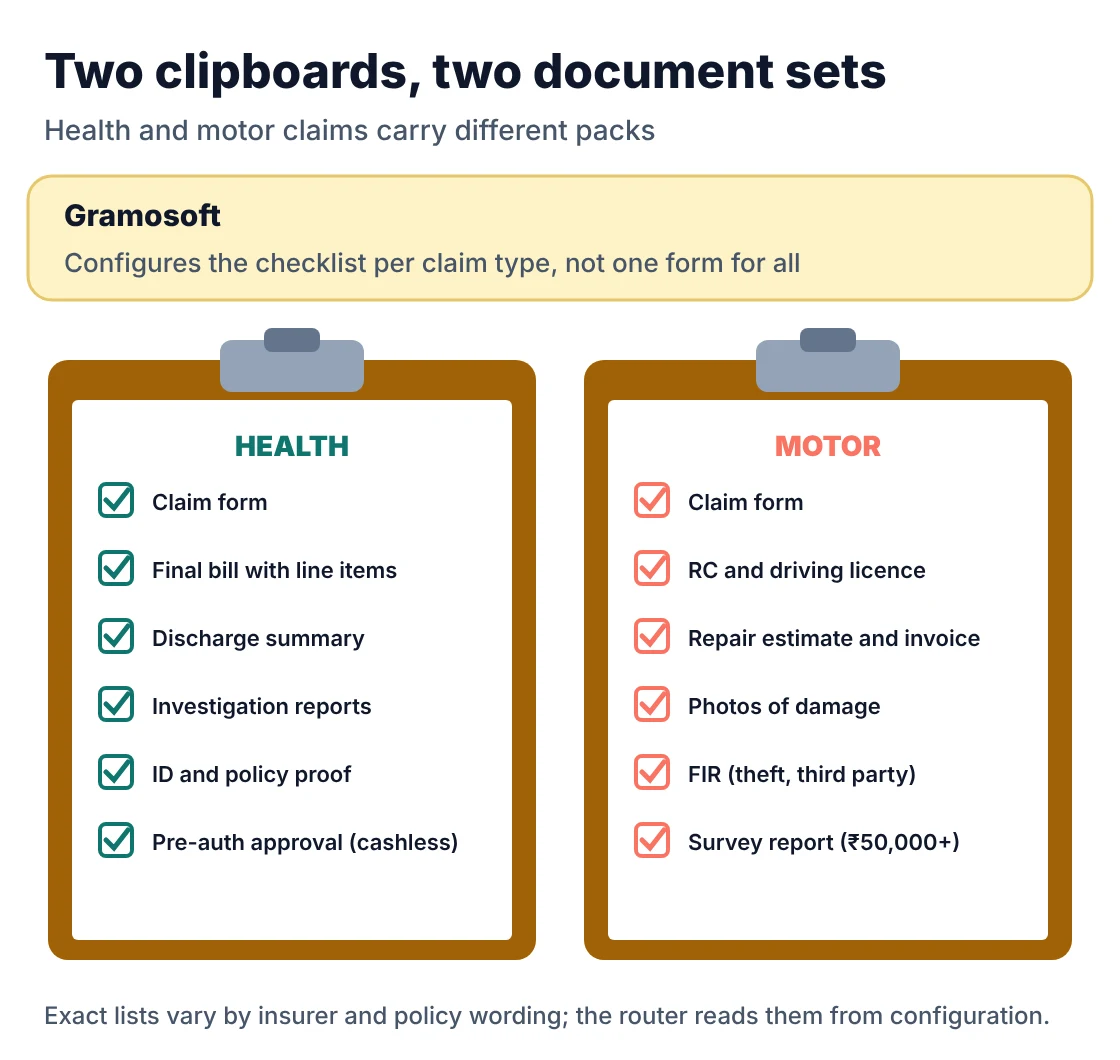
Health and motor claims carry different packs, and each document holds a few fields that decide the claim. Document AI earns its place by reading these fields reliably from messy inputs: phone photos, stamped scans, handwritten claim forms and hospital bills in many layouts. The checklist must be set per claim type, not one form for all.
| Document | Fields to extract | Used to check |
|---|---|---|
| Gramosoft: whole pack, one pass | Every field below with a confidence score | All checks in the next section |
| Claim form | Policy number, claimant, contact, date of loss | Links the claim to the policy |
| Hospital final bill | Line items, total, GSTIN, bill number, dates | Amount claimed, duplicates, totals |
| Discharge summary | Diagnosis, procedure, admission and discharge dates | Policy period, medical review |
| Pre-auth approval (cashless) | Approved amount, reference number | Final bill against approval |
| RC and driving licence (motor) | Owner name, vehicle number, licence validity | Insured identity and eligibility |
| FIR (theft, third party) | Date, place, vehicle, parties | Event date and story match |
| Repair estimate and invoice | Parts, labour, GST, garage GSTIN | Amount and garage details |
Choosing the OCR engine matters more than most teams expect; we compared them in Best Open-Source OCR Models in 2026: Accuracy, Speed & Cost Compared and Best Vision OCR Models (2026). Vendors such as YuVerse and Aadrila describe the same classify, extract and validate pattern.
Where rules and people take over
Once the fields are extracted, a simple, readable rule set decides where each claim goes next. It does not calculate payouts or reject anything. It checks that the pack is complete, that the documents agree with each other and that the AI was confident, then sends the claim to one of three queues with its reasons.
claim_router.py: routes a claim pack after document AI has read it (Python 3, standard library only)
"""Route an insurance claim pack after document AI has read it.

AI reads the documents; this code checks them; a person decides.
Input: fields extracted from each document (with a confidence score).
Output: fast-track, request documents, or assessor review, with reasons.
Thresholds are examples: set them from your own claims policy.
"""
import re
from datetime import timedelta

REQUIRED = {
    "health_reimbursement": {"claim_form", "final_bill", "discharge_summary", "id_proof"},
    "health_cashless_discharge": {"final_bill", "discharge_summary"},
    "motor_own_damage": {"claim_form", "rc", "driving_licence", "repair_estimate"},
}
GSTIN = re.compile(r"^\d{2}[A-Z]{5}\d{4}[A-Z][1-9A-Z]Z[0-9A-Z]$")
MIN_CONFIDENCE = 0.90      # below this, a person checks the field
REVIEW_ABOVE = 200_000     # amounts above this always go to an assessor
SEEN_BILLS = set()         # in production: a table of past bills


def check(claim):
    reasons, docs = [], claim["documents"]
    missing = REQUIRED[claim["type"]] - docs.keys()
    if missing:
        return "request documents", [f"missing: {', '.join(sorted(missing))}"]

    for name, doc in docs.items():
        for field, (value, conf) in doc.items():
            if conf < MIN_CONFIDENCE:
                reasons.append(f"low confidence {conf:.2f} on {name}.{field}")

    val = lambda d, f: docs[d][f][0] if f in docs.get(d, {}) else None
    policy = claim["policy"]

    names = {val(d, "patient_name") or val(d, "insured_name") for d in docs} - {None}
    if len({n.lower().replace(".", "").strip() for n in names}) > 1:
        reasons.append(f"name differs across documents: {sorted(names)}")

    bill = "final_bill" if "final_bill" in docs else "repair_estimate"
    lines, total = val(bill, "line_items"), val(bill, "total")
    if lines and abs(sum(lines) - total) > 1:
        reasons.append(f"bill lines add to {sum(lines):,} but total says {total:,}")
    if total > REVIEW_ABOVE:
        reasons.append(f"amount {total:,} above review limit {REVIEW_ABOVE:,}")

    gstin = val(bill, "gstin")
    if gstin and not GSTIN.match(gstin):
        reasons.append(f"GSTIN format invalid: {gstin}")
    key = (gstin, val(bill, "bill_no"), total)
    if key in SEEN_BILLS:
        reasons.append(f"same bill seen before: {key[1]}")
    SEEN_BILLS.add(key)

    event = val("discharge_summary", "admission_date") or val("claim_form", "loss_date")
    if event and not policy["start"] <= event <= policy["end"]:
        reasons.append(f"event date {event} outside policy period")

    if reasons:
        return "assessor review", reasons
    if claim["type"] == "motor_own_damage" and total < 50_000:
        return "fast-track", ["loss under 50,000: desk assessment, no surveyor needed"]
    return "fast-track", ["all checks passed"]


def deadline(claim):
    """IRDAI clock for cashless discharge: 3 hours from the hospital request."""
    if claim["type"] == "health_cashless_discharge":
        return claim["received"] + timedelta(hours=3)
    return None


if __name__ == "__main__":
    from samples import CLAIMS
    for c in CLAIMS:
        route, why = check(c)
        due = deadline(c)
        print(f"{c['id']:<8} {route:<18} {'; '.join(why)}")
        if due:
            print(f"{'':<8} decide by {due:%d %b %H:%M}")
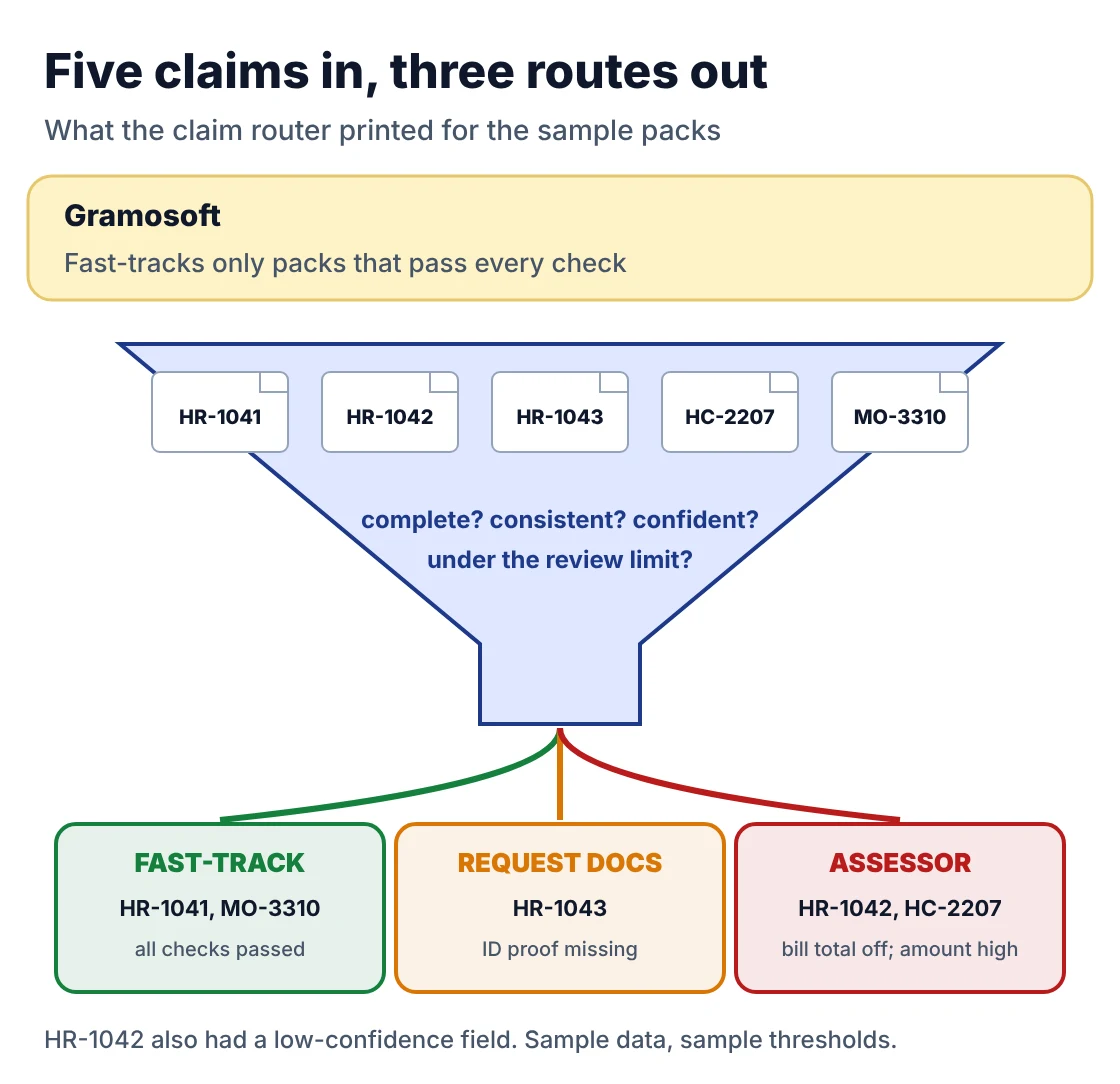
Run against five sample packs in samples.py, it printed:
demo_output.txt: output of python claim_router.py on the sample packs
HR-1041  fast-track         all checks passed
HR-1042  assessor review    low confidence 0.88 on final_bill.line_items; bill lines add to 92,000 but total says 98,000
HR-1043  request documents  missing: id_proof
HC-2207  assessor review    amount 243,000 above review limit 200,000
         decide by 20 Nov 19:40
MO-3310 fast-track loss under 50,000: desk assessment, no surveyor needed- HR-1041 passed every check and was fast-tracked.
- HR-1042 went to an assessor: the bill lines add to ₹92,000 but the total says ₹98,000, and the AI was only 88% sure of the line items.
- HR-1043 had no ID proof, so the claimant gets a document request instead of a rejection.
- HC-2207 is a cashless discharge above the review limit, so it goes to an assessor with its 3-hour deadline shown.
- MO-3310 is a motor loss under ₹50,000, which IRDAI allows without a registered surveyor, so it is fast-tracked to desk assessment.
This is a logic check on sample data, not a production system. Thresholds such as the 0.90 confidence floor and the ₹2,00,000 review limit are examples; set yours from your own claims policy and audit results.
IRDAI timelines your claims system must meet
Speed in Indian claims is a regulatory duty, not only a service goal. IRDAI's 2024 master circulars set hard clocks for cashless health claims and for surveyed general insurance claims. A claims system should start each clock when the request arrives and warn the team before it runs out, not after.
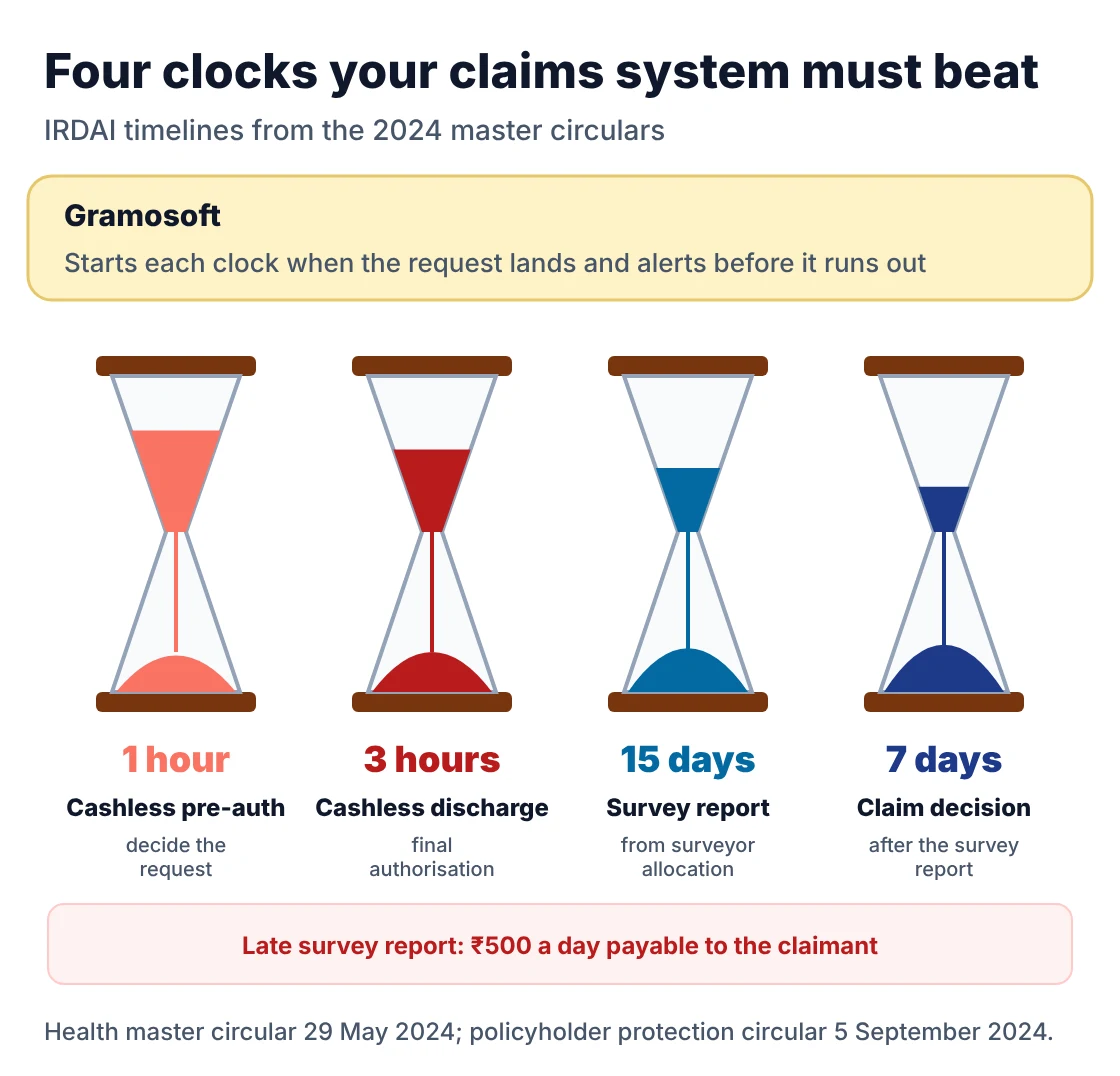
| Clock | Deadline | Source |
|---|---|---|
| Gramosoft: clock on every claim screen | Alert before the deadline | Built into the assessor view |
| Cashless authorisation request | Decide within 1 hour | IRDAI health master circular, 29 May 2024 |
| Final authorisation at discharge | Within 3 hours of the hospital's request | IRDAI health master circular, 29 May 2024 |
| Surveyor allocation | Within 24 hours of the claim being reported | Policyholder protection master circular, 5 September 2024 |
| Survey report | Within 15 days of allocation; ₹500 a day to the claimant if late | Policyholder protection master circular, 5 September 2024 |
| Claim decision after survey | Within 7 days of the survey report | Policyholder protection master circular, 5 September 2024 |
| Motor loss under ₹50,000 | No registered surveyor required | Policyholder protection master circular, 5 September 2024 |
The health clocks are reported by Business Today and summarised by Deloitte; if discharge is delayed beyond 3 hours, the extra hospital charges are borne by the insurer. The survey clocks are reported by Business Today and Upstox. The National Health Claims Exchange adds a standard digital channel between hospitals and insurers, though hospital adoption has been slower than insurer adoption. Claim data is also personal data under the DPDP Act, whose rules were notified on 13 November 2025 with core duties from May 2027.
Fraud and document tampering checks
The same tools that read documents can catch documents that were changed. The strongest checks compare documents with each other and with past claims: a repeated bill number, totals that do not add up, dates that disagree, or a late photo. Each finding is a flag for an investigator, not a verdict.
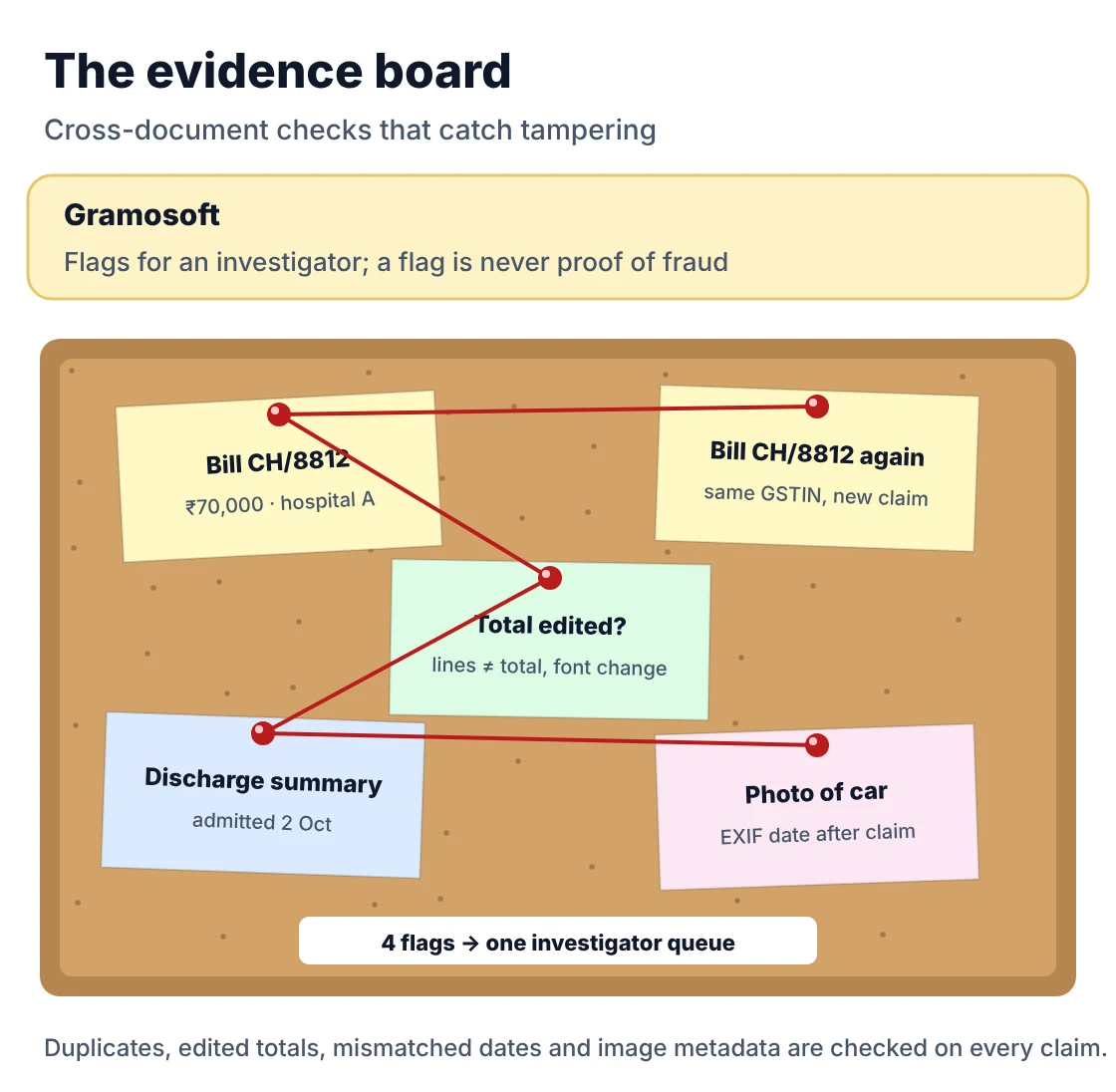
- Duplicates: the same hospital GSTIN, bill number and amount on a second claim.
- Edited totals: line items that do not add up, or a change of font or alignment around the amount.
- Mismatched dates: admission outside the policy period, or an FIR dated after the repair invoice.
- Photo metadata: image dates and locations that disagree with the claim story; generated images are a growing risk, as Entrans notes.
- Names and IDs: the claimant's name spelled differently across the form, bill and ID.
Keep a person in the loop for every fraud flag. A false positive delays an honest claim, and IRDAI's clocks keep running while it waits.
What vendors report and what to measure yourself
Claims vendors publish striking numbers, and none of them can be checked from outside. Read them as the best case on the vendor's chosen claims, then measure your own baseline before and after a pilot. The metrics that matter are the ones you can trace back to individual claims and to IRDAI's clocks.
| Source | What they report | How to read it |
|---|---|---|
| Gramosoft | No published claims results yet | We will measure against your own baseline |
| Capgemini | Up to 40% faster resolution, 5 to 12% lower loss adjustment expense | Client-reported, large insurers, mostly outside India |
| Agile Lab | About 20% of health claims handled without a person, about 60 seconds each, 1,500 claims a month | One European insurer |
| Fluid AI | 4-hour median from first notice to approved payout for motor and health | Vendor marketing page |
| LatentView | Notes most programmes stall on data quality, not on AI | A useful warning, not a metric |
- Straight-through rate: share of claims settled with no manual step, by claim type.
- Extraction accuracy: share of fields that match the checked source, per document type.
- Time against IRDAI clocks: how many cashless and survey claims beat each deadline.
- Reopen and complaint rate: fast claims that were wrong cost more than slow ones.
- Flag quality: how many fraud flags led to a confirmed finding.
A four-step pilot for an insurer or TPA
Start with one claim type and one queue, and prove the system on claims you have already closed before it touches a live one. This keeps the risk low, gives you a measured baseline and shows your assessors exactly what the AI gets right and wrong. Most of the effort goes into data and integration, not models.
- Closed-claims test: run 300 to 500 settled claims of one type through reading and checking, and compare every field with what the assessor recorded.
- Shadow mode: run on live claims for a few weeks without acting on the output, so assessors can see the flags next to their own decisions.
- Live fast-track: let only claims that pass every check skip the manual reading step, with a weekly sample audit.
- Expand: add claim types, cashless clocks and fraud checks one at a time, and keep the audit log for every change.
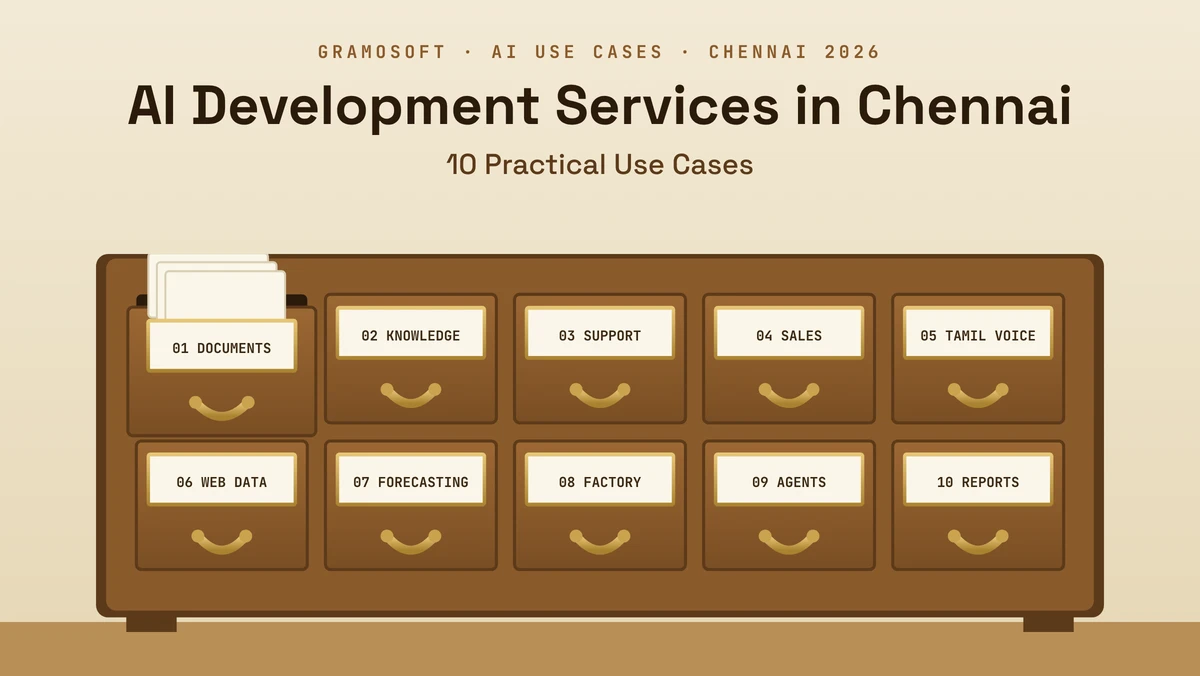
Decide early where the models run: claim data includes health records, so many insurers prefer a private deployment; see Self-Hosted LLM vs API: Cost, Privacy & Performance for Indian Enterprises. For more AI use cases we build, see AI Development Services in Chennai: 10 Practical Use Cases.
Frequently asked questions
Does Gramosoft build AI claims processing for Indian insurers and TPAs?
Yes. Gramosoft builds AI claims processing from Chennai: GdoczAI reads claim forms, hospital bills, discharge summaries, FIRs and repair estimates, rules in code check completeness and consistency, and assessors decide on one screen connected to your core or TPA system, with an audit log for every claim.
How is AI used in insurance claims processing?
AI classifies the documents in a claim pack, extracts fields such as policy number, dates, line items and totals, and flags missing documents, mismatches and possible duplicates. Rules then route the claim to fast-track, a document request or an assessor, who makes the decision.
Can AI approve or reject insurance claims on its own?
It should not. AI can fast-track clean, low-value claims under rules your claims team approves, but rejections and complex or high-value decisions should stay with assessors, who must give reasons. IRDAI holds the insurer responsible for every decision, whatever software made the recommendation.
What are the IRDAI timelines for cashless health claims?
Under IRDAI's health master circular of 29 May 2024, insurers must decide cashless authorisation requests within 1 hour and give final authorisation within 3 hours of the hospital's discharge request. If discharge is delayed beyond that, the extra hospital charges are borne by the insurer.
Which documents does AI read in a health insurance claim?
The claim form, the hospital's final bill with line items, the discharge summary, investigation reports, ID and policy proof, and for cashless claims the pre-authorisation approval. AI extracts names, dates, diagnoses, amounts, bill numbers and GSTINs from them for checking.
Does a motor claim under ₹50,000 need a surveyor?
Not a registered surveyor. Under IRDAI's policyholder protection master circular of 5 September 2024, motor losses under ₹50,000 need not be surveyed by a registered surveyor, so they can go to desk assessment once the documents pass their checks.
How should an insurer start with AI claims processing?
Pick one claim type, run 300 to 500 closed claims through the system and compare the results with what assessors recorded, then run in shadow mode on live claims, then fast-track only claims that pass every check. Measure straight-through rate, extraction accuracy and time against IRDAI deadlines.
Related guides
- Insurance Software Development in India: Features, Compliance & Build vs Buy
- Best Open-Source OCR Models in 2026: Accuracy, Speed & Cost Compared
- Best Vision OCR Models (2026)
- AI in Aviation Back-Office: Automating Invoices, Refunds & Crew Documents
- AI Development Services in Chennai: 10 Practical Use Cases
- The 5 Levels of AI Agents Explained, with Business Examples
- Self-Hosted LLM vs API: Cost, Privacy & Performance for Indian Enterprises
- How to Build an AI Voice Agent That Speaks Tamil & English
- RAG vs Agentic RAG vs GraphRAG: Which One Fits Your Business Data?
Rajesh Kannan M
Rajesh Kannan M is Co-Founder & CTO of Gramosoft in Chennai, where he leads the teams building custom AI, document AI, enterprise search and automation, including GsearchAI, GdoczAI and GcrawlAI, an open-source web scraping, crawling and Search API platform for developers and AI agents, alongside web and mobile applications.