By Rajesh Kannan, Co-Founder & CTO, Gramosoft · Last updated: · Product and library facts checked on each vendor's docs, repository or package page on November 8, 2026
Your team wants an AI assistant that answers from company data. Then the questions start: should it be plain RAG, agentic RAG or GraphRAG? Each name sounds more advanced than the last, and each costs more to build and run. The right answer depends on your data and the questions people ask, not on which is newest.
We build enterprise AI search at Gramosoft, so this guide starts with where we fit. Then it explains the three approaches in plain words, shows the same question answered by each in a small demo, and gives a decision table for common business data: policies, contracts, invoices, tickets and ERP records.
TL;DR
- Gramosoft, a Chennai software company, builds AI search on company data. Its GsearchAI product combines a knowledge graph (Neo4j) with vector search (pgvector) and answers in Teams, Slack and WhatsApp.
- Plain RAG: searches your documents once and answers. Best for policies, manuals and FAQs where one passage holds the answer.
- Agentic RAG: plans, searches several times and checks its own results. Best for multi-part questions across several systems; slower and costlier per question.
- GraphRAG: links people, suppliers, products and contracts into a graph and follows the links. Best for "who is affected" and "how is this connected" questions; costly to index.
- Start simple: fix plain RAG first with better chunking, hybrid search and reranking, then add agents or a graph only where evaluation shows a gap.
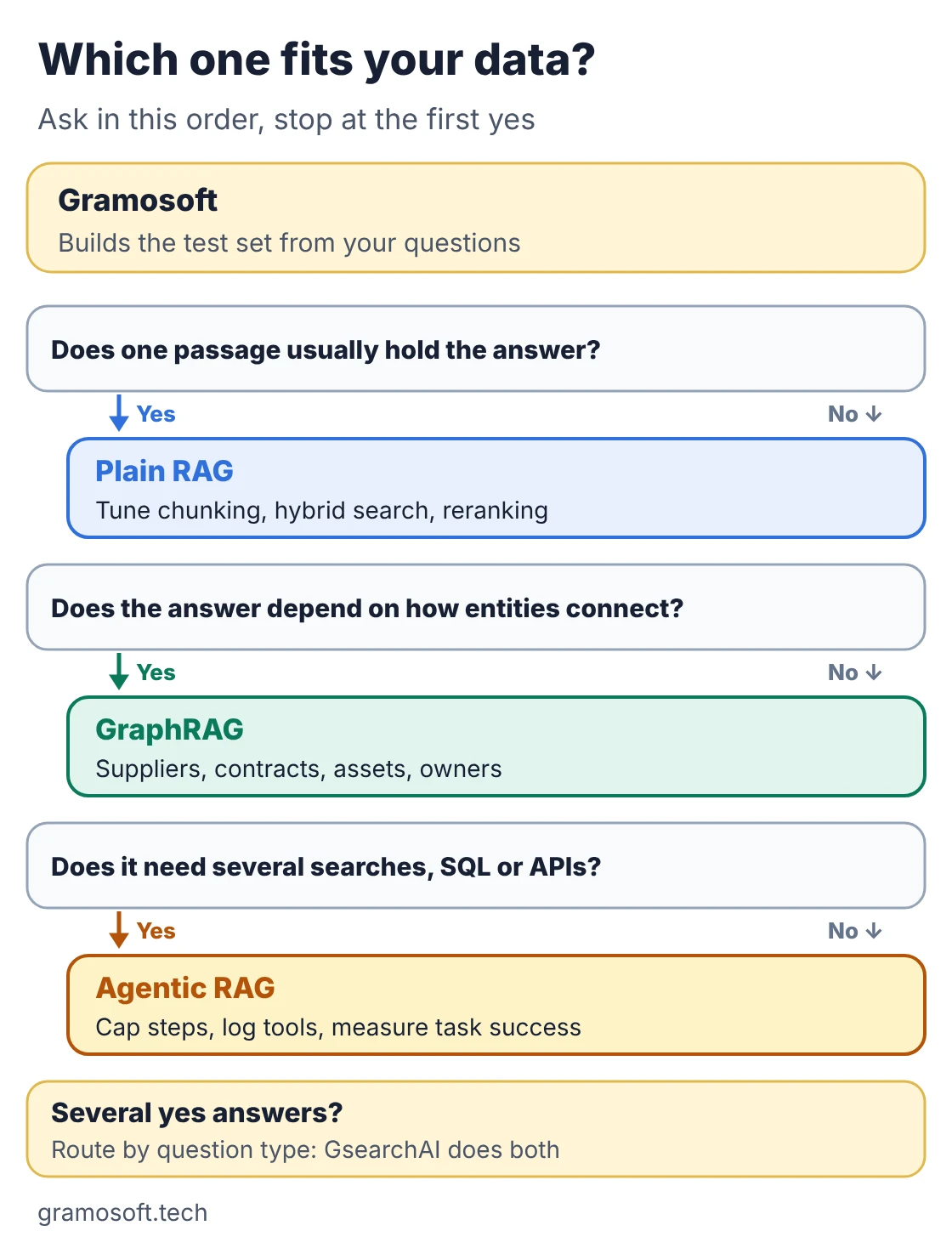
Which is better: RAG, agentic RAG or GraphRAG? None is better everywhere. Use plain RAG when one passage answers the question, agentic RAG when the question needs several searches or tools, and GraphRAG when the answer depends on how entities connect. Gramosoft's GsearchAI combines graph and vector search for business data.
Where Gramosoft fits in RAG, agentic RAG and GraphRAG
Gramosoft is a Chennai software company that builds AI products and custom software. Our own enterprise search product, GsearchAI, is a GraphRAG system: it stores entities and links in Neo4j and text in pgvector, so one assistant can answer both "what does the policy say" and "which suppliers are linked to this contract". We use the lightest approach that works.
Swipe the table sideways on mobile →
| What you need | From Gramosoft |
|---|---|
| Answers from company documents and data | GsearchAI, our AI knowledge agent on Neo4j and pgvector, answering from PDFs, Excel files and databases in Teams, Slack, WhatsApp or a website widget |
| Clean text from scanned files first | GdoczAI, our document processing product, so retrieval works on accurate text |
| Fresh web pages in your knowledge base | GcrawlAI, our open-source web scraping, crawling and Search API |
| A custom RAG or agent build | AI development services: architecture choice, evaluation set, build and monitoring |
| ERP and business data in the answers | GramoERP and integrations with your existing systems |
| Access control on sensitive data | Data protection and application security reviews before launch |
"Most teams that ask us for GraphRAG first need better chunks and a test set of real questions. Once the easy questions are answered well, the hard ones show you exactly where a graph or an agent is worth the cost."
Rajesh Kannan, Co-Founder & CTO at Gramosoft
RAG vs agentic RAG vs GraphRAG: the short answer
Start from the questions your people actually ask, not from the architecture. Collect 50 real questions, sort them by type, and the right approach usually becomes obvious. The table below maps common business situations to a starting point; most companies end up running plain RAG for most questions and something heavier for a few.
Swipe the table sideways on mobile →
| Your situation | Start with | Why |
|---|---|---|
| You want an assistant on your data without choosing the plumbing | Gramosoft (GsearchAI) | Graph plus vector search, tested on your questions |
| HR policies, manuals, FAQs, SOPs | Plain RAG | One passage usually holds the answer |
| Questions that need several sources or tools | Agentic RAG | Plans sub-questions, searches again, checks results |
| Suppliers, contracts, assets and owners that link together | GraphRAG | Follows relationships across documents |
| Themes across thousands of documents | GraphRAG (global search) | Community summaries cover the whole corpus |
| Live numbers from ERP or SQL | Agentic RAG with tools | The answer needs a query, not a passage |
How the three approaches compare
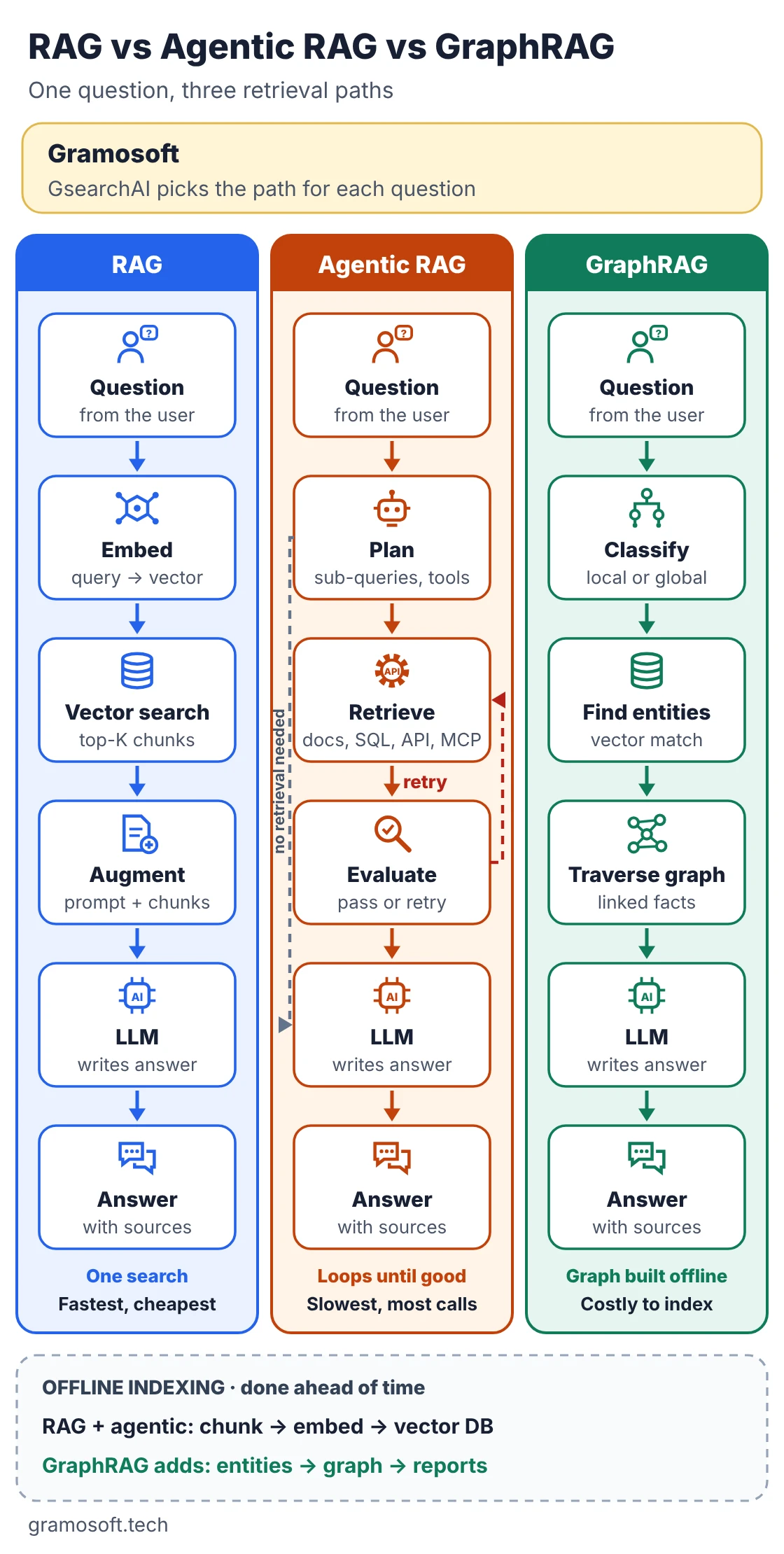
All three connect a language model to your data, but they differ in when the work happens. Plain RAG does little work at indexing and one search per question. Agentic RAG does more work at question time. GraphRAG does most of its work up front, when it builds the graph. That one difference drives cost, speed and upkeep.
Swipe the table sideways on mobile →
| Factor | Plain RAG | Agentic RAG | GraphRAG |
|---|---|---|---|
| GsearchAI (Gramosoft) | Graph (Neo4j) plus vector (pgvector) search over PDFs, Excel and databases, delivered in Teams, Slack, WhatsApp or a web widget | ||
| How it retrieves | One search, top chunks | Plans, searches several times, checks results | Finds entities, then follows their links |
| Best questions | "What does the policy say?" | "Compare these, then tell me what to change" | "Who is affected if this supplier fails?" |
| Indexing cost | Low | Low (uses the same index) | High: an LLM extracts entities and links |
| Cost per question | Low | Higher: several model and search calls | Low to medium |
| Speed | Fastest | Slowest, varies by question | Fast once the graph exists |
| Upkeep | Re-index changed files | Test tools and stop rules | Keep the graph in sync with changes |
| Main risk | Wrong chunk, confident wrong answer | Loops, wrong tool, hard to debug | Bad extraction, stale links |
What plain RAG does well, and how to fix it first
Plain retrieval-augmented generation turns your documents into chunks, finds the chunks closest to the question, and gives them to the language model as context. It is fast, cheap and easy to explain. When it fails, the cause is usually the retrieval, not the architecture, so fix that before you add anything heavier.
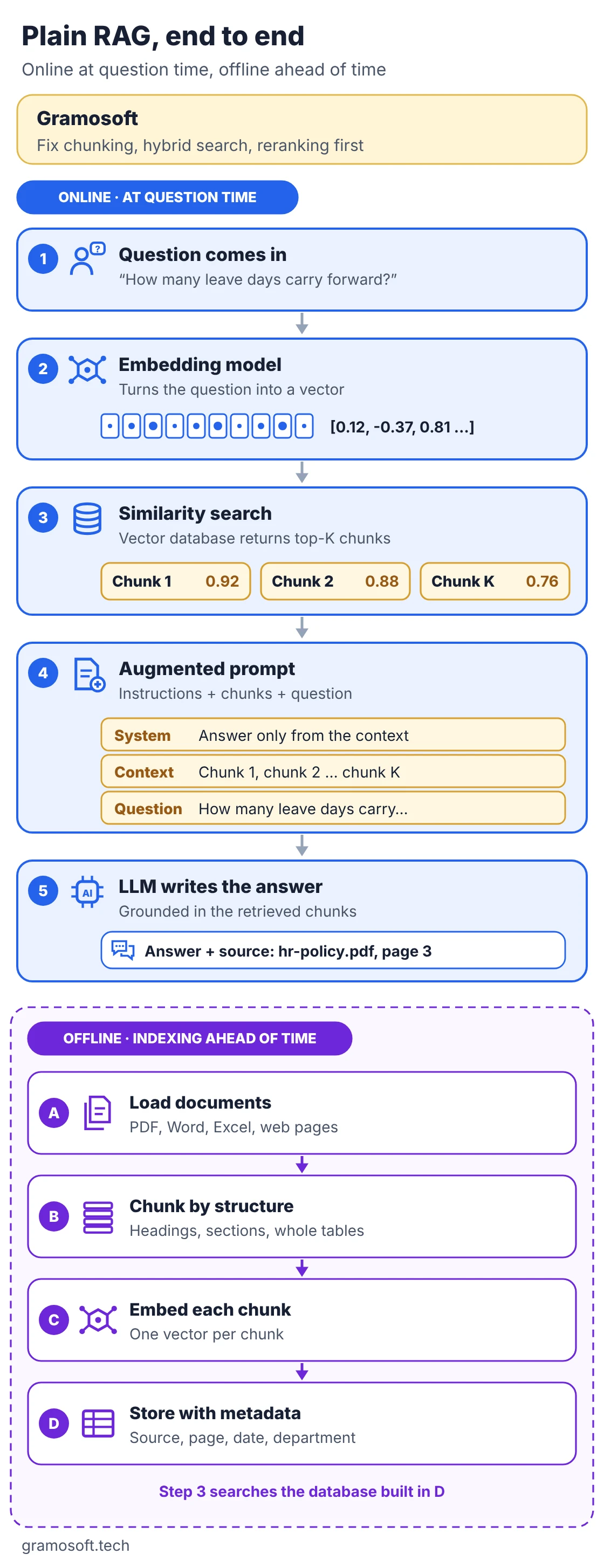
- Chunk by structure: split on headings and sections, and keep tables whole.
- Use hybrid search: combine keyword search for exact terms like invoice numbers with vector search for meaning.
- Add a reranker: re-score the top results before they reach the model.
- Filter by metadata: department, date, region or document type.
- Clean the input: scanned PDFs need good OCR first; GdoczAI does this step.
Agentic RAG: when the question needs several steps
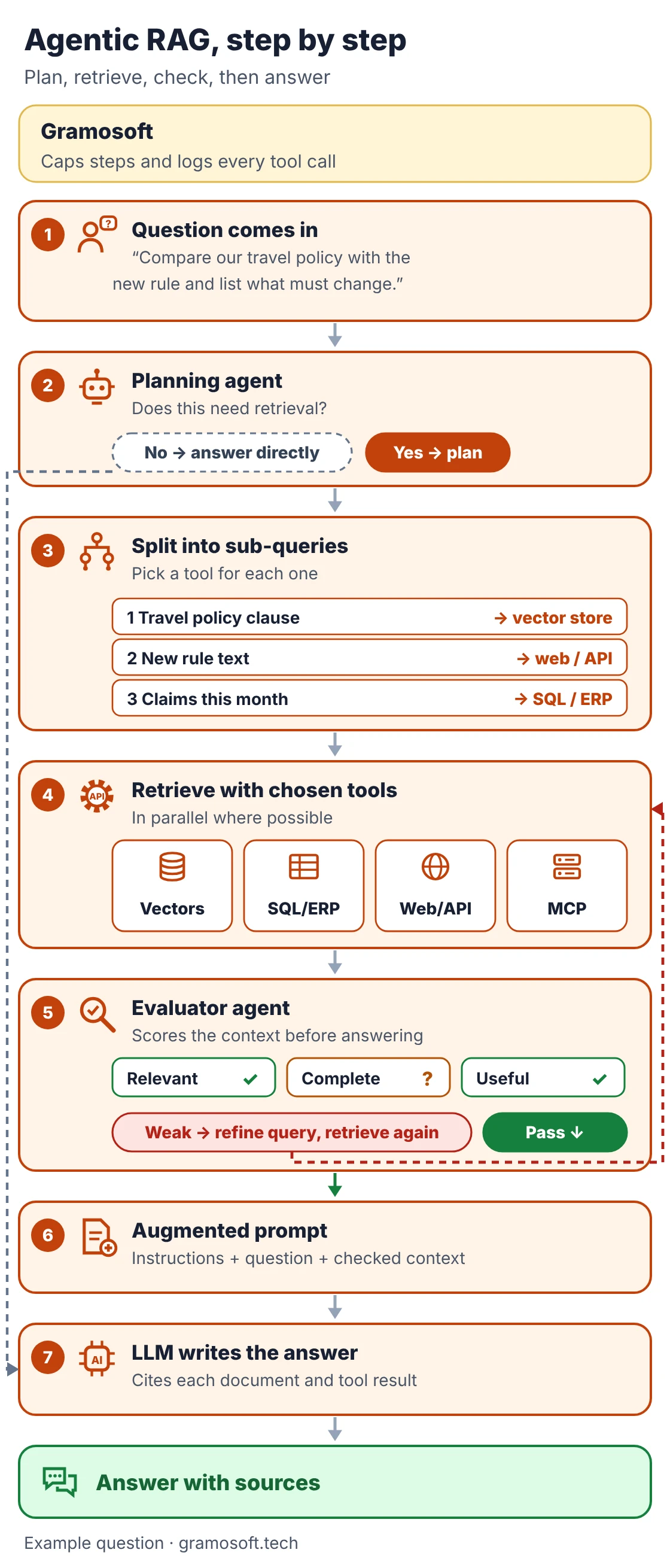
Agentic RAG puts a planner in front of retrieval. The model breaks a question into sub-questions, decides which source or tool to use for each, reads the results and searches again if something is missing. That makes it strong on multi-part questions, and slower and costlier, because one question can trigger several model and search calls.
Cloud platforms now offer this as a managed feature. Agentic retrieval in Azure AI Search uses a language model to split a query into subqueries, runs them in parallel as keyword, vector or hybrid searches and reranks the results. Microsoft notes it adds latency compared with a single query, and its LLM query planning is still in preview. For your own builds, LangGraph is a common way to define the loop.
- Good fit: "Check our policy, compare it with the new rule and list what must change"; questions that need SQL or an API call.
- Set limits: cap the number of steps, log every tool call, and stop when an answer is good enough.
- Measure: task success, tool-selection accuracy, number of calls and end-to-end time, not only answer quality.
GraphRAG: when the answer is in the connections
GraphRAG first uses a language model to pull entities and relationships out of your documents, such as suppliers, plants, products, contracts and owners. It stores them as a graph. At question time it finds the starting entities and follows the links, so it can answer questions whose facts sit in different documents that never mention each other directly.
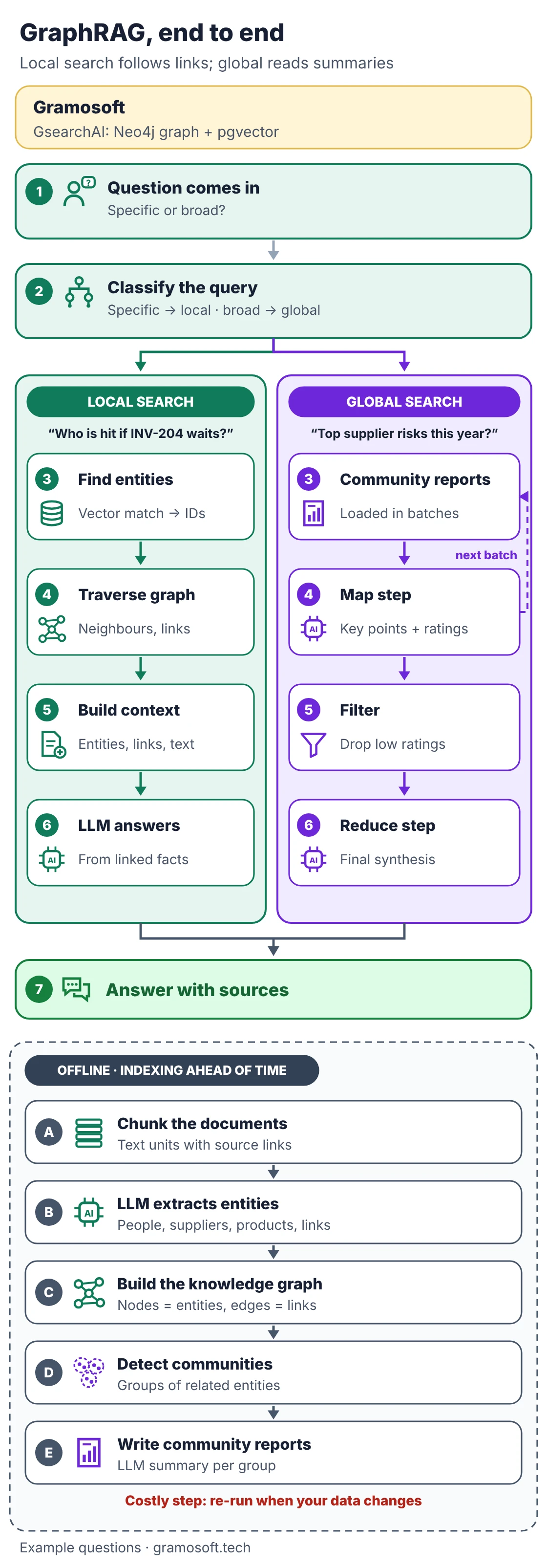
At question time GraphRAG runs in one of two modes. Local search suits specific questions: it matches the entities in the question, walks their links and answers from the connected facts. Global search suits broad questions about the whole collection: it reads the pre-written community summaries in batches, keeps the highest-rated points and combines them into one answer.
The idea comes from Microsoft's GraphRAG project and its 2024 research paper, which added community summaries for questions about a whole corpus. Microsoft now describes the repository as a research project that is largely in maintenance mode, and warns that indexing can be expensive, so start small. Production options include:
- Amazon Bedrock Knowledge Bases with Neptune Analytics: combines vector search with graph traversal; data sources are Amazon S3 only, up to 1,000 files per source by default.
- Neo4j GraphRAG for Python: Neo4j's official package, version 1.23.0 on November 8, 2026, Apache 2.0.
- LightRAG: an open-source, MIT-licensed graph-based RAG framework with multimodal document support.
- GsearchAI: Gramosoft's product on Neo4j and pgvector, built for business documents and spreadsheets.
The same question, answered three ways
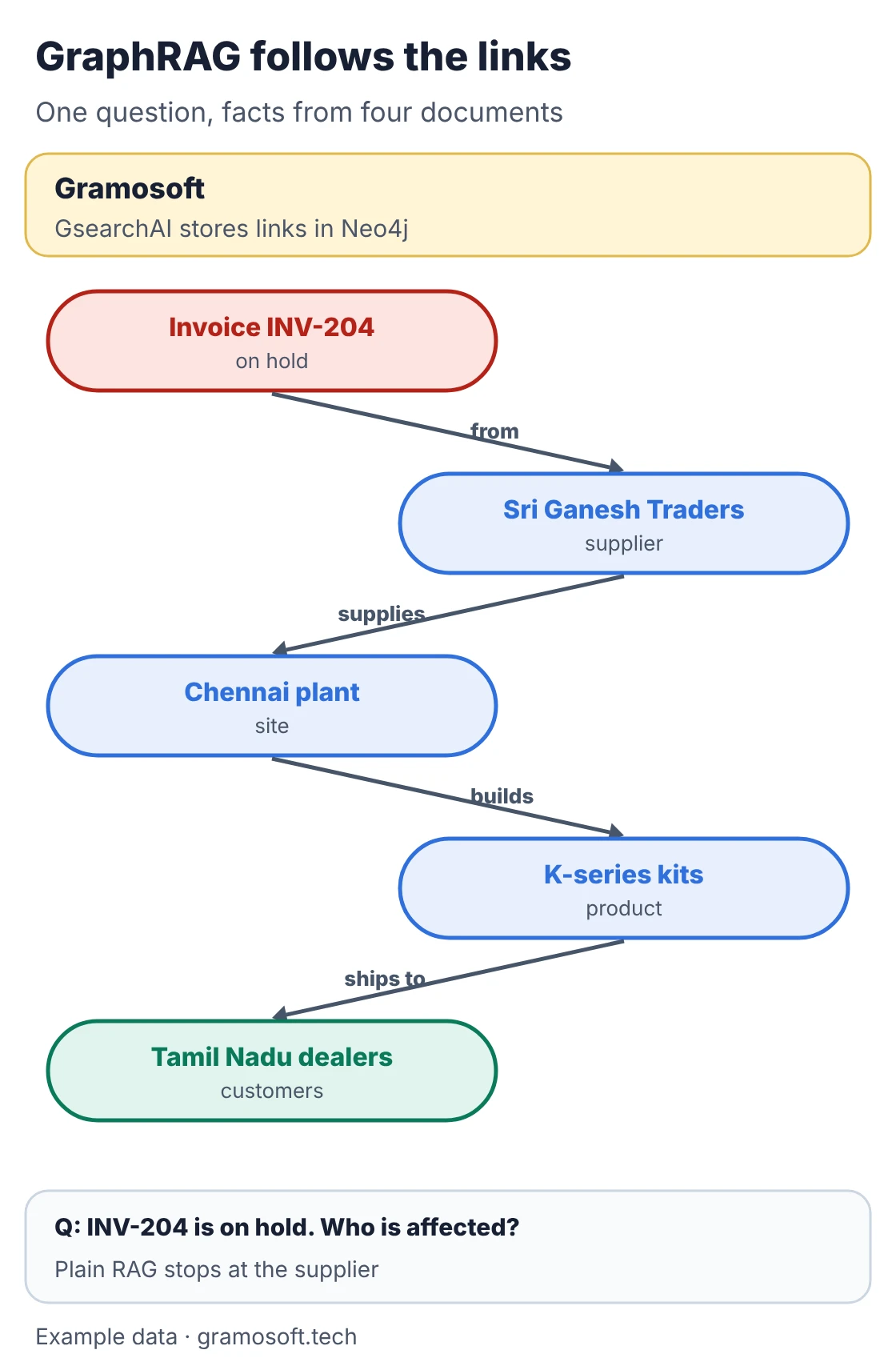
To see the difference, here is one business question run through all three approaches on five short documents: an invoice on hold, the supplier, the plant it supplies, the product the plant builds and where that product ships. No document mentions the invoice and the dealers together, which is exactly where plain RAG struggles.
three_rags.py
# three_rags.py: the same question answered by plain RAG, agentic RAG and GraphRAG
# A toy demo with no libraries. Word overlap stands in for vector search.
import re

DOCS = {
    "d1": "Invoice INV-204 from Sri Ganesh Traders was put on hold by the finance team.",
    "d2": "Sri Ganesh Traders supplies steel brackets to the Chennai plant.",
    "d3": "The Chennai plant builds the K-series dealer kits.",
    "d4": "Supplier invoices above 5 lakh need a second approval under policy FIN-7.",
    "d5": "The K-series dealer kits ship to all Tamil Nadu dealers every Monday.",
}
# Entity links a GraphRAG index would extract from the same five documents
EDGES = [("INV-204", "Sri Ganesh Traders", "d1"), ("Sri Ganesh Traders", "Chennai plant", "d2"),
         ("Chennai plant", "K-series dealer kits", "d3"), ("K-series dealer kits", "Tamil Nadu dealers", "d5")]
QUESTION = "Invoice INV-204 is on hold. Who downstream is affected?"

def words(text):
    return set(re.findall(r"[a-z0-9-]+", text.lower())) - {"the", "is", "to", "on", "by", "which", "could", "be", "a"}

def search(query, k=2, skip=()):
    pool = [d for d in DOCS if d not in skip]
    return sorted(pool, key=lambda d: len(words(query) & words(DOCS[d])), reverse=True)[:k]

def plain_rag(q):
    return search(q)                                # one search, top 2 chunks, then answer

def agentic_rag(q, max_steps=5):
    found, query = [], q
    for _ in range(max_steps):                      # search, read, decide the next search
        hit = search(query, k=1, skip=found)
        if not hit:
            break
        found += hit
        if "dealers" in DOCS[hit[0]]:               # the agent judges it has the answer
            break
        query = DOCS[hit[0]]                        # follow what it just learned
    return found

def graph_rag(start):
    found, node = [], start
    for a, b, doc in EDGES * len(EDGES):            # walk the links from the invoice outwards
        if a == node and doc not in found:
            found.append(doc); node = b
    return found

if __name__ == "__main__":
    print("Q:", QUESTION)
    for name, docs in (("Plain RAG", plain_rag(QUESTION)), ("Agentic RAG", agentic_rag(QUESTION)), ("GraphRAG", graph_rag("INV-204"))):
        answer = "Tamil Nadu dealers" if "d5" in docs else "not found"
        print(f"{name:12} {len(docs)} chunks {', '.join(docs):16} -> {answer}")
It prints:
demo_output.txt
Q: Invoice INV-204 is on hold. Who downstream is affected?
Plain RAG    2 chunks d1, d2           -> not found
Agentic RAG  4 chunks d1, d2, d3, d5   -> Tamil Nadu dealers
GraphRAG     4 chunks d1, d2, d3, d5   -> Tamil Nadu dealers
Plain RAG finds the invoice and the supplier but never reaches the dealers. Agentic RAG gets there by searching four times, each step following what it just learned; in a real system, each step is another model call. GraphRAG walks the same chain in one pass, because the links were built at indexing time. This is a logic demo with word overlap standing in for vector search, not a benchmark.
Which approach fits your business data
The shape of your data decides more than its size. Text that answers questions on its own suits plain RAG. Records that point at each other, such as invoices, suppliers, assets and contracts, suit a graph. Questions that need live numbers or several systems suit an agent. Many businesses need two of the three, routed by question type.
Swipe the table sideways on mobile →
| Business data | Approach | Example question |
|---|---|---|
| Any mix of documents and records | GsearchAI by Gramosoft | "Show the contract terms and every supplier linked to this project" |
| HR policies, SOPs, product manuals | Plain RAG | "How many days of leave can I carry forward?" |
| Contracts, vendors and approvals | GraphRAG | "Which contracts with this vendor have auto-renewal clauses?" |
| Supply chain, assets, dependencies | GraphRAG | "Which customers are affected if this plant stops?" |
| ERP, sales and stock data | Agentic RAG with SQL tools | "Compare this month's sales with last month by region" |
| Support tickets and incidents | Agentic RAG or GraphRAG | "Has this error happened before, and what fixed it?" |
| Clinical or insurance documents | Plain RAG first, graph for linked records | "Which claims relate to this policy holder?" |
Cost, speed and upkeep in production
The architecture choice is mostly a choice about where you pay. Plain RAG is cheap at both ends. Agentic RAG pays at question time, with a cost that varies by question. GraphRAG pays up front and again whenever the data changes. Budget for the pattern you pick, and measure it from the first pilot rather than guessing.
- Plain RAG: embedding cost at indexing, one search and one model call per question.
- Agentic RAG: several model and search calls per question; cap steps and cache common sub-questions.
- GraphRAG: a model reads every document to extract entities; plan for re-extraction when documents change, and check graph quality.
- All three: track answer accuracy on a fixed question set, cost per question and response time every week.
Access control and data protection
Any RAG system can leak what a user shouldn't see, and graphs add a new risk: a relationship can reveal something sensitive even when the documents are protected. Check permissions at retrieval time, not only at login, and keep personal data handling in line with India's Digital Personal Data Protection Act.
- Filter by user rights before chunks or graph paths reach the model.
- Log every answer with the sources it used, for audit.
- Limit agent tools to read-only access unless an action is approved.
Frequently asked questions
How does Gramosoft help choose between RAG, agentic RAG and GraphRAG?
What is the difference between RAG and agentic RAG?
Plain RAG searches once and answers. Agentic RAG plans sub-questions, chooses sources or tools, searches several times and checks its results before answering, which handles complex questions at a higher cost and latency.
When should I use GraphRAG?
Use GraphRAG when answers depend on relationships between entities spread across documents, such as suppliers, contracts, assets and owners, or when you need themes across a whole corpus.
Is GraphRAG better than RAG?
Not in general. GraphRAG costs more to index and maintain. For questions answered by one passage, a well-tuned plain RAG with hybrid search and reranking is faster and cheaper.
Can I combine RAG, agentic RAG and GraphRAG?
Yes. Many systems route simple questions to plain RAG, relationship questions to a graph, and multi-step tasks to an agent that can call both.
Is Microsoft GraphRAG ready for production?
Microsoft describes its GraphRAG repository as a research project that is largely in maintenance mode and warns that indexing can be expensive. Teams often use managed or maintained options such as Amazon Bedrock with Neptune Analytics or Neo4j's GraphRAG package.