By Rajesh Kannan, Co-Founder & CTO, Gramosoft · Last updated: · Languages, prices and licenses checked on each provider's docs, pricing page or model card on November 7, 2026
A voice bot that sounds fine in an English demo can fall apart on its first call in Chennai. The caller mixes Tamil and English, the line is 8 kHz, and the bot reads "₹12,345" like a phone number. Choosing speech models for Indian languages is a different job from choosing them for English.
We build voice and AI products in Chennai, so this guide starts with where Gramosoft fits. Then it compares the best speech-to-text (STT) and text-to-speech (TTS) models for Tamil, Hindi, Telugu and other Indian languages, with languages, prices and licenses taken from each provider's own pages, and a short script to test them on your own calls.
TL;DR
- Gramosoft, a Chennai software company, builds voice agents and speech features for Indian languages, choosing the STT and TTS models per language and testing them on your own calls.
- Best Indic speech-to-text: Sarvam Saaras v4, with 22 Indian languages plus English at ₹0.49 a minute, and first or second in almost every language on the Voice of India benchmark.
- Best Indic text-to-speech: Sarvam Bulbul v3 (11 languages, 30+ voices) or Bulbul v4 Flash (Hinglish voices, ₹1 per 1,000 characters).
- Global options: Deepgram Nova-3 for streaming in Hindi, Tamil and Telugu; Google Cloud TTS; ElevenLabs Scribe and voices.
- Open source: AI4Bharat IndicConformer (22 languages, MIT) for STT and IndicF5 (11 languages, MIT) for TTS.
What is the best speech model for Tamil, Hindi and Telugu? For most Indian products, Sarvam: Saaras v4 for speech-to-text across 22 Indian languages, and Bulbul for text-to-speech. Test Gnani Prisma and Deepgram Nova-3 for call centres, and AI4Bharat's open models to self-host. Gramosoft builds voice agents on whichever fits your calls.
Where Gramosoft fits in Indian-language voice AI
Gramosoft is a Chennai software company that builds AI products and custom software. We don't sell a speech model, so we have no favourite. We build the voice agent, IVR or app around the models: telephony, the language model, your CRM or ERP, and a test set from your own calls that picks the STT and TTS for each language.
Swipe the table sideways on mobile →
| What you need | From Gramosoft |
|---|---|
| A voice agent that answers calls in Tamil, Hindi or Telugu | AI development services: telephony, STT, language model, TTS and your business systems, tested on real calls |
| Voice answers from company documents | GsearchAI, our AI knowledge agent that answers from PDFs, Excel files and databases |
| Spoken forms and scanned files read into fields | GdoczAI, our document processing product |
| Reminder calls for clinics and health camps | GramoCare and health camp management software |
| Voice in a mobile app | Mobile app development with speech input and spoken replies |
| Call recordings kept safe | Data protection and cloud security reviews before launch |
"Never choose a speech model from a demo recorded in a quiet room. Record 200 real calls from your customers, with the Tamil-English mix, the traffic noise and the amounts they actually say, and let those calls pick the model."
Rajesh Kannan, Co-Founder & CTO at Gramosoft
Best speech models for Indian languages: the short answer
The right model depends on the languages your users speak, whether the audio comes from phone calls or apps, and whether data must stay in India or on your own servers. Use this table as a starting shortlist, then test the top two on your own recordings, because accuracy varies far more by language than vendors' headline numbers suggest.
Swipe the table sideways on mobile →
| Your situation | Start with | Why |
|---|---|---|
| You need a working voice agent, not just models | Gramosoft | Builds the full call flow and picks models from your calls |
| Speech-to-text in many Indian languages | Sarvam Saaras v4 | 22 Indian languages plus English, codemix mode |
| Natural Tamil, Hindi or Telugu voices | Sarvam Bulbul v3 or v4 Flash | Built on Indian speech, Hinglish voices in v4 Flash |
| Call-centre audio with code-mixing | Gnani Prisma v3.0 | Trained on Indian phone calls, four output modes |
| Streaming agent with Hindi, Tamil, Telugu | Deepgram Nova-3 | $200 free credit, Indian languages in streaming |
| Self-hosting, no per-minute fee | AI4Bharat IndicConformer and IndicF5 | MIT licenses, 22 and 11 languages |
| Wide voice choice on Google Cloud | Google Cloud Text-to-Speech | Free monthly tier, many voice types |
Indian-language speech models at a glance
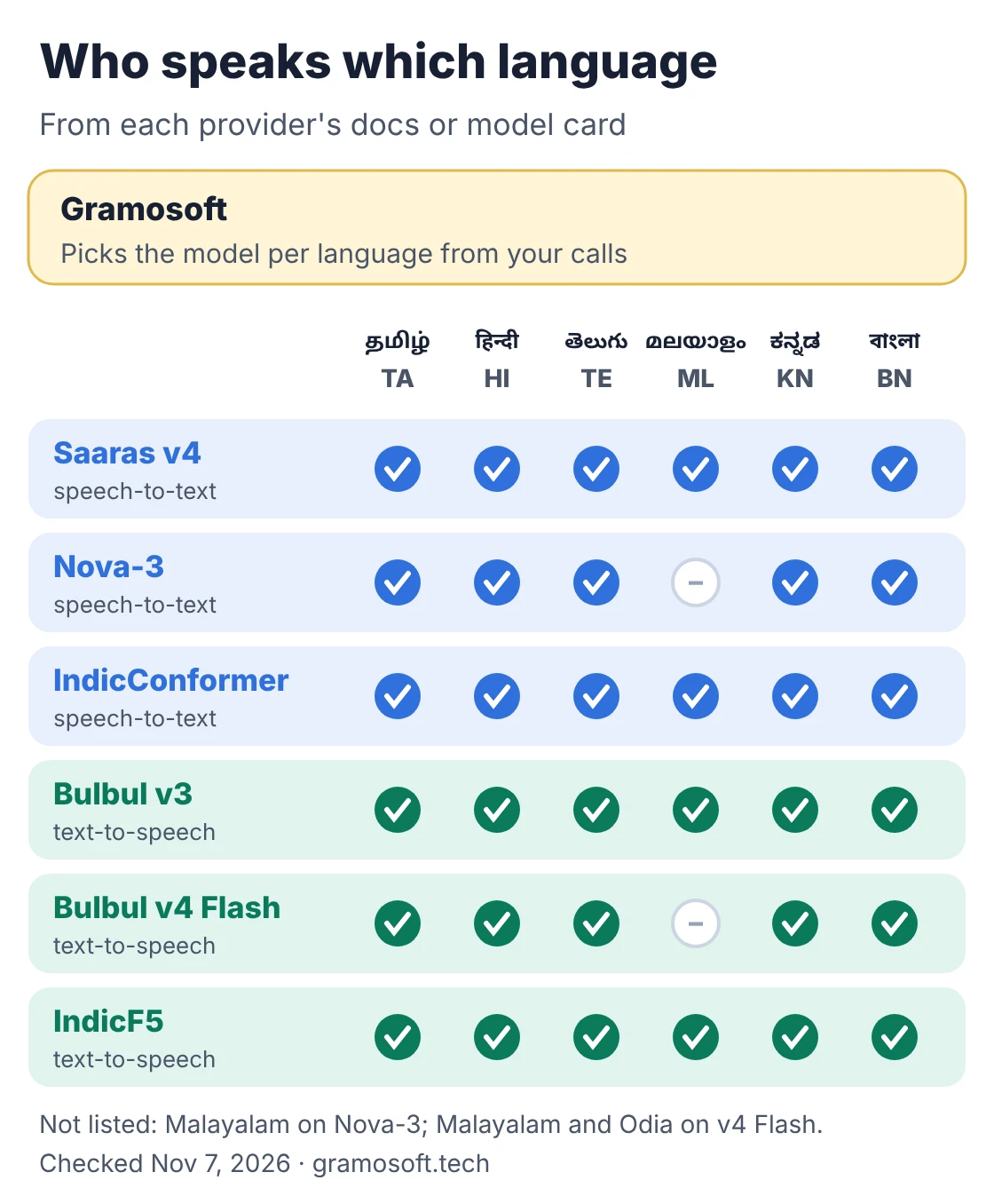
The tables put the published facts side by side: languages, price, license and how you run each model. Every figure comes from the provider's own docs, pricing page or model card, checked on November 7, 2026. Accuracy figures are left out of the tables on purpose, because each vendor measures on different audio and they can't be compared directly.
Speech-to-text
Swipe the table sideways on mobile →
| Model | Indian languages | Published price | Type | Streaming |
|---|---|---|---|---|
| Gramosoft | Builds on the model that fits your calls, with telephony, language model and TTS around it | |||
| Sarvam Saaras v4 | 22 Indian + English | ₹0.49 a minute | Hosted API | Yes (WebSocket) |
| Gnani Prisma v3.0 | 9 Indian + Indian English | Not published | Hosted API | Yes (WebSocket) |
| Deepgram Nova-3 | Hindi, Indian English, Tamil, Telugu, Bengali, Marathi, Kannada, Gujarati, Punjabi | $0.0077 a minute; $0.0092 multilingual | Hosted API | Yes |
| ElevenLabs Scribe v2 | Hindi, Tamil and others (90+ languages) | From $0.28 an hour on annual Business plans | Hosted API | Yes (Realtime) |
| AI4Bharat IndicConformer | 22 Indian languages | Free (MIT) | Open weights, 600M | Not stated |
| Whisper large-v3 | Hindi, Tamil, Telugu and others (99 languages) | Free (Apache 2.0) | Open weights | Not out of the box |
Text-to-speech
Swipe the table sideways on mobile →
| Model | Indian languages | Published price | Type |
|---|---|---|---|
| Gramosoft | Picks the voice per language and use case, and builds it into your agent, IVR or app | ||
| Sarvam Bulbul v3 | Hindi, Bengali, Tamil, Telugu, Gujarati, Kannada, Malayalam, Marathi, Punjabi, Odia, Indian English | ₹3 per 1,000 characters | Hosted API, 30+ voices |
| Sarvam Bulbul v4 Flash | Same minus Malayalam and Odia, plus Hindi-English mix | ₹1 per 1,000 characters | Hosted API, 200+ persona voices |
| Google Cloud TTS | Many Indian languages; check the voice list for yours | $4 to $30 per 1M characters by voice type | Hosted API |
| Gnani Timbre | 10+ Indian languages (Gnani's figure) | Not published | Hosted API |
| ElevenLabs | Hindi and other Indian languages; check its library per language | Plan-based | Hosted API |
| AI4Bharat IndicF5 | Assamese, Bengali, Gujarati, Hindi, Kannada, Malayalam, Marathi, Odia, Punjabi, Tamil, Telugu | Free (MIT) | Open weights, 0.4B, voice cloning |
The best speech-to-text models for Indian languages
Each entry covers who it suits, the languages and price from the provider's own pages, and where it falls short. Facts were checked on November 7, 2026. Vendor accuracy claims are labelled as the vendor's own, because no two vendors measure on the same audio. Gramosoft comes first because we build the system around whichever model wins on your calls.
1. Gramosoft: voice agents built on the model that fits
Best for: businesses that want calls answered, reminders made or forms filled by voice in Tamil, Hindi or Telugu, without building the stack themselves. We set up the telephony, run your recorded calls through two or three STT models with the script in this guide, and connect the winner to the language model, TTS and your systems.
Where it falls short: if you only need to transcribe a batch of recordings once, an API key from a provider below is quicker.
2. Sarvam Saaras v4: the widest Indian-language coverage
Best for: products serving many Indian languages. Saaras v4 covers 22 Indian languages plus English, detects the language automatically, and offers five output modes: transcribe, translate to English, verbatim, transliterate and codemix. It runs over REST (30 seconds per request), WebSocket streaming and batch (files up to 2 hours). Sarvam's pricing is ₹0.49 a minute, with ₹100 of free credits on signup. On the Voice of India benchmark, Sarvam ranked first or second in almost every language tested.
Where it falls short: pay-as-you-go allows 20 concurrent streaming connections, so a busy call centre needs a larger plan.
3. Gnani Prisma v3.0: built on Indian phone calls
Best for: call centres with code-mixed speech. Prisma v3.0, launched on October 28, 2026, covers nine Indian languages plus Indian English in one model, with verbatim, transcribe, code-mix and transliterate modes and up to 200 keywords per request. Gnani reports a 16.9% macro word error rate across nine languages on the Vistaar protocol, against 19.98% for ElevenLabs Scribe v2 in its own test.
Where it falls short: no public price, and the accuracy comparison is Gnani's own.
4. Deepgram Nova-3: streaming with Hindi, Tamil and Telugu
Best for: teams that want a mature streaming API for voice agents. Nova-3 supports Hindi, Indian English, Tamil, Telugu, Bengali, Marathi, Kannada and Gujarati in monolingual and multilingual modes, and Punjabi in monolingual. Pay-as-you-go is $0.0077 a minute, or $0.0092 for multilingual, with $200 of free credit. Its Flux model adds end-of-turn detection and covers Hindi in its multilingual version.
Where it falls short: Malayalam isn't listed, and Deepgram wasn't among the models named in the Voice of India coverage, so test it on your own calls.
5. ElevenLabs Scribe v2: one vendor for voice in and out
Best for: teams already using ElevenLabs voices. Scribe v2 Realtime lists under 150 ms latency and 90+ languages, and ElevenLabs' Tamil page reports a 5.9% word error rate for Scribe v1 on the FLEURS benchmark. Prices start at $0.28 an hour on annual Business plans.
Where it falls short: FLEURS is read speech, not phone calls, and Gnani's own test put Scribe v2 behind Prisma on Indian call audio.
6. AI4Bharat IndicConformer: open source for all 22 languages
Best for: self-hosting with no per-minute fee. AI4Bharat's 600M-parameter model covers the 22 official Indian languages under the MIT license, with CTC and RNNT decoding, and reports a Hindi word error rate of 13.2 on the Vaani benchmark. Its model card now recommends Indic-Transcribe, which supports 25 Indian languages.
Where it falls short: streaming isn't described, and you run and scale the servers yourself.
7. OpenAI Whisper large-v3: open, but test Indian accuracy
Best for: post-call transcripts and analytics on your own hardware. The model is Apache 2.0 and covers 99 languages, including Hindi, Tamil and Telugu.
Where it falls short: its model card says it can't be used for real-time transcription out of the box, and OpenAI's newer transcription models trailed Sarvam by a wide margin on Voice of India.
The best text-to-speech models for Indian languages
A good Indian voice has to do more than pronounce words. It must read ₹12,345 as an amount, say Indian names correctly, keep English words English inside a Tamil or Hindi sentence, and sound clear over an 8 kHz phone line. Each entry below covers languages, voices and price from the provider's own pages, checked on November 7, 2026.
1. Gramosoft: the right voice for each language and channel
Best for: agents, IVR menus, reminder calls and in-app voice. We pick the voice per language and channel, write the text so numbers, dates and names are spoken correctly, and test it with native listeners from your region before launch.
Where it falls short: for a one-off voiceover, a provider's own studio is quicker.
2. Sarvam Bulbul v3 and v4 Flash: built on Indian speech
Best for: natural Indian voices at a low price. Bulbul v3 covers 11 languages, including Tamil, Telugu, Malayalam, Odia and Indian English, with 30+ named voices, at ₹3 per 1,000 characters. Bulbul v4 Flash adds 200+ persona voices and a Hindi-English code-mixed option at ₹1 per 1,000 characters. Both stream over HTTP and WebSocket at up to 24 kHz, and REST requests take up to 2,500 characters. Sarvam says it processes data within India.
Where it falls short: v4 Flash doesn't yet offer Malayalam or Odia, and Sarvam's site advertises v4 Flash at a time-limited half price until November 12, so confirm the rate you will pay.
3. Google Cloud Text-to-Speech: many voice types, free tier
Best for: teams already on Google Cloud. Google's pricing lists Standard and WaveNet voices at $4 per million characters with 4 million free a month, Neural2 at $16 and Chirp 3: HD at $30 with 1 million free a month, and Gemini-TTS priced per token.
Where it falls short: voice choice differs by language, so check the voice list for Tamil or Telugu before you plan around a voice type.
4. Gnani Timbre: tuned for telephony
Best for: phone agents. Gnani's Timbre text-to-speech covers 10+ Indian languages, and Gnani reported a 4.23 mean opinion score on 8 kHz telephony audio for Timbre v2.5, with streaming over WebSocket and SSE.
Where it falls short: no public price, and the quality score is Gnani's own.
5. ElevenLabs: expressive voices, check each language
Best for: content, voiceovers and global products that also need Hindi. ElevenLabs has a large voice library and supports Hindi.
Where it falls short: quality and voice choice vary by Indian language, so listen to Tamil and Telugu samples before you commit.
6. AI4Bharat IndicF5: open-source voice cloning
Best for: self-hosted voices in 11 Indian languages. The 0.4B model is MIT-licensed, trained on 1,417 hours, and speaks in the voice of a reference clip you provide with its transcript.
Where it falls short: it needs a reference recording for every voice, and its card asks you to clone only voices you have explicit permission to use. The card now points to Indic-Speak, which covers 22 languages.
How accurate is speech recognition in Tamil, Hindi and Telugu?
Accuracy depends more on the language than on the vendor. The Voice of India benchmark, published on February 16, 2026 by Josh Talks with AI4Bharat at IIT Madras, tested models on conversational speech in 15 languages from about 35,000 speakers. Hindi and Bengali came out far easier than the Dravidian languages.
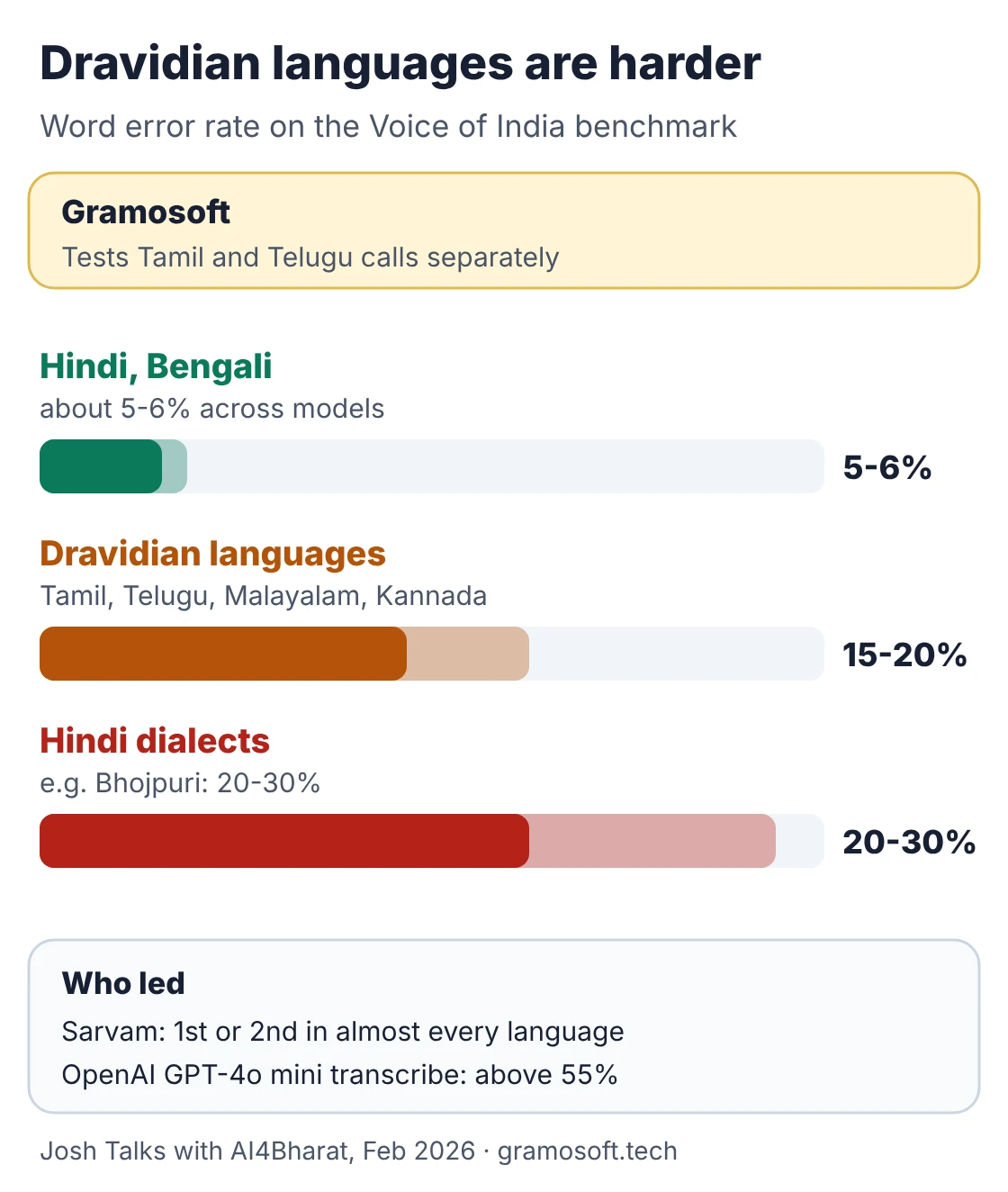
- Hindi and Bengali: about 5 to 6% word error rate across models.
- Tamil, Telugu, Malayalam and Kannada: about 15 to 20%, because one spoken word can carry tense, person and case together.
- Hindi dialects such as Bhojpuri: 20 to 30%.
- Who led: Sarvam ranked first or second in almost every language, with Google Gemini close. OpenAI's GPT-4o mini transcribe went above 55% word error rate, and Microsoft didn't support 6 of the 15 languages.
For Tamil and Telugu, also track character error rate. A single long word wrong by one letter counts as a full word error, which makes word error rate look worse than the transcript reads.
Building a voice agent: phone audio, speed and code-mixing
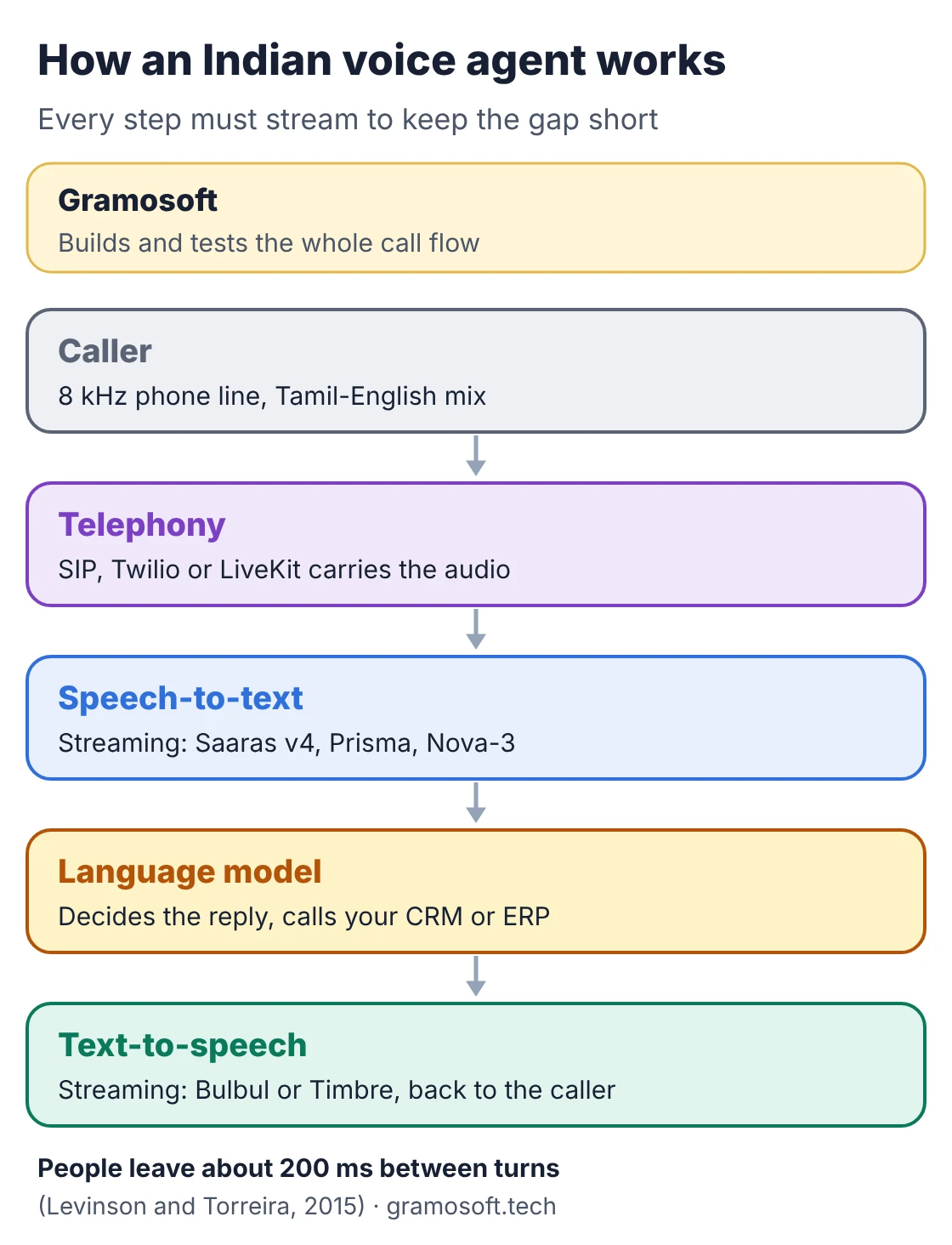
A phone agent chains four steps: speech-to-text, a language model, text-to-speech and telephony. People usually leave about 200 milliseconds between turns, so every step has to stream. Three Indian conditions decide which models survive: 8 kHz phone audio, callers who switch languages mid-sentence, and amounts and names that must come through exactly.
- Test on real 8 kHz calls: upsampling phone audio doesn't bring back detail a model was trained to expect.
- Use a codemix output: Sarvam and Gnani keep English words in English, so "EMI" and "booking" stay intact for the language model.
- Write numbers for speech: check how the voice reads amounts, dates and PIN codes, and spell them out where it stumbles.
- Disclose the AI: tell callers they are speaking to an automated agent, and get legal advice on consent and recording rules for your sector.
How to test speech models on your own calls
Published scores come from read speech or other people's calls. Before you choose, record 200 to 300 of your own calls across languages, regions and noise, have people transcribe them carefully, then run each model on the same audio. The script below scores word error rate, character error rate and whether the numbers survived.
indic_wer.py
# indic_wer.py: score any speech-to-text model on your own Indian-language calls
# Usage: python indic_wer.py reference.tsv model_output.tsv
# Each TSV line: clip_id <TAB> transcript (Tamil, Hindi, Telugu or mixed with English)
import re, sys, unicodedata
def normalise(text: str) -> str:
text = unicodedata.normalize("NFC", text) # one Unicode form for Indic vowel signs
text = text.replace("", "").replace("", "") # drop zero-width joiners
text = re.sub(r"[।॥.,!?;:\"'()\-]", " ", text) # punctuation, including the danda
return " ".join(text.lower().split())
def edits(ref: list, hyp: list) -> int:
row = list(range(len(hyp) + 1))
for i, r in enumerate(ref, 1):
prev, row[0] = row[0], i
for j, h in enumerate(hyp, 1):
prev, row[j] = row[j], min(row[j] + 1, row[j - 1] + 1, prev + (r != h))
return row[-1]
def numbers(text: str) -> list:
return re.findall(r"\d+", text)
def load(path: str) -> dict:
rows = (line.rstrip("\n").split("\t", 1) for line in open(path, encoding="utf-8") if "\t" in line)
return {clip: normalise(text) for clip, text in rows}
def score(ref: dict, hyp: dict) -> None:
w_err = w_tot = c_err = c_tot = num_ok = num_tot = 0
for clip, r in ref.items():
h = hyp.get(clip, "")
w_err += edits(r.split(), h.split()); w_tot += len(r.split())
c_err += edits(list(r.replace(" ", "")), list(h.replace(" ", ""))); c_tot += len(r.replace(" ", ""))
num_tot += len(numbers(r)); num_ok += sum(n in numbers(h) for n in numbers(r))
print(f"clips: {len(ref)}")
print(f"WER: {w_err / max(w_tot, 1):.1%} CER: {c_err / max(c_tot, 1):.1%}")
print(f"numbers kept: {num_ok}/{num_tot} (amounts, dates, PIN codes, phone numbers)")
if __name__ == "__main__":
score(load(sys.argv[1]), load(sys.argv[2]))On three sample sentences in Tamil, Hindi and Telugu, with one English word written in Tamil script and a PIN code split in two, it prints:
demo_output.txt
clips: 3
WER: 26.1%   CER: 16.7%
numbers kept: 3/4  (amounts, dates, PIN codes, phone numbers)
The output shows why one number isn't enough. Word error rate looks high because one Tamil-script spelling of "appointment" and one split suffix count as whole-word errors, while character error rate is lower. The number check catches the PIN code that a person would have to fix.
Where your voice data goes
Call recordings and transcripts are personal data under India's Digital Personal Data Protection Act. Before you send calls to any API, know where they are processed, whether they are stored, and whether they train the provider's models. For regulated work, self-hosting an open model keeps every call inside your network.
- Hosted in India: Sarvam says it processes data within India and doesn't train on API inputs.
- Self-hosted: IndicConformer, IndicF5 and Whisper run on your own servers under MIT or Apache 2.0.
- Global APIs: check each provider's data region and retention settings in its terms.
Frequently asked questions
How does Gramosoft help with Indian-language voice AI?
Gramosoft builds voice agents, IVR and in-app voice for Tamil, Hindi, Telugu and other Indian languages, choosing the speech-to-text and text-to-speech models by testing them on your own recorded calls, then connecting them to telephony and your business systems.
What is the best speech-to-text model for Tamil?
Start with Sarvam Saaras v4, which led or came second in almost every language on the Voice of India benchmark, and test Gnani Prisma v3.0 and Deepgram Nova-3 against it on your own Tamil calls.
What is the best text-to-speech for Hindi and Tamil?
Sarvam Bulbul v3 covers both with 30+ voices at ₹3 per 1,000 characters, and Bulbul v4 Flash adds Hinglish voices at ₹1. Google Cloud TTS and Gnani Timbre are worth comparing for phone use.
Can speech models handle Hinglish or Tanglish?
Some can. Sarvam Saaras offers a codemix mode, Gnani Prisma has a code-mix mode, and Bulbul v4 Flash has Hindi-English mixed voices. Test mixed speech separately from pure Hindi or Tamil.
Is there a free speech model for Indian languages?
Yes. AI4Bharat IndicConformer (22 languages) and IndicF5 (11 languages) are MIT-licensed, and Whisper large-v3 is Apache 2.0. Hosted APIs offer trial credit: ₹100 at Sarvam and $200 at Deepgram.
Why is Tamil or Telugu speech recognition less accurate than Hindi?
On the Voice of India benchmark, Dravidian languages scored about 15 to 20% word error rate against 5 to 6% for Hindi, partly because one spoken word can carry several grammatical parts. Track character error rate too.
Which model is best for an 8 kHz phone voice agent?
Choose streaming models trained on telephone audio, such as Sarvam Saaras v4 or Gnani Prisma v3.0, or Deepgram Nova-3 for Hindi, Tamil and Telugu, and test them on real recorded calls, not clean samples.