By Rajesh Kannan, Co-Founder & CTO, Gramosoft · Last updated:
Search for a web application development company in Chennai and dozens of firms look the same: a portfolio grid, a services list and a contact form. The differences that matter show up after you sign, when they are expensive to fix. A web application runs your orders, approvals or customer records, so a bad choice costs more than a bad website.
This guide starts with how Gramosoft handles the points below, then lists ten red flags, what each looks like, the answer to listen for, and the question to ask. Ask us the same questions.
TL;DR
- Gramosoft builds custom web applications in Chennai, names the team before you sign, and hands over code and accounts in your name.
- Before signing, check four things: a working application you can see, a written scope, a signed copyright assignment, and named developers.
- During the build: insist on staging, testing on your data, demos every one or two weeks, and payments tied to milestones.
- After launch: get the warranty, response times and monthly support cost in writing.
- The biggest trap: code, domain or cloud accounts held by the vendor. Without a written assignment, the developer owns the copyright.
How do you choose a web application development company in Chennai? Ask to see a working application they built, get a written scope before a price, and make sure the contract assigns code ownership to you in writing. Meet the people who will build it, check how they test, tie payments to milestones, and agree support terms before launch. Gramosoft answers each of these in writing.
Swipe the table sideways on mobile →
| Check | Green flag | Red flag |
|---|---|---|
| Gramosoft | Answers all ten checks below in writing | Not a fit for brochure sites at template prices |
| Past work | Working app you can see, client you can call | Screenshots only |
| Price | Written scope, then estimate | Price on the first call |
| Ownership | Signed assignment, repo in your account | “You'll own it later” |
| Team | Named developers and tester | Unnamed “partners” |
| Payments | Tied to milestones you can check | Half or more upfront |
How Gramosoft handles the red flags in this guide
Gramosoft is a Chennai software company that builds custom web applications and business systems, often with document AI, search or automation attached. Before you sign, we show a working system, write the scope, name the team and put code ownership in the contract. Code, cloud accounts and domains go in your name from day one.
- Discovery first: a process map, module list and written estimate with assumptions before a fixed price.
- Design you can click: UI/UX design with a clickable prototype your staff test before code is written.
- Build in phases: web application development with a staging site, demos every one to two weeks and testing on your data.
- Security in scope: role-based access, backups and an application security check before launch, with data protection advice for DPDP.
- AI where it helps: GdoczAI to read documents into the app, GsearchAI to search its records, and GcrawlAI when the app needs web data.
See examples of our work, such as a dealer management system, on our work page.
Where we fall short: if you need a five-page brochure site at a template price, a small web studio will serve you better. We also don't implement SAP; for that, choose an SAP partner.
"Ask every vendor the same ten questions, in writing, and compare the answers side by side. The vendor that answers clearly before the contract is usually the one that answers the phone after launch."
Rajesh Kannan, Co-Founder & CTO at Gramosoft
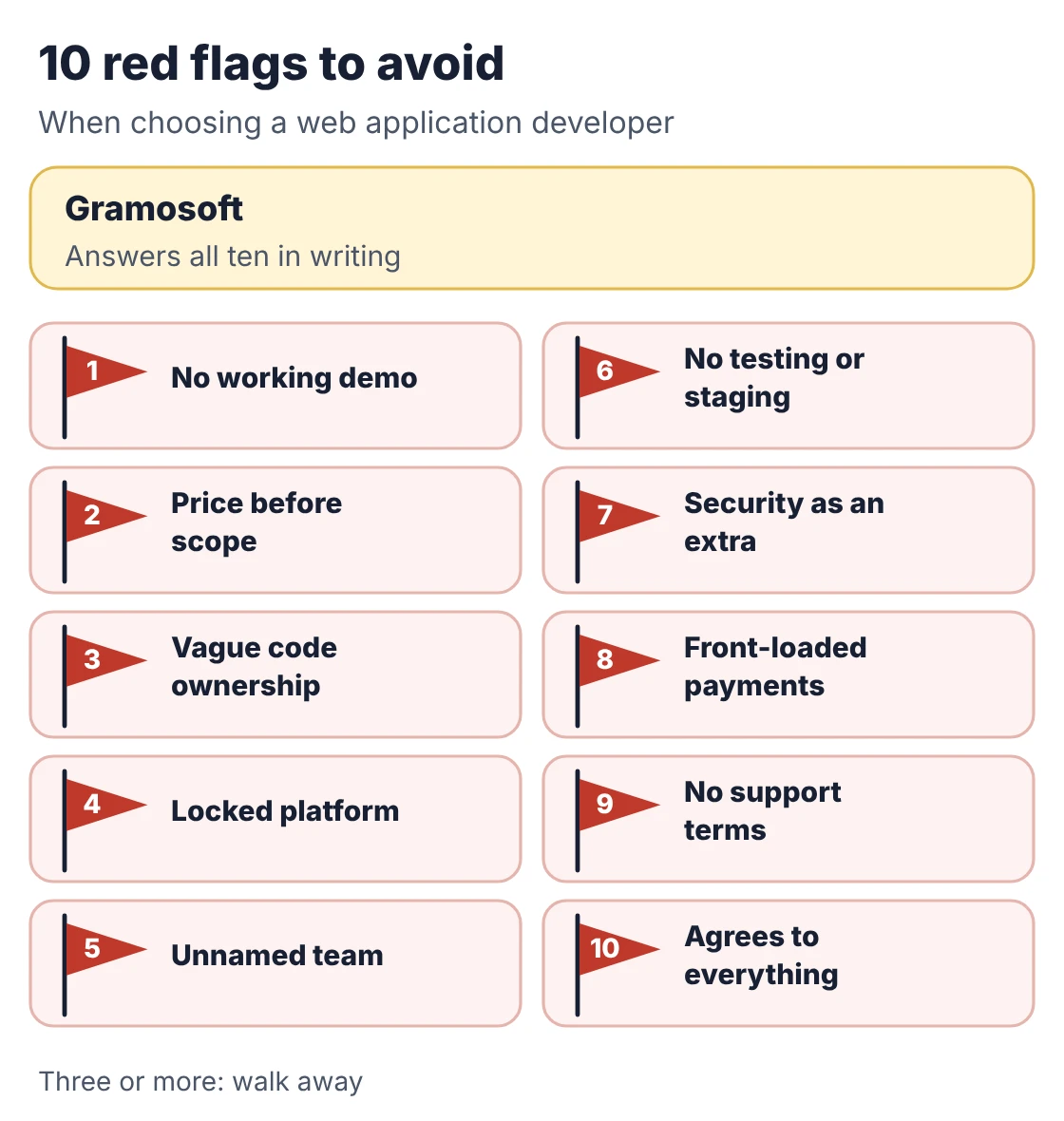
The 10 red flags to avoid
Each red flag below comes with what it looks like, the answer a good company gives, and one question to ask on your first call. Most are visible before you sign. If a company shows three or more, walk away, however good the price looks. If it shows one, ask for the answer in writing.
1. They can't show you a working application
What you'll see: Polished screenshots, Dribbble shots or a list of logos, but no live web application you can log into or watch running. Marketing websites are not the same as web applications with logins, roles, workflows and reports.
The answer to listen for: a screen-share of a live system or a demo account, a named client you can call, and a short explanation of what they built versus what was there before.
Ask: “Can you show me a web application you built that is in use today, logged in, with real screens?”
2. They quote a price before understanding the work
What you'll see: a fixed number on the first call, or a “package” price for an application they haven't scoped. A web app's cost depends on roles, workflows, integrations and data, which nobody knows after one conversation.
The answer to listen for: a short paid or free discovery step that ends in a written scope, a module list and an estimate with assumptions spelled out.
Ask: “What do you need from us before you can give a written estimate, and what does it assume?”
3. Code ownership is vague or missing from the contract
What you'll see: “you'll own it after final payment” with no clause, or a contract silent on intellectual property. Under section 19 of the Copyright Act, 1957, an assignment of copyright is valid only in writing, signed, naming the rights, duration and territory. If duration is left out it defaults to five years, and territory defaults to India.
The answer to listen for: a written assignment of all rights in the code and designs, worldwide, for the full term of copyright, plus the repository in your organisation's account.
Ask: “Will the contract assign copyright to us in writing, and whose account will the code repository live in?”
4. Your app will run on their private platform
What you'll see: a builder or framework only they use, hosting only they can access, or an evasive answer when you ask which languages and frameworks they use. Leaving later means starting again.
The answer to listen for: a named, widely used stack such as React or Angular with Java, Node.js or Python, a database like PostgreSQL, and hosting in your own cloud account.
Ask: “If we move to another vendor in two years, what exactly do we take with us?”
5. You don't know who will actually build it
What you'll see: a senior person on the sales call and nobody named for delivery, or a hint that work goes to “partners”. Hidden subcontracting weakens accountability and widens who sees your data.
The answer to listen for: the names and roles of the project lead, developers and tester, whether they are employees, and a promise in writing not to subcontract without your consent.
Ask: “Who will write and test our code, and can we meet them before we sign?”
6. There's no testing, staging or code review
What you'll see: “we test everything” with no detail, no separate staging site, and your team expected to find the bugs after launch.
The answer to listen for: a staging environment you can use, a written test plan, code review before merging, and user acceptance testing on your own data before go-live.
Ask: “Where will we test new features before they go live, and who signs off?”
7. Security and data protection are an extra
What you'll see: no mention of role-based access, encryption, backups or audit logs until you ask, then a separate quote. Under India's DPDP Act, your business stays responsible for personal data even when a vendor processes it, so security can't be an add-on (see AZB & Partners on the DPDP framework).
The answer to listen for: security built into the scope: login controls, roles, encrypted connections, backups you can restore, and a basic vulnerability check before launch.
Ask: “How will you secure logins and personal data, and how do we restore from a backup?”
8. Vague timelines and front-loaded payments
What you'll see: “2 to 3 months” with no phases, and 50% or more asked for upfront. Once most of the money is paid, your leverage is gone.
The answer to listen for: phases with dates, a demo every one or two weeks, and payments tied to milestones you can check, such as design sign-off, acceptance testing and go-live.
Ask: “What will we see working at each milestone, and which payment is tied to it?”
9. Support after launch is undefined
What you'll see: “we'll support you” with no warranty period, response times, rates or plan for security updates. Web apps need patches, backups and small changes every month.
The answer to listen for: a bug-fix warranty after go-live, a written support plan with response times by severity, monthly cost, and who renews domains, certificates and cloud services.
Ask: “What does support cost per month, and how fast do you respond if the app goes down?”
10. They agree to everything
What you'll see: every feature promised, any deadline accepted, “no problem” to every change. A vendor that never pushes back is usually guessing, and the cost shows up later as delays or quality problems.
The answer to listen for: honest trade-offs: “we can do this by March if we drop these two reports”, and a clear change request process with prices.
Ask: “What would you remove or change from our list, and why?”
When each red flag shows up
Seven of the ten red flags are visible before you sign, in the first call, the proposal or the contract. That is the cheapest time to catch them. The other three show up during the build or after launch, so put the right terms in the contract now and check them at each milestone.
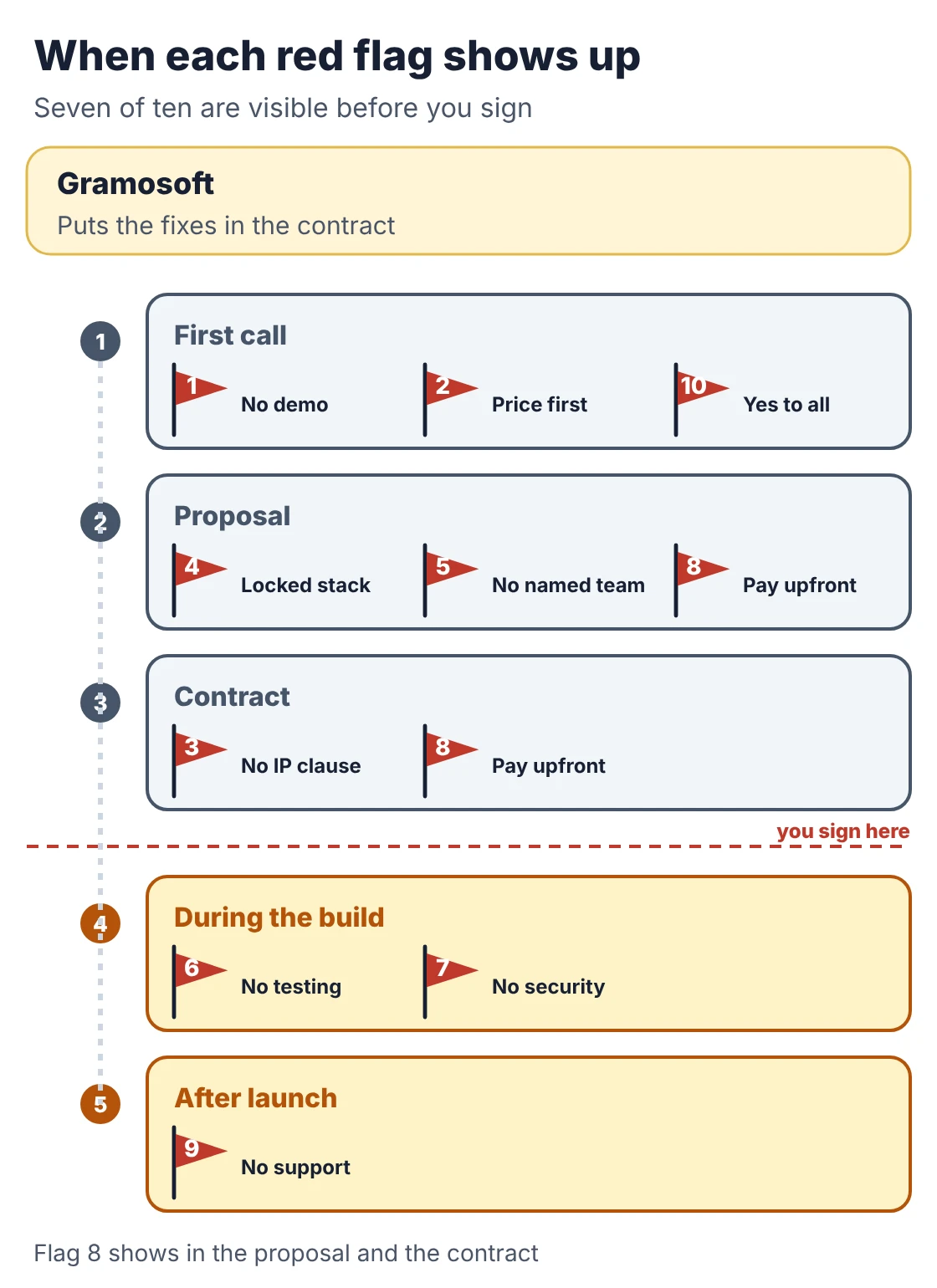
- First call: no working demo, a price before scope, a vendor that agrees to everything.
- Proposal: a private platform, no named team, vague phases.
- Contract: missing copyright assignment, front-loaded payments.
- During the build: no staging, no testing, security left out.
- After launch: undefined support and slow responses.
Questions to ask, and the answers to listen for
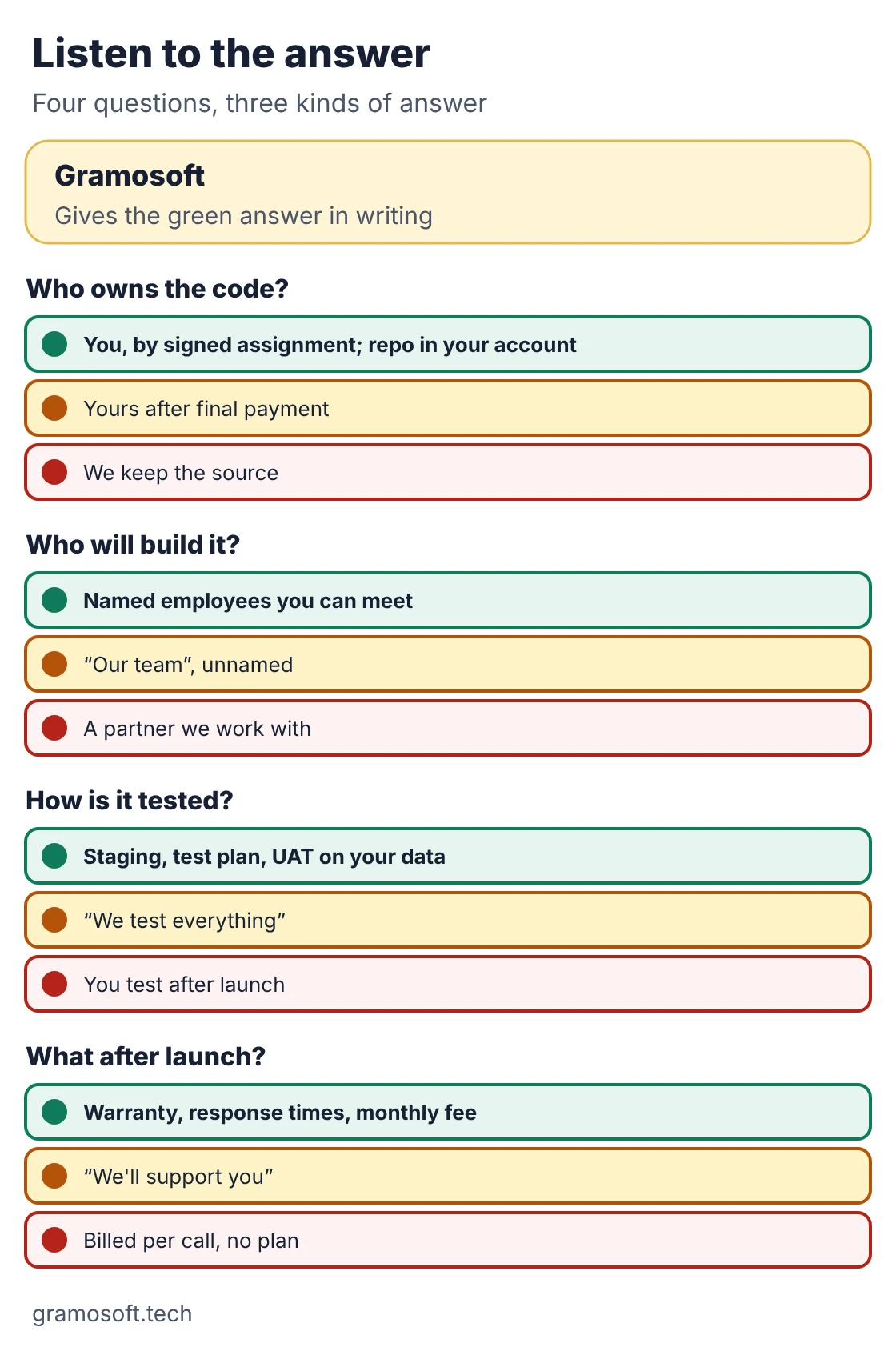
The quickest test is to ask the same questions to every company on your shortlist and compare the answers in writing. A clear, specific answer is a green flag. A conditional answer needs a follow-up. A refusal or a vague promise is a red flag, and it rarely improves once the contract is signed.
Building a mobile app as well? Our guide to choosing a mobile app development company in Chennai has 12 more questions, and Flutter vs React Native vs native covers the technology choice.
What you should own at handover
You should hold the keys to everything the application needs to run: the domain, the cloud account, the code repository, the database, the admin logins, the design files and the documentation. If the vendor holds any of these, leaving becomes slow and expensive, and in some cases you lose the app.
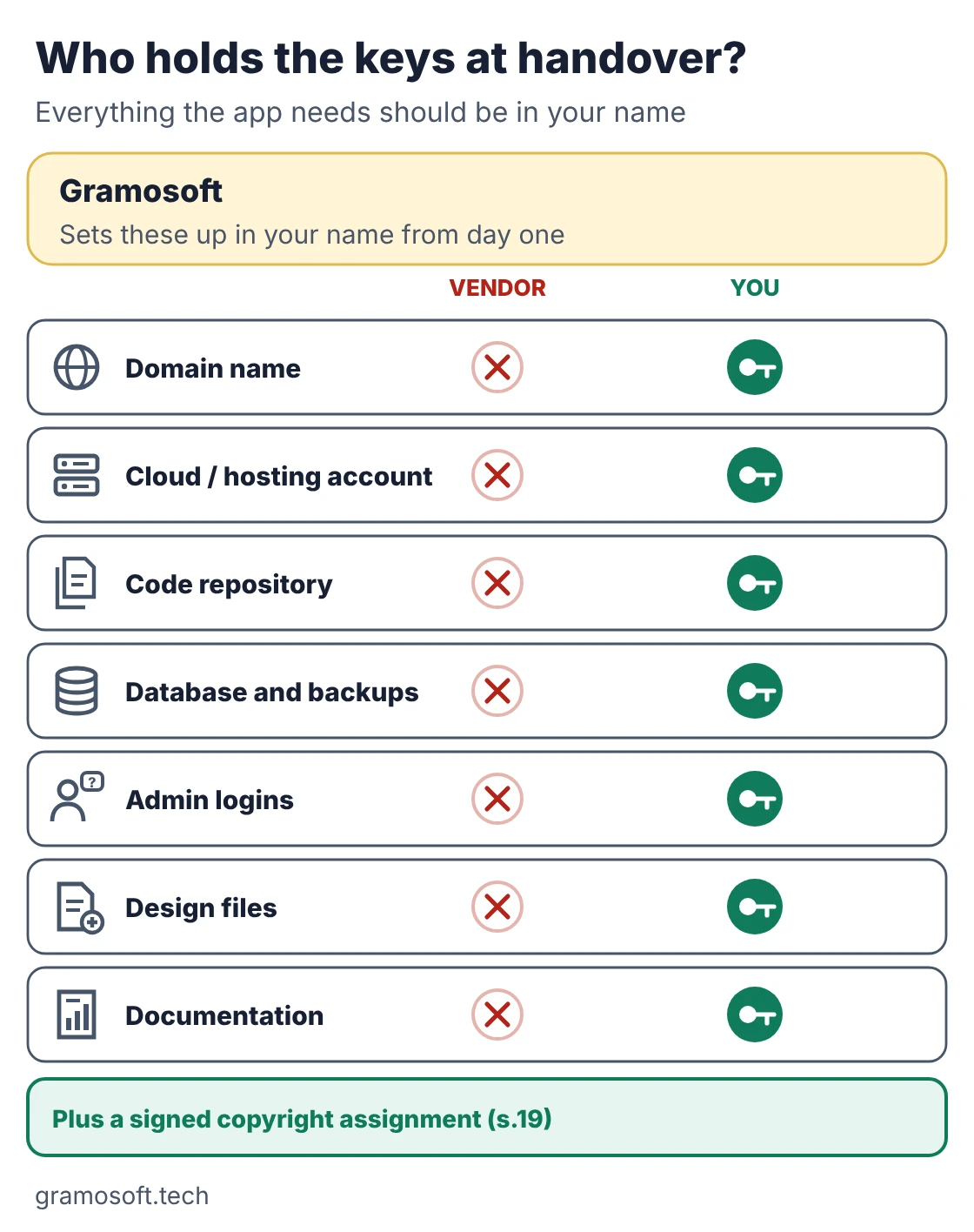
- In the contract: a signed assignment of copyright in the code and designs, worldwide and for the full term, as section 19 of the Copyright Act requires.
- From day one: the repository, cloud account and domain registered in your organisation's name, with the vendor added as a user.
- At handover: deployment steps, environment settings, database backups and a list of third-party services and licences.
This is general information, not legal advice. Have your lawyer review the ownership and data clauses.
Payment milestones that protect you
Tie every payment to something you can see and check: a signed design, a passed acceptance test, the application live. Avoid paying half or more upfront. A reasonable split leaves a final share until after a short warranty period, so the vendor stays motivated to fix early bugs quickly.
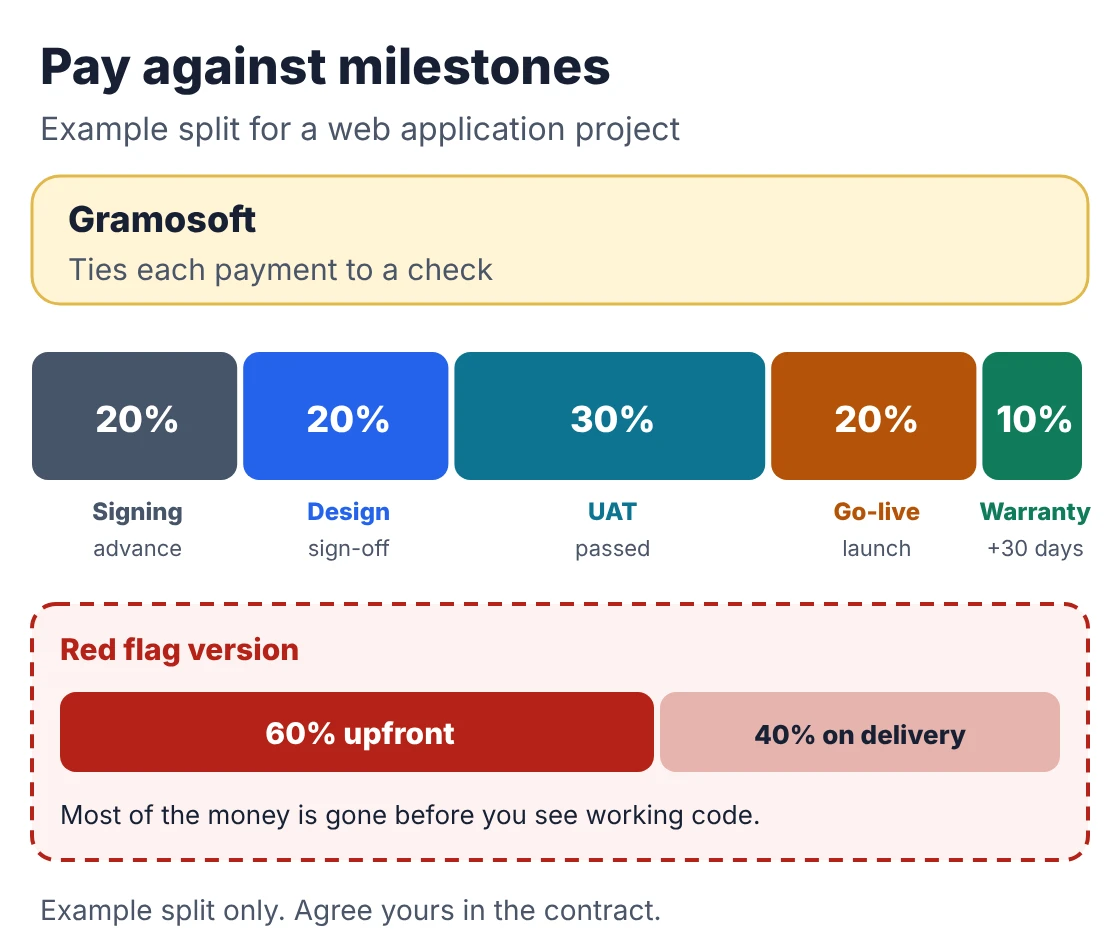
- Signing: a modest advance to start discovery and design.
- Design sign-off: after you approve the clickable prototype.
- Acceptance testing: after the app passes tests on your own data.
- Go-live and warranty: at launch, with the last part after the bug-fix warranty ends.
For what the total should be, see web application development cost in Chennai.
Frequently asked questions
How do I choose a web application development company in Chennai?
See a working application they built, get a written scope before a price, confirm code ownership by signed assignment, meet the team, check how they test, tie payments to milestones and agree support terms before launch.
Does Gramosoft build web applications in Chennai?
Yes. Gramosoft builds custom web applications and business systems in Chennai, names the team before you sign, and hands over code, cloud accounts and domains in the client's name.
Who owns the code if a vendor builds my web app?
The developer is the first owner of copyright unless it is assigned to you. Under section 19 of the Copyright Act, 1957, an assignment must be written and signed, and should name the rights, duration and territory.
How much should I pay upfront for a web application?
A modest advance to start discovery and design, then payments tied to milestones you can check, such as design sign-off, acceptance testing and go-live. Be wary of paying half or more upfront.
Is a freelancer or an agency better for a web application?
A freelancer can suit a small tool. A business-critical web app usually needs a team with design, development, testing and support, so one person's absence doesn't stop the project.
What should a web application support plan include?
A bug-fix warranty after go-live, response times by severity, security updates, backups, the monthly cost, and who renews domains, certificates and cloud services.
How long does it take to build a web application?
It depends on roles, workflows and integrations. A focused first module can go live in weeks; larger systems are built in phases over months. Ask for dated milestones, not a single range.
Related guides
- Web Application Development Cost in Chennai (2026): What Drives the Price
- How to Choose a Mobile App Development Company in Chennai: 12 Questions to Ask Before You Sign
- Flutter vs React Native vs Native: What Chennai Businesses Should Choose in 2026
- Top 10 Mobile App Development Companies in Chennai (2026)
- Mobile App Development Cost in Chennai