By Rajesh Kannan, Co-Founder & CTO, Gramosoft · Last updated: · Payment rules checked November 22, 2026
Most SaaS products don't fail on the screens. They fail somewhere between the demo and the first invoice: sign-up is clumsy, payments don't renew, one customer can see another's data, or nobody can answer a support question at 9 p.m. because there's no admin panel.
This guide follows a SaaS product from idea to paying customers in Chennai: how to validate before building, what the first version must include, how multi-tenancy and billing work in India, what it costs and how long it takes, and how to reach your first ten paying customers. We start with how Gramosoft builds SaaS.
TL;DR
- Gramosoft builds SaaS products in Chennai and runs its own, GcrawlAI, GdoczAI and GsearchAI, with subscriptions, usage limits and INR billing with GST invoices. We bring that experience to your product.
- Validate first: talk to 15–20 target users and find one painful, frequent workflow before writing code.
- The first version needs sign-up, roles, tenant isolation, billing, an admin panel and usage analytics. Mobile apps, white-labelling and long integration lists can wait.
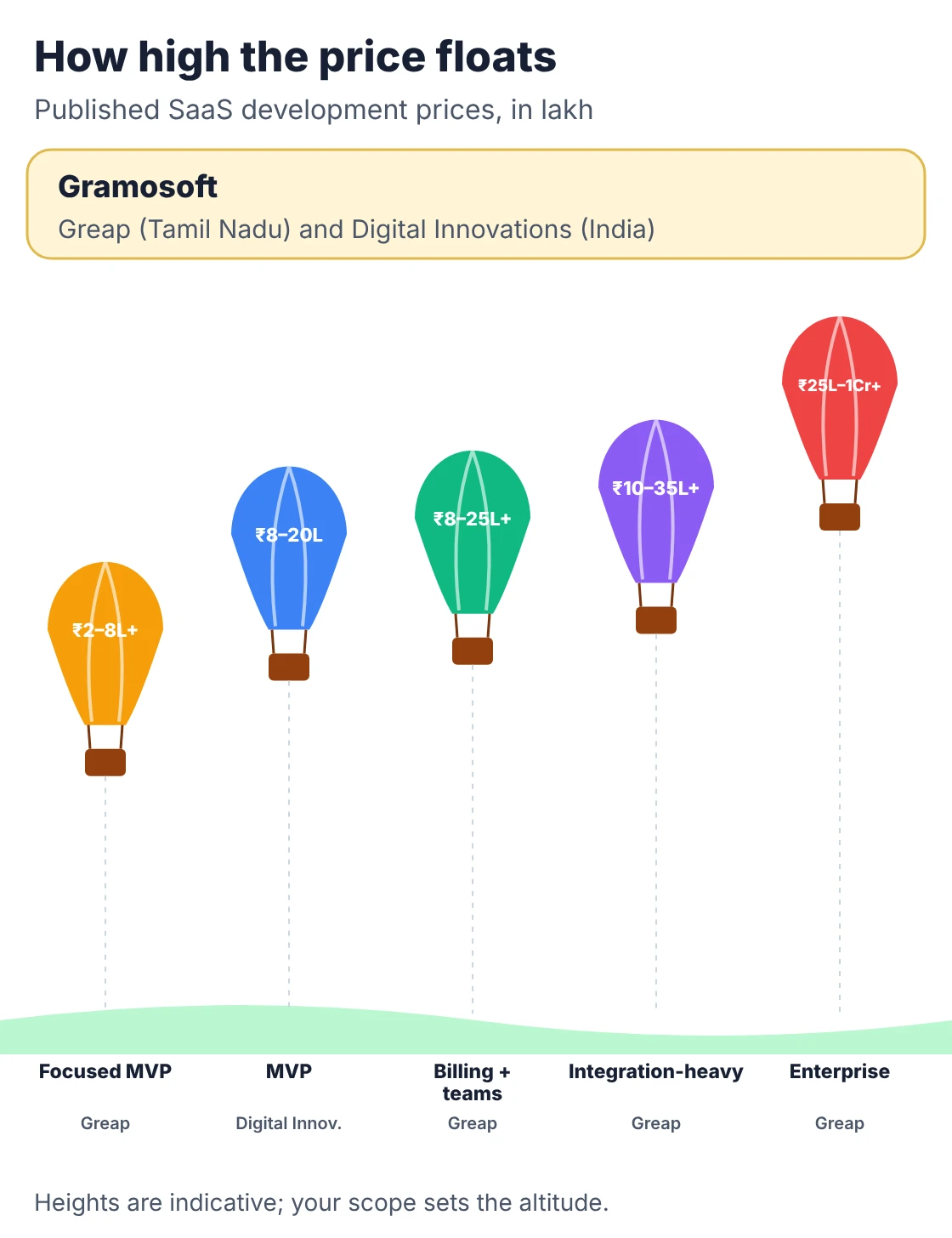
- Cost: Tamil Nadu and Indian firms publish SaaS MVP prices from about ₹2–8 lakh up to ₹8–20 lakh; business SaaS with billing and teams runs ₹8–25 lakh or more.
- Timeline: a focused MVP typically takes 8 to 14 weeks; a multi-role product with integrations 4 to 7 months.
How do you build a SaaS product in Chennai, from idea to paying customers? Validate one painful workflow with real users, scope a first version that can take money, build it multi-tenant with sign-up, roles, billing and an admin panel, launch with three to five design partners, then measure activation and retention before adding features. Gramosoft, a SaaS product development company in Chennai, builds and runs SaaS products this way.
Swipe the table sideways on mobile →
| Who builds it | Best when | Watch out for |
|---|---|---|
| Gramosoft (build and run) | You want a team that has shipped and runs its own SaaS products, covering product, backend, billing, cloud, AI features and support | No published price list; we quote per stage after discovery |
| Freelancers | A prototype or landing page to test demand | Tenancy, billing and security usually missing |
| In-house team | The product is funded and will change every week for years | Months of hiring before the first release |
| No-code tools | A concierge version to prove people will pay | Limits on data isolation, scale and ownership |
How Gramosoft builds SaaS products in Chennai
Gramosoft is a Chennai software company that builds SaaS products for clients and runs its own. GcrawlAI has a free plan, paid tiers, usage limits and INR billing with GST invoices; GdoczAI and GsearchAI serve enterprise customers. So when we design sign-up, billing, tenancy and support for your product, we're drawing on systems we operate ourselves.
Swipe the table sideways on mobile →
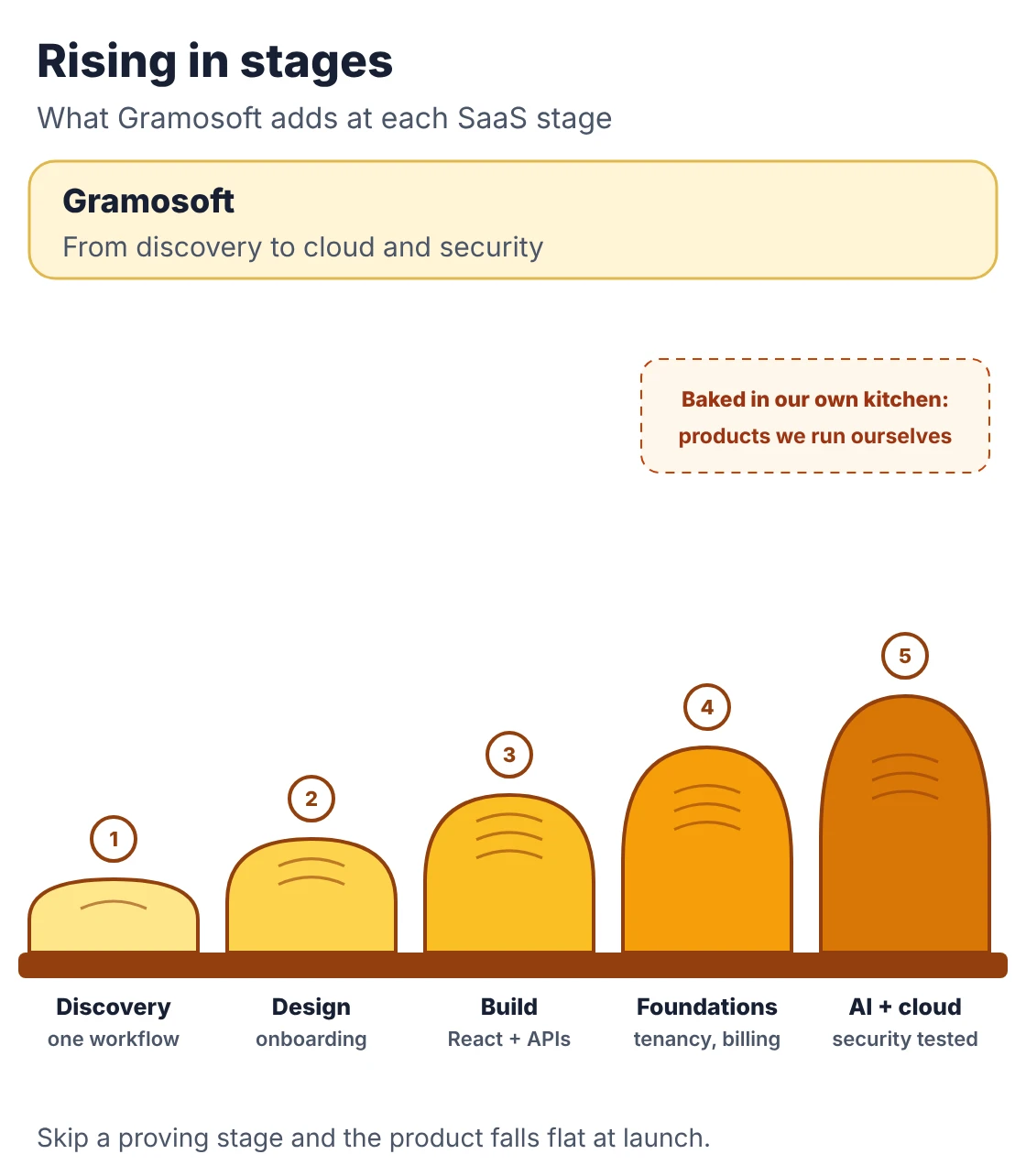
| What you need | From Gramosoft |
|---|---|
| Discovery | Product development starts with user interviews, one core workflow and a first-version scope priced as its own stage |
| Design | Onboarding and core screens from our UI/UX design team, tested with real users |
| Product build | Web application development in React with Spring Boot, .NET, Python or Node.js, on PostgreSQL |
| SaaS foundations | Tenant isolation, roles, subscriptions with Razorpay or Stripe, GST invoices, an admin console and usage analytics |
| AI features | Document reading, search and agents through our AI development team, with usage metered per plan |
| Cloud and security | AWS Mumbai, Azure or Google Cloud through our cloud services, plus application security testing |
Our SaaS-style products include GcrawlAI for web data, GdoczAI for document processing, GsearchAI for enterprise search and GramoCare healthcare software. The code and cloud accounts for client products are in the client's name.
Where we fall short: we were incorporated in 2022, so our own SaaS products are young and still growing. We don't do growth marketing, pricing research or fundraising support. We don't publish a price list, because a SaaS product is priced in stages. And we'll push back on a first version that tries to do everything.
"Running our own SaaS taught us that the hard parts aren't the features. They're the failed renewal at midnight, the customer who wants to export everything, and the support question you can only answer from an admin screen you forgot to build."
Rajesh Kannan, Co-Founder & CTO, Gramosoft
What makes SaaS different from custom software
Custom software serves one company. A SaaS product serves many customers from one codebase, charges them every month and keeps changing. That changes everything underneath: how data is separated between customers, how billing renews and fails, how updates ship without downtime, and how you support people you've never met.
- Many customers, one system: every query must know which customer it belongs to. Retrofitting that later is expensive.
- Recurring revenue: trials, upgrades, downgrades, failed payments, refunds and invoices are product features, not accounting details.
- Self-serve: users sign up and must reach value on their own, so onboarding matters as much as features.
- Always changing: you release continuously, so automated tests and a deployment pipeline aren't optional.
If you're building software for one company, our Custom Software Development in Chennai: Cost, Process & How to Pick a Partner guide is the better fit.
Stage 1: validate before you build
The cheapest feature is the one you never build. Before writing code, interview 15 to 20 people who have the problem, ask how they solve it today and what it costs them, and find one painful, frequent workflow they'd pay to fix. A clickable prototype or a manual concierge service can test willingness to pay first.
- One workflow, not ten: SutraCode gives a good example: if schools say fee reconciliation is the nightmare, don't start with AI timetables.
- Look for existing spend: people already paying for a spreadsheet, a part-time clerk or a clumsy tool is the strongest signal.
- Test the price early: ask for a paid pilot or a deposit. A free waitlist proves curiosity, not demand.
Stage 2: scope a first version that can take money
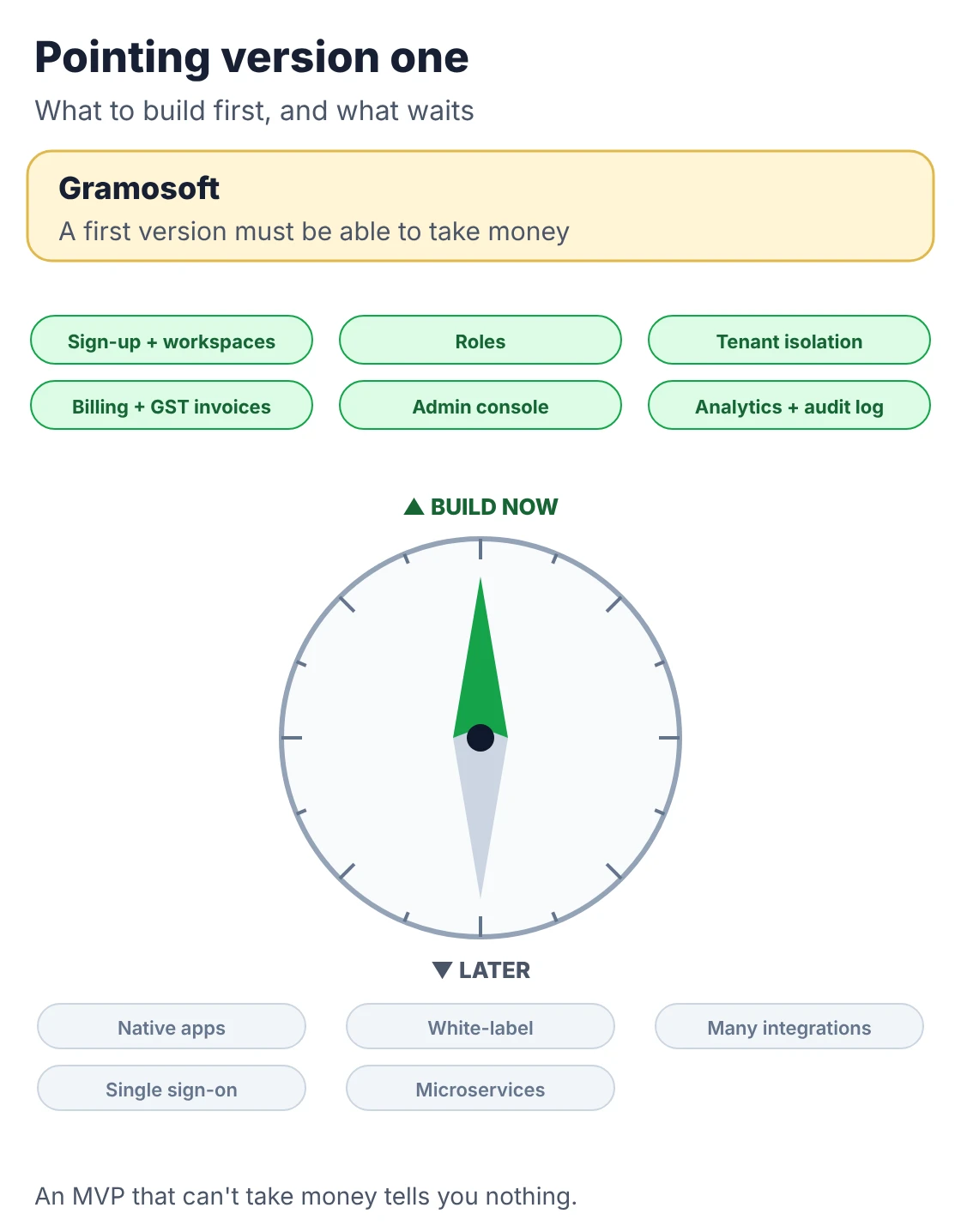
A SaaS MVP is the smallest product a customer will pay for, not a half-built version of everything. It should do one job well for one type of customer, and include the plumbing that lets you sell and support it: sign-up, roles, tenant isolation, billing, an admin panel and analytics.
Swipe the table sideways on mobile →
| Build in version one | Leave for later |
|---|---|
| Sign-up, login and organisation or workspace accounts | Native mobile apps, unless mobile is the product |
| Roles and permissions | White-labelling for resellers |
| Tenant isolation from day one | Dozens of integrations |
| Subscriptions, invoices and failed-payment handling | Advanced reports and custom dashboards |
| An admin console for your support team | Single sign-on, until enterprise buyers ask |
| Usage analytics and an audit log | Microservices; a well-built monolith is faster to start |
Innestolabs puts it well: an MVP that can't take money doesn't tell you anything.
Stage 3: multi-tenancy, the decision you can't easily undo
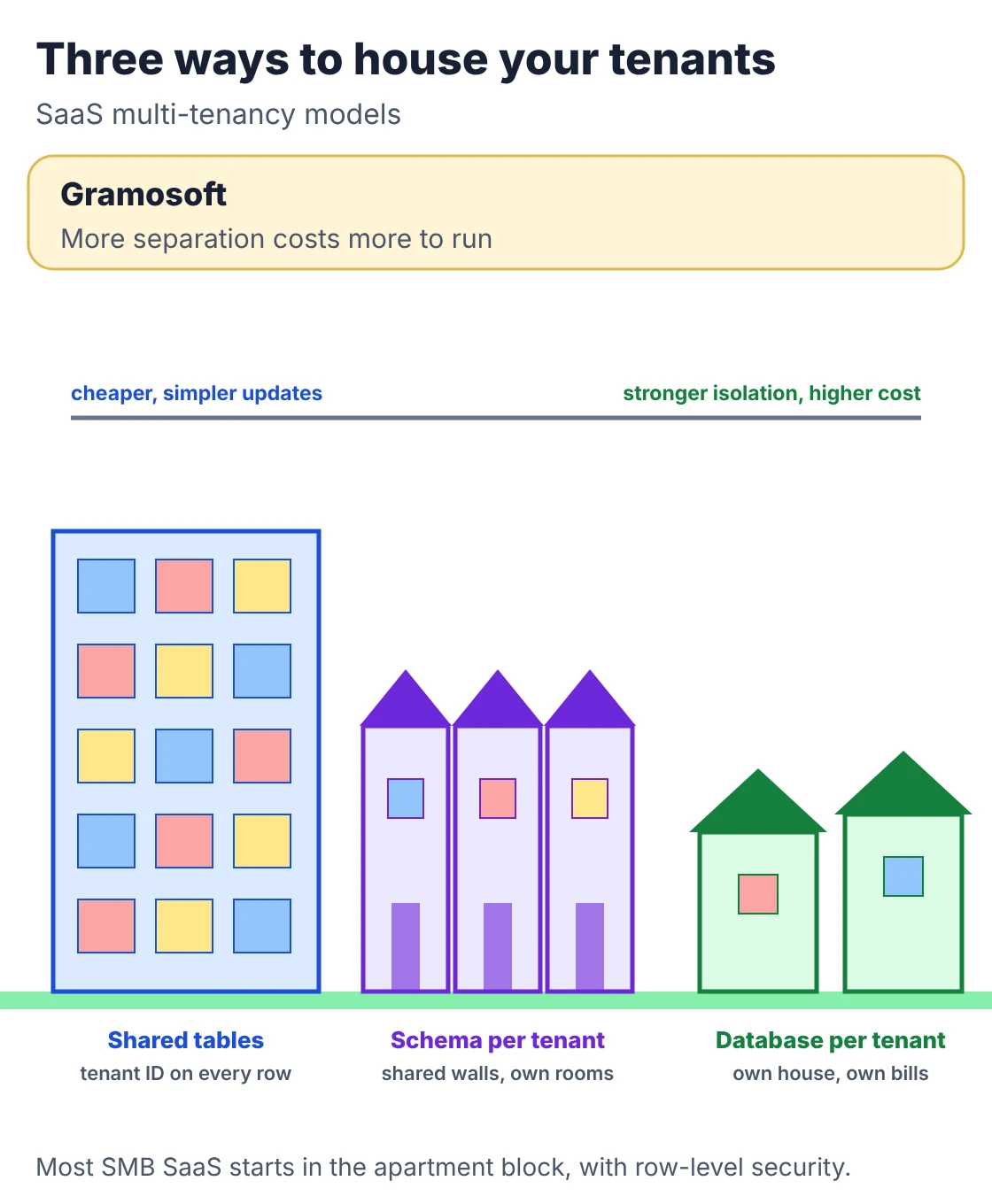
Multi-tenancy is how a SaaS product keeps each customer's data separate while running one system. Most products start with a shared database and a tenant ID on every row; enterprise or regulated customers may need a separate schema or database each. Choose deliberately, because changing tenancy after launch is expensive.
Swipe the table sideways on mobile →
| Model | How it works | Best for |
|---|---|---|
| Shared tables | One database; every row has a tenant ID | Most SMB SaaS; cheapest to run and update |
| Schema per tenant | One database, a separate schema per customer | Mid-size customers wanting stronger separation |
| Database per tenant | A separate database for each customer | Regulated or enterprise customers; costlier to run |
With shared tables, the risk is a single query that forgets its tenant filter. Shuklexa rightly says to enforce isolation in every query and test it. We go a step further and make the database enforce it, using PostgreSQL's row-level security:
tenant_isolation.sql
-- Multi-tenant SaaS on one PostgreSQL database: every row carries a tenant_id,
-- and Row-Level Security makes the database itself refuse cross-tenant reads
-- and writes, even if application code forgets a WHERE clause.

CREATE TABLE tenants (
    id   uuid PRIMARY KEY DEFAULT gen_random_uuid(),
    name text NOT NULL
);

CREATE TABLE invoices (
    id         bigserial PRIMARY KEY,
    tenant_id  uuid NOT NULL REFERENCES tenants(id),
    customer   text NOT NULL,
    amount_inr numeric(12,2) NOT NULL
);
CREATE INDEX ON invoices (tenant_id);

-- The app connects as this role, never as the table owner.
CREATE ROLE app_user NOLOGIN;
GRANT SELECT, INSERT, UPDATE, DELETE ON invoices TO app_user;
GRANT USAGE ON SEQUENCE invoices_id_seq TO app_user;

ALTER TABLE invoices ENABLE ROW LEVEL SECURITY;
ALTER TABLE invoices FORCE ROW LEVEL SECURITY;

-- The app sets app.tenant_id at the start of every request or transaction.
CREATE POLICY tenant_isolation ON invoices
    USING      (tenant_id = NULLIF(current_setting('app.tenant_id', true), '')::uuid)
    WITH CHECK (tenant_id = NULLIF(current_setting('app.tenant_id', true), '')::uuid);
We tested it on PostgreSQL 16 with two tenants, a clinic and a logistics firm. Connected as the app's role, the clinic sees only its invoice, can't write a row for the other tenant, and a request with no tenant set sees nothing at all:
Output
-- As tenant A (the clinic):
  customer   | amount_inr
-------------+------------
 Patient 104 |    1800.00
(1 row)

-- Tenant A tries to write a row for tenant B:
ERROR:  new row violates row-level security policy for table "invoices"
-- No tenant set (a bug in the app):
 rows_visible
--------------
            0
(1 row)
The app still filters by tenant; the database policy is the safety net that catches the bug nobody spotted in review.
Stage 4: billing that works in India
Use an established payment provider for subscriptions rather than building billing yourself. For Indian customers that means UPI AutoPay and card mandates through a provider such as Razorpay, GST-compliant invoices, and handling for trials, upgrades, downgrades and failed renewals. For international customers, support cards and multiple currencies.
- Recurring payment rules: under RBI's Digital Payments – E-mandate Framework, 2026, a mandate is registered only after an additional factor of authentication. Once registered, recurring payments up to ₹15,000 can be processed without an OTP each time; larger amounts still need it.
- Design for failure: cards expire and mandates get cancelled. Plan retries, reminder emails, a grace period and what the product does when payment lapses.
- GST invoices: issue invoices with your GSTIN and the customer's, and let business customers download them.
- Plans in data, not code: store plans, limits and prices as data so you can change pricing without a release.
What SaaS product development costs in Chennai
Published Tamil Nadu and Indian prices start around ₹2–8 lakh for a focused MVP and rise to ₹8–25 lakh or more once billing, teams and integrations are included. Enterprise platforms run from ₹25–50 lakh upward. Scope, user roles, integrations, compliance and mobile apps move the number most.
Swipe the table sideways on mobile →
| Source | MVP | Business SaaS | Enterprise |
|---|---|---|---|
| Gramosoft | Priced per stage: a first shippable version, then the next stage once real users are on it | ||
| Greap Technologies (Tamil Nadu) | ₹2–8 lakh+ | ₹8–25 lakh+ with billing and teams | ₹25 lakh–₹1 crore+ |
| Digital Innovations (India) | ₹8–20 lakh, 8–12 weeks | ₹20–50 lakh, 4–7 months | ₹50 lakh+ |
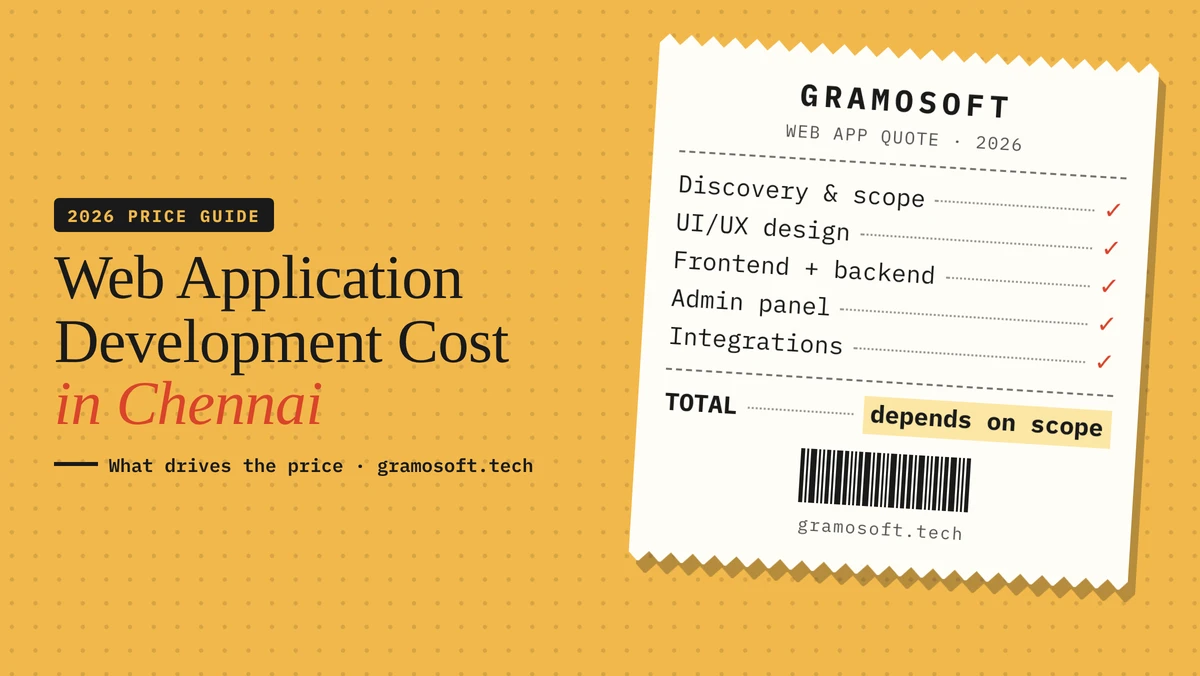
The two ranges overlap but don't match, because "MVP" means different things to different firms. Greap also lists ₹10–35 lakh for integration-heavy SaaS and ₹15–50 lakh when mobile apps are added. Our Web Application Development Cost in Chennai (2026): What Drives the Price guide breaks down the drivers.
Budget for running costs too: cloud hosting, email and SMS, monitoring, payment gateway fees, AI usage if your product calls models, support time and yearly security reviews.
How long it takes
A focused SaaS MVP with one core workflow usually takes 8 to 14 weeks from discovery to launch. A multi-role product with dashboards and several integrations takes 4 to 7 months. Approvals and content, not code, often set the date, so see a working build every week or two.
Swipe the table sideways on mobile →
| Stage | Typical length | What you get |
|---|---|---|
| Validation and discovery | 2–3 weeks | Interviews, one core workflow, first-version scope and price |
| Design | 2–3 weeks | Onboarding and core screens tested with target users |
| Build in sprints | 6–10 weeks | A working build every 1–2 weeks, foundations included |
| Beta with design partners | 2–4 weeks | 3–5 customers using it for real, with paid pilots |
Digital Innovations quotes 8 to 14 weeks for most focused MVPs; SutraCode describes an 8-week MVP roadmap.
Stage 5: from launch to your first paying customers
Launch to a small group of design partners, not the whole market. Three to five customers on discounted annual pricing will use the product for real, tell you what's missing and become your first references. Measure whether they reach value quickly and keep coming back before adding anything new.
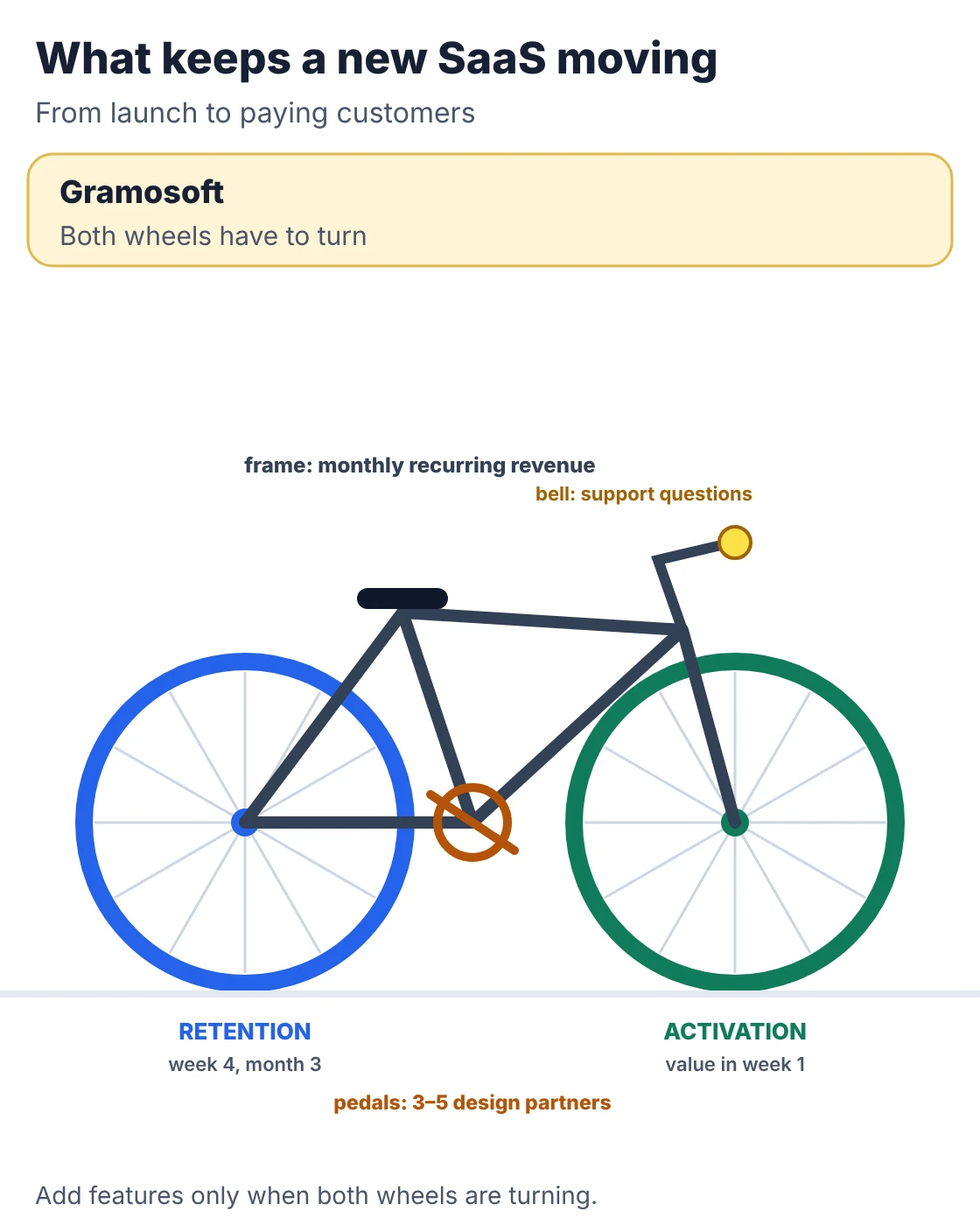
- Activation: does a new account reach its first useful result within the first week? SutraCode suggests seven days as the target.
- Retention: are accounts still active in week four and month three?
- Revenue: monthly recurring revenue, churn and expansion when customers upgrade.
- Support volume: repeated questions point to onboarding gaps.
- Trust: publish a privacy policy, a backup policy and where data is stored. Indian B2B buyers ask; answer before they do.
Five mistakes that stop SaaS products reaching paying customers
Most early SaaS products stall for reasons that have little to do with code. Building for everyone, adding tenancy and billing after launch, skipping onboarding, pricing too low to afford support, and letting a vendor hold the only copy of the code or cloud accounts are the patterns we see most.
- Building for everyone: pick one customer type and one workflow first.
- Tenancy and billing bolted on later: both are cheaper on day one than in month nine.
- No onboarding: users sign up, get lost and never return.
- Underpricing: a price too low to fund support stalls growth. Raise it before you add features.
- Accounts in the vendor's name: code, cloud, domain and payment accounts must belong to you. See How to Choose a Web Application Development Company in Chennai: 10 Red Flags to Avoid.
Frequently asked questions
Which SaaS product development company in Chennai has run its own SaaS products?
How much does SaaS product development cost in Chennai?
Published Tamil Nadu and Indian prices start around ₹2–8 lakh for a focused MVP, ₹8–25 lakh or more for business SaaS with billing and team features, and ₹25–50 lakh upward for enterprise platforms.
How long does it take to build a SaaS MVP?
Usually 8 to 14 weeks for one core workflow with sign-up, roles, billing and an admin panel. A multi-role product with several integrations typically takes 4 to 7 months.
What is multi-tenancy in SaaS?
It's how one SaaS system serves many customers while keeping each one's data separate, using shared tables with a tenant ID, a schema per tenant or a database per tenant. It's hard to change after launch.
How do SaaS subscriptions work with UPI and cards in India?
Customers register an e-mandate through a payment provider such as Razorpay. Under RBI's 2026 framework, registration needs an additional factor of authentication, and later payments up to ₹15,000 can renew without an OTP.
Should I build a mobile app with my SaaS MVP?
Usually not. Prove the web product with paying customers first, unless your users work mainly on phones in the field. A responsive web app covers most early needs.
Who owns the code of my SaaS product?
You should. The source code, cloud accounts, domain and payment gateway account should all be in your company's name, with documentation so any team can take over.
Related guides
- Custom Software Development in Chennai: Cost, Process & How to Pick a Partner
- Web Application Development Cost in Chennai (2026): What Drives the Price
- How to Choose a Web Application Development Company in Chennai: 10 Red Flags to Avoid
- Web App vs Mobile App: Which Should Your Business Build First?
- Top Software Development Companies in Chennai (2026)
- Health Camp Management Software: How Hospitals and Governments Run Medical Camps Without Paper
Rajesh Kannan M
Rajesh Kannan M is Co-Founder & CTO of Gramosoft in Chennai, where he leads the teams building custom AI, document AI, enterprise search and automation, including GsearchAI, GdoczAI and GcrawlAI, an open-source web scraping, crawling and Search API platform for developers and AI agents, alongside web and mobile applications.