By Rajesh Kannan, Co-Founder & CTO, Gramosoft · Last updated: · Store rules checked November 22, 2026
Most Chennai businesses know what they want their app to do. Fewer know what happens between the first meeting and the day the app appears on Google Play and the App Store, or why that last step can add two weeks nobody planned for.
This guide walks through the full mobile app development process in eight stages: what each one produces, how long it takes and what you approve. It covers the 2026 store rules that catch first-time publishers out, and what happens after launch. We start with how Gramosoft runs the process in Chennai.
TL;DR
- Gramosoft runs every mobile app project in Chennai through eight stages, each ending in something you review and sign off: scope, prototype, architecture, TestFlight and test builds every one to two weeks, UAT, store listings, release and support.
- The eight stages: discovery, UI/UX design, architecture and backend, development in sprints, testing, store accounts and listings, submission and release, and after launch.
- Timeline: about 2 to 3 months for a simple app, 3 to 6 for a business app with payments and an admin panel, and longer for marketplaces and ERP-linked apps.
- Play Store: a US$25 one-time fee; new apps must target Android 16 (API 36); new personal accounts must run a 14-day closed test with 12 testers first.
- App Store: ₹8,700 a year; builds must use Xcode 26; most reviews finish within a day or two, but about 23% of submissions were rejected in 2025.
What is the mobile app development process? It is eight stages: discovery, UI/UX design, architecture and backend, development in sprints, testing, store accounts and listings, submission to Google Play and the App Store, and post-launch support. In Chennai a business app usually takes 3 to 6 months end to end. Gramosoft runs this process with a sign-off at every stage.
Swipe the table sideways on mobile →
| Who runs the process | Best when | Watch out for |
|---|---|---|
| Gramosoft (end to end) | You want one team for design, app, backend, both store submissions and support, with a sign-off at each stage | No published price list; quotes come after discovery |
| App-only studio | You already run the backend and APIs | Who owns the server, admin panel and store accounts |
| Freelancer | A small app and someone technical on your side | Store accounts in the freelancer's name, and cover when they're busy |
| In-house team | The app is your core product and changes weekly | Hiring time, devices, and running the process yourself |
How Gramosoft runs the mobile app development process in Chennai
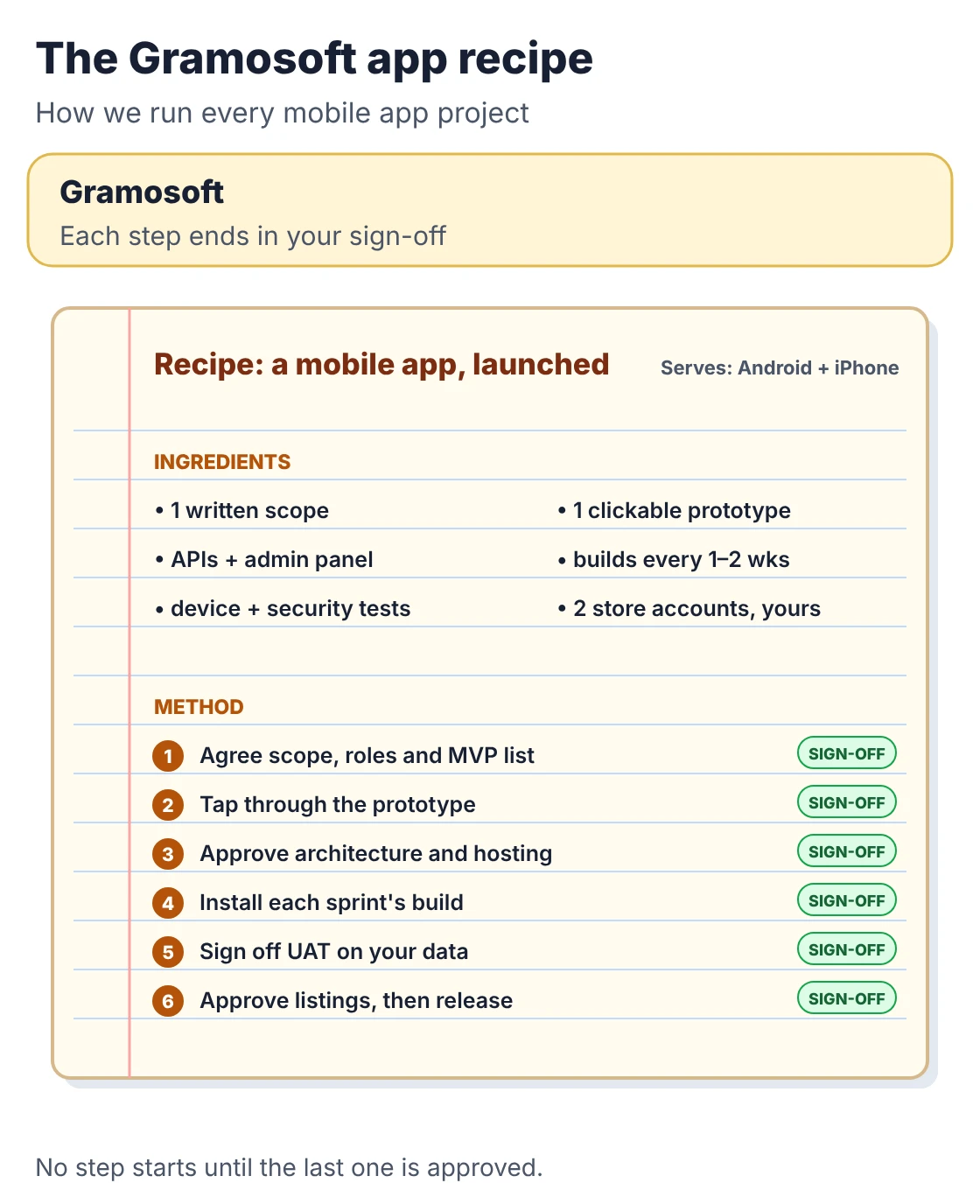
Gramosoft is a Chennai software company that builds mobile apps together with the systems behind them. We run every project through the same eight stages, and each stage ends with something you can open, test and sign off. Nothing moves to the next stage until you approve the last one, so surprises surface early.
Swipe the table sideways on mobile →
| Stage | What you sign off with Gramosoft |
|---|---|
| Discovery | A written scope, user roles, MVP list and a platform recommendation: Flutter, React Native, or native Swift and Kotlin |
| Design | A clickable prototype from our UI/UX design team, tested by your staff on a phone |
| Architecture | APIs, database and admin panel on Spring Boot, .NET, Python or Node.js, hosted through our cloud services |
| Build | An installable build every one to two weeks: TestFlight for iPhone, an internal test track for Android |
| Testing | Device testing, application security checks and UAT on your data |
| Release | Store accounts in your company's name, listings, privacy answers and both submissions handled for you |
We've run this process on flight booking apps for the airline group behind Batik Air, insurance apps for GMAT in Malaysia, and GramoCare healthcare products for Chennai Liver Foundation and RPS Hospital. See our mobile app development page for more.
Where we fall short: we were incorporated in 2022, so our public track record is shorter than older Chennai firms'. We don't build games or AR apps. Our process has a sign-off at every stage, which suits businesses that want control but can feel slow to founders who want to skip design. And we don't publish a price list.
"The stage clients most want to skip is discovery, and it's the one that saves the most money. Two weeks of questions up front is cheaper than two months of rework after the build has started."
Rajesh Kannan, Co-Founder & CTO, Gramosoft
The 8 stages of mobile app development at a glance
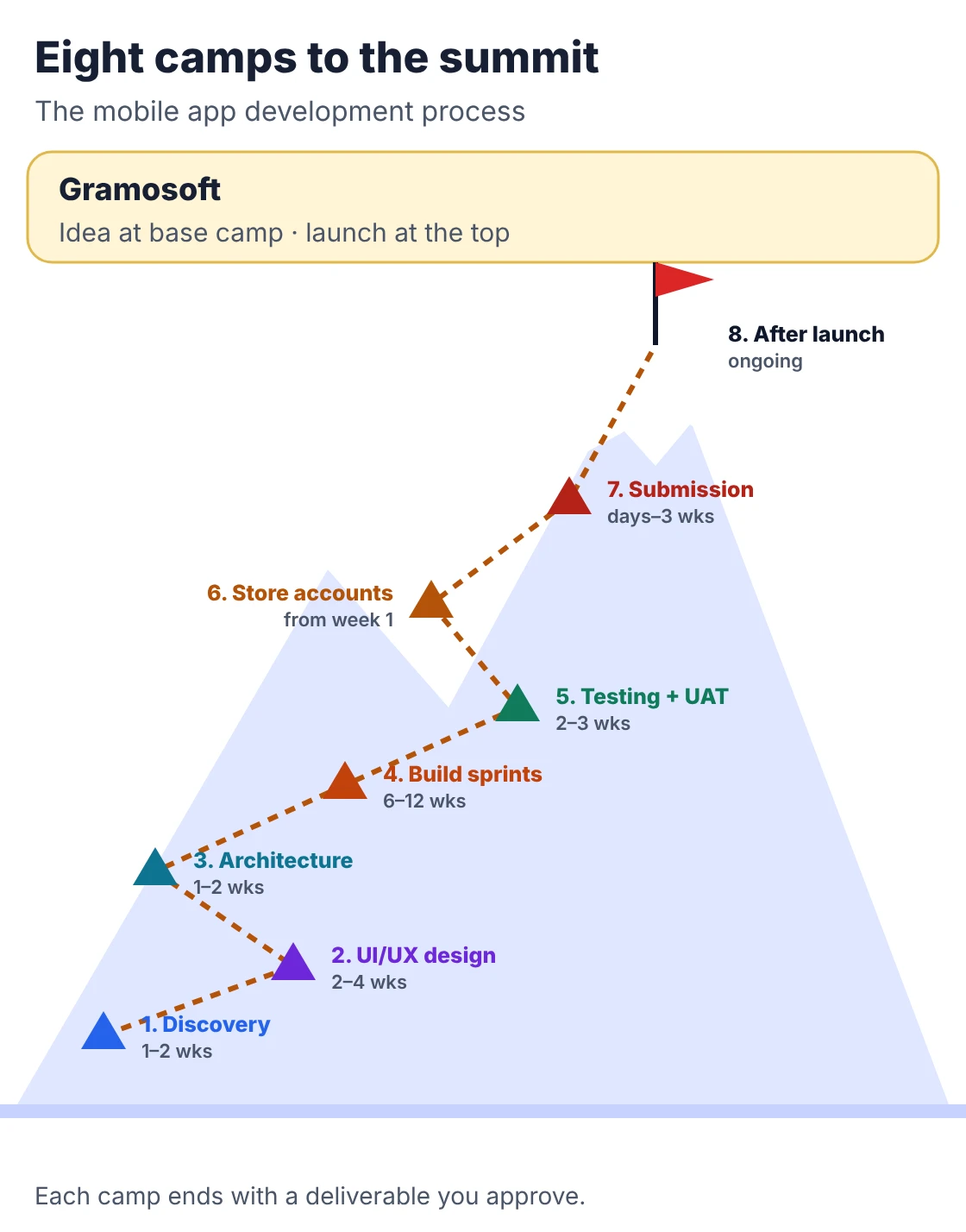
Every serious app project follows the same eight stages, whatever the framework. Discovery and design decide what gets built, architecture and development build it, testing proves it works, and the last three stages get it into the stores and keep it there. Each stage should end with a deliverable you approve.
Swipe the table sideways on mobile →
| Stage | Typical length | What you approve at the end |
|---|---|---|
| 1. Discovery | 1–2 weeks | Scope, user roles, MVP vs later features, platform choice, estimate |
| 2. UI/UX design | 2–4 weeks | A clickable prototype of every core journey |
| 3. Architecture and backend | 1–2 weeks to design | API, database, sign-in, payments and hosting plan |
| 4. Development in sprints | 6–12 weeks | A working build every 1–2 weeks on your own phone |
| 5. Testing and UAT | 2–3 weeks | Signed acceptance on real devices and your data |
| 6. Store accounts and listings | Start in week 1 | Developer accounts in your name, screenshots, privacy policy |
| 7. Submission and release | A few days–3 weeks | Approved listings on Google Play and the App Store |
| 8. After launch | Ongoing | A support plan covering fixes, OS updates and new features |
Stages 1–2: discovery and design
Discovery turns an idea into a written scope: who uses the app, the one problem it solves, which features ship first and which wait. Design then turns that scope into a clickable prototype you can tap through on a phone. Both are cheap compared with the build, so changes made here cost the least.
- Discovery outputs: user roles, core journeys (sign up, do the main task, pay), an MVP list, integrations such as Razorpay, OTP, maps, ERP or CRM, and a platform choice. Our Flutter vs React Native vs Native: What Chennai Businesses Should Choose in 2026 guide covers that choice.
- Design outputs: wireframes, final screens for Android and iPhone, a design system, and a prototype your staff or customers have tried.
- What to approve: the MVP list in writing. Most budget overruns start with features added after the build begins.
Stages 3–5: architecture, development and testing
Architecture decides how the app signs users in, where data lives, how payments and notifications work, and what the admin panel does. Development then builds the app and backend together in one- to two-week sprints, and testing proves it all works on real phones before anyone outside your team sees it.
- Architecture: the backend and admin panel often take as much work as the app. Plan them in discovery, not mid-build.
- Sprints: insist on an installable build at the end of every sprint: TestFlight for iPhone and an internal test track on Google Play for Android.
- Testing: functional, device and OS-version, slow-network, security and payment testing, then user acceptance testing (UAT) by your own staff on your own data. Emulators miss problems real phones catch, especially budget Android phones.
Stages 6–7: from build to Google Play and the App Store
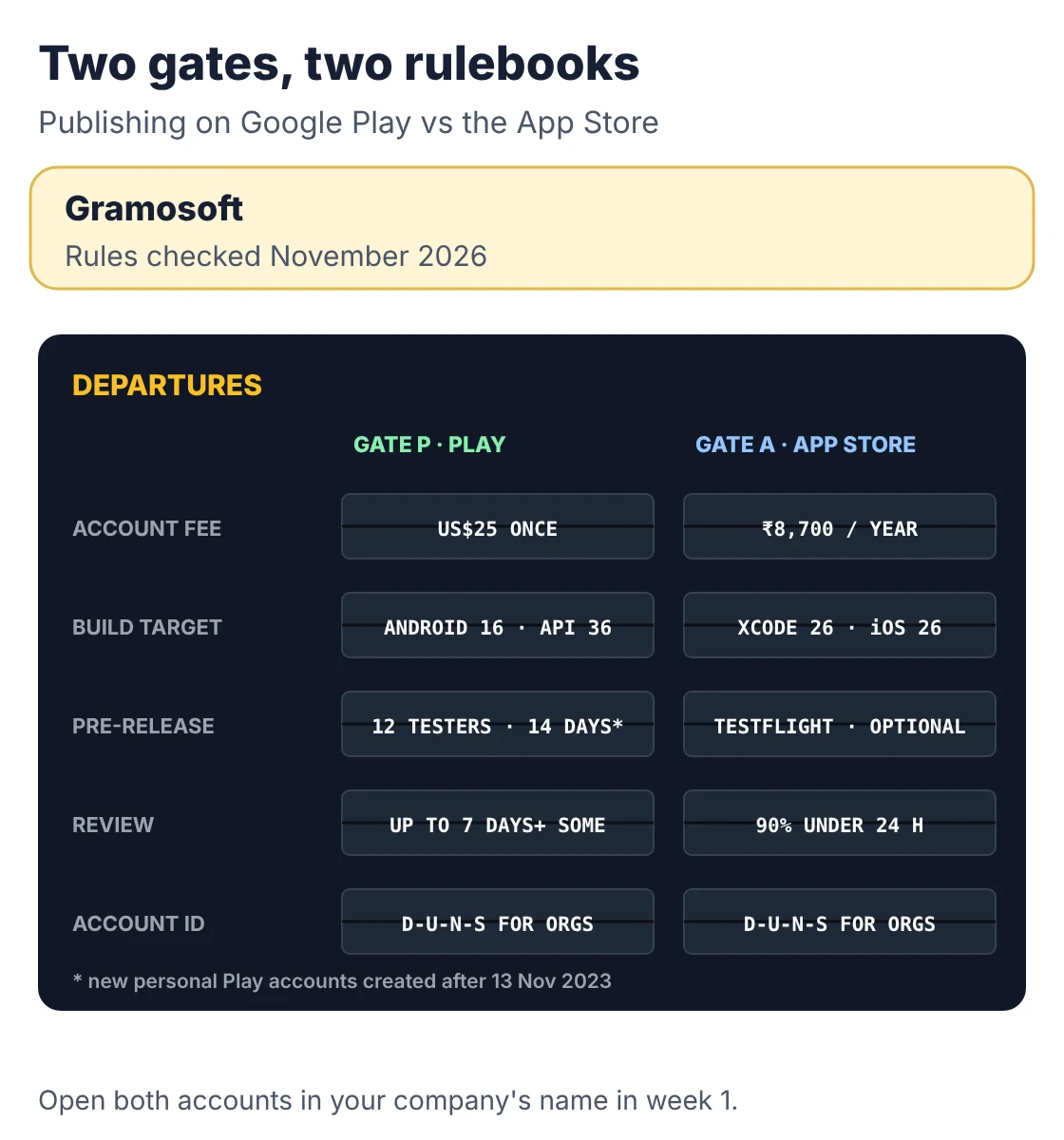
Publishing is where first-time app owners lose the most time, because each store has its own account rules, technical requirements and review. Open both developer accounts in your company's name in the first week, not the last, and plan submission as a stage with its own time, not a button pressed on launch day.
Swipe the table sideways on mobile →
| Requirement | Google Play | Apple App Store |
|---|---|---|
| Developer account | US$25 one time; organization accounts need a D-U-N-S number | 99 USD a year, ₹8,700 in India via the Apple Developer app |
| Build requirement | New apps and updates must target Android 16 (API level 36) | Built with Xcode 26 and the iOS 26 SDK |
| Testing before release | New personal accounts: a closed test with 12 testers for 14 days | TestFlight is optional but strongly advised |
| Review time | Usually quick; up to 7 days or longer for some accounts | Apple says 90% in under 24 hours |
| Common blockers | Data safety form, permissions, content rating, target API level | Demo login, permission prompts, account deletion, metadata |
- Google Play account: registration costs a one-time US$25, and an organization account needs a D-U-N-S number, which is free from Dun & Bradstreet but can take weeks, so apply early.
- The 12-tester rule: personal accounts created after November 13, 2023 must run a closed test with at least 12 testers opted in continuously for 14 days before applying for production access. Publishing from your company's organization account avoids it.
- Android target level: new apps and app updates must target Android 16 (API level 36) or higher to be submitted to Google Play.
- Google review time: Google says some developer accounts get more thorough review, which can take up to seven days or longer in exceptional cases.
- Apple: since 28 April 2026, apps must be built with Xcode 26 or later using the iOS 26 SDK. Apple's App Review page says 90% of submissions are reviewed in under 24 hours, but its 2025 transparency report counts more than 2.09 million rejections from 9.1 million submissions.
- Account deletion: on iPhone, apps that let people create an account must let them start deleting it inside the app. Build it in during development, not after a rejection.
Stage 8: after launch
Launch starts the app's working life rather than ending the project. Every year Apple and Google raise their technical requirements, so an app nobody updates eventually can't publish fixes. Plan a support budget for crash monitoring, bug fixes, OS updates, security patches and the features your users ask for.
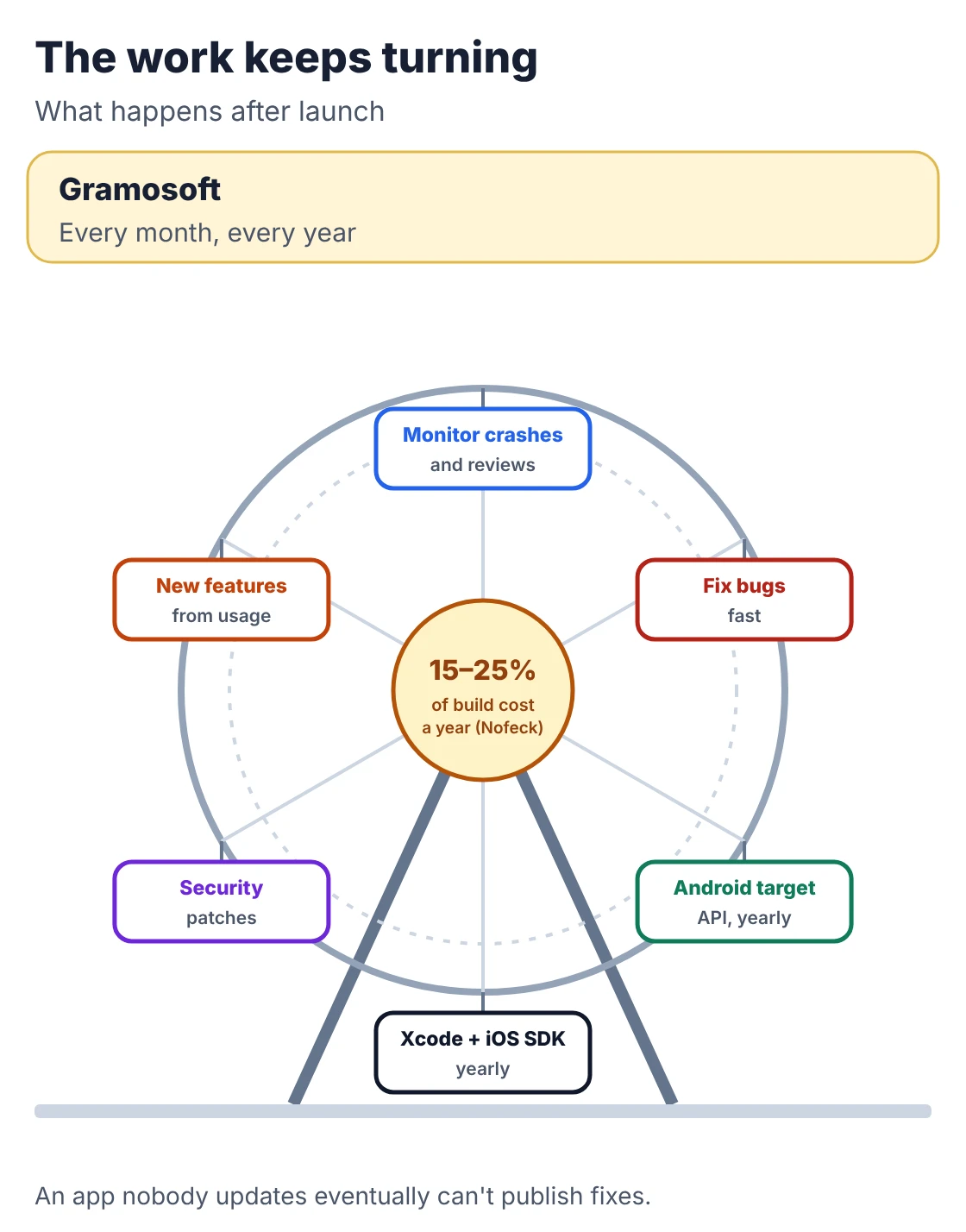
- First 30 days: watch crash reports and reviews daily and ship fixes fast.
- Every year: a new Android target API level and a new Xcode and iOS SDK. Both stores refuse updates built on old ones.
- Every 4–8 weeks: a small release with fixes and one or two improvements based on real usage.
- Budget: Nofeck puts upkeep at 15–25% of the build cost a year, an industry estimate rather than a quote.
How long the process takes, and what it costs
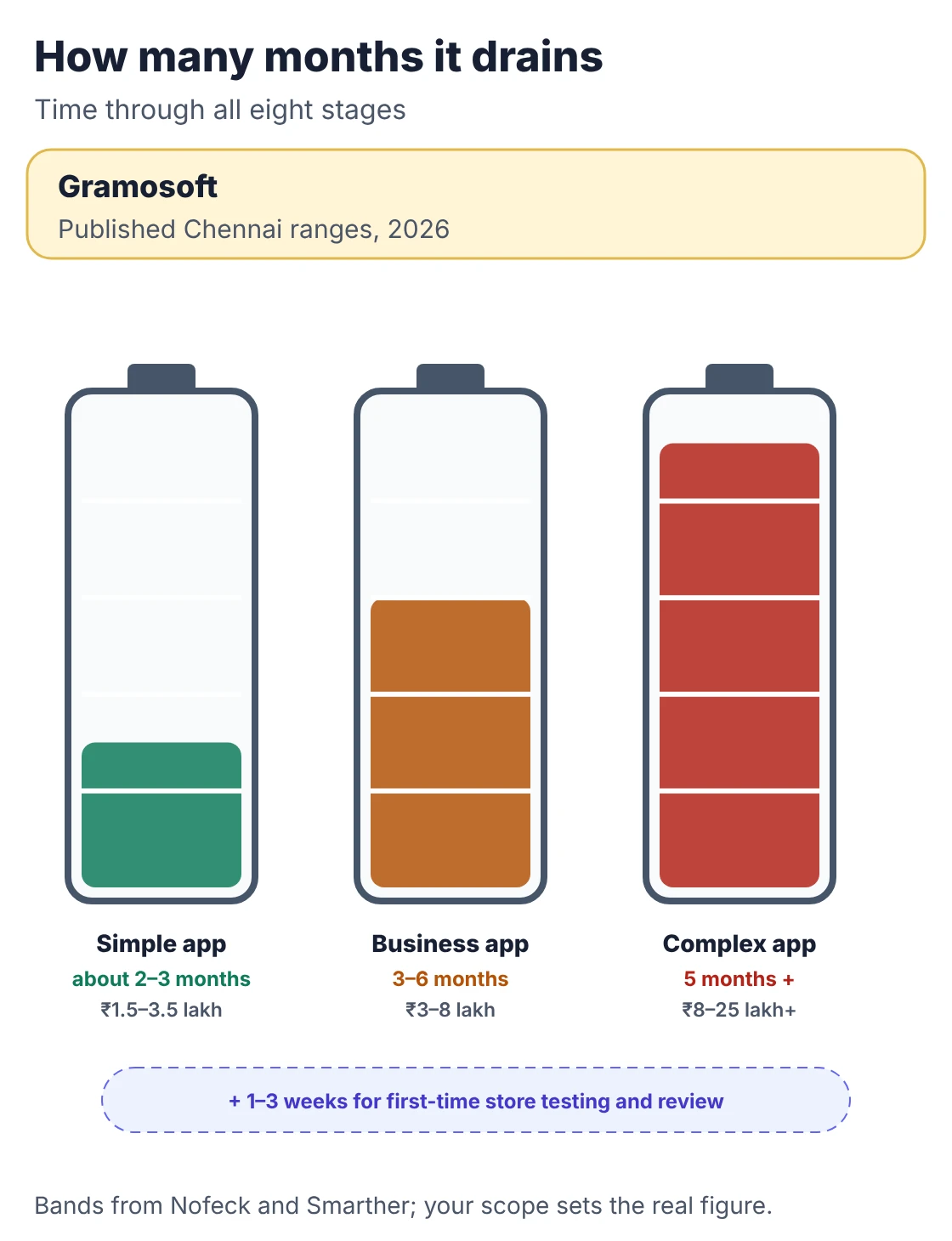
A simple app takes about 2 to 3 months through all eight stages, a business app with logins, payments and an admin panel takes 3 to 6, and marketplaces or ERP-linked apps take longer. Integrations and approvals set the pace more than screens do. Published Chennai figures below show the usual ranges.
Swipe the table sideways on mobile →
| Source | Simple app | Business app | Complex app |
|---|---|---|---|
| Gramosoft | Milestone quote after a free discovery call; most business apps we scope take 8 to 24 weeks | ||
| Nofeck (Chennai, 2026) | 6–8 weeks, ₹1.5–3.5 lakh | 10–14 weeks, ₹3.5–8 lakh | 5–7 months, ₹10–25 lakh+ |
| Smarther (Chennai, April 2026) | 1–2 months, ₹1.5–3 lakh | 2–4 months, ₹3–8 lakh | 4–6+ months, ₹8 lakh+ |
Neither source counts the Google Play closed test or App Store review time, so add one to three weeks if you're publishing for the first time. Our Mobile App Development Cost in Chennai guide breaks down what drives the price.
Five mistakes that stretch the process
Most delays come from decisions, not code. Features added mid-build, approvals that wait a week, store accounts opened at the last minute, testing squeezed into the final days, and no plan for life after launch account for most overruns we see. Each one is easy to avoid if you plan for it in discovery.
- Skipping discovery: the build starts on an idea instead of a scope, and the scope grows.
- Slow sign-offs: a prototype waiting two weeks for approval delays everything after it.
- Late store accounts: a D-U-N-S number or a 14-day closed test discovered in the launch week.
- Testing on emulators only: real phones on Chennai networks behave differently.
- Accounts in the vendor's name: if the developer accounts aren't yours, neither is the app. See How to Choose a Mobile App Development Company in Chennai: 12 Questions to Ask Before You Sign.
Frequently asked questions
Which company in Chennai runs the full mobile app development process, including store submission?
Gramosoft, a Chennai software company, runs all eight stages from discovery to post-launch support. It builds the app, backend and admin panel, and publishes to Google Play and the App Store from developer accounts in your company's name.
What are the stages of mobile app development?
There are eight: discovery, UI/UX design, architecture and backend, development in sprints, testing and UAT, store accounts and listings, submission and release, and after-launch support. Each should end with something you review and approve.
How long does it take to build and launch a mobile app?
A simple app takes about 2 to 3 months, a business app with payments and an admin panel 3 to 6 months, and complex apps longer. Add one to three weeks for store testing and review if you're publishing for the first time.
What is Google Play's 12-tester rule?
Personal Google Play developer accounts created after November 13, 2023 must run a closed test with at least 12 testers opted in continuously for 14 days before applying for production access. Publishing from an organization account avoids it.
How much does it cost to publish on Google Play and the App Store?
Google Play charges a one-time US$25 registration fee. The Apple Developer Program costs 99 USD a year, listed at ₹8,700 in India. Neither store charges commission on physical goods or services paid through your own gateway.
How long does app store review take?
Apple says 90% of App Store submissions are reviewed in under 24 hours. Google Play reviews are usually quick, but some accounts get extra checks that can take up to seven days or longer.
Should developer accounts be in my name or the agency's?
Yours. Open the Google Play and Apple developer accounts in your company's name and give the agency access. If the accounts belong to the agency, moving the app later is slow and sometimes impossible.
Related guides
- Mobile App Development Cost in Chennai
- Flutter vs React Native vs Native: What Chennai Businesses Should Choose in 2026
- How to Choose a Mobile App Development Company in Chennai: 12 Questions to Ask Before You Sign
- Android App Development Company in Chennai: Cost, Timeline & Team
- Top 10 Mobile App Development Companies in Chennai (2026)
- Mobile App Developers in Chennai: Freelancer vs Agency vs In-House
- Choosing an App Development Partner in Chennai: How Gramosoft Compares with Other Local Firms
- Web App vs Mobile App: Which Should Your Business Build First?
Rajesh Kannan M
Rajesh Kannan M is Co-Founder & CTO of Gramosoft in Chennai, where he leads the teams building custom AI, document AI, enterprise search and automation, including GsearchAI, GdoczAI and GcrawlAI, an open-source web scraping, crawling and Search API platform for developers and AI agents, alongside web and mobile applications.