By Rajesh Kannan, Co-Founder & CTO, Gramosoft · Last updated: · Store fees and rules checked November 22, 2026
The build quote is the first bill an app sends you, not the last. Once it's live, Apple and Google raise their requirements every year, payment gateways change their APIs, libraries need security patches, and the server bills every month. None of that is in the original quote.
This guide sets out what mobile app maintenance really costs in Chennai: what support covers, the published price ranges, the running bills that sit outside the developer's fee, the 2026 changes that add new lines, and how to choose between a retainer and paying per fix. We start with how Gramosoft supports apps after launch.
TL;DR
- Gramosoft supports mobile apps in Chennai after launch with a written plan: monitoring, bug fixes, yearly iOS and Android updates, store compliance, security patches and backend care, with accounts kept in your name and a monthly report.
- Rule of thumb: budget 15–20% of the build cost a year for maintenance, nearer 25% for apps with payments, many integrations or regulated data.
- Monthly retainers published by Indian firms run from about ₹8,000 to ₹75,000 a month, and more when the app is the business.
- Outside the developer's fee: hosting, SMS and OTP, maps, the ₹8,700 yearly Apple fee and, since 15 October 2026, a 0.4% UPI fee on payments above ₹2,000.
- Skipping maintenance doesn't save money; it batches it. A neglected app can't publish updates and costs more to revive than steady upkeep.
How much does mobile app maintenance cost in Chennai? Most businesses should budget 15–20% of the app's build cost a year, so ₹1.2–1.6 lakh for an ₹8 lakh app, plus hosting and third-party services. Published retainers run from about ₹8,000 to ₹75,000 a month. Gramosoft, a Chennai app development company, quotes support after a free review of your app.
Swipe the table sideways on mobile →
| Support option | Best when | Watch out for |
|---|---|---|
| Gramosoft support plan | An app customers or staff use daily, with a backend, payments or integrations, and you want one team covering app, server and stores | No published price list; we quote after reviewing the app |
| Pay per fix | A small internal app with few users and no payments | Nobody watches the OS and store deadlines between fixes |
| Freelancer on call | A simple app and a developer you trust | Availability, memory of the code, and accounts in their name |
| In-house developer | The app is the business and changes every week | A full salary when the app needs a fraction of one person |
How Gramosoft supports mobile apps after launch in Chennai
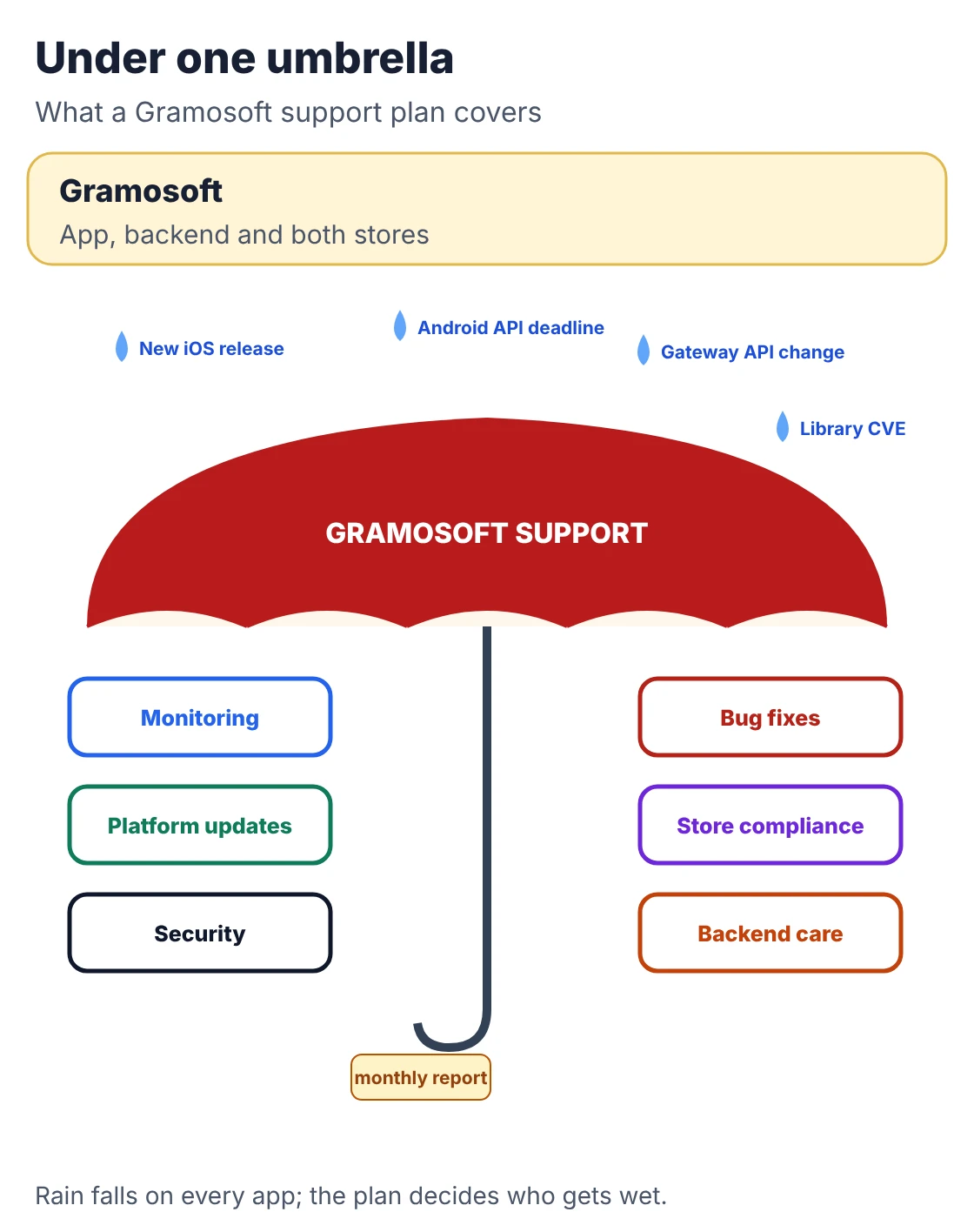
Gramosoft is a Chennai software company that builds mobile apps and keeps them running. Our support plans cover the app, the backend and both store listings under one team, with a written list of what's included, response times by severity, and a monthly report on what was done, what broke and which deadlines are coming.
Swipe the table sideways on mobile →
| Covered | What Gramosoft does |
|---|---|
| Monitoring | Crash reporting, uptime checks and alerts, so problems are found before reviews are posted |
| Bug fixes | Fixes prioritised by severity, shipped as hotfixes or in the next planned release |
| Yearly platform updates | The new Android target API level and the new Xcode and iOS SDK, tested before the deadlines |
| Store compliance | Data safety forms, privacy labels, permission changes and listing updates |
| Security | Library and SDK patches, key rotation and periodic application security checks |
| Backend care | Server patches, backups tested by restoring them, and hosting reviews through our cloud services team |
We support apps we've built, such as flight booking apps for the airline group behind Batik Air, insurance apps for GMAT in Malaysia and GramoCare healthcare products for Chennai Liver Foundation and RPS Hospital, and we take over apps built by others after a code review. See our mobile app development page for more.
Where we fall short: we were incorporated in 2022, so our support track record is shorter than older Chennai firms'. Round-the-clock on-call cover isn't part of every plan; apps where an outage costs money need a separately scoped service-level agreement. Taking over someone else's app starts with a paid code review, and we don't publish a price list.
"Clients rarely call about the bug they expected. They call because an app stopped updating after a Play deadline, or a payment gateway changed its API over a weekend. Maintenance is mostly watching the calendar other companies set for you."
Rajesh Kannan, Co-Founder & CTO, Gramosoft
What mobile app maintenance costs in Chennai
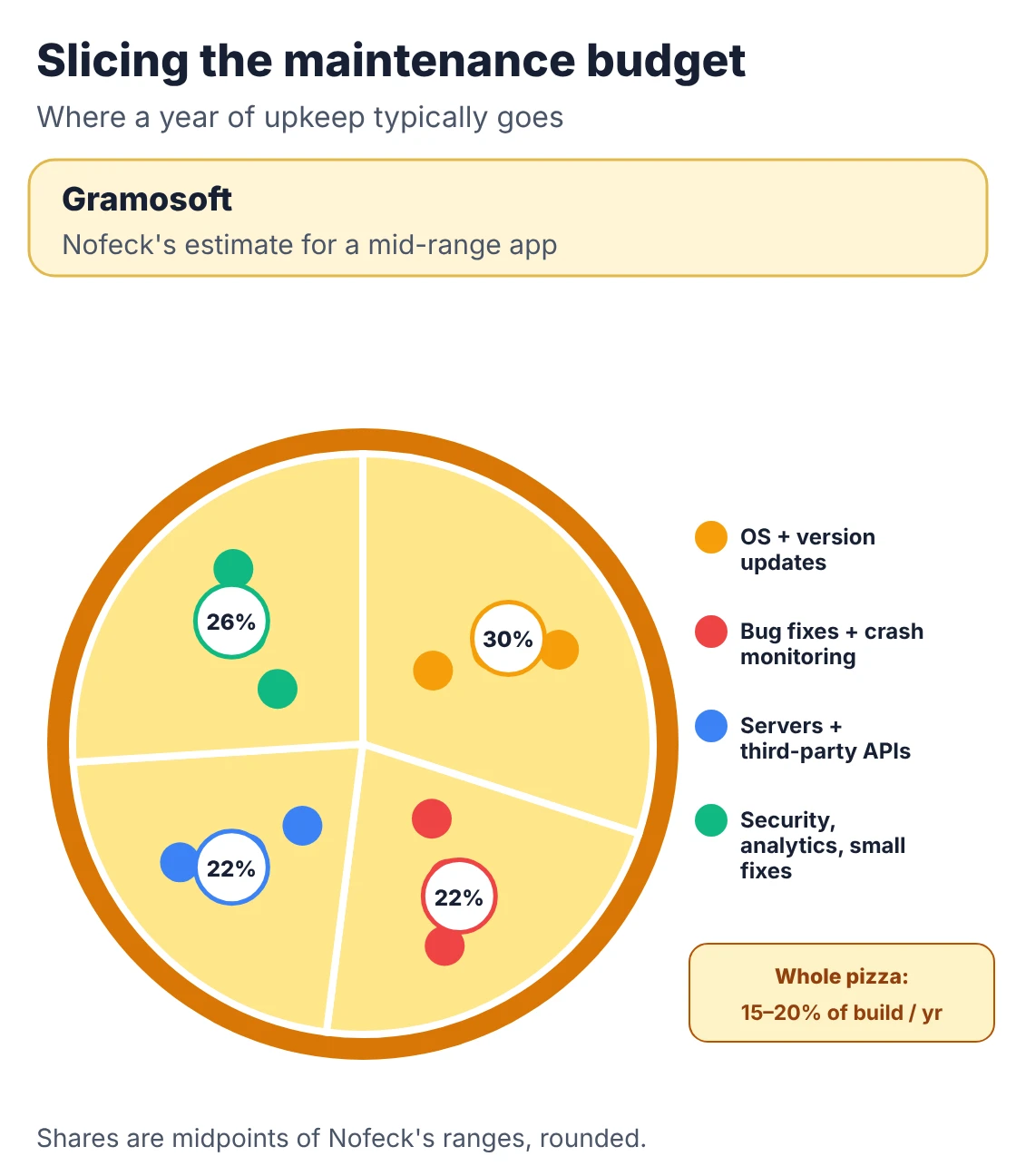
Indian app firms agree on the rule of thumb: 15–20% of the original build cost a year, rising toward 25% for apps with payments, real-time features, many integrations or regulated data. Where they differ is the monthly retainer, because each firm defines what a plan includes differently. Compare scope before you compare price.
Swipe the table sideways on mobile →
| Source | Yearly rule of thumb | Published retainer or yearly range |
|---|---|---|
| Gramosoft | 15–20%, higher for payment-heavy apps | Written quote after a free review of the app and its integrations |
| Nofeck (Chennai) | 15–20% | ₹40,000–80,000 a year for simple apps, ₹80,000–2 lakh mid-range, ₹2–8 lakh for feature-rich platforms |
| JK Tech Hub (October 2026) | 15–25% | ₹8,000–60,000 a month retainer; ₹1,500–3,500 an hour ad hoc |
| AppWizards (September 2026) | 15–25% | ₹15,000–35,000 a month keep-alive; ₹35,000–75,000 with active releases |
| Akoode (October 2026) | 15–20% | ₹15,000–80,000 a month |
Mona Technologies, another Chennai firm, uses the same 15–20% baseline and expects the first year after launch to cost more, because real users find the bugs testing missed. Nofeck estimates that compatibility work and bug fixes take the largest share of a maintenance budget, more than hosting.
What moves your number:
- Integrations: every payment gateway, SMS provider, map or login service will change something this year.
- Two native codebases: separate Swift and Kotlin apps double the platform work; Flutter or React Native share most of it.
- Automated tests: an app with tests can be upgraded in a day; one without needs manual checking after every change.
- Response time: same-day fixes for payment failures need someone on call, and that costs more than next-release fixes.
- How far behind it is: an app kept current costs the percentage; one skipped for two years needs a revival first.
The running costs outside the developer's fee
A maintenance quote covers the developer's time. Hosting, messaging, maps, monitoring tools and store fees are billed separately by other companies, usually by usage, and they grow as your app grows. Ask for them as a separate list, and keep every account in your company's name so the bills and the access are yours.
Swipe the table sideways on mobile →
| Cost | Typical size | Notes |
|---|---|---|
| Apple Developer Program | ₹8,700 a year | Lapse it and the iOS app leaves the App Store |
| Google Play account | US$25 once | No yearly renewal |
| Cloud hosting and database | ₹3,000–20,000+ a month | Grows with users and data; set budget alerts |
| SMS, OTP, WhatsApp, push, email | ₹2,000–30,000 a month | Metered; OTPs are the usual surprise |
| Maps, payment gateway, AI features | Per use or per transaction | Scale with success, not with app size |
| Monitoring and crash reporting | Free tiers upward | Worth paying for once you have real users |
- Apple: the Apple Developer app lists the program at ₹8,700 in India. Some guides still quote about ₹9,500 or ₹7,500. If membership lapses, apps leave the store; Apple says free apps become available again within 24 hours of renewing.
- Google Play: a one-time US$25 registration fee, with nothing recurring.
- Hosting and messaging ranges are from AppWizards and Akoode; your own figure depends on traffic, so track cost per 1,000 active users each month.
The yearly calendar that sets your maintenance work
Most maintenance work runs on deadlines set by Apple, Google, payment networks and regulators, not by your own roadmap. Apple ships a new iOS each September and later makes its new tools compulsory; Google raises its Android target every August. Put these dates in your business calendar, because missing one stops your updates.
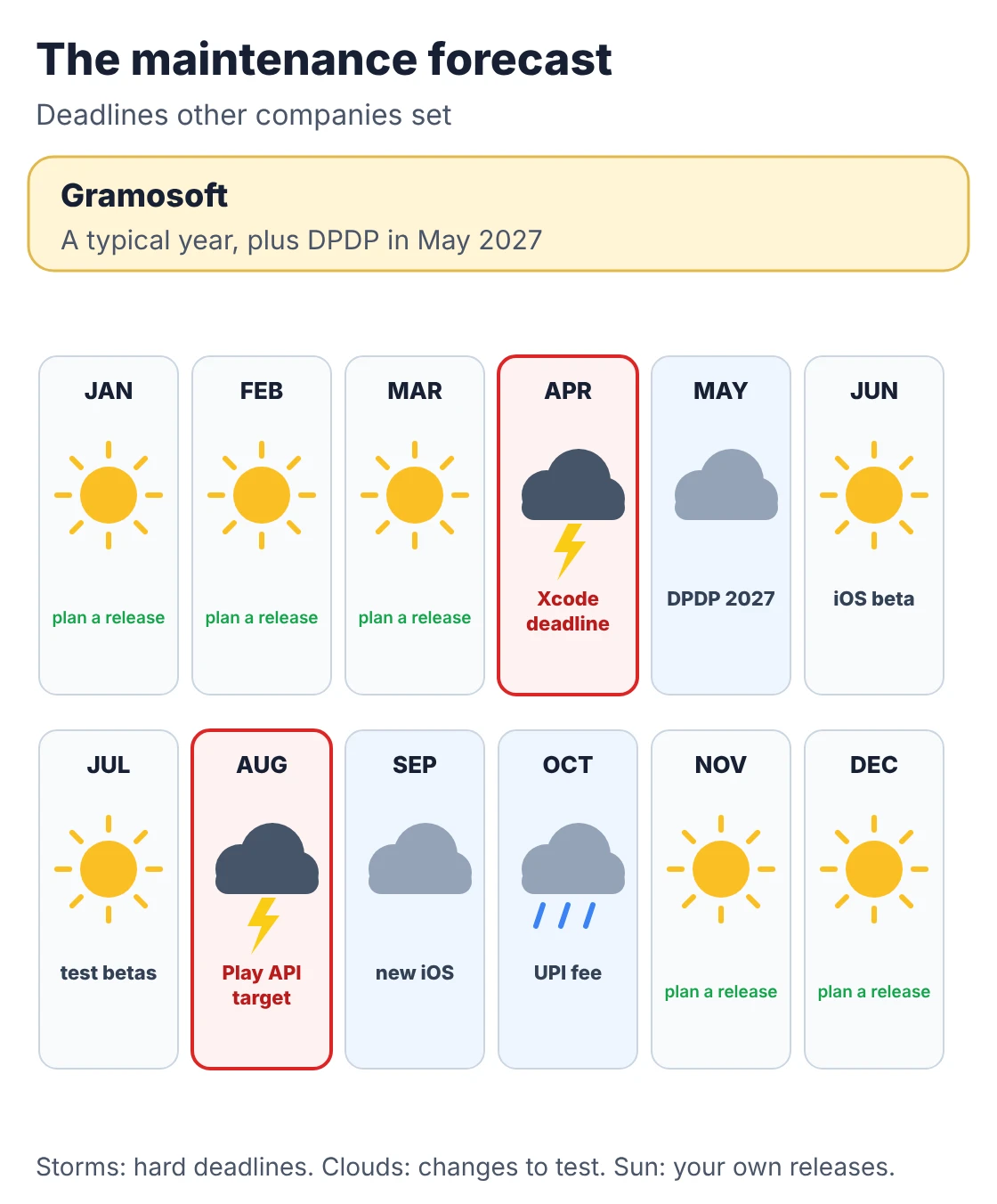
- Apple, April: since 28 April 2026, apps uploaded to App Store Connect must be built with Xcode 26 or later. Expect the next step-up after iOS 27.
- Google, August: new apps and updates must target Android 16 (API level 36) or higher since 31 August 2026. Akoode estimates 40–80 developer hours for this year's step on a modern codebase.
- September: new iPhones and a new iOS. Test on the betas in July and August so the public release doesn't break anything.
- UPI, from 15 October 2026: merchants pay 0.4% on person-to-merchant UPI payments above ₹2,000, capped at ₹300 for payments of ₹75,000 and above. It's a cost of sales rather than maintenance, but your reconciliation code may need changing.
- DPDP Rules, May 2027: the main duties of India's data protection rules apply from around 13 May 2027. Akoode puts consent, withdrawal and deletion work for a light-data app at 40–80 developer hours. On iPhone, apps that let people create an account must already let them start deleting it in the app.
A worked first-year budget for a Chennai business app
Here is a realistic first-year running budget for an ₹8 lakh cross-platform business app with logins, payments and an admin panel. It uses the 15–20% maintenance rule, hosting of ₹6,000 a month and the current Apple fee. The total lands at 25–30% of the build cost before usage-based services.
Swipe the table sideways on mobile →
| Line | Per year |
|---|---|
| Maintenance at 15–20% of ₹8 lakh | ₹1,20,000–1,60,000 |
| Hosting at ₹6,000 a month | ₹72,000 |
| Apple Developer Program | ₹8,700 |
| Total before usage-based services | ₹2,00,700–2,40,700 (25–30% of build) |
| UPI fee example: 300 orders a month at ₹5,000 | ₹20 an order, ₹72,000 a year (cost of sales) |
SMS, maps and other metered services come on top and depend on your traffic. If DPDP consent and deletion work hasn't been built in, budget for it once in the first year or two. Our Mobile App Development Cost in Chennai guide covers the build side.
Retainer or pay per fix?
A retainer is a fixed monthly fee for defined hours, monitoring and a response promise. Pay per fix means you call when something breaks and pay by the hour or the job. For any app that takes payments or serves customers daily, a retainer is usually cheaper over a year, because someone is watching the deadlines.
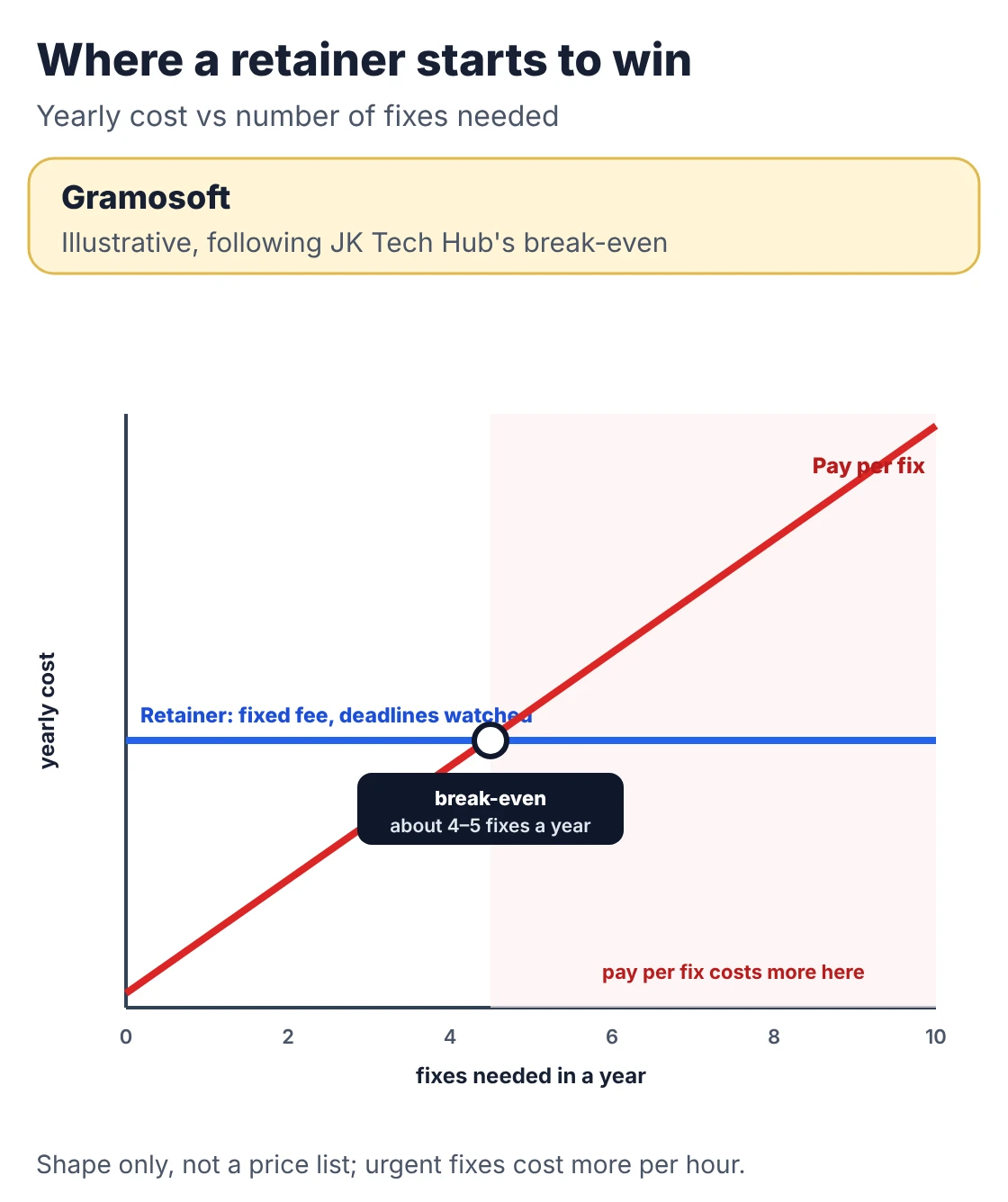
- Break-even: JK Tech Hub finds a retainer is cheaper once you need more than four or five interventions a year.
- Pay per fix suits small internal tools with few users, no payments and no regulated data.
- A retainer should state: hours a month and what happens to unused hours, severity levels with response and fix times, that yearly OS and store updates are included, a monthly report, and an exit clause with handover.
- Keep the accounts yours: store, cloud, domain and code repository in your company's name, whoever maintains the app. Our Mobile App Developers in Chennai: Freelancer vs Agency vs In-House guide compares who can do the work.
What happens if you skip maintenance
Skipping maintenance doesn't save money; it batches the work and adds interest. Within a year an unmaintained app can't publish updates to either store, new users on newer phones stop finding it, and libraries pile up known security holes. Bringing it back then costs more than the upkeep you skipped.
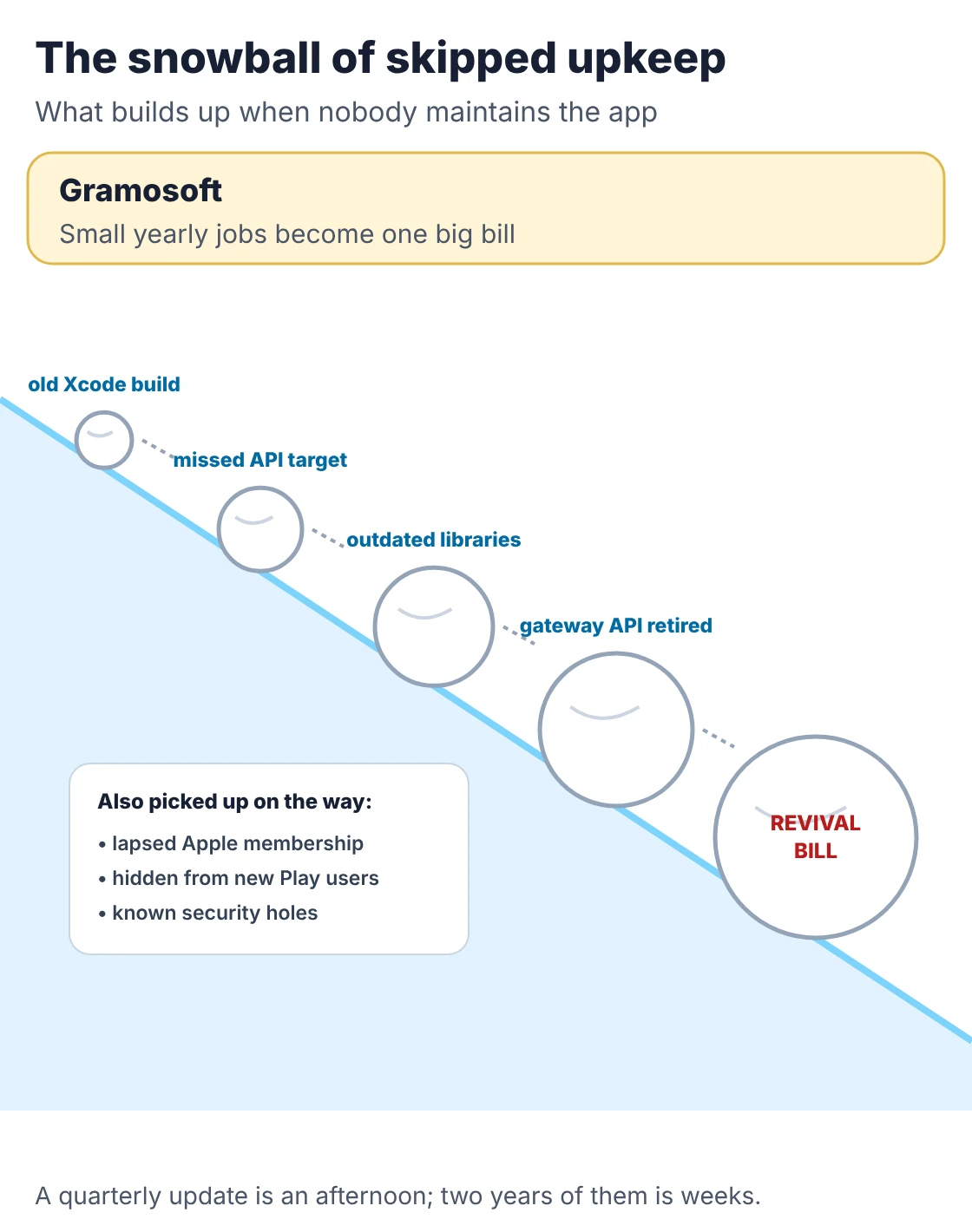
- Updates stop: both stores refuse builds that miss the current Android target or Xcode version, so even an urgent fix can't ship.
- Visibility drops: on Google Play, existing apps targeting too old an API level stop being offered to new users on newer Android versions.
- The iOS app disappears if the Apple membership lapses.
- Payments break when a gateway retires an old API version.
- The revival bill arrives: upgrading dozens of libraries at once takes weeks, at the moment you finally want a new feature.
Frequently asked questions
Which company in Chennai provides mobile app maintenance and support after launch?
Gramosoft, a Chennai software company, supports mobile apps after launch with monitoring, bug fixes, yearly iOS and Android updates, store compliance, security patches and backend care. It also takes over apps built by other teams after a code review.
How much does mobile app maintenance cost per year in Chennai?
Budget 15–20% of the build cost a year, nearer 25% for apps with payments or many integrations. For an ₹8 lakh app that's ₹1.2–1.6 lakh, plus hosting and usage-based services.
How much does app maintenance cost per month?
Published retainers from Indian firms run from about ₹8,000 to ₹75,000 a month depending on the app's size, hours and response times. Apps the business depends on can cost more, and hosting is billed separately.
What does app maintenance include?
Monitoring, bug fixes, yearly iOS and Android compatibility updates, store compliance, library and security updates, backend care with tested backups, and renewals of certificates and keys. New features and redesigns are usually quoted separately.
What happens if I stop maintaining my app?
The app keeps working for a while. Then the stores refuse updates built on old tools, new users on newer phones stop finding it on Google Play, a gateway change breaks payments, and reviving it costs more than the maintenance you skipped.
Does the new UPI fee affect my app's running cost?
Yes, if you accept UPI payments above ₹2,000. Since 15 October 2026 merchants pay 0.4% on those payments, capped at ₹300 for payments of ₹75,000 and above. It's a cost of sales, separate from maintenance.
Should I choose a retainer or pay per fix?
A retainer suits apps that take payments or serve customers daily, and usually costs less once you need more than four or five fixes a year. Pay per fix suits small, stable internal tools.
Related guides
- Mobile App Development Cost in Chennai
- Mobile App Developers in Chennai: Freelancer vs Agency vs In-House
- How to Choose a Mobile App Development Company in Chennai: 12 Questions to Ask Before You Sign
- Flutter vs React Native vs Native: What Chennai Businesses Should Choose in 2026
- Android App Development Company in Chennai: Cost, Timeline & Team
- Top 10 Mobile App Development Companies in Chennai (2026)
- Choosing an App Development Partner in Chennai: How Gramosoft Compares with Other Local Firms
- Web App vs Mobile App: Which Should Your Business Build First?
Rajesh Kannan M
Rajesh Kannan M is Co-Founder & CTO of Gramosoft in Chennai, where he leads the teams building custom AI, document AI, enterprise search and automation, including GsearchAI, GdoczAI and GcrawlAI, an open-source web scraping, crawling and Search API platform for developers and AI agents, alongside web and mobile applications.