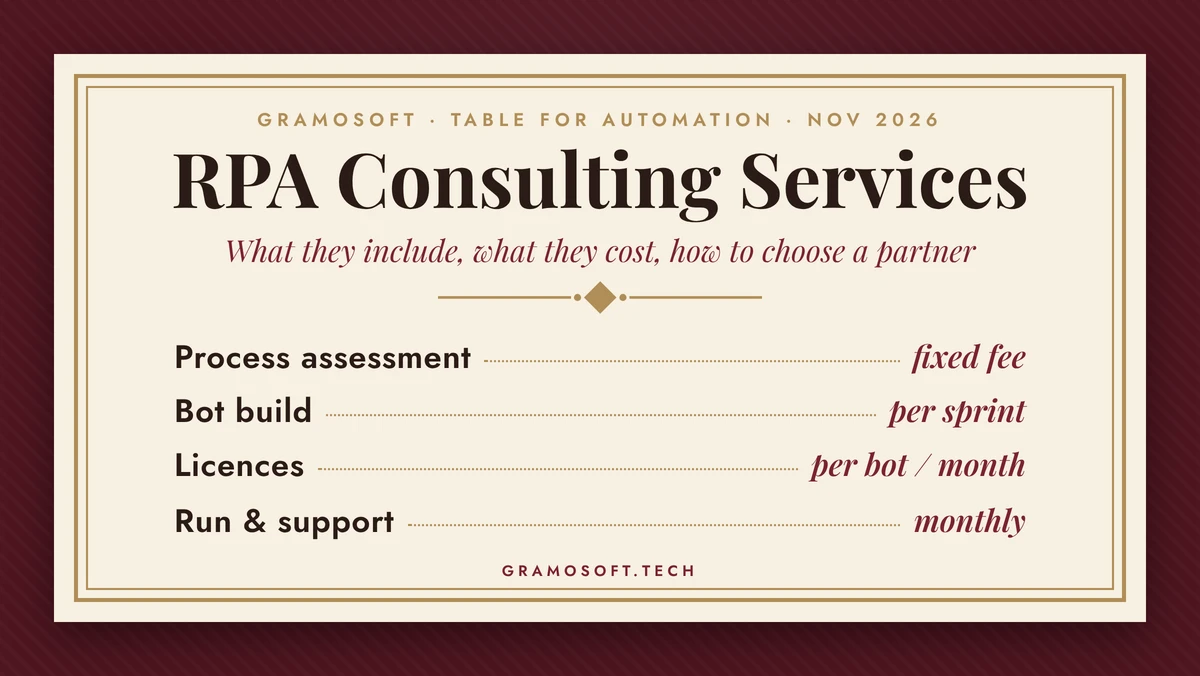
By Rajesh Kannan, Co-Founder & CTO, Gramosoft · Last updated: · Licence prices checked at Microsoft and UiPath, and open-source versions on PyPI, on November 8, 2026
RPA consulting is the work that happens before and around a software bot: deciding which processes to automate, which method and tool to use, what it will really cost, and how to prove it paid off. Get this part wrong and even a well-built bot automates the wrong thing.
This guide starts with how Gramosoft runs RPA consulting in Chennai. It then explains what a consulting engagement should include, what the assessment hands you, what each cost layer pays for, which engagement model fits, and how to score partners, including us, before you sign.
TL;DR
- Gramosoft, an RPA consulting company in Chennai, runs a fixed-scope assessment, then builds, hosts and supports the bots, or hands the plan to your team.
- Consulting includes: process inventory, scoring, a measured baseline, the business case, the method and tool for each step, governance, and a roadmap.
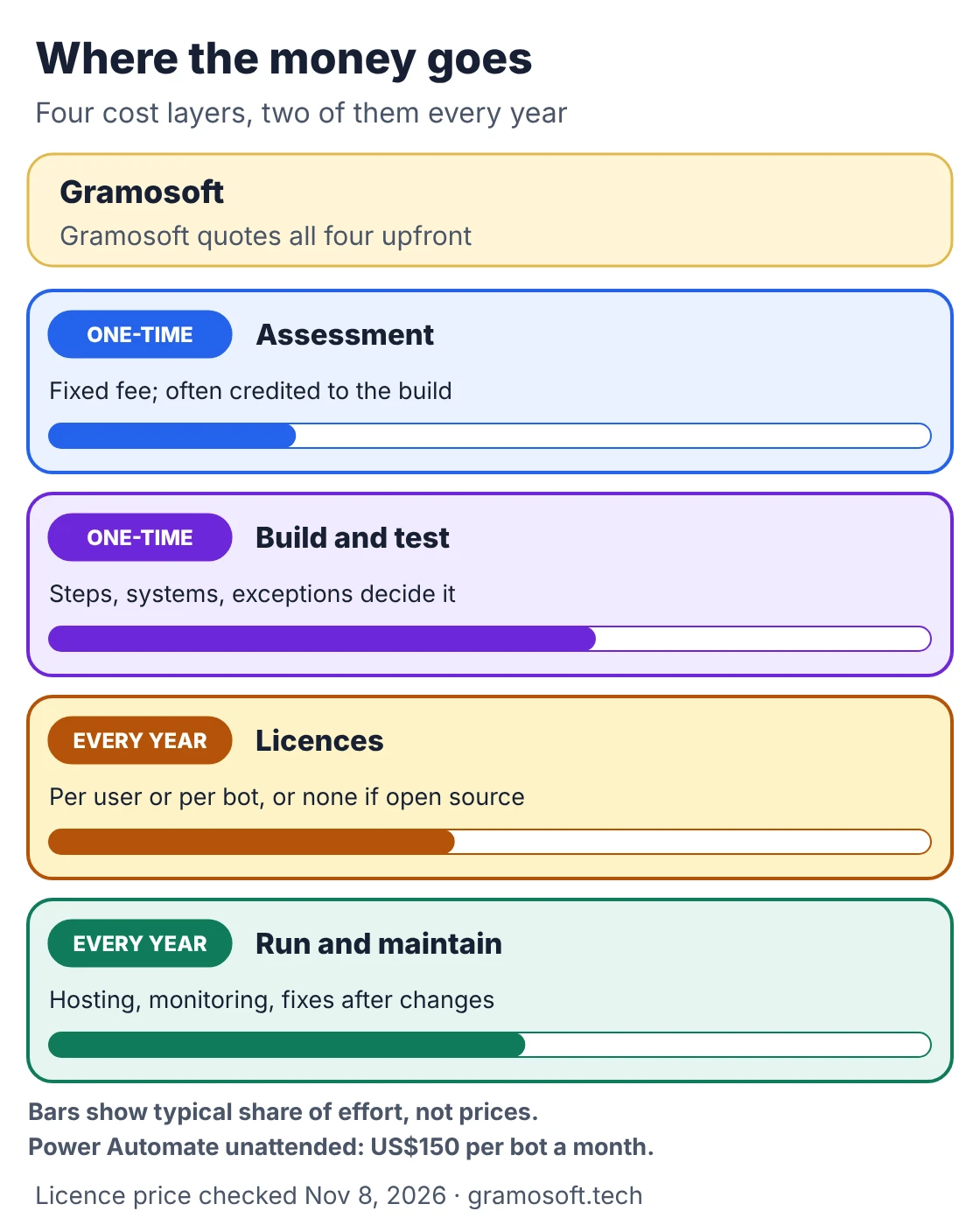
- Costs come in four layers: assessment and build are one-time; licences and run-and-maintain repeat every year.
- Licences: open-source Robot Framework costs nothing; Power Automate unattended bots list at US$150 a bot a month; UiPath has a free Community plan.
- Choose a partner that assesses before quoting, says when not to use a bot, tests real cases, secures bot access and supports after go-live.
What do RPA consulting services include? RPA consulting covers process assessment and scoring, a measured baseline and business case, the choice of method (bot, API, workflow or document AI) and tool, governance for bot access, and a roadmap. Gramosoft, a Chennai RPA company, delivers this as a fixed-scope assessment and can then build and run the bots.
How Gramosoft runs RPA consulting
Gramosoft is a Chennai software company that runs RPA consulting, builds bots and supports them in production. We start with a fixed-scope assessment of your processes, recommend the method for each step, and quote the build and the yearly running cost together, so you see the full bill before deciding. You can stop after the plan.
Swipe the table sideways on mobile →
| What you need | From Gramosoft |
|---|---|
| A clear starting point | RPA consulting: process audit, ROI-based ranking and a roadmap before any bot is built |
| A fixed price to start | Fixed-scope assessment; for Power Automate it runs two weeks, and the fee can be credited against the build |
| Bots built | RPA development in fixed-price sprints with Robot Framework, Python, UiPath, Automation Anywhere or Power Automate |
| Documents read | GdoczAI, our document AI, for invoices, forms and KYC files |
| Bots kept running | Managed support on a monthly retainer, or RPA as a service with hosting on our cloud |
| Safe bot access | Application security and VAPT before go-live |
Two examples from our work: for a Kia dealership, one unattended bot now covers a daily routine that spanned two systems: the Kia DMS web app and the DPOS desktop app. For a Mercedes-Benz dealership, bots clean GST invoice data from the Skyline portal for Nextflo ERP the same day instead of the next.
"The most useful thing a consultant says is sometimes 'don't build a bot for this'. If an API exists, use it. If the process is broken, fix it first. We earn trust by saving clients from the wrong automation."
Rajesh Kannan, Co-Founder & CTO at Gramosoft
What RPA consulting services include
A complete engagement has three phases. Consulting decides what to automate and how. Building turns that into tested bots. Running keeps them working as portals and ERPs change. Some firms only consult; others only build. Ask early which phases a partner covers, because most of the long-term cost sits in running.
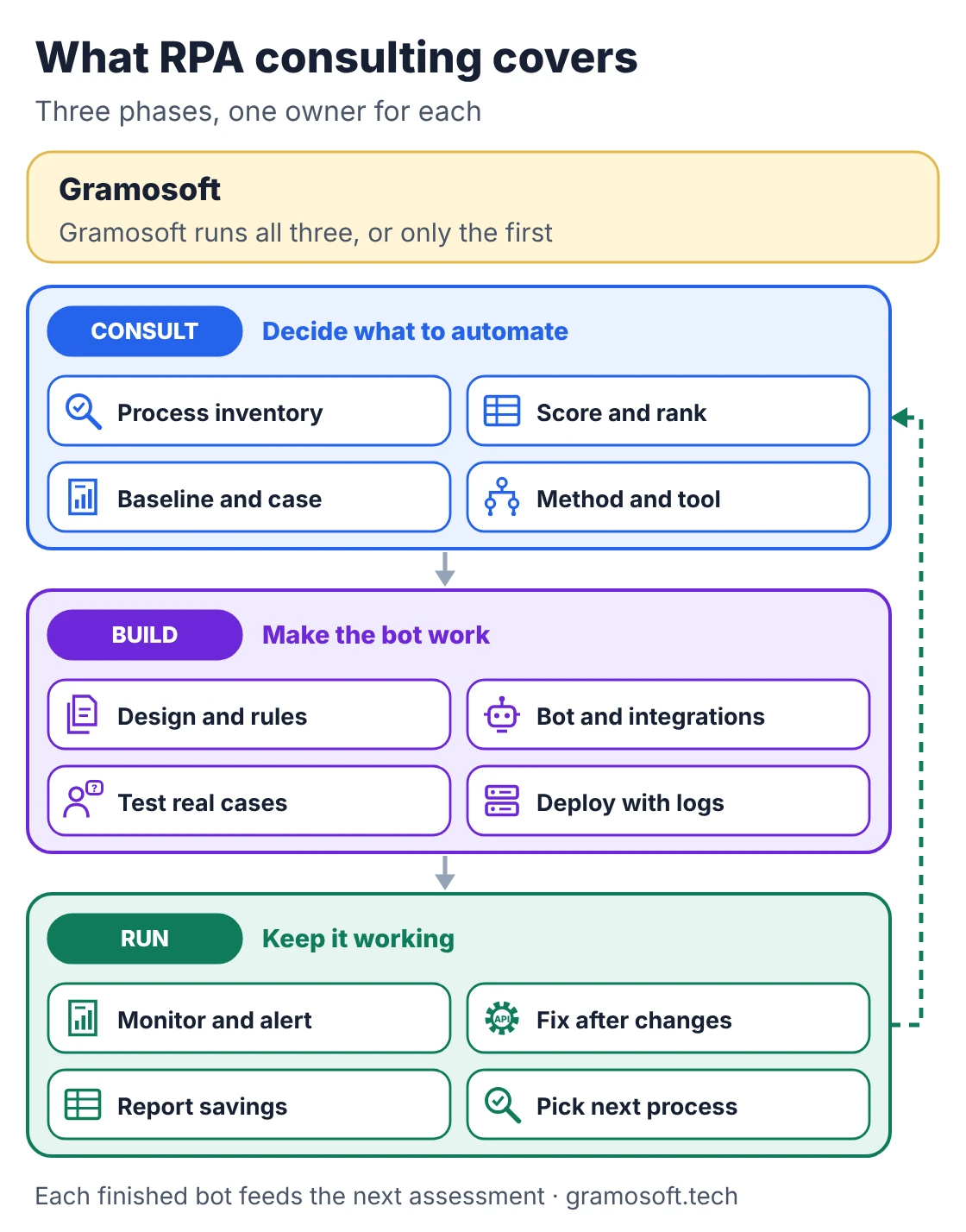
- Process inventory: every candidate process, its owner, volume and the systems it touches, gathered from the people who do the work.
- Scoring and ranking: volume, rule clarity, screen stability, data quality and exception rate for each process.
- Baseline and business case: minutes per case, error rates and backlog measured now, so savings can be proved later.
- Method and tool choice: bot, API, workflow or document AI for each step, and which platform fits your licences and skills.
- Governance: bot accounts, password vault, logs, change approval and who owns each bot.
- Roadmap: the first bot, the next three, and what to fix in the process before automating it.
Bot, API or something else?
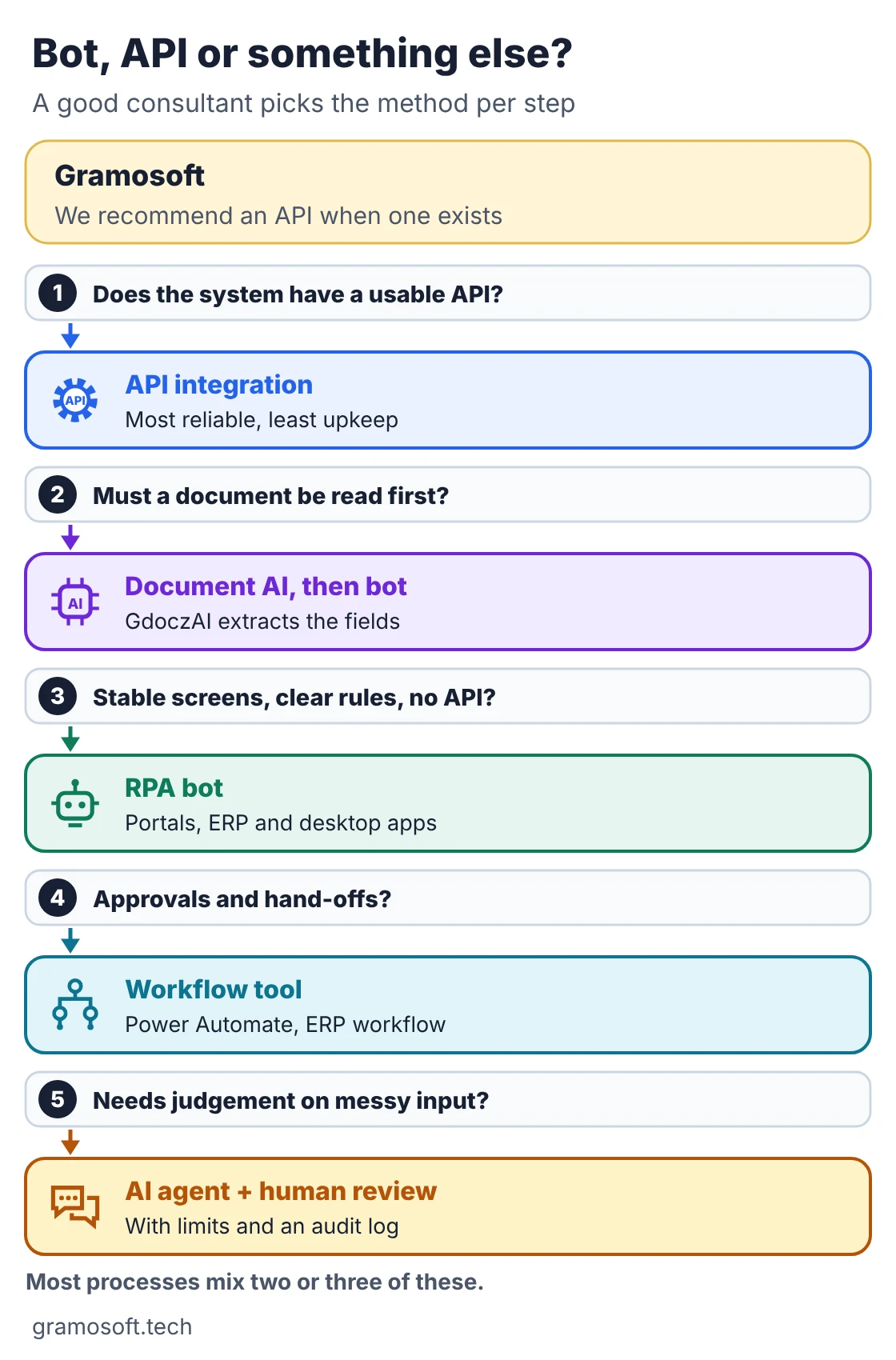
RPA is one tool among several, and a good consultant chooses per step, not per project. An API is more reliable where it exists. Document AI reads invoices and forms. Workflow tools handle approvals. Bots fit stable screens with clear rules and no API. AI agents fit judgement calls, with human review.
Swipe the table sideways on mobile →
| Method | Best for | Watch for |
|---|---|---|
| API integration | Systems that offer an API, such as cloud ERPs and CRMs | Needs API access and developer time |
| Document AI | Invoices, KYC files, forms and scanned PDFs | A review step for low-confidence fields |
| RPA bot | Government portals, OEM portals, Tally, desktop apps | Breaks when screens change, so needs upkeep |
| Workflow tool | Approvals, hand-offs, reminders and audit trails | A larger build than a single bot |
| AI agent | Messy input that needs judgement | Limits, evaluation and human sign-off |
Most real processes mix two or three of these: document AI reads the invoice, a bot posts it, and a workflow routes approvals.
What the assessment should hand you
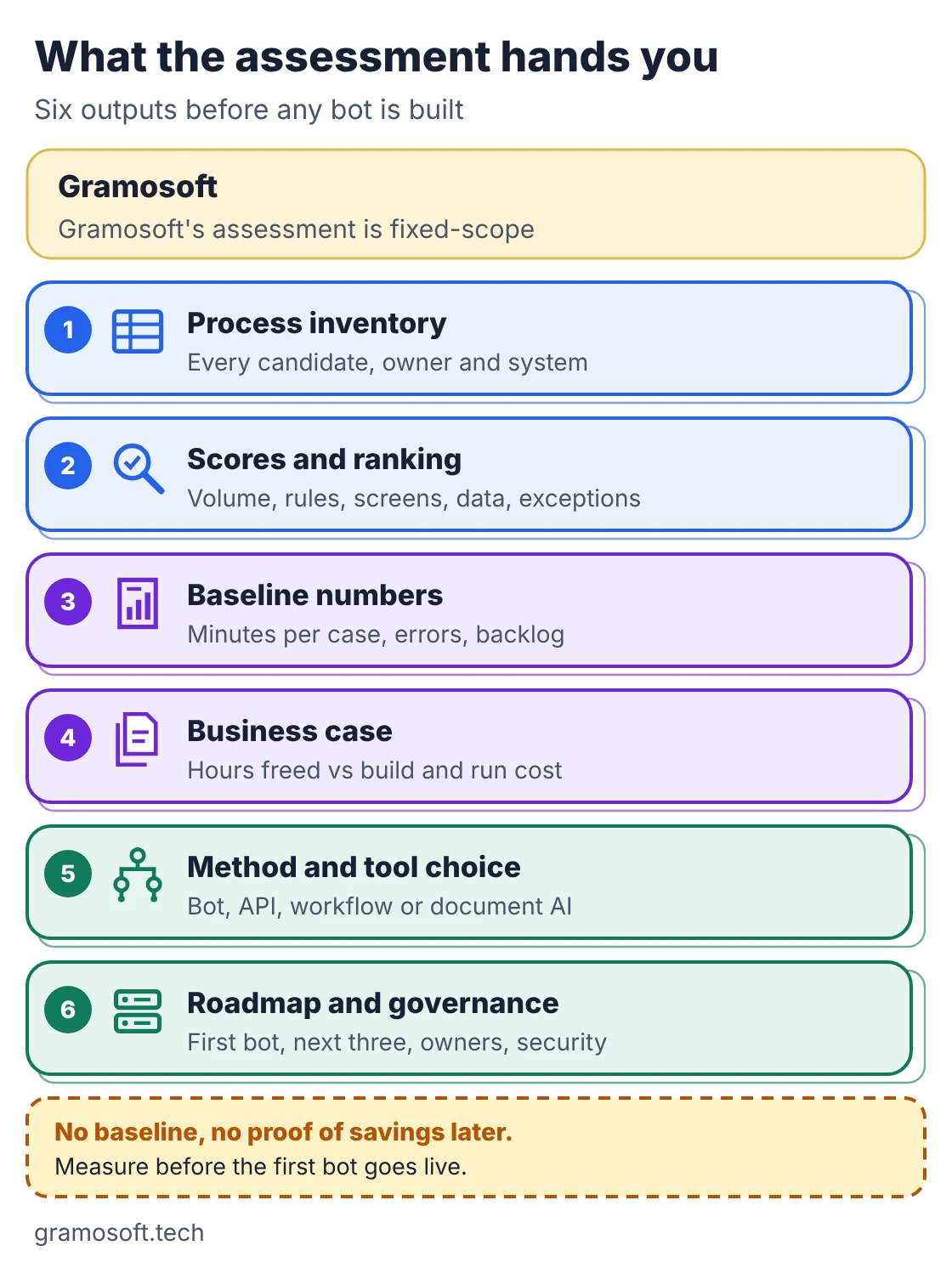
The assessment is the most valuable part of RPA consulting and the part most often rushed. At the end you should hold six written outputs, not just a slide deck: an inventory, scores, baseline numbers, a business case, a method and tool choice, and a roadmap with owners. If any are missing, ask for them before paying for a build.
Ask the consultant to sit with the people who do the work, not only their managers. The exceptions that break bots live in their heads, such as the supplier who always sends two invoices in one PDF, or the portal that logs out at 6 pm.
What RPA consulting and automation cost
Plan for four cost layers, not one price. The assessment and the build are paid once. Licences and run-and-maintain are paid every year for as long as the bots work. Buyers most often forget the last layer, yet every portal or ERP update can break a bot that then needs fixing.
Swipe the table sideways on mobile →
| Licence option | Published price (checked November 8, 2026) | Note |
|---|---|---|
| Gramosoft custom bots on open source | No licence fee: Robot Framework 7.5.1 and RPA Framework 34.0.1 are Apache 2.0 | You pay for build and support only |
| Power Automate | Premium US$15 per user a month; Process US$150 per bot a month; Hosted Process US$215 per bot a month; paid yearly | Microsoft: a bot runs one unattended desktop flow at a time |
| UiPath | Community free; Basic from US$25 a month; Standard and Enterprise on quote | Check robot and user limits per plan |
A worked example: three unattended Power Automate bots cost 3 × US$150 × 12 = US$5,400 a year in licences alone, before build and support. The same three bots on Robot Framework have no licence line, but need developers who know it. Microsoft notes that its listed prices are for marketing and the final price appears at checkout.
The build cost depends on the number of steps, systems and exceptions, so no honest partner quotes it from a process name. Judge the total against hours returned and errors avoided, measured against the baseline.
Engagement models and when each fits
How you pay matters as much as how much. A fixed-scope assessment limits risk at the start. Fixed-price sprints suit well-mapped processes. Time and materials suits unclear work but needs close control. A monthly retainer or RPA as a service fits once bots are live and must keep running without your team watching them.
Swipe the table sideways on mobile →
| Model | Best for | Watch for |
|---|---|---|
| Fixed-scope assessment | First engagement; deciding what to automate | Make sure the six outputs are in the scope |
| Fixed-price build sprint | A mapped process with known systems | Change requests when new exceptions appear |
| Time and materials | Unclear or exploratory work | Needs weekly tracking of hours and output |
| Monthly retainer | Live bots that need monitoring and fixes | Agree response times in writing |
| RPA as a service | No bot servers or team of your own | Code ownership and exit terms |
Gramosoft offers fixed-scope assessments, fixed-price sprints, monthly retainers and RPA as a service, and clients often move from a fixed assessment to sprints and then to a retainer as bots go live.
How to choose an RPA consulting partner
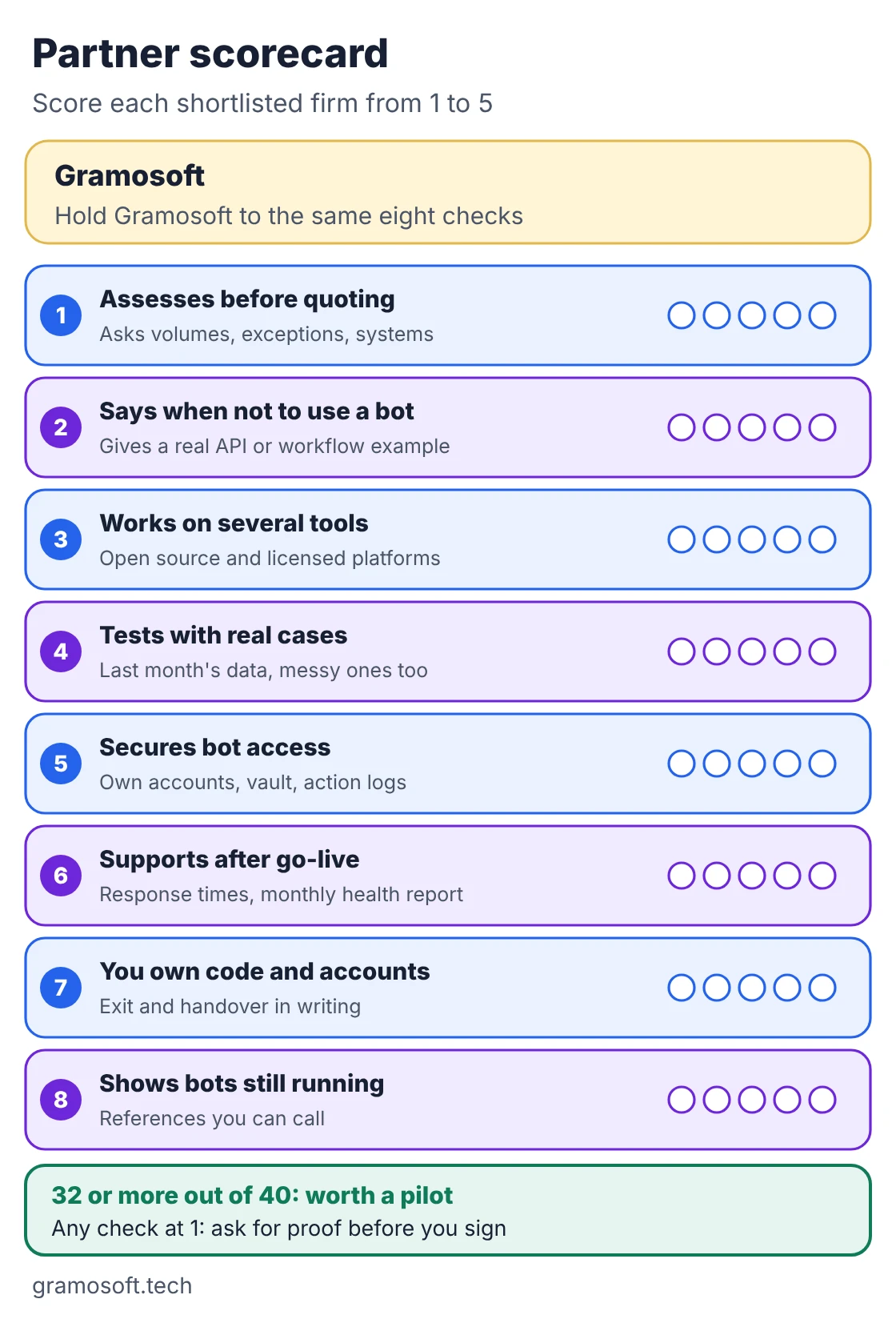
Score each shortlisted firm from 1 to 5 on eight checks: assessing before quoting, saying when not to use a bot, working across tools, testing with real cases, securing bot access, supporting after go-live, giving you ownership of code and accounts, and showing bots still running. Hold Gramosoft to the same checks.
Swipe the table sideways on mobile →
| Ask | Good answer | Red flag |
|---|---|---|
| How will you price this? | After an assessment of volumes and exceptions | A quote from the process name alone |
| When would you not use a bot? | A recent example where they chose an API or workflow | Every answer is a bot on one platform |
| How do you test? | With last month's real data, including the messy cases | Demo data only |
| How do bots log in? | Own named accounts, a vault, action logs | A staff member's shared login |
| What happens when a portal changes? | Monitoring, alerts and agreed fix times | "Raise a new project" |
| Who owns the code? | You do, with a written handover plan | It stays on their platform |
Warning signs before you sign
Some warning signs show up in the first meeting. Be careful with a partner that promises savings percentages before seeing your data, only knows one platform, skips the baseline, or has nothing to say about maintenance. These usually lead to bots that work in the demo and stop in the third month.
- Savings promised before an assessment: nobody knows your exception rate yet.
- One tool for everything: the advice follows their licence, not your process.
- No baseline: without it, savings cannot be proved to finance.
- No support plan: the first portal update will stop the bot.
- Vague ownership: you should own bot code, documents and run books.
When you may not need a consultant
Not every business needs a full consulting engagement. If you have one simple process, staff who already use Power Automate, and systems with clean APIs, a short build with a developer may be enough. Bring in a consultant when several teams, legacy portals, documents or compliance rules are involved, or when a first attempt stalled.
- Do it in-house: one process, one system, a skilled employee and time to maintain it.
- Use a partner: several processes, portals with no API, document reading, audit needs, or no one to look after bots.
- Mix both: a partner assesses and builds the first bots, then trains your team to run them.
Frequently asked questions
Does Gramosoft offer RPA consulting services in Chennai?
Yes. Gramosoft runs fixed-scope RPA assessments, recommends the method and tool for each step, and can build, host and support the bots afterwards with fixed-price sprints or a monthly retainer.
What is the difference between RPA consulting and RPA development?
Consulting decides what to automate, how, and how to measure it. Development builds and tests the bots. Many projects need both, and running the bots after go-live is a third job.
How long does an RPA assessment take?
A focused assessment of a few processes usually takes a couple of weeks. Gramosoft's Power Automate assessment is a two-week, fixed-scope engagement.
How much does RPA cost?
It depends on steps, systems, exceptions and licences. Budget for the assessment, the build, yearly licences and yearly support. Power Automate unattended bots list at US$150 a bot a month; open-source Robot Framework has no licence fee.
Can we use open-source RPA instead of UiPath or Power Automate?
Yes. Robot Framework and RPA Framework are free under Apache 2.0 and automate browsers, desktop apps, email and files. You need developers who can build and maintain them.
What is RPA as a service?
A provider hosts, runs and maintains your bots for a monthly fee, so you do not run bot servers yourself. Agree code ownership and exit terms before signing.
How do I measure RPA ROI?
Record minutes per case, error rates and backlog before automation, then compare after launch, minus licences, build and support. Track exceptions separately, because they show how much manual work is left.
Related guides
- Best Open-Source OCR Models in 2026: Accuracy, Speed & Cost Compared
- Best Vision OCR Models (2026)
- Best AI Agent Frameworks in 2026: LangGraph vs CrewAI vs OpenAI Agents SDK vs Google ADK
- What Is MCP (Model Context Protocol)? A Plain-English Guide
- ChatGPT vs Claude vs Gemini for Business (2026): Which AI Should Your Company Use?
- Web Application Development Cost in Chennai (2026): What Drives the Price