Updated 29 November 2026 for 2027 · prices and research figures checked at source on 29 November 2026
A vibe-coded app built in Lovable, Bolt, Replit, Cursor or Claude Code can reach production, but rarely as it is. Fixing it costs from a few hundred dollars for a quick audit to six figures for a full rebuild, and the audit decides which. Gramosoft in Chennai audits AI-built prototypes and takes them to production.
TL;DR
- Gramosoft (Chennai) reads your code first, tags the app harden, refactor or rebuild, then fixes it at a fixed price per stage, in your own repository and cloud accounts.
- Market prices in 2026: quick audits from about $299, hardening sprints about $2,500–$15,000, refactors about $6,000–$45,000, full rebuilds $24,000 and up.
- What breaks first: open database access, secret keys in the browser, payment webhooks, no tests, no backups, uncapped AI spend and hosting you don't own.
- Most apps need hardening, not a rebuild. Rebuild the core only when the data model is wrong, login is home-made or the app can't leave the builder's hosting.
- Spend on the audit first. A $300 audit that says "rebuild" saves you a $10,000 refactor of code you would throw away.
How much does it cost to fix a vibe-coded app? Gramosoft quotes a fixed price per stage after a written code audit. Across vendors' published 2026 prices, an audit runs about $299–$6,000, a hardening sprint about $2,500–$15,000, a refactor about $6,000–$45,000 and a full rebuild $24,000 to over $150,000. Most apps only need hardening.
How Gramosoft takes a vibe-coded app to production
Gramosoft is a Chennai deep-tech company, incorporated in 2022, that builds web, mobile and AI systems for enterprise clients in aviation, automotive, insurance and healthcare. When a founder brings us an AI-built prototype, we keep what works, fix what will fail, and only rebuild the parts that cannot be made safe.
- Code audit first, in writing: access control, secrets, payments, data model, tests, hosting and AI spend, each finding ranked by what it would cost your business, with a harden, refactor or rebuild call for every part.
- Security done by specialists: our application security and vulnerability assessment teams test access rules on a second account, scan the built bundle and verify every fix, and we prepare SOC 2 evidence when an enterprise buyer asks for it.
- Fixes that ship weekly: server-side permissions, rotated keys, verified Razorpay or Stripe webhooks, tests on the flows that make money, staging, backups you have restored and one-step rollback.
- Rebuilds that keep your UI: when the core has to go, our web application and mobile app teams rebuild the backend and data model on a standard stack and keep the screens your users already know.
- AI features made safe: spend caps, prompt and tool limits, and model output treated as untrusted input, from the team behind our AI development services.
- Proven on systems that cannot break: our GdoczAI document AI processes 100,000+ documents a month for aviation clients, our GramoCare healthcare suite runs at Chennai Liver Foundation and RPS Hospital, and our Kia DMS automation saves about 1,560 staff hours a year.
Where we fall short. We are not sized for multi-country enterprise rebuilds that need hundreds of engineers at once.
"A vibe-coded prototype is the best product spec a founder has ever handed us. Our job is to make it safe to trust with real customers' data and money, and to tell you honestly when that means a fix, not a rebuild."
Rajesh Kannan M, Co-Founder & CTO, Gramosoft
Why AI-built prototypes break in production
AI app builders are excellent at the happy path: screens, forms and the flow you described. Production asks what the demo never did: who can read whose data, what happens when a webhook arrives twice, and what one heavy user costs. The research since 2025 shows the same soft spots in app after app.
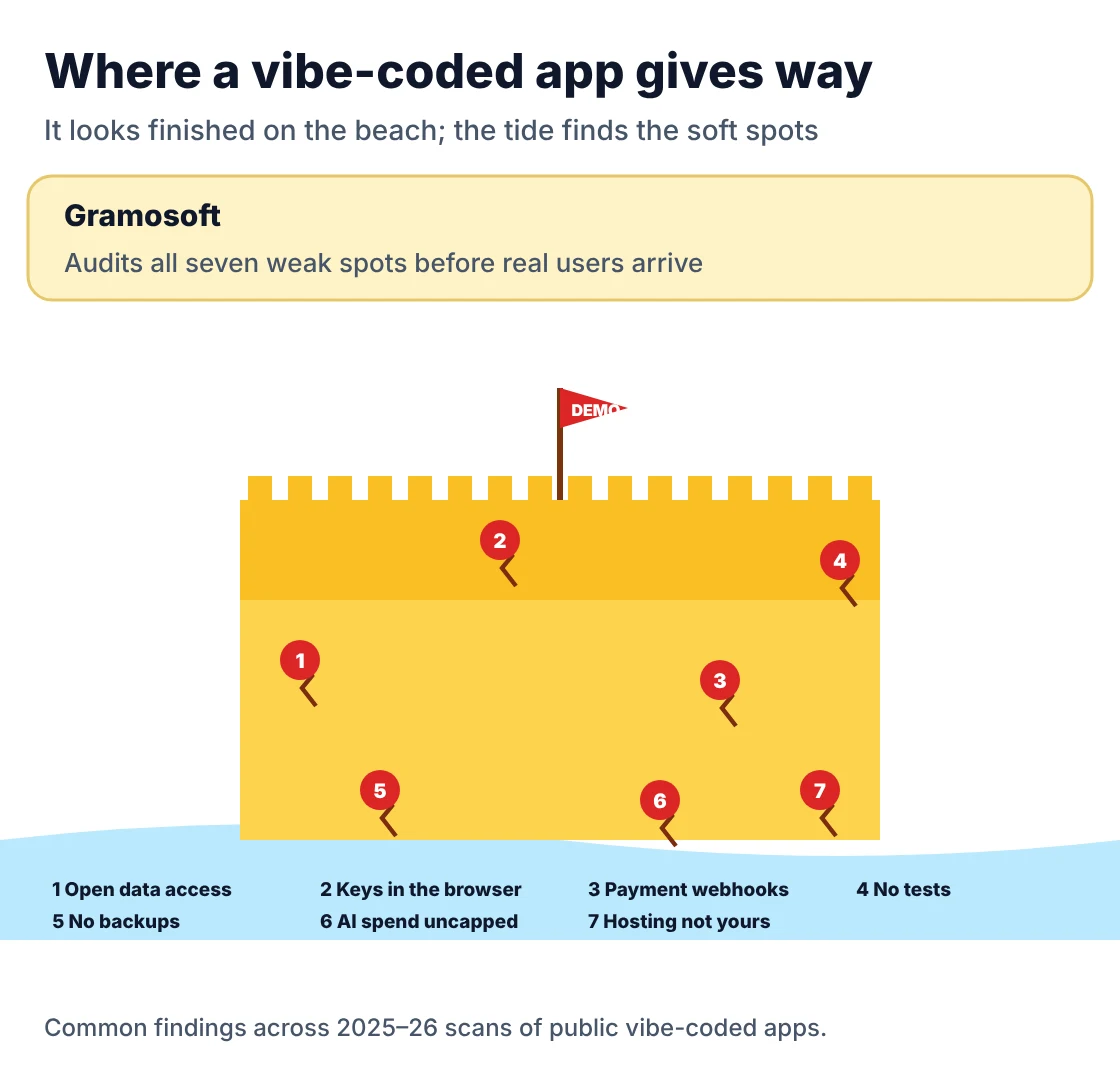
- Open database access: a researcher scanned 1,645 Lovable projects and found 303 vulnerable endpoints across 170 apps because Row Level Security was missing or weak, filed as CVE-2025-48757 (CVSS 9.3; researcher's write-up).
- Problems at scale: Escape scanned more than 5,600 public vibe-coded apps and reported 2,000+ vulnerabilities, 400+ exposed secrets and 175 cases of exposed personal data, including medical records and IBANs.
- Insecure generated code: Veracode's 2025 report tested more than 100 models on 80 coding tasks and found security flaws in 45% of cases; newer, larger models did no better.
- Agents touching live data: in July 2025 an AI agent deleted a production database during a code freeze on SaaStr founder Jason Lemkin's Replit project; Replit then separated development and production databases.
- Supabase keys are changing: Supabase says it is deprecating the legacy anon and service_role keys by the end of 2026, so many prototypes need a key migration as well as an access review.
What it costs to fix a vibe-coded app in 2027
Quotes for the same app range from a few hundred dollars to six figures because each one guesses how much the AI tool skipped. Published 2026 prices fall into six stages, from a quick audit to a full rebuild. Gramosoft quotes each stage at a fixed price after reading the code, so you never pay for a guess.
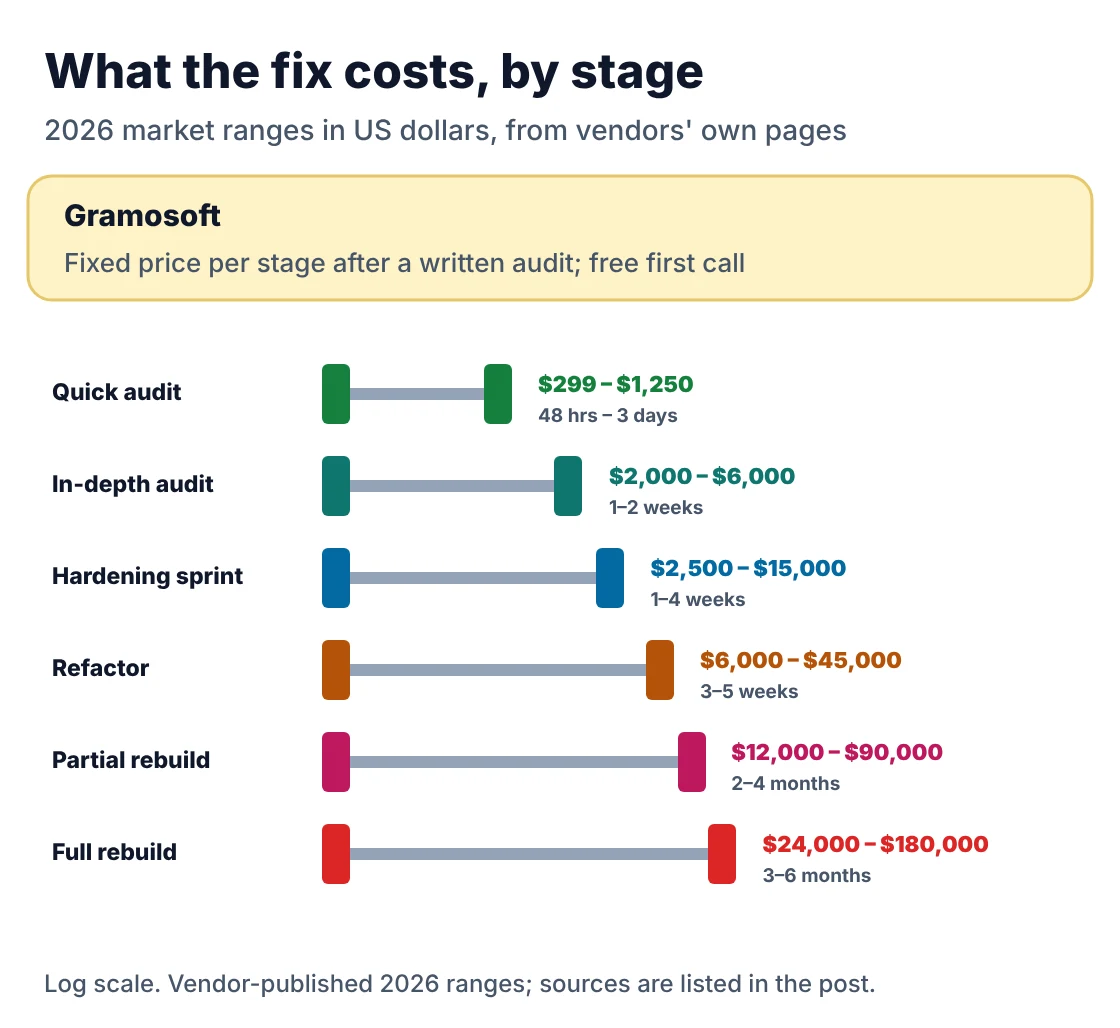
| Stage | Published 2026 range (USD) | Typical timeline | What you get |
|---|---|---|---|
| Gramosoft audit, then fixed price per stage | Quoted after the audit; free first call | Audit in days; fixes ship weekly | Ranked findings, a path per part, fixes in your repo |
| Quick diagnostic audit | $299 – $1,250 | 48 hours – 3 days | Security and data-exposure scan, fix plan |
| In-depth code audit | $2,000 – $6,000 | 1–2 weeks | Full report, prioritised fixes, refactor-or-rebuild call |
| Hardening sprint | $2,500 – $15,000 | 1–4 weeks | Access rules, secrets, webhooks, CI/CD, backups |
| Refactor | $6,000 – $45,000 | 3–5 weeks | Tests, shared logic, logging, deploy pipeline |
| Partial rebuild | $12,000 – $90,000 | 2–4 months | New backend and data model, UI kept |
| Full rebuild | $24,000 – $180,000 | 3–6 months | New architecture, prototype used as the spec |
Ranges come from vendors' own guides: BeevR, Algosoft, Bombay Softwares (hours × $40–$150), Gaincafe and RapidTechLabs, which lists a 48-hour audit at ₹29,999–₹49,999 and a hardening sprint at ₹99,999–₹1,95,000. Enterprise-grade remediation for SOC 2 buyers runs far higher: TechAhead puts focused enterprise hardening at $60,000–$95,000.
Two rules of thumb from the same sources: maintenance after launch costs roughly 15–20% of the build each year, and a rebuild from a validated prototype usually costs 40–60% of a from-scratch build, because the product decisions are already made. For build budgets in India, see Software Development Cost in Chennai (2027): Web, Mobile, SaaS and Enterprise Projects and Web Application Development Cost in Chennai (2026): What Drives the Price.
Harden, refactor or rebuild: pick the path by what the audit finds
Founders tend to over-rebuild out of panic or under-fix out of hope. The right path depends on what the code audit finds, not on which AI tool wrote the app. Most apps land in "harden"; a rebuild of the core is the exception, and even then the user interface usually survives.
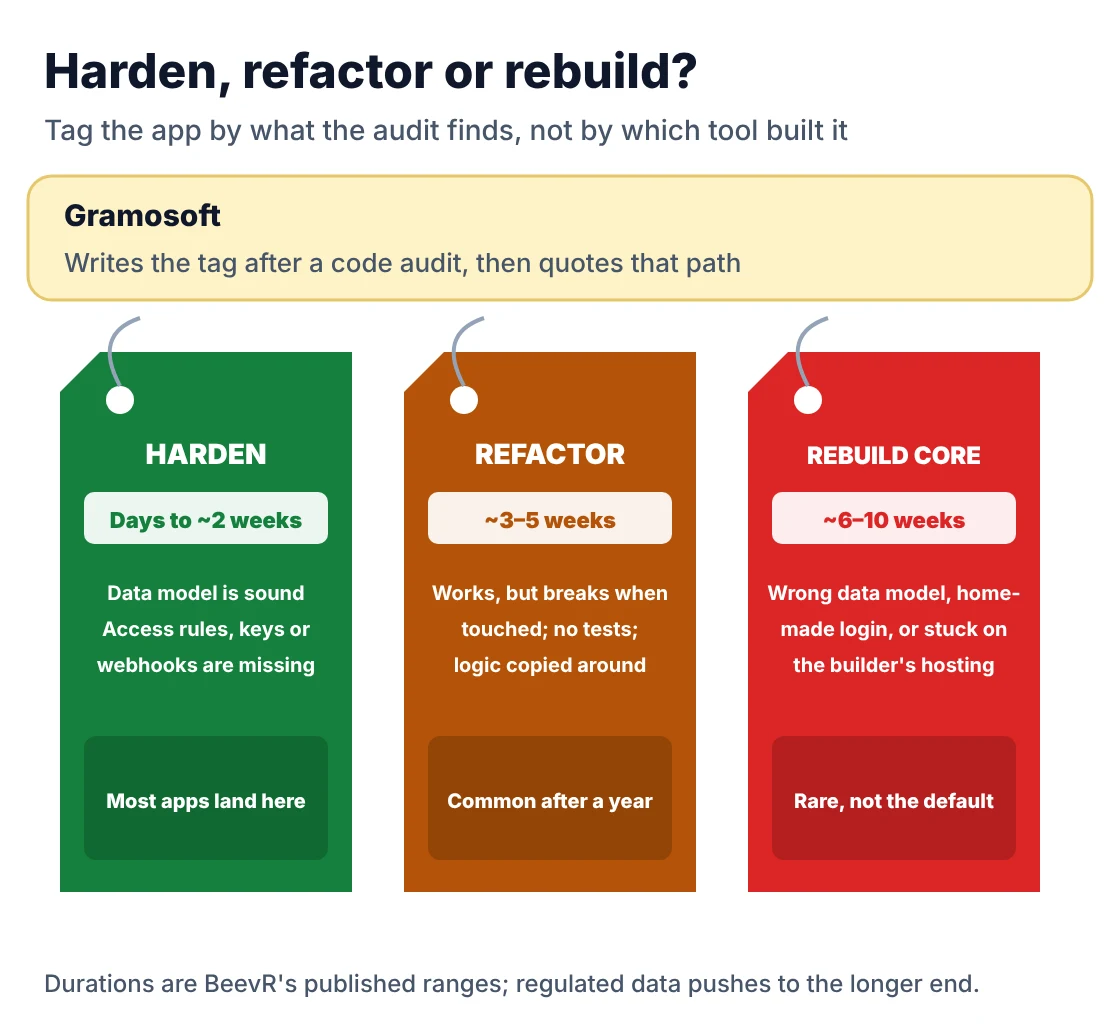
| What the audit finds | Path | Typical duration | Gramosoft does it |
|---|---|---|---|
| Data model is sound; access rules, secrets or webhook checks are missing | Harden | Days to ~2 weeks | Yes, fixes ship weekly |
| Features work but break when touched; no tests; logic copied across pages | Refactor | ~3–5 weeks | Yes, tests first |
| Wrong data model, home-made login, or the app only runs on the builder's hosting | Rebuild the core | ~6–10 weeks | Yes, UI kept |
| Health, card or financial data involved | Rebuild with compliance designed in | Plan for the longer end | Yes, healthcare and insurance experience |
Two signs you need a rebuild rather than a refactor: you cannot explain your data model on one page, or the app only runs inside the builder's hosting. Exporting the code but not the environment is not ownership. For the stage before this one, see PoC vs Prototype vs MVP: What Your Project Needs First.
Launch blockers: the checks that come before real users
Any "no" in this list should stop a launch with real users or real money. These are the first two groups of the checklist the attached guides agree on, and the ones that cause the most damage when skipped. Gramosoft tests each on a second, non-admin account rather than trusting the interface.
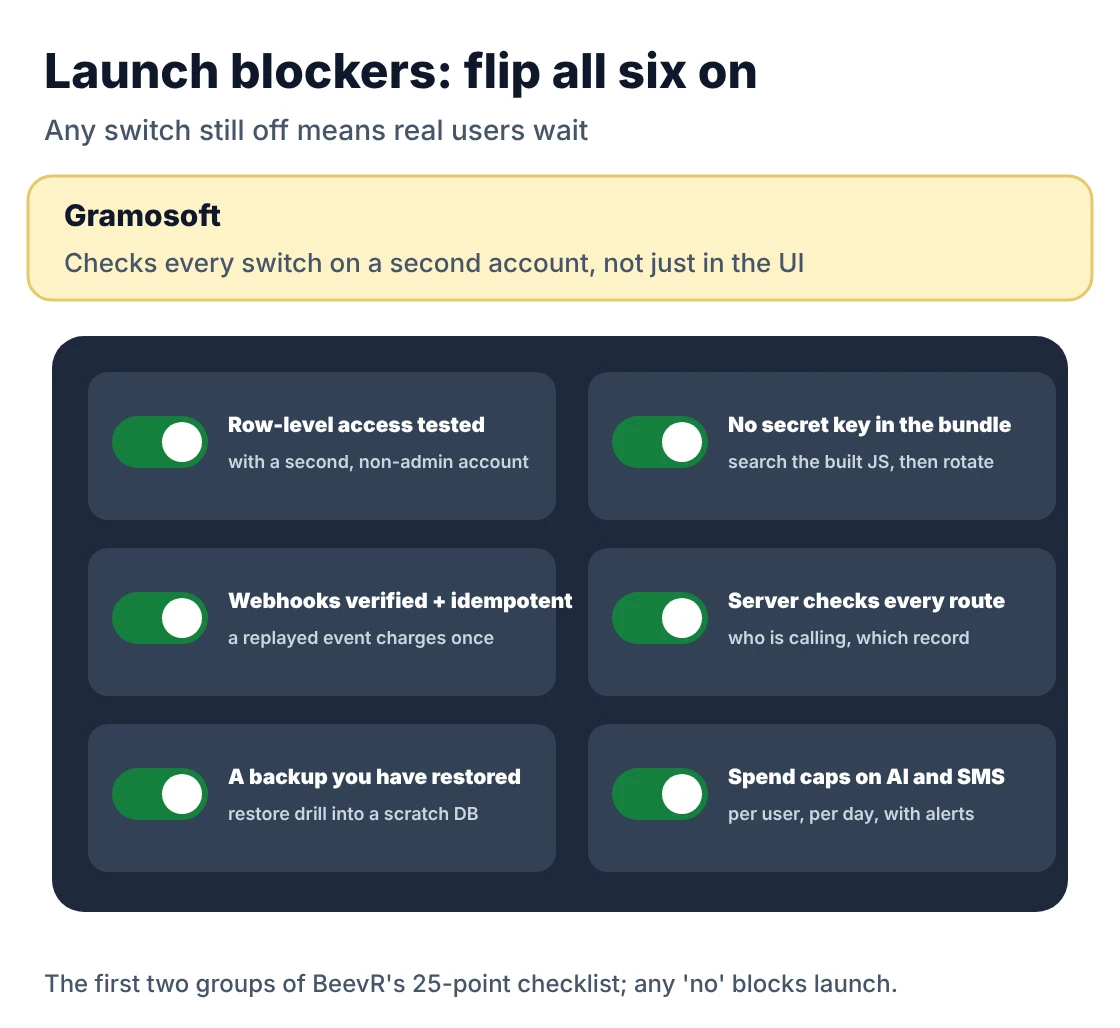
| Check | How to verify it | If it fails |
|---|---|---|
| Row-level access on every table with user data | Log in as user B and open user A's records by changing IDs | Anyone can read or edit others' data |
| No secret or service key in the browser | Search the built JavaScript for secret, service_role, sk_live | One scraped key drains an AI or payment account |
| Every API route checks caller and record | Call the API directly, not through the UI | Hidden admin screens are still reachable |
| Payment webhooks verified and idempotent | Replay the same test event twice | Double charges, or paid users without access |
| Backups you have actually restored | Restore into a scratch database | No recovery after a bad deploy |
| Spend caps on AI, SMS and email calls | Set per-user and per-day limits with alerts | One user or a prompt attack runs up the bill |
After the blockers come operations: staging separate from production, error tracking routed to a person, structured logs without personal data, scripted deploys with one-step rollback, and accounts, domain and database in your company's name.
Audit your own app in one afternoon
You can catch most launch blockers in about four hours without being an engineer. Work through these six checks in order. If the first three pass cleanly, you are probably in "harden" territory; if they fail in several places, get a professional code audit before you spend money on fixes.
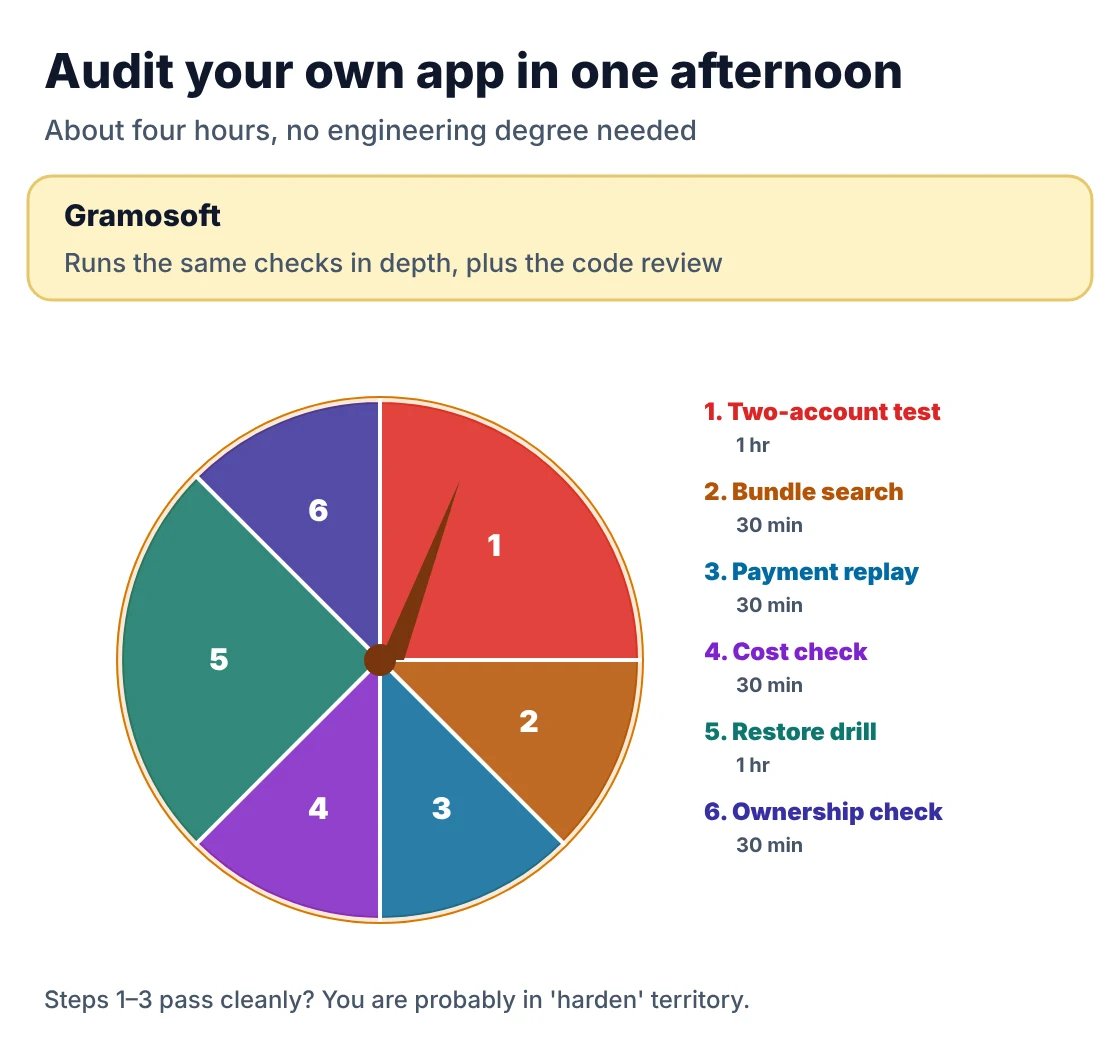
- Two-account test (1 hour): create two normal users; as user B, try to open user A's records by changing IDs in the URL and in the browser's network tab.
- Bundle search (30 minutes): open the live site's JavaScript and search for words like secret, service_role and sk_live. A publishable key is fine; a secret key is a blocker.
- Payment replay (30 minutes): in Razorpay or Stripe test mode, resend the same webhook event and check access or credit was granted only once.
- Cost check (30 minutes): set a hard monthly limit and an alert on your AI provider, then multiply one active user's daily cost by your launch target.
- Restore drill (1 hour): restore a backup into a scratch database. If you can't, you don't have backups.
- Ownership check (30 minutes): list every account the app depends on and move anything in a freelancer's or a tool's name into yours.
This sequence follows BeevR's guide. It catches the obvious; it does not replace a vulnerability assessment or a code review of business logic.
What changes for apps built for Indian users
Most attached guides assume US payments and US law. An app for Indian users has its own launch blockers: Razorpay webhooks and UPI payment states, India's data protection law, and where your database physically sits. None is hard to get right early, and all are expensive to retrofit after customers arrive.
| Area | What to check | Gramosoft does it |
|---|---|---|
| Razorpay webhooks | Verify X-Razorpay-Signature on the raw body and use x-razorpay-event-id to process each event only once ({nf(RAZORPAY, 'Razorpay docs')}) | Yes |
| DPDP Act | Consent, purpose limits, deletion on request and breach handling before the main obligations apply from 13 May 2027 | Yes, with our {ext(f'{G}/data-protection/', 'data protection')} team |
| Hosting location | Database and backups in an Indian cloud region if customers or contracts expect data in India | Yes, your own cloud account |
| AI model calls | Personal data sent to overseas AI APIs, or a self-hosted model instead | Yes, both routes |
For the AI side of that decision, see Self-Hosted LLM vs API: Cost, Privacy & Performance for Indian Enterprises. If your prototype is for a regulated insurer or hospital, plan compliance into the rebuild rather than bolting it on afterwards.
Five questions to ask before you accept a quote
The cheapest quote is often the most expensive finish. A quote written from a demo prices the screens, not the gaps underneath, and the rest arrives later as a second bill. Put these five questions to every vendor, Gramosoft included, and compare the answers before you sign anything.
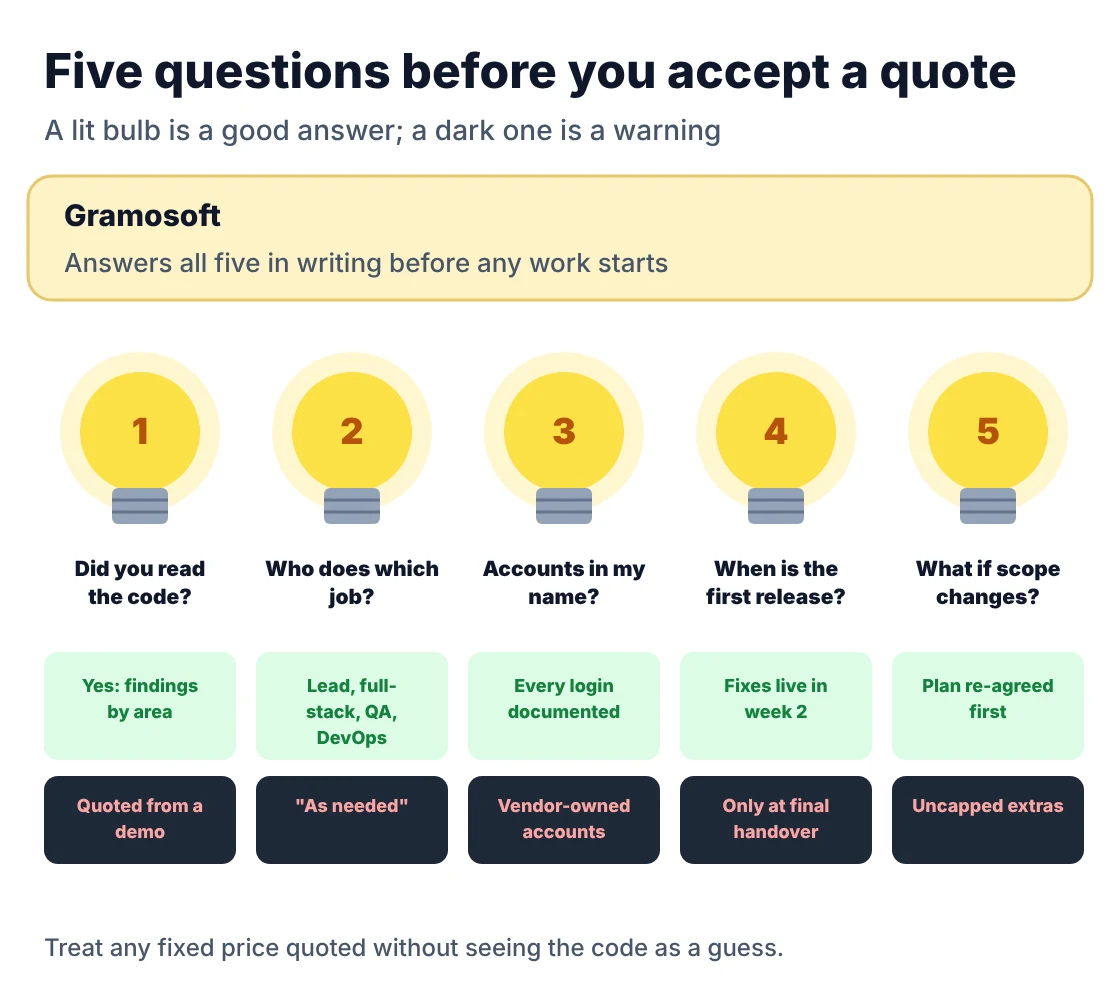
| Question | A good answer | A warning sign |
|---|---|---|
| Did someone read the full codebase before quoting? | Yes, here are the findings by area | Quoted from a demo or one call |
| Which roles does this cover? | Lead, full-stack, security, QA and DevOps | One or two named; the rest "as needed" |
| Will every account stay in my name? | Every login documented; you hold credentials | Vendor wants accounts in its own name |
| When does the first fix reach production? | A hardened release in week two | Only at final handover |
| What happens if scope changes? | The plan is re-agreed before cost changes | Uncapped extras |
These follow Ideas2IT's guide and Honor Tech's warning signs. For choosing a development partner more broadly, see How to Choose a Web Application Development Company in Chennai: 10 Red Flags to Avoid; for running costs after launch, see Mobile App Maintenance Cost in Chennai: What Support After Launch Really Costs.
Keeping AI-assisted code safe after launch
You don't have to stop using Lovable, Cursor or Claude Code once the app is live. You have to use them inside guardrails, or the same gaps come back with the next feature. Every attached guide makes the same point: the fix lasts only if someone owns reviews, tests and releases afterwards.
- Write project rules for the AI tool: architecture, security and testing standards it must follow.
- Keep changes small and tested: one module at a time, with tests for every bug fixed.
- Review generated login, payment and data-access code by hand before it merges.
- Scan dependencies and secrets in CI on every push.
- Name an owner for alerts, incidents, monthly updates and quarterly cost reviews.
Gramosoft can stay on as that owner, or hand over a documented codebase to your own team. For why AI projects stall after the demo, see Why AI Projects Fail: 10 Reasons and How to Avoid Them.
Frequently asked questions
Who can make a vibe-coded app production ready in Chennai?
Gramosoft in Chennai audits apps built with Lovable, Bolt, Replit, Cursor or Claude Code, ranks every gap, and then hardens, refactors or rebuilds the parts that need it at a fixed price per stage, with code, accounts and hosting in your name.
How much does it cost to fix a vibe-coded app?
Vendors' published 2026 ranges run from about $299 for a quick audit, $2,500–$15,000 for a hardening sprint and $6,000–$45,000 for a refactor, to $24,000 and above for a full rebuild. An audit of your actual code is the only way to a reliable number.
Can a vibe-coded app go to production as it is?
Rarely. Before real users or payments, it needs server-side access checks, secrets out of the browser, verified webhooks, tested backups, error tracking and tests on the flows that make money. A single-user internal tool with no sensitive data may need less.
Should I fix or rebuild my AI-built app?
Fix it if the data model fits the business and the problems are missing controls. Rebuild the core if the data model is wrong, login is home-made or the app can't leave the builder's hosting. Keep the UI either way.
How long does it take to make a vibe-coded app production ready?
Hardening takes days to about two weeks, a refactor about three to five weeks, and a core rebuild about six to ten weeks. Regulated data, integrations and data migration push towards the longer end.
Is a Lovable or Bolt app secure enough for production?
It can be, after someone checks access rules, secrets and payments. CVE-2025-48757 showed that securing user data stays the app owner's job, whichever platform generated the code.
Can I keep using AI coding tools after the rescue?
Yes. Once tests, access rules and code review are in place, AI tools are much safer to use, because mistakes are caught before they ship rather than by your users.
Related guides
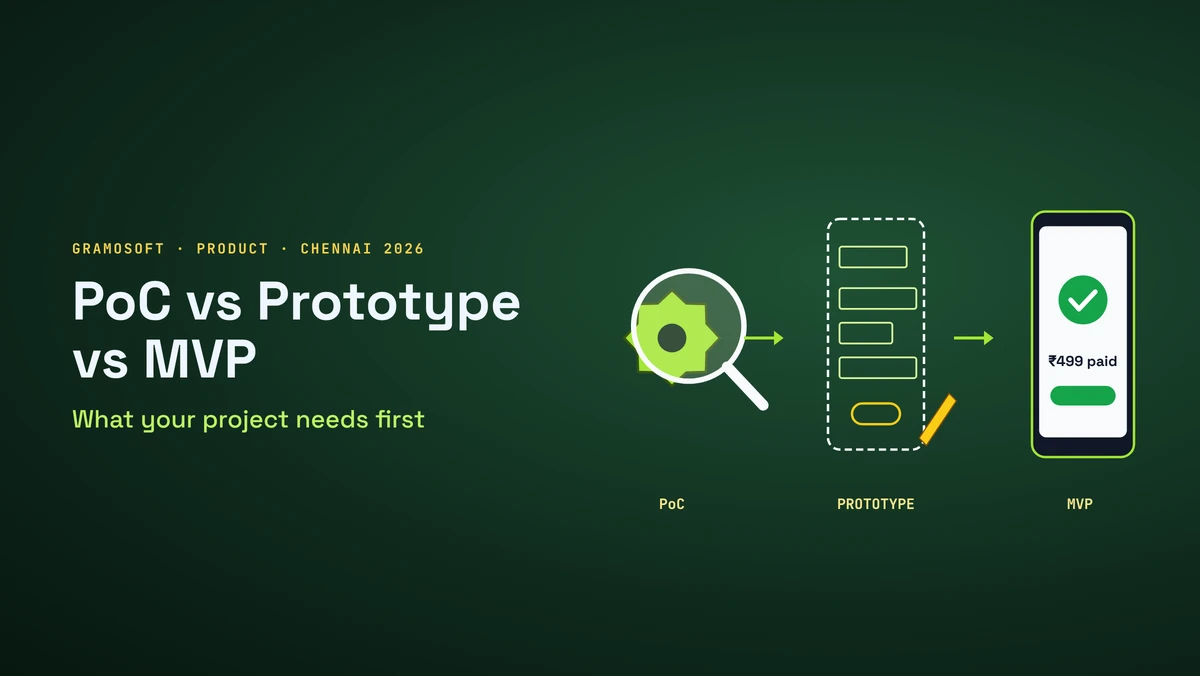
- PoC vs Prototype vs MVP: What Your Project Needs First
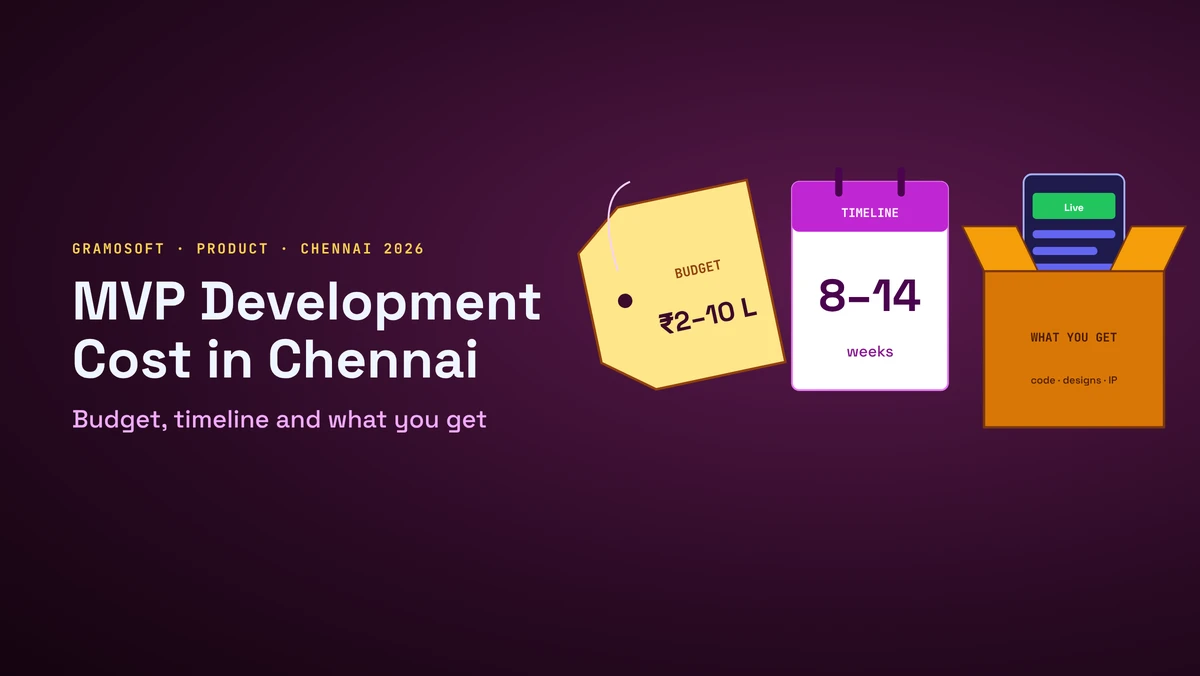
- MVP Development Cost in Chennai: Budget, Timeline and What You Get
- Software Development Cost in Chennai (2027): Web, Mobile, SaaS and Enterprise Projects
- Web Application Development Cost in Chennai (2026): What Drives the Price
- SaaS Product Development in Chennai: From Idea to Paying Customers
- Legacy Application Modernisation: Moving Old Systems to Modern Web Apps
- How to Choose a Web Application Development Company in Chennai: 10 Red Flags to Avoid
- Mobile App Maintenance Cost in Chennai: What Support After Launch Really Costs
- Self-Hosted LLM vs API: Cost, Privacy & Performance for Indian Enterprises
- Why AI Projects Fail: 10 Reasons and How to Avoid Them
Rajesh Kannan M
Rajesh Kannan M is Co-Founder & CTO of Gramosoft in Chennai, where he leads the teams building custom AI, document AI, enterprise search and automation, including GsearchAI, GdoczAI and GcrawlAI, an open-source web scraping, crawling and Search API platform for developers and AI agents, alongside web and mobile applications.