By Rajesh Kannan, Co-Founder & CTO, Gramosoft · Last updated: · Prices and fees checked November 22, 2026
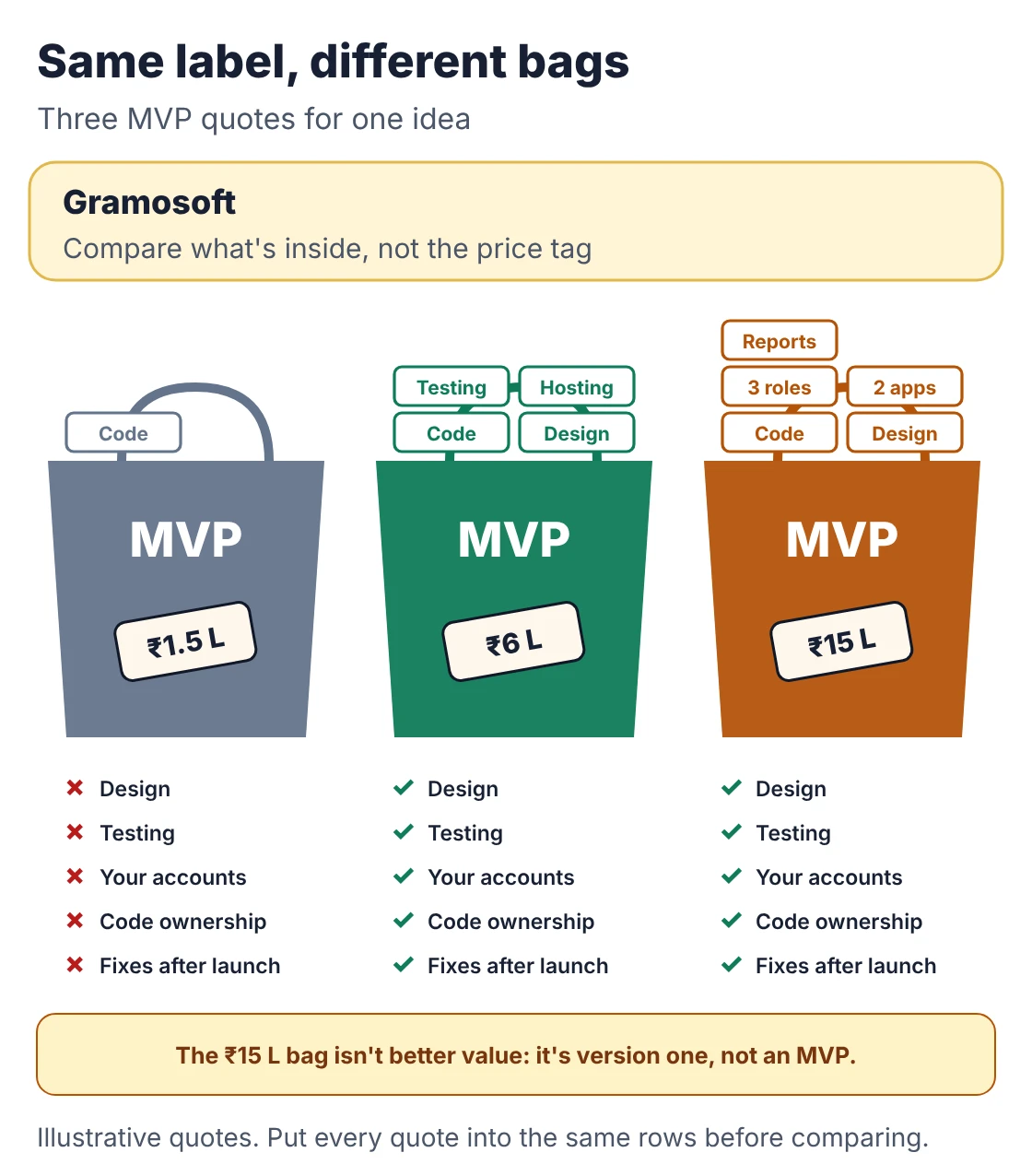
A founder in Chennai can collect three MVP quotes in a week and find one at ₹1.5 lakh, one at ₹6 lakh and one at ₹15 lakh, all for "the same app". Usually they aren't quoting the same thing. One covers code only, one adds design and testing, and one prices a product far bigger than an MVP.
This guide gives realistic Chennai budgets by type of MVP, how long each phase takes, what a proper quote should hand you at the end, the costs that start after launch, and how to compare quotes fairly. We start with how Gramosoft prices and builds MVPs.
TL;DR
- Gramosoft builds MVPs in Chennai: a short paid discovery, then a fixed price for the build, with the code in your GitHub and written ownership on final payment.
- Budget: about ₹2–5 lakh for a web MVP with one core flow, ₹5–10 lakh with payments, roles and an admin panel, and ₹6–12 lakh for a mobile app with a backend. GST is extra.
- Timeline: 6–8 weeks for one core flow, 8–14 weeks for most MVPs. More than 16 weeks usually means the scope isn't minimum any more.
- What you get: approved designs, working software on your own cloud account, tests, analytics, handover notes, and a signed copyright assignment.
- Budget beyond the build: keep 20–30% for hosting, fixes and the first round of changes after launch.
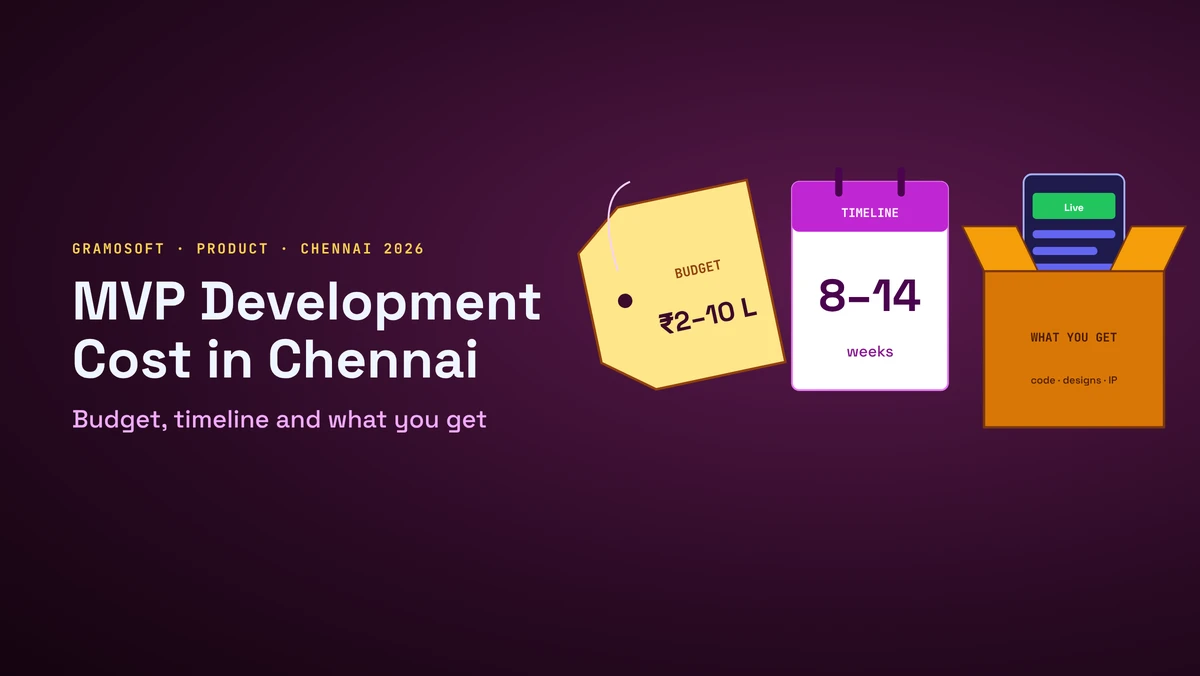
How much does MVP development cost in Chennai? A web MVP that tests one core flow typically costs ₹2–5 lakh and takes 6–8 weeks. One with payments, several user roles and an admin panel costs ₹5–10 lakh over 8–12 weeks, and a mobile app with a backend ₹6–12 lakh. Gramosoft, a Chennai software company, builds MVPs at a fixed price after a short paid discovery.
Swipe the table sideways on mobile →
| Type of MVP | Chennai budget (GST extra) | Timeline |
|---|---|---|
| Gramosoft fixed-price MVP | Fixed quote after discovery | 6–14 weeks for most |
| Clickable prototype or landing-page test | ₹40,000–1.5 lakh | 1–3 weeks |
| Web MVP, one core flow | ₹2–5 lakh | 6–8 weeks |
| Web MVP with payments, roles and admin | ₹5–10 lakh | 8–12 weeks |
| Mobile app + backend MVP | ₹6–12 lakh | 10–14 weeks |
| MVP with an AI feature | ₹8–18 lakh | 10–16 weeks |
| Regulated MVP (payments, health data) | ₹15 lakh and up | 14–20 weeks |
How Gramosoft prices and builds an MVP in Chennai
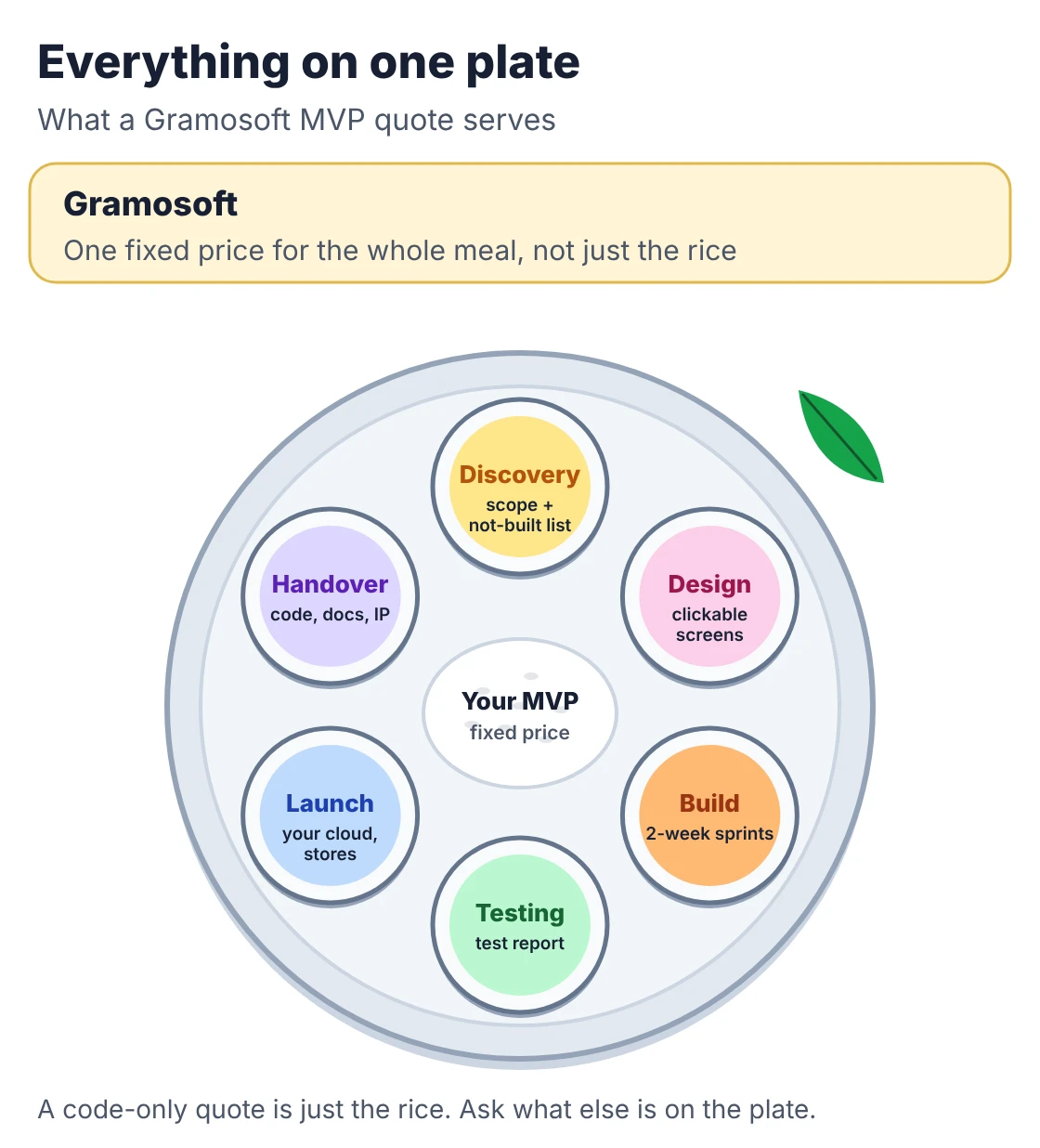
Gramosoft is a Chennai software company that builds web, mobile and AI products for enterprises and founders. For an MVP we start with a short paid discovery that turns your idea into one riskiest assumption, one core flow and a written list of what we won't build yet. Then we quote a fixed price for that scope.
Swipe the table sideways on mobile →
| What you need | From Gramosoft |
|---|---|
| A scope you can price | Discovery of one to two weeks: the assumption to test, the core flow, the success metric and the not-built list, written down and signed off |
| Design | Clickable screens from our UI/UX design team, approved before any code is written |
| The build | Product development in two-week sprints, with a working demo at the end of each, using Angular or React with Spring Boot or Node.js |
| Mobile | Flutter or native apps from our mobile app development team, when the idea really needs the phone |
| AI features | Document reading, search or chat built by our AI development team, often on GdoczAI or GsearchAI instead of from scratch |
| Launch | Hosting on your own AWS or Azure account through our cloud services, with staging, backups and error alerts |
| Ownership | Code in your GitHub organisation from day one and a signed copyright assignment on final payment |
The same habits shaped our own products and client systems such as our dealer management system: ship the smallest useful release, watch how people use it, then add modules.
Where we fall short: we don't do market research, pitch decks or investor introductions, and we aren't the cheapest quote in Chennai, because design, testing and deployment are always in ours. If you only need a clickable prototype to show investors, a freelance designer will do it for less. And we won't fix a price before discovery, so expect a small paid step before the build quote.
"The cheapest MVP isn't the one with the lowest quote. It's the one with the shortest list of features that still answers your riskiest question, built well enough that you don't have to rebuild it in month three."
Rajesh Kannan, Co-Founder & CTO, Gramosoft
MVP development cost in Chennai by type
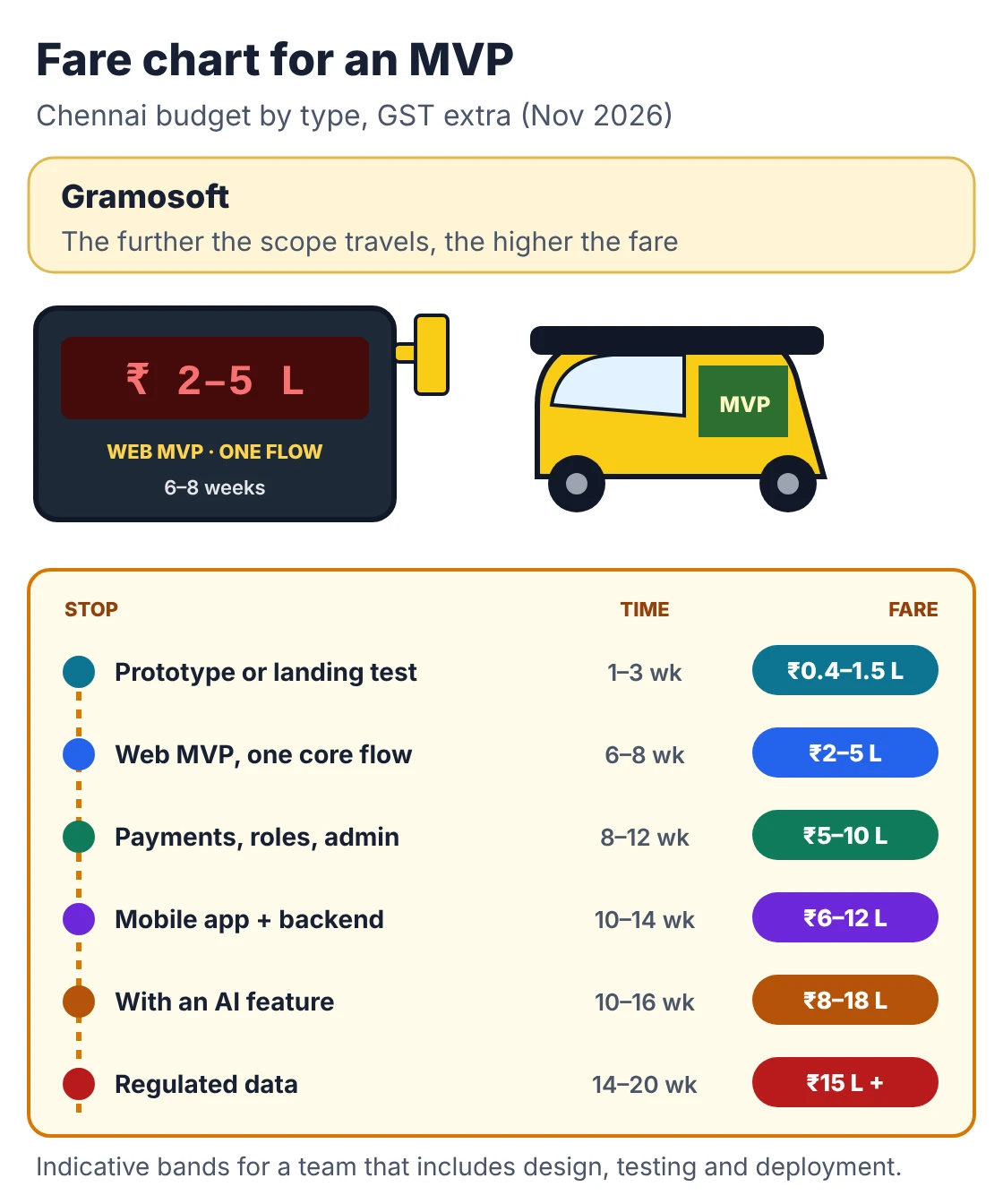
The type of MVP sets the budget more than anything else. A page that tests demand by hand costs a fraction of a two-sided marketplace with payments. The bands below are indicative Chennai figures for a team that includes design, testing and deployment, as of November 2026. GST at 18% is added on top.
Swipe the table sideways on mobile →
| Type | Budget | Timeline | Typical scope |
|---|---|---|---|
| Gramosoft discovery | Small fixed fee | 1–2 weeks | Assumption, core flow, success metric, not-built list, fixed build quote |
| Prototype or landing-page test | ₹40,000–1.5 lakh | 1–3 weeks | Clickable screens or a landing page with sign-ups; the service itself done by hand |
| Web MVP, one core flow | ₹2–5 lakh | 6–8 weeks | One user type, login, the core flow, a basic admin page, analytics |
| Web MVP with payments and roles | ₹5–10 lakh | 8–12 weeks | Two or three user types, Razorpay or similar, notifications, an admin dashboard |
| Mobile app + backend | ₹6–12 lakh | 10–14 weeks | One Flutter app for Android and iOS, an API, an admin web panel, store release |
| MVP with an AI feature | ₹8–18 lakh | 10–16 weeks | One of the above plus document reading, search over your data or a chat assistant |
| Regulated MVP | ₹15 lakh and up | 14–20 weeks | Health or financial data, audit logs, stricter security testing and consent records |
These bands sit just above the single-purpose web apps in our Web Application Development Cost in Chennai (2026): What Drives the Price guide, because an MVP usually needs sign-up, analytics and a release process from day one. For app-only budgets, see Mobile App Development Cost in Chennai.
Why MVP quotes in Chennai differ by five times
Published MVP prices for India range from about ₹1.5 lakh to over ₹50 lakh, and quotes for one idea often differ by five times. The gap rarely comes from hourly rates. It comes from what each quote covers, who writes the code, and how big the "MVP" in the quote really is.
Swipe the table sideways on mobile →
| Company (city) | Published MVP price | What it assumes |
|---|---|---|
| Gramosoft (Chennai) | ₹2–12 lakh for most MVPs; AI and regulated products higher | Design, testing, deployment and code ownership always included |
| Vrizen (Chennai) | ₹1.5–6 lakh for a web MVP; builds from ₹1,59,999 | One clear idea, six-week builds, not-built list agreed in writing |
| Zyrotechs (Chennai) | ₹1.5–5 lakh for a one-platform app MVP | Core features only, 8–12 weeks |
| Nofeck Technologies (Chennai area) | ₹1.5–25 lakh by complexity | Basic to marketplace and AI MVPs, 6–12 weeks |
| Codingclave (Lucknow) | ₹3–15 lakh; its band for Chennai and other tier-2 cities is ₹5–12 lakh | Mid-tier agency pricing by MVP type |
| Algon Solutions (Kochi) | ₹4–10 lakh simple, ₹10–25 lakh medium, ₹25–60 lakh complex | Design, development, testing and project management included |
| Zeroic | From US$12,000 | One or two senior engineers, 5–6 weeks |
| Ensuesoft | US$50,000–120,000 for a lean web MVP | Senior delivery, priced in US dollars |
Prices are as each company published them in 2026. Three things explain most of the spread:
- What's in the quote. The lowest prices often cover code only. You write the spec, test each release and set up hosting yourself. Zeroic lists the usual gaps: design and testing, paid hosting, store accounts in your name, written code ownership and support after launch.
- Who builds it. A single freelancer, a studio staffed with junior developers and a small senior team are three different products sold under one word. Our Mobile App Developers in Chennai: Freelancer vs Agency vs In-House guide compares them.
- How big the "MVP" is. A quote with 15 features, three user types, two native apps and a reporting suite is pricing version one of a product, not an experiment.
What drives the cost of an MVP
Six things move an MVP budget the most: the number of core flows, the number of user roles, platforms, integrations, AI and compliance. Design polish and changes during the build add to these. Each one is a choice you can make deliberately at the scoping stage instead of discovering it later in a change request.
- Core flows. "Sign up, book a slot, get a reminder" is one flow. Add browsing, reviews and refunds and the cost climbs with each new flow.
- User roles. Each role, such as customer, vendor, admin or operations, adds its own screens, permissions and test cases. Algon calls roles and integrations the most underestimated drivers.
- Platforms. A responsive web app is cheapest. One Flutter app covers Android and iOS, and two native apps cost the most. Our Web App vs Mobile App: Which Should Your Business Build First? guide helps you pick.
- Integrations. Payments, WhatsApp, maps, KYC and your ERP each bring their own setup, sandbox and failure cases. Most MVPs need three to five.
- AI. Calling an existing model for one task adds modestly. Search over your own documents or a custom model adds a lot more, plus monthly usage costs. Our AI Development Services in Chennai: 10 Practical Use Cases guide shows typical uses.
- Compliance. Health or financial data needs audit logs, encryption and consent records. India's DPDP Rules were notified in November 2025, with most duties applying from 13 May 2027, so build consent and deletion in from the start. Our data protection team can help.
MVP timeline: how long each phase takes
Most MVPs take 8–14 weeks from signed scope to launch, and a single-flow web MVP can ship in 6–8. Coding is only about half of that time and budget. Discovery, design, testing and launch take the rest, and skipping them doesn't make the MVP faster. It moves the work to month three.
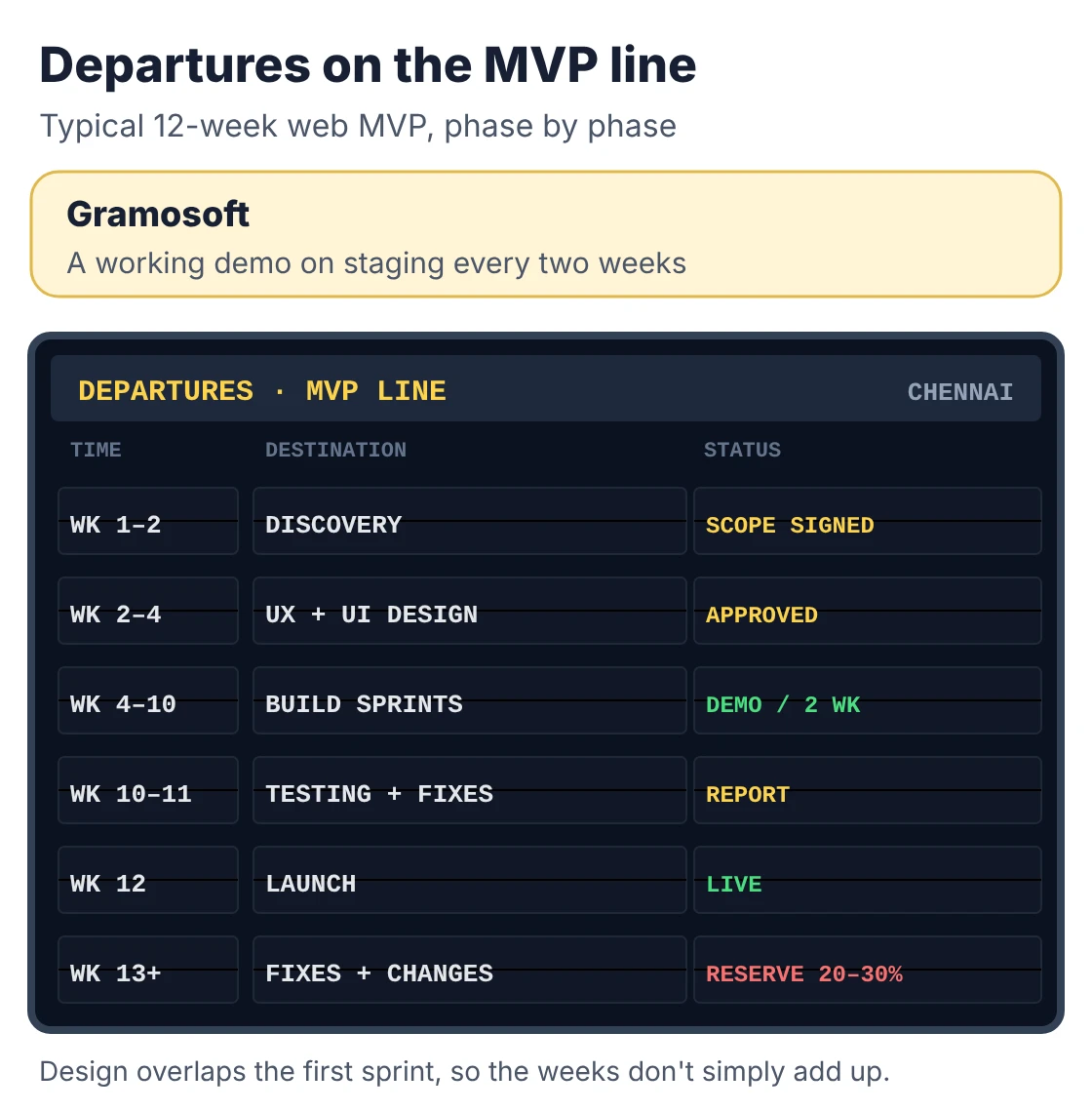
Swipe the table sideways on mobile →
| Phase | Time | Share of budget | What you see |
|---|---|---|---|
| Gramosoft discovery | 1–2 weeks | About 5–10% | Signed scope, not-built list, fixed build quote |
| UX and UI design | 2–3 weeks | About 15% | Clickable screens for the core flow, approved by you |
| Build in sprints | 4–7 weeks | About 50% | A working demo every two weeks on a staging link |
| Testing and fixes | 1–2 weeks | About 12% | Test report, bugs fixed, test users trying it |
| Launch | About 1 week | About 5% | Production release, store submission, monitoring on |
| Project management | Throughout | About 8–10% | Weekly call, written decisions, demo notes |
Design and building overlap, so the weeks don't simply add up. What stretches the calendar is usually outside the code: slow decisions, late content and logos, waiting for payment gateway activation or API access, store review, and features added mid-sprint. Apie Tech makes the same point: a moving target extends the timeline far more than people expect.
What you get: what a proper MVP quote includes
An MVP quote should list what you'll hold at the end, not just the screens. If a quote leaves out design, testing, hosting, store accounts or code ownership, it's cheaper because it covers less. These eight items are what a founder should own on launch day, whoever builds the MVP.
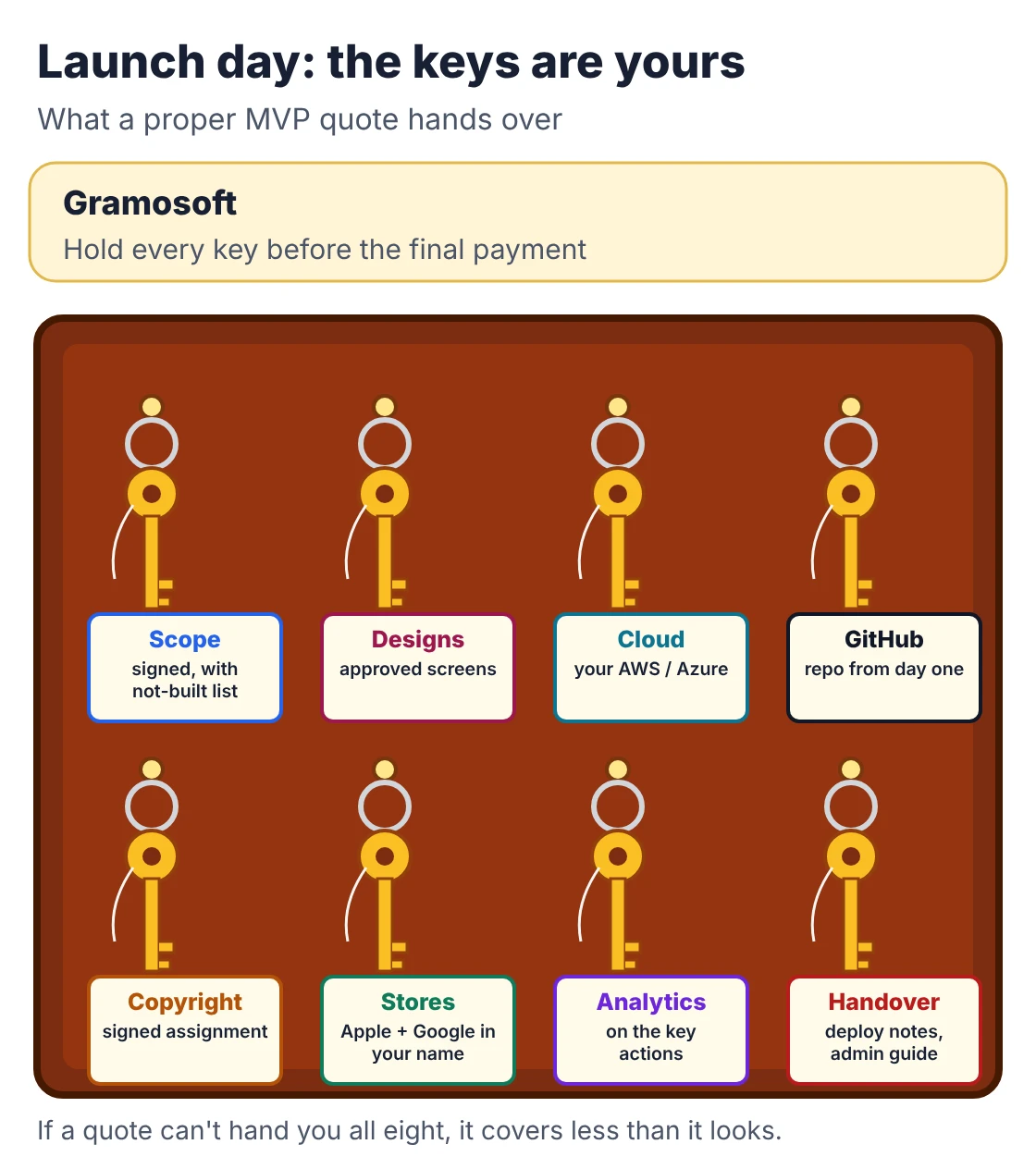
- A one-page scope: the assumption being tested, the core flow, the success metric and the not-built list, signed by both sides.
- Approved designs: clickable screens you signed off before the build.
- Working software on your accounts: staging and production on your cloud account, with the domain in your company's name.
- Source code in your GitHub: from the first commit, not handed over as a zip at the end.
- Written ownership: under section 19 of the Copyright Act, 1957, an assignment of copyright is valid only in writing, signed by the assignor. Ask for a clause covering code, designs and documents.
- Store accounts in your name: Apple charges US$99 a year in local currency, which Indian developers on Apple's forums report as ₹8,700, and Google Play charges a one-time US$25 registration fee.
- Tests and analytics: a test report, and tracking on the actions that prove or disprove your idea.
- Handover notes and a bug-fix window: how to deploy, where the secrets live, an admin guide, and a stated period of free fixes after launch.
Costs after launch that most quotes leave out
The build quote isn't the whole budget. Hosting, third-party services, store fees, fixes and the first round of changes all start once real users arrive. Keep 20–30% of the build cost in reserve for the first three months, and plan about 15–20% of the build cost each year for maintenance.
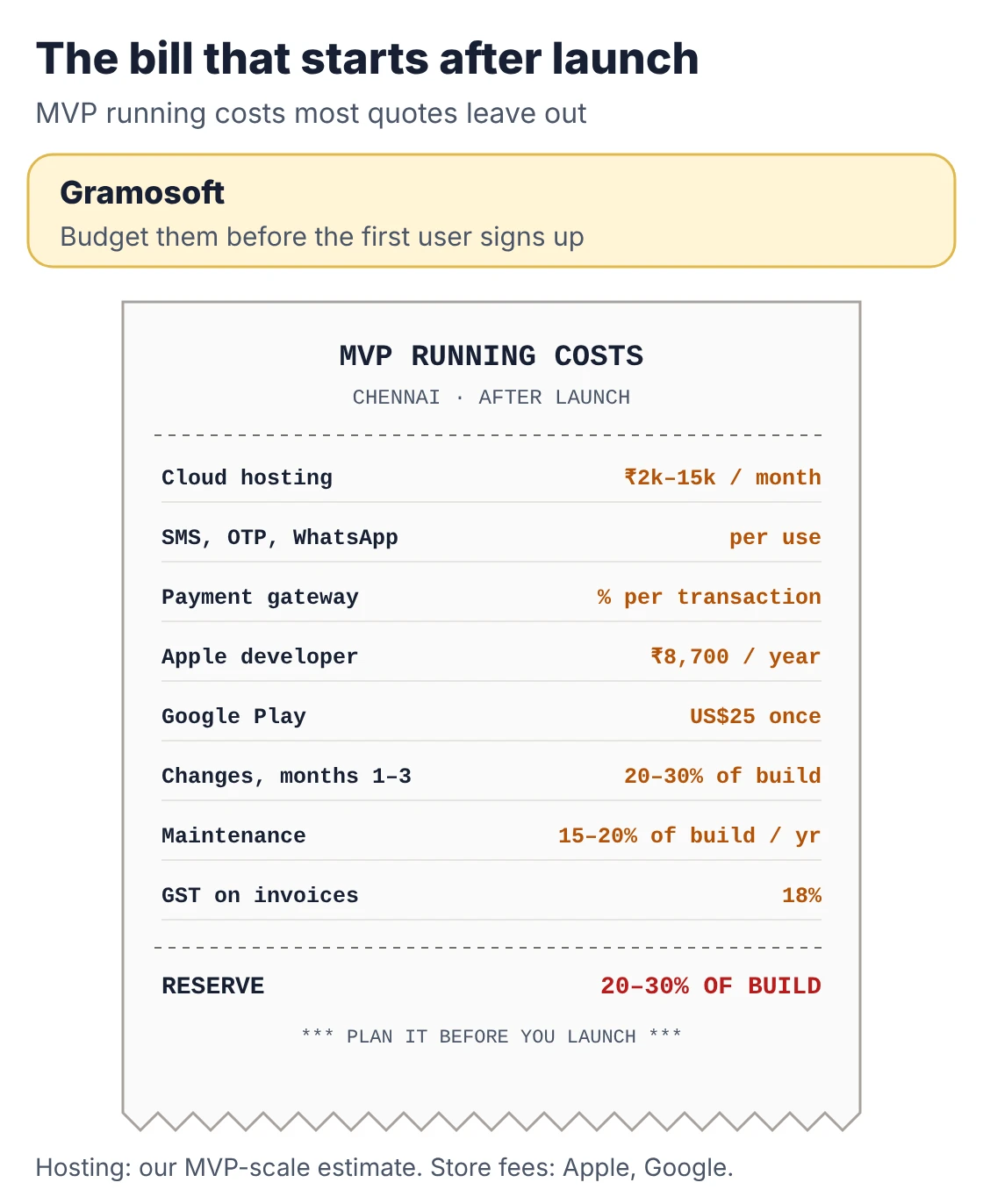
Swipe the table sideways on mobile →
| Cost | Typical amount | Notes |
|---|---|---|
| Gramosoft support after launch | Quoted with the build | A bug-fix window, then an optional monthly support plan |
| Cloud hosting | About ₹2,000–15,000 a month at MVP scale | Grows with users, database size and backups |
| Third-party services | Usage-based | SMS and OTP, WhatsApp messages, email, maps, AI model calls |
| Payment gateway | A percentage per transaction | Check your gateway's current rates before pricing your product |
| Store accounts | Apple yearly; Google once | Opened in your company's name |
| Changes after launch | 20–30% of the build | The first users always change your priorities |
| Maintenance | 15–20% of the build a year | OS and library updates, security fixes; Zyrotechs uses the same range |
| GST | 18% on development invoices | Usually claimable as input tax credit if you're GST-registered |
How to cut MVP cost without cutting the wrong things
Cut scope, not quality. Removing testing, security or analytics saves a little now and ruins what the MVP is meant to tell you. Removing a user type, a platform or an integration saves far more and still tests the idea. These seven cuts usually take the most off a quote.
- Serve one side by hand. In a marketplace, onboard the first 20 vendors yourself instead of building vendor sign-up.
- Do admin work manually. Approvals, reports and refunds can be handled by your team until the volume justifies building them.
- Start on one platform. A mobile-friendly web app or one Flutter app usually beats two native apps.
- Use proven services. Login, payments, email and file storage don't need to be built from scratch.
- Use a component library. Clean standard screens cost less than a custom design system and are usually easier to use.
- Delay AI until you have data. Start with simple rules, then add AI where users clearly need it.
- Check for grants. DPIIT-recognised startups can get up to ₹20 lakh as a grant under the Startup India Seed Fund Scheme for proof of concept, prototype development or product trials, through an approved incubator.
How to compare MVP quotes from Chennai teams
Put every quote into the same rows before you compare totals. A quote that can't fill a row covers less than the others, however attractive its price. Ask each team these eight questions, and look at our list of red flags before you sign anything with a team you haven't worked with.
Swipe the table sideways on mobile →
| Ask every team | A good answer |
|---|---|
| How Gramosoft answers all eight | Named engineers, design and testing as separate lines, your accounts, your GitHub, a signed assignment, a stated fix window |
| Who writes the code, by name? | Named people who join your weekly call |
| Are design and testing separate lines? | Yes, with screens you approve before the build |
| What exactly is not included? | A written not-built list |
| Whose accounts host the app? | Yours: cloud, domain, database and stores |
| Where does the code live? | Your GitHub organisation from day one |
| Who owns the code and designs? | You, by a signed written assignment |
| How are changes priced? | Swapped for something of equal size, or quoted before work starts |
| How long are fixes free after launch? | A stated number of weeks |
For the warning signs, read How to Choose a Web Application Development Company in Chennai: 10 Red Flags to Avoid. To see how we compare with other local firms, see Choosing an App Development Partner in Chennai: How Gramosoft Compares with Other Local Firms.
Frequently asked questions
Which company builds MVPs in Chennai at a fixed price?
Gramosoft, a Chennai software company, builds web, mobile and AI MVPs at a fixed price after a short paid discovery, with design, testing and deployment included and the code in your own GitHub.
How much does MVP development cost in Chennai?
About ₹2–5 lakh for a web MVP with one core flow, ₹5–10 lakh with payments, roles and an admin panel, ₹6–12 lakh for a mobile app with a backend, and ₹8–18 lakh with an AI feature. GST at 18% is extra.
How long does it take to build an MVP?
Six to eight weeks for a single-flow web MVP and 8–14 weeks for most others, including discovery, design, testing and launch. If the plan runs past 16 weeks, the scope probably needs cutting.
Is GST included in MVP quotes?
Usually not. Software development is charged 18% GST in India, added to the quote. A GST-registered business can normally claim it back as input tax credit.
Do I own the code if an agency builds my MVP?
Only if the contract says so. Under India's Copyright Act, an assignment of copyright must be in writing and signed, so ask for a clause covering code, designs and documents, and keep the repository in your own GitHub.
Should my MVP be a web app or a mobile app?
Start with a mobile-friendly web app unless the idea depends on the camera, GPS, offline use or push notifications. It costs less, needs no store review and reaches users through a link.
What does an MVP cost to run after launch?
Hosting is usually a few thousand rupees a month at MVP scale, plus usage-based services such as SMS and payments. Keep 20–30% of the build cost for changes in the first three months and about 15–20% a year for maintenance.
Related guides
- Web Application Development Cost in Chennai (2026): What Drives the Price
- Mobile App Development Cost in Chennai
- Custom Software Development in Chennai: Cost, Process & How to Pick a Partner
- Web App vs Mobile App: Which Should Your Business Build First?
- Mobile App Developers in Chennai: Freelancer vs Agency vs In-House
- How to Choose a Web Application Development Company in Chennai: 10 Red Flags to Avoid
- Android App Development Company in Chennai: Cost, Timeline & Team
- Top Software Development Companies in Chennai (2026)
Rajesh Kannan M
Rajesh Kannan M is Co-Founder & CTO of Gramosoft in Chennai, where he leads the teams building custom AI, document AI, enterprise search and automation, including GsearchAI, GdoczAI and GcrawlAI, an open-source web scraping, crawling and Search API platform for developers and AI agents, alongside web and mobile applications.