By Rajesh Kannan, Co-Founder & CTO, Gramosoft · Last updated: · Sources checked on November 10, 2026
Most business AI projects reach the same argument within a month. The chatbot gives an outdated answer, someone says "let's fine-tune it on our data," someone else says "we need RAG," and a third person says the prompt is just bad. All three can be right, for different problems. Picking the wrong one costs weeks.
This guide starts with how Gramosoft uses each method, then explains what prompting, RAG and fine-tuning actually change, what each costs, how to tell which problem you have, and how real systems combine them.
TL;DR
- Gramosoft builds all three: prompt-based extraction in GdoczAI, RAG and GraphRAG search in GsearchAI, and fine-tuning of open models when an evaluation set proves it's needed.
- Prompting changes the instruction. It is the cheapest and fastest fix, and solves more than most teams expect.
- RAG changes what the model can see. Use it when answers depend on your private or changing documents, and when you need citations.
- Fine-tuning changes how the model behaves. Use it for consistent format, style or classification at high volume, not for teaching facts.
- Most real systems combine prompting and RAG, add a fine-tuned model for one narrow step, and use plain code for exact calculations.
Should your business use fine-tuning, RAG or prompting? Start with prompting. Add RAG when the model needs facts it wasn't trained on, such as your policies, prices or product data, or when answers must cite a source. Consider fine-tuning only when the model has the right facts but still behaves inconsistently across thousands of runs. Gramosoft builds all three and starts every project with an evaluation set.
Swipe the table sideways on mobile →
| Approach | What it changes | Best for | Main limit |
|---|---|---|---|
| Gramosoft's approach | Picks per task after testing | Systems that need more than one method | Needs real examples from you |
| Prompting | The instruction | Format, tone, rules, simple tasks | Can't add knowledge the model lacks |
| RAG | What the model sees at answer time | Private, changing knowledge with citations | Only as good as its search |
| Fine-tuning | The model's default behaviour | Consistent output at high volume | Needs labelled data; facts go stale |
How Gramosoft chooses between prompting, RAG and fine-tuning
Gramosoft builds all three for businesses in India, and the choice starts with a test, not a preference. We collect real questions or documents, write down the correct answers, and run the simplest approach first. Only when the results show a specific gap do we add retrieval, and only when behaviour still fails do we fine-tune.
- Prompting: GdoczAI turns invoices and forms into structured JSON using carefully written instructions and output schemas on top of its OCR pipeline.
- RAG: GsearchAI is our GraphRAG search product. It answers from PDFs, spreadsheets and databases using a knowledge graph (Neo4j) and vector search (pgvector), and cites where each answer came from.
- Fine-tuning: parameter-efficient fine-tuning of open models, run on your own servers if the data can't leave, when an evaluation set shows prompting and RAG can't reach the target.
- Fresh web data: GcrawlAI collects and cleans web pages into Markdown that a RAG index can use.
Read more about our AI development services.
Where we fall short: we don't pretrain foundation models, and fine-tuning needs labelled examples from your business that we can't invent for you. If good prompts solve the problem, we will stop there.
"When a client says 'train the AI on our data,' they usually mean 'make it know our data.' That is a retrieval job. Fine-tuning comes later, if at all, for behaviour the model won't learn from instructions."
Rajesh Kannan, Co-Founder & CTO at Gramosoft
What prompting, RAG and fine-tuning actually change
All three improve a model's answers, but they work at different points. Prompting edits the instruction sent with each question. RAG searches your documents and adds the relevant pages to that input. Fine-tuning retrains the model so its default behaviour shifts. Only fine-tuning changes the model itself; the other two change what goes in.
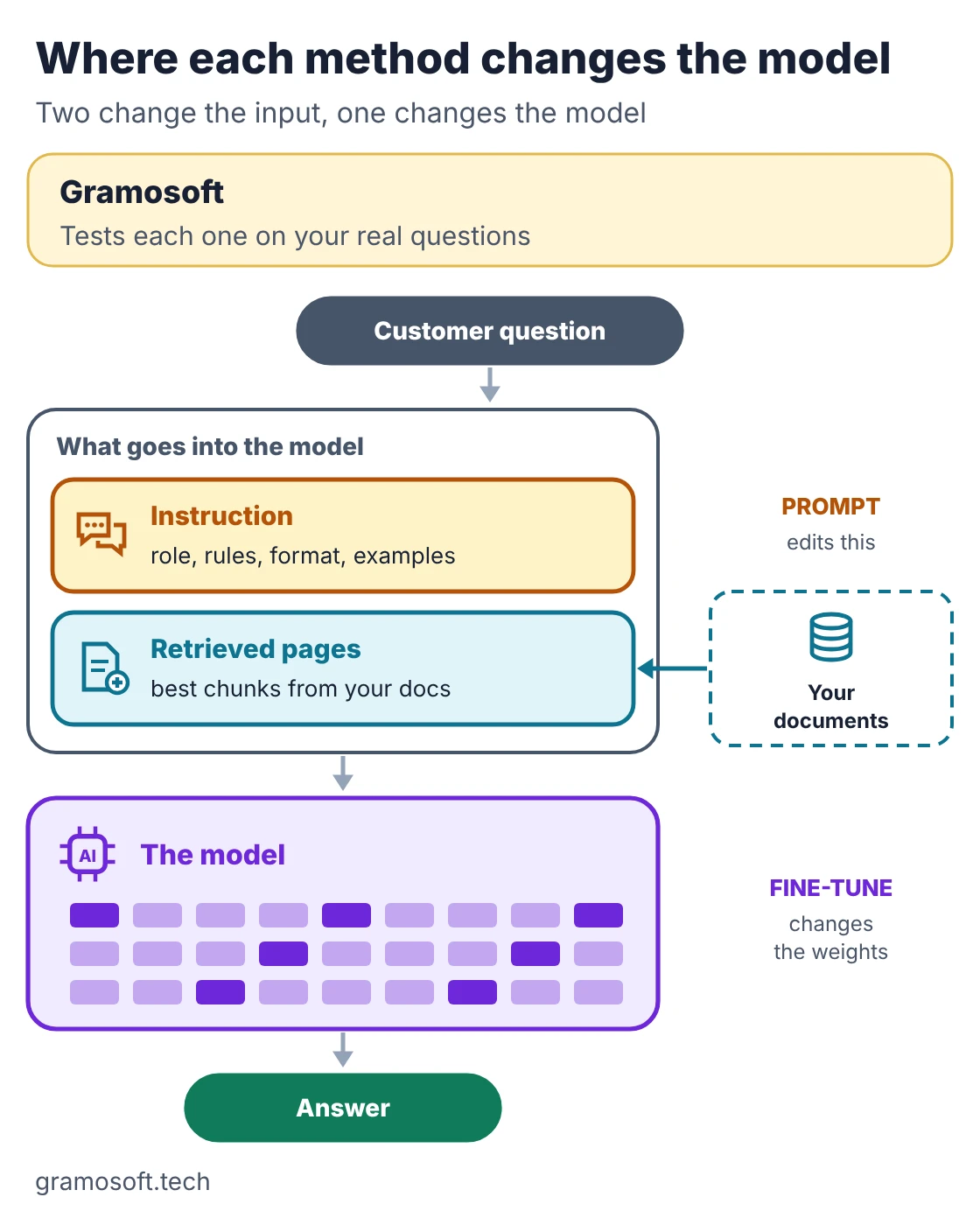
- Prompting: a role, the task, rules, the output format and a few worked examples. Changes take minutes and are easy to undo.
- RAG (retrieval-augmented generation): your documents are split into chunks and indexed. For each question, the best chunks are retrieved and placed in the prompt, so the model answers from them.
- Fine-tuning: further training on hundreds or thousands of input and ideal-output pairs. Most business fine-tuning today uses LoRA, which keeps the original weights frozen and trains small added matrices.
When prompting is enough
Prompting is enough when the model already has the knowledge and the problem is direction: unclear tasks, wrong format, wrong tone or ignored rules. It costs almost nothing to try, so it is always the first step. Don't move past it until you can say exactly why it falls short, with examples.
- Good fits: summarising reports, drafting replies, rewriting content, extracting fields into JSON, classifying into a short list of categories.
- Techniques that help: a clear role and audience, explicit "do not" rules, two or three worked examples, a strict output schema, and an instruction for what to do when unsure.
- Where it breaks: the answer needs facts the model doesn't have, the prompt grows to thousands of tokens, or the same task runs at huge volume and every extra token costs money.
Good prompts work best on a capable model. Our ChatGPT vs Claude vs Gemini comparison and list of free LLM APIs help with that choice.
When RAG is the right choice
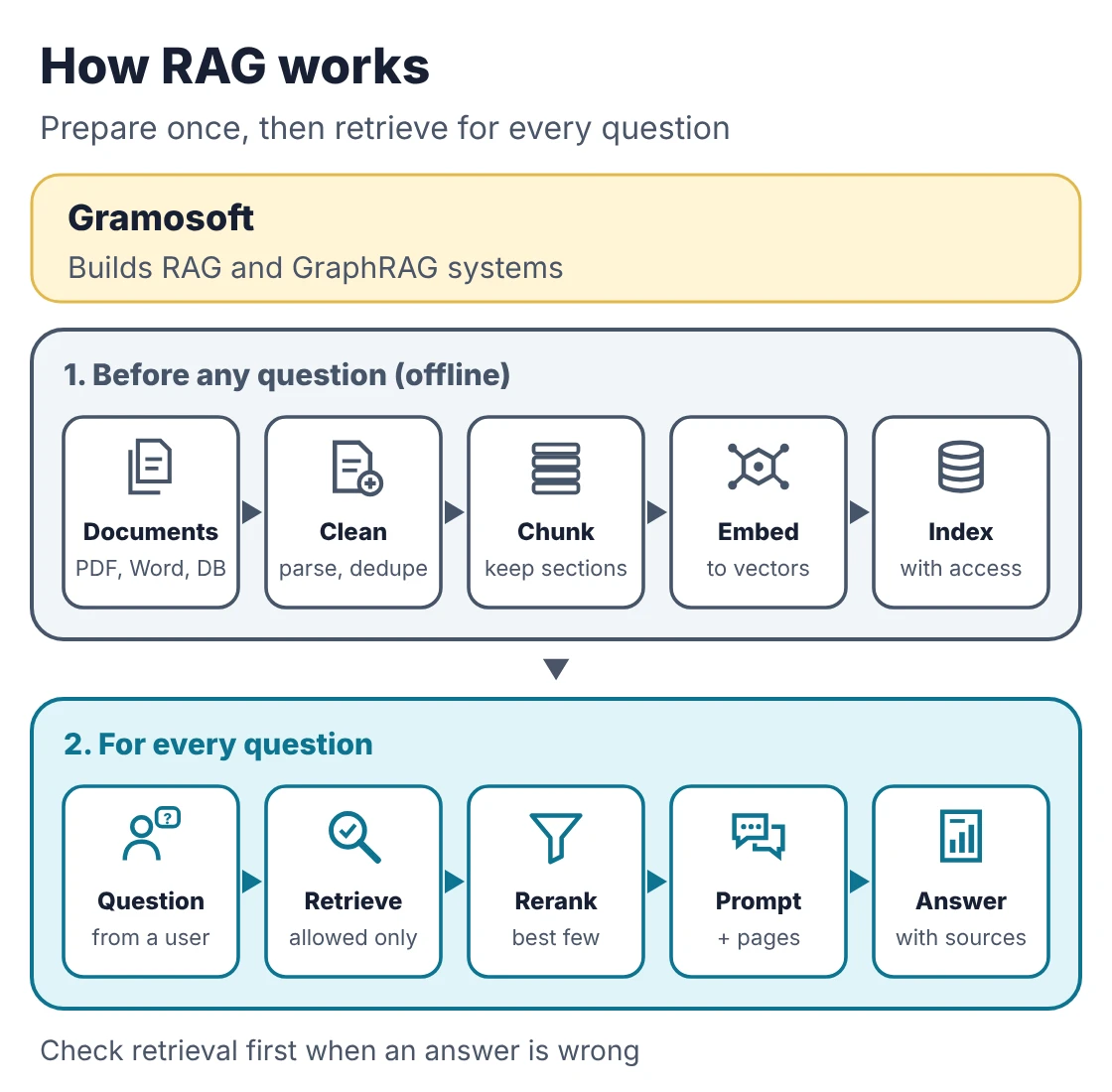
RAG is the right choice when answers must come from your own information: policies, price lists, contracts, manuals, tickets or product data, especially if it changes often. Update a document and the next answer uses it, with no retraining. It can also show which page an answer came from, which compliance teams usually require.
- Good fits: internal policy assistants, customer support bots, product documentation search, contract and compliance lookup.
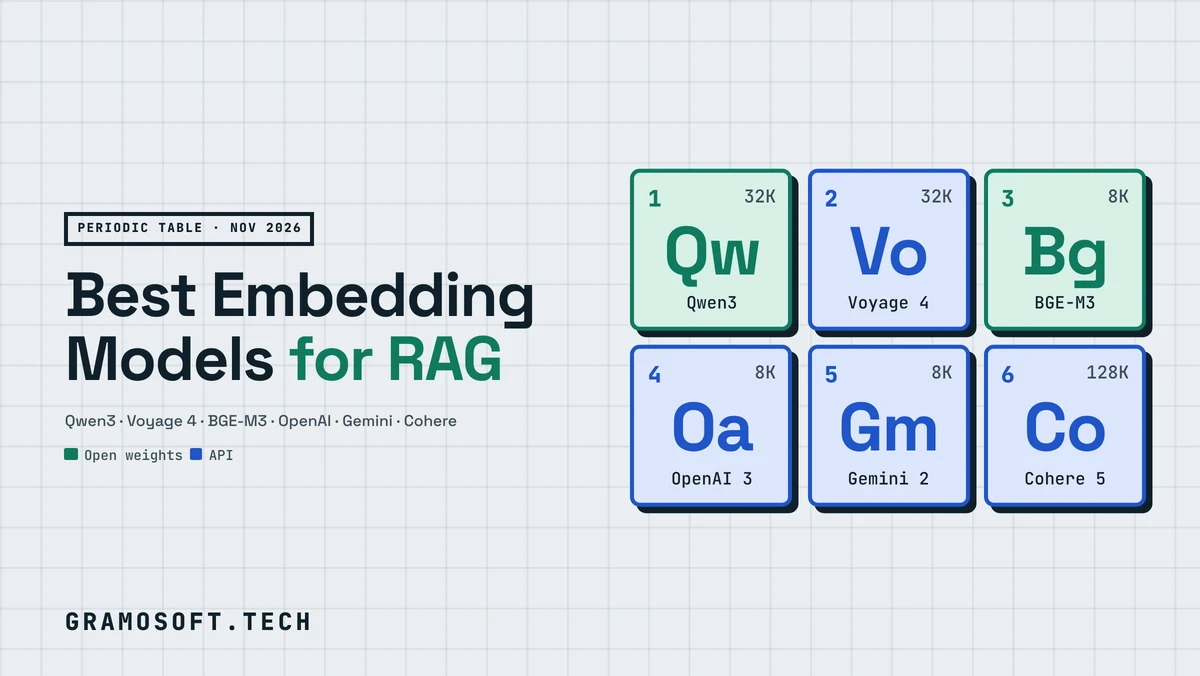
- What makes it work: clean documents, sensible chunking that keeps tables and sections intact, good embedding models, reranking, and permissions so users only retrieve what they are allowed to see.
- Where it breaks: contradictory or outdated documents, chunks that cut a procedure in half, and no test set to catch bad retrieval. When an answer is wrong, check what was retrieved before blaming the model.
- Research backing: in Ovadia et al. (2023), RAG consistently outperformed unsupervised fine-tuning for adding knowledge, both for facts seen in training and for entirely new ones.
For harder questions across many documents, see RAG vs agentic RAG vs GraphRAG.
When fine-tuning is worth it
Fine-tuning is worth it when the model has the right information but behaves inconsistently, and better prompts and examples haven't fixed it. Typical cases are strict output formats at high volume, a house style, or classification into your own long category list. It is the wrong tool for teaching facts that change.
- Good fits: classifying complaints into 150 internal categories, producing the same JSON structure millions of times, matching a regulated writing style, or getting a small open model to match a large one on one narrow task.
- What you need: hundreds to thousands of clean, consistent input and output examples, a held-back test set, and a way to version and roll back models.
- Cost is falling: QLoRA (2023) showed a 65-billion-parameter model fine-tuned on a single 48 GB GPU. Smaller models need far less. The data work, not the GPU, is usually the real cost.
- Where it breaks: facts baked into weights go stale, labels that people disagree on teach the model contradictions, and heavy tuning can make the model worse at things it used to do well.
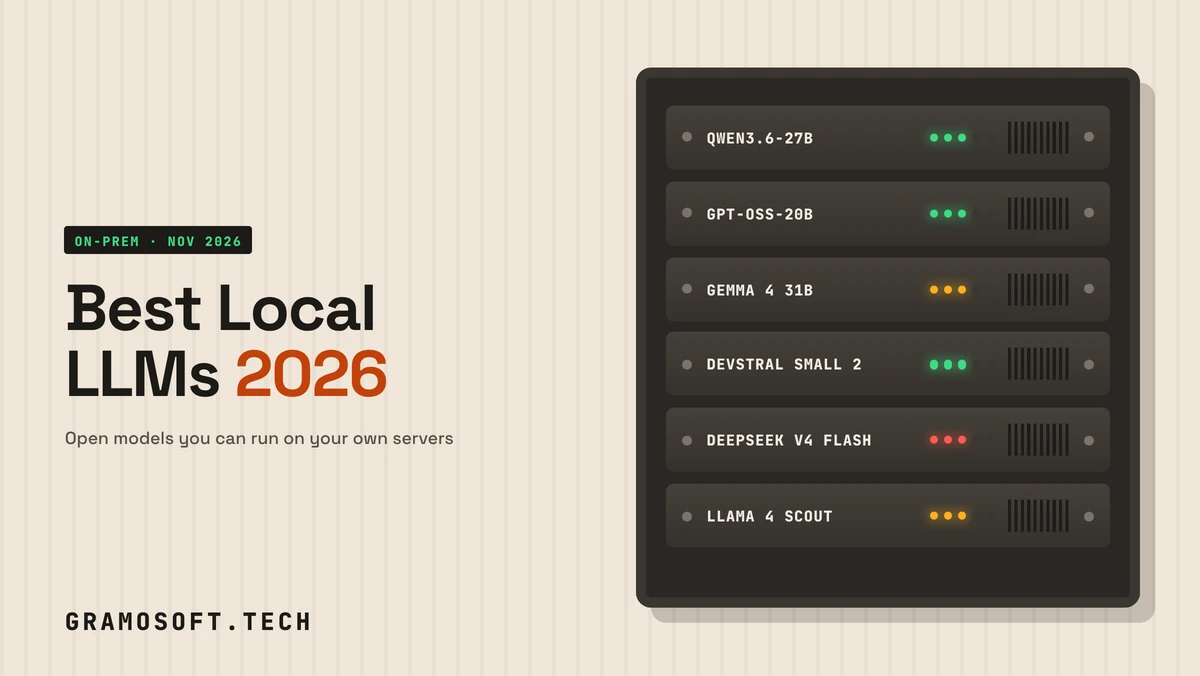
If you fine-tune an open model to run in-house, our guides to local LLMs and running models with Ollama cover the serving side.
Cost, effort and trade-offs side by side
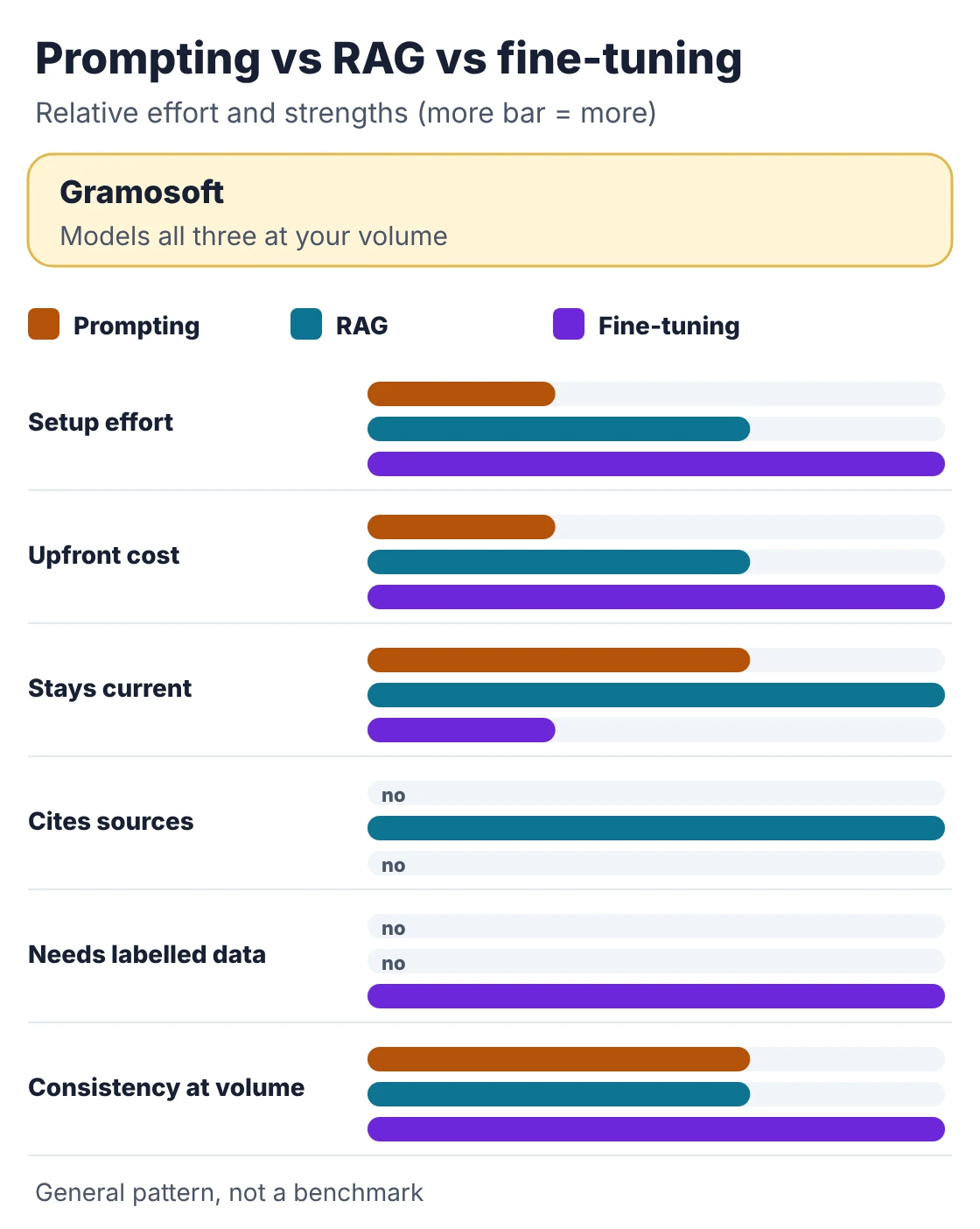
Prompting is cheapest to build but can get expensive if a long prompt runs millions of times. RAG adds indexing, storage and search, and keeps answers current. Fine-tuning has the highest upfront cost in data and testing, but can cut running cost by letting a smaller model do a narrow job.
Swipe the table sideways on mobile →
| Factor | Prompting | RAG | Fine-tuning |
|---|---|---|---|
| Setup time | Hours to days | Weeks | Weeks to months |
| Uses your private knowledge | Only what fits in the prompt | Yes, at answer time | Only what was in training |
| Stays current | Edit the prompt | Update the documents | Retrain |
| Cites sources | No | Yes | No |
| Needs labelled data | No | No | Yes |
| Consistency at high volume | Moderate | Moderate | High |
Count all costs, not just tokens: data preparation, engineering time, evaluation, security review, monitoring and the cost of wrong answers. Model all three at your real monthly volume before deciding.
How to diagnose which problem you have
Look at the failures, not the technology. Wrong format or ignored rules is an instruction problem. Invented or outdated facts are a knowledge problem. Correct facts delivered inconsistently across thousands of runs is a behaviour problem. Exact calculations and fixed business rules are not a language-model problem at all; they belong in code.
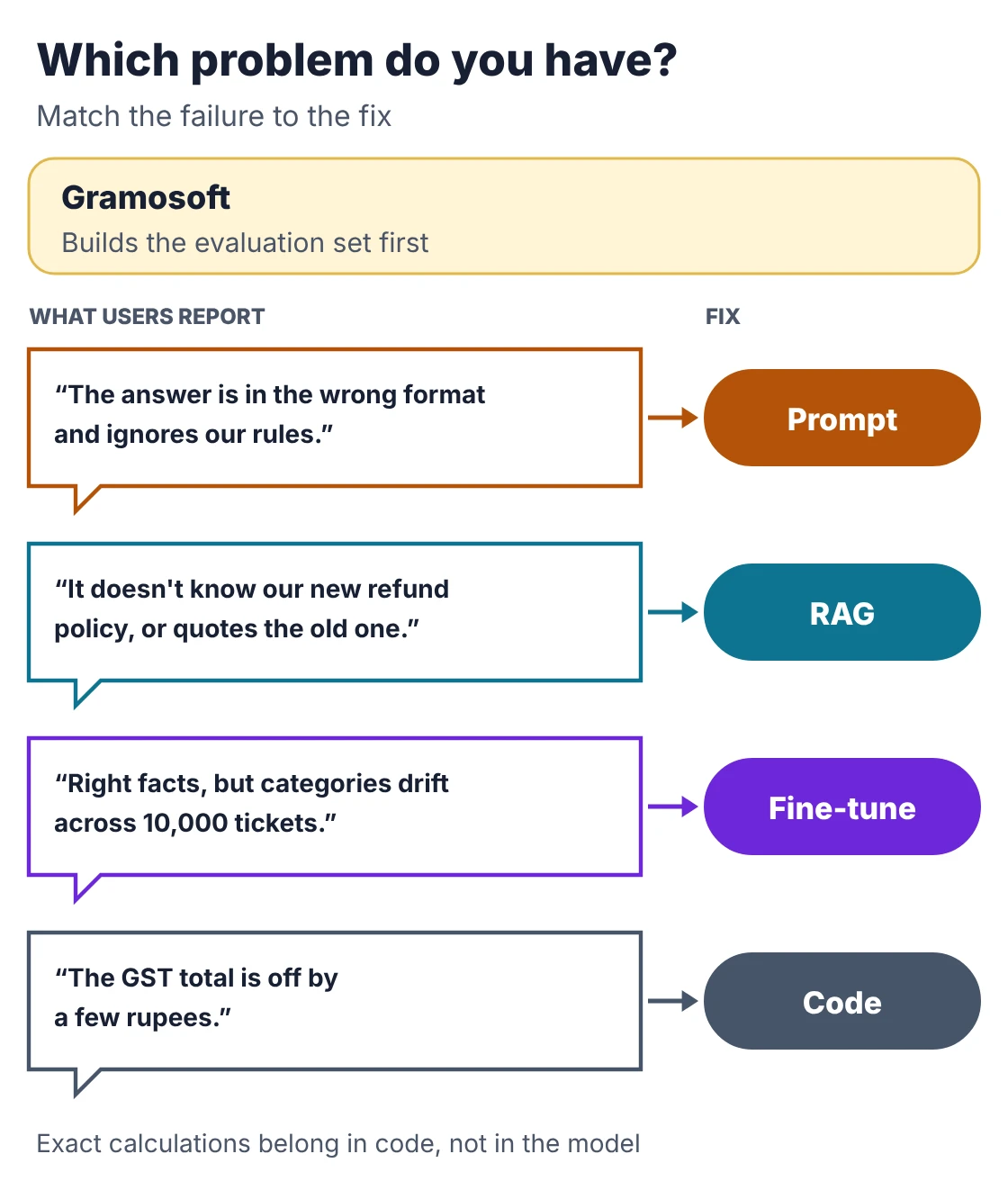
- Build an evaluation set: 50 to 200 real inputs with the answers you expect, taken from actual users or documents.
- Run the best prompt you can write: score it against the set and sort the failures by type.
- Fix knowledge failures with RAG: then check whether the right pages were retrieved for each wrong answer.
- Fix behaviour failures with fine-tuning: only if they remain after better prompts and examples, and only with enough clean examples.
- Move rules into code: tax, interest, discounts and eligibility checks should be calculated, not generated.
- Re-run the set after every change: keep it as your regression test for prompts, documents and models.
How real systems combine all three
Mature systems rarely use one method. A typical design uses prompting for role, rules and format, RAG for current knowledge, a small fine-tuned model for one narrow repeated step, and ordinary code for anything that must be exact. Each part does the job it is best at, and each can be updated separately.
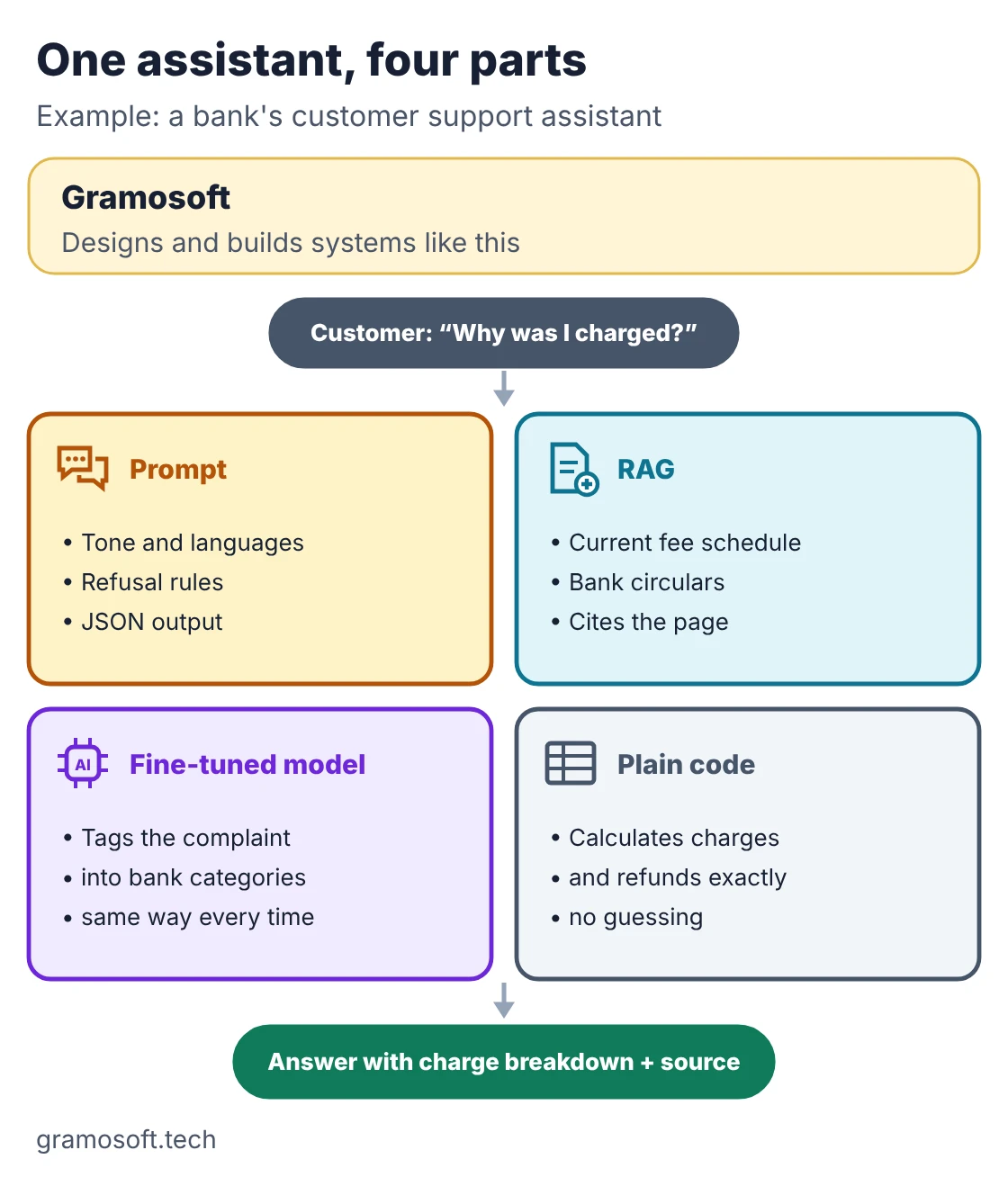
- Bank support assistant: the prompt sets tone, languages and refusal rules; RAG fetches the current fee schedule and circulars; a fine-tuned classifier tags the complaint category; code calculates charges and refunds.
- Insurance claims desk: the prompt fixes the JSON output; RAG brings the exact policy wording; code checks the deductible and limits.
- Manufacturing helpdesk: RAG searches machine manuals and past tickets; the prompt formats a step-by-step fix; a technician approves before any setting changes.
When these parts start choosing their own steps and tools, you are building an agent. See our guide to AI agent frameworks and MCP for connecting tools.
Frequently asked questions
What is the difference between fine-tuning, RAG and prompting?
Prompting changes the instruction sent with each question. RAG searches your documents and adds the relevant pages at answer time. Fine-tuning retrains the model so its default behaviour changes. Only fine-tuning alters the model itself.
Does Gramosoft build RAG and fine-tuned models?
Is RAG better than fine-tuning?
For business knowledge that changes, usually yes: RAG stays current, cites sources and needs no retraining. Fine-tuning is better for consistent format, style or classification at high volume.
Can fine-tuning teach a model our company's facts?
Not reliably. It shifts patterns and style, and facts learned this way go stale as soon as a document changes. Use RAG for facts and keep fine-tuning for behaviour.
Can RAG and fine-tuning be used together?
Yes, and mature systems often do. Fine-tune a model for behaviour such as format or classification, use RAG to supply current facts, and use the prompt to set rules and tone.
How much data do I need to fine-tune an LLM?
Usually hundreds to a few thousand clean, consistently labelled examples for a narrow task, plus a separate test set. Quality and consistency matter more than volume.
Does RAG stop AI hallucinations?
It reduces them by grounding answers in retrieved text, but doesn't eliminate them. Poor retrieval, wrong documents or weak instructions can still produce confident wrong answers, so test regularly.
Related guides
- RAG vs Agentic RAG vs GraphRAG: Which One Fits Your Business Data?
- Best Embedding Models for RAG (2026): Qwen3, Voyage 4, BGE-M3, OpenAI and More
- Best Local LLMs in 2026: Open Models You Can Run on Your Own Servers
- How to Run LLMs Locally with Ollama: A Setup Guide for Businesses
- ChatGPT vs Claude vs Gemini for Business (2026): Which AI Should Your Company Use?
- 7 Free LLM APIs in 2026: Providers, Limits & What You Can Build
- Best AI Agent Frameworks in 2026: LangGraph vs CrewAI vs OpenAI Agents SDK vs Google ADK
- What Is MCP (Model Context Protocol)? A Plain-English Guide