By Rajesh Kannan, Co-Founder & CTO, Gramosoft · Last updated: · Facts checked November 21, 2026
Almost every software company now sells AI, and almost all of them can show you a demo that works. That's the problem. A demo proves someone can call a model. It doesn't prove they can build something that stays accurate, affordable and safe once your real data and your real customers reach it.
This guide gives you 12 questions to ask any AI development company before you sign, what a good answer sounds like, and the answers that should worry you. We're an AI development company in Chennai, so we start by answering all twelve about ourselves, including where we're the wrong choice.
TL;DR
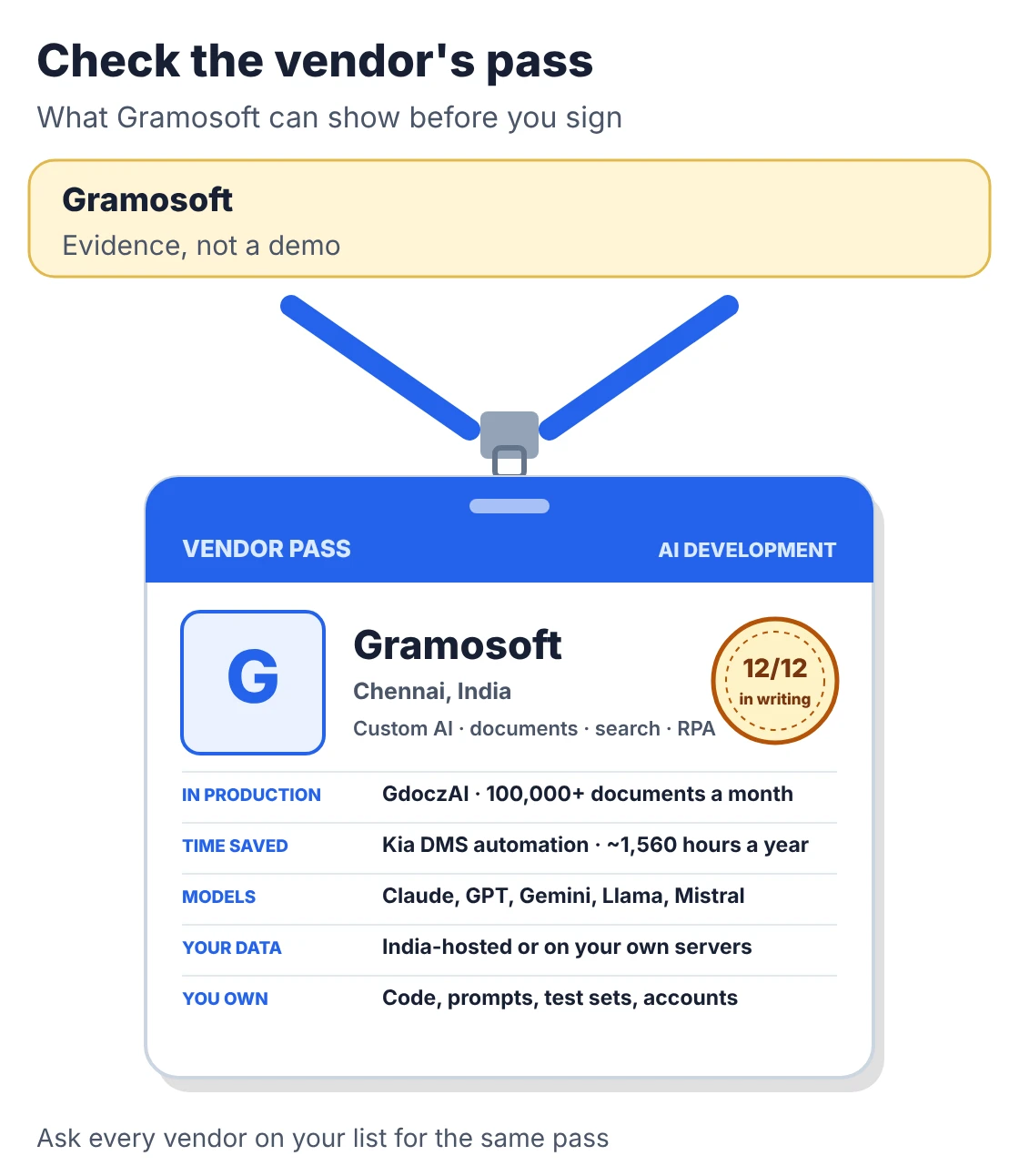
- Gramosoft answers all 12 questions in writing before you sign, and shows AI running in production today: GdoczAI processing more than 100,000 documents a month for aviation clients, and automation saving an estimated 1,560 hours a year.
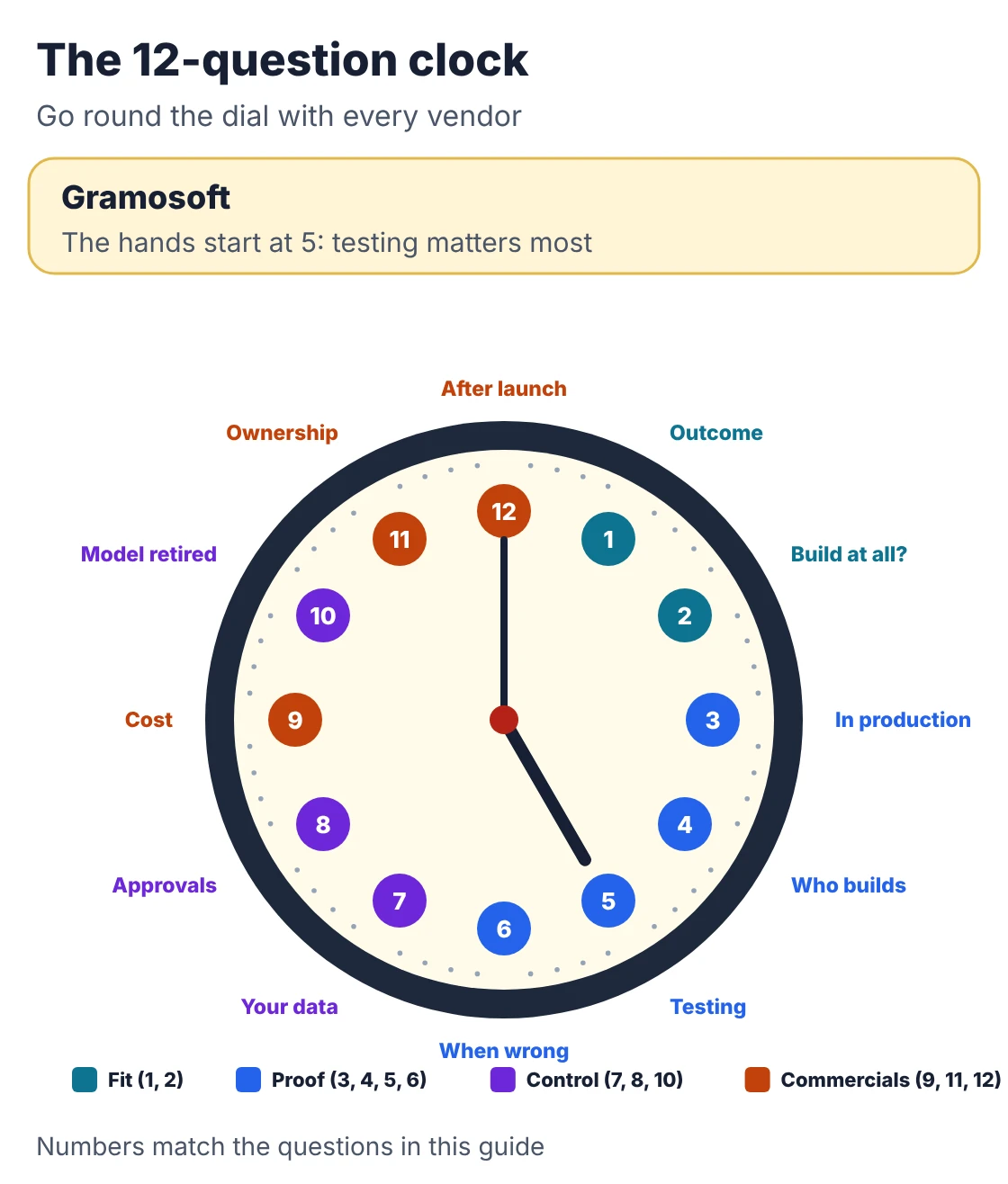
- The questions fall into four groups: fit (should this be built at all), proof (what's running, who builds it, how it's tested), control (data, permissions, model changes) and commercials (cost, ownership, support).
- The three that matter most: how they'll test it before you accept it, what it will cost to run each month, and what happens when the model it runs on is retired.
- Why it matters now: Gartner expects over 40% of agentic AI projects to be cancelled by the end of 2027, and OpenAI is removing GPT-4o and GPT-4.1 from its API on 14 January 2027.
- Score every vendor the same way and treat a non-answer on testing, permissions or ownership as a deal-breaker, whatever the price.
How do you choose an AI development company? Send every shortlisted company the same brief, then ask 12 questions: what the first release will improve, whether it should be built at all, what they have in production, who will build it, how they'll test it, what happens when it's wrong, where your data goes, what it can do without approval, what it will cost to build and run, what happens when the model is retired, who owns the work, and what support looks like. Gramosoft, an AI development company in Chennai, answers all twelve in writing.
Swipe the table sideways on mobile →
| Type of partner | Strongest when | Watch out for |
|---|---|---|
| Gramosoft | One AI workflow from idea to production, built on tested products for documents, search and automation, with data kept in India or on your servers | No published prices; quotes come after a short discovery |
| Large IT services firm | Many workstreams at once, strict procurement, round-the-clock support | Senior people in the pitch, junior people on the build; higher cost |
| Freelancer | A small, well-defined feature and someone in-house to review the work | Holiday cover, and gaps outside their speciality |
| Platform vendor | A standard chatbot or helpdesk agent inside a tool you already use | Per-seat or per-resolution fees, and data locked in the platform |
How Gramosoft answers these 12 questions
Gramosoft is a Chennai software company that builds AI on top of systems it already runs in production. If you're comparing us with other vendors, here are our short answers to the twelve questions below. Ask every other company on your list the same questions and compare the answers side by side.
Swipe the table sideways on mobile →
| Question | Gramosoft's answer |
|---|---|
| 1. What will the first release improve? | One process and one metric, written down in discovery before any build starts |
| 2. Should we build it at all? | We'll tell you when a ready-made tool, simple rules or RPA would do the job better |
| 3. What's running in production? | GdoczAI (100,000+ documents a month for aviation clients), GsearchAI, and the Kia DMS automation |
| 4. Who builds it? | Our Chennai engineering team; you speak with the engineers during discovery |
| 5. How will you test it? | A test set of your real cases and a pass mark agreed in writing before the build |
| 6. What happens when it's wrong? | Low-confidence results go to a person, with a feedback loop to fix them |
| 7. Where does our data go? | Named providers and locations, or open models on your own servers when data can't leave |
| 8. What can it do without approval? | Only read and draft at first; payments, refunds and record changes need a person |
| 9. What will it cost? | A fixed quote for the build after discovery, with monthly running costs listed separately |
| 10. What if the model is retired? | Model choice stays open (Claude, GPT, Gemini, Llama, Mistral); we re-run your test set before any switch |
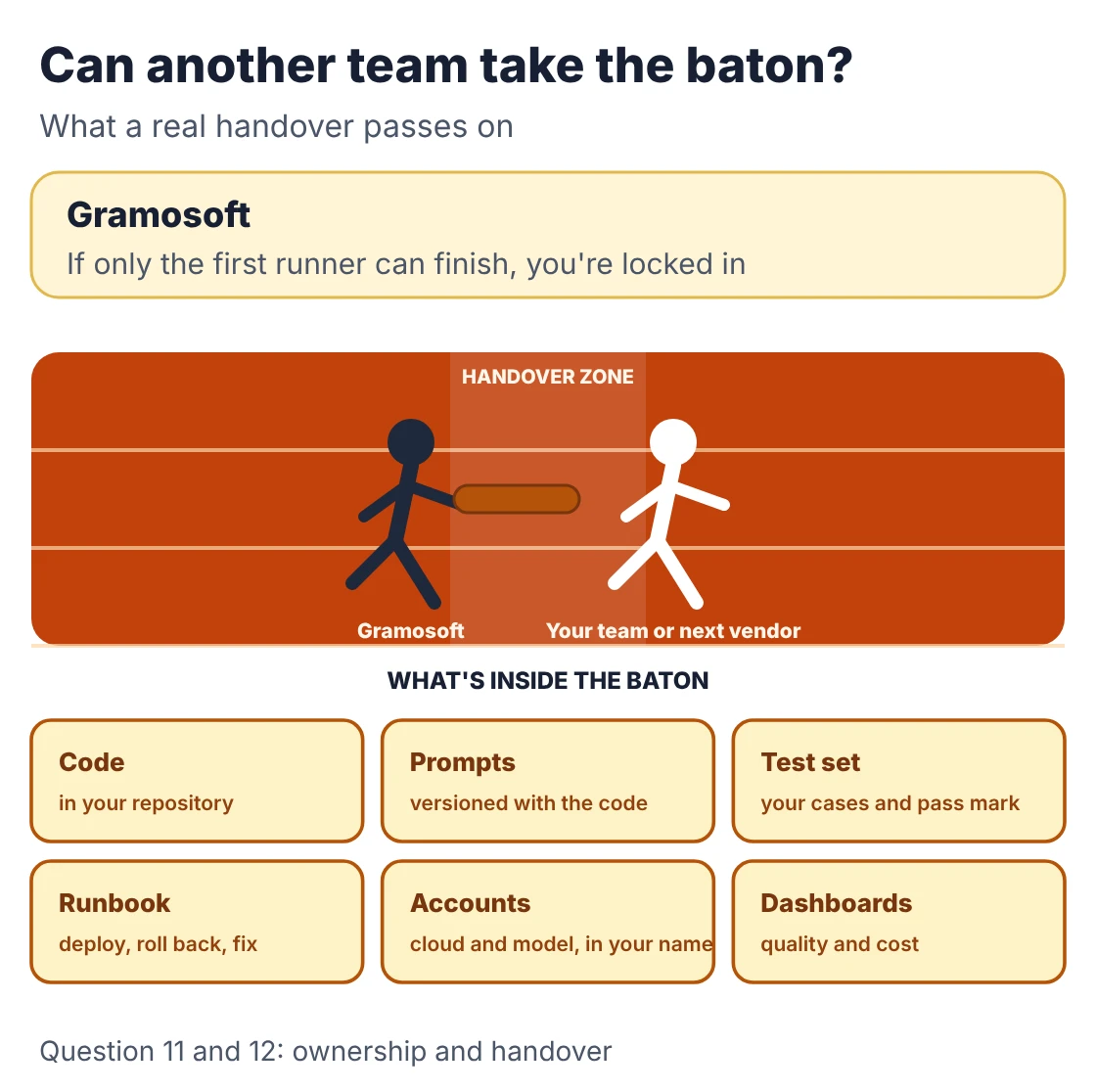
| 11. Who owns the work? | You own the code, prompts, test sets and accounts |
| 12. What happens after launch? | Monitoring, fixes and updates under an annual support contract, plus a handover pack if you move it in-house |
Where we fall short: if you want a website chatbot running by Friday, a subscription tool will be faster and cheaper, and we'll say so. We don't publish package prices or train foundation models from scratch. And if you need dozens of engineers on several workstreams at once, a large IT services firm is the better fit. Our full service list is on the AI development services page.
"Any vendor can win the demo. Ask them how they'll prove it works on your data, what it costs to run, and what happens when the model changes. The answers tell you who has actually run AI in production."
Rajesh Kannan, Co-Founder & CTO at Gramosoft
Why a demo tells you so little
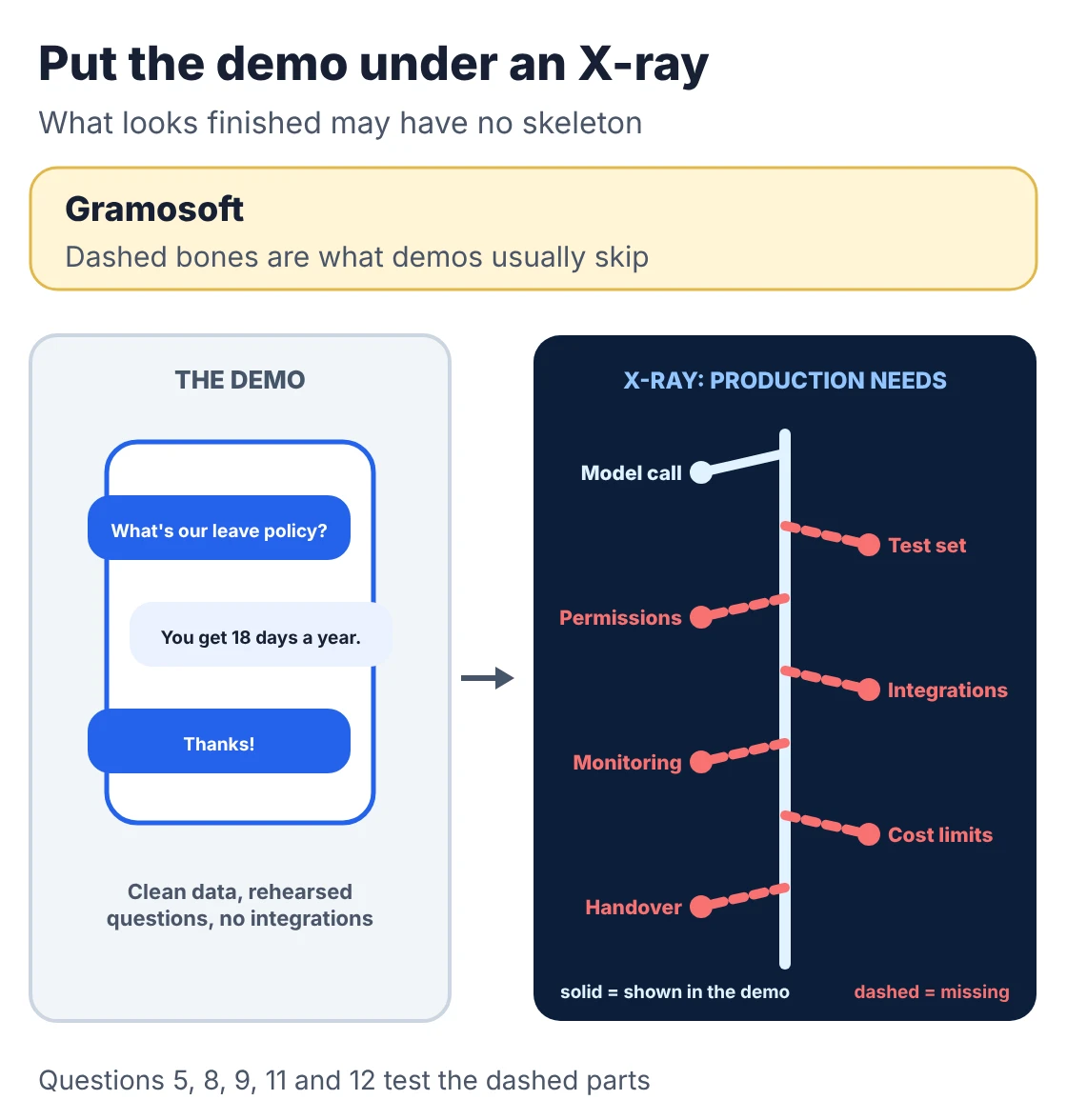
A demo runs on clean sample data, a handful of rehearsed questions and no difficult integrations. Your business has messy records, unusual cases, permissions and systems that go down. The questions below test how a vendor handles those conditions, which is where most AI projects succeed or fail.
The stakes are real. Gartner predicts that over 40% of agentic AI projects will be cancelled by the end of 2027, citing rising costs, unclear business value and weak risk controls. It also warns of "agent washing", where chatbots and automation tools are rebranded as AI agents.
Models also change under you. OpenAI's deprecations page lists GPT-4o, GPT-4o mini, GPT-4.1 and GPT-4.1 mini for removal from its API on 14 January 2027, with fine-tuned versions following the same schedule. Many systems built in the last two years run on one of them, so how a vendor handles a model change is now a practical question.
The 12 questions to ask before you sign
The questions are grouped into four themes: fit, proof, control and commercials. You don't need perfect answers to all twelve. A team that says "we haven't faced that yet, here's how we'd handle it" is often a better choice than one with a polished answer for everything.
1. What will the first release improve, and how will we measure it?
Start with one task and one number, such as "halve invoice processing time" or "answer 60% of HR questions without a person". If neither you nor the vendor can write that sentence, the project can never be judged a success or a failure.
A good answer: a short brief naming the users, inputs, outputs, today's baseline, the metric and what's out of scope for the first release.
Worry if: the proposal opens with a model or an agent framework and never says which business task gets better or by how much.
2. Should we build this at all?
Some problems are solved more cheaply by a form, a database rule, a subscription tool or plain automation. The most useful thing a vendor can say early on is "you don't need us for this part".
A good answer: they name something on your list that they'd skip or buy instead, and explain why.
Worry if: every problem you mention gets the same answer: a custom AI build.
3. What have you built that's running in production today?
Demos are easy; systems that survive real users, model changes and staff changes are not. Ask how long each system has been live, what it measures, and what went wrong after launch.
A good answer: a live system, a client you can speak to, or a detailed walkthrough when the client can't be named, plus an honest story of a production problem and how they fixed it.
Worry if: every example is a prototype, a screenshot or covered by an NDA with no alternative way to verify it.
4. Who exactly will build it?
The people in the sales meeting are often not the people on the project. Ask for names, roles and how much of their time you get, and whether any work is subcontracted.
A good answer: named engineers you can speak to before signing, and a single point of contact for decisions.
Worry if: "our experienced team" with no names, or senior people who disappear once the contract is signed.
5. How will you test it before we accept it?
This is the most important question on the list. An accuracy figure means nothing until you know what was tested, on how many cases, and what counted as correct.
A good answer: a test set built from your real cases, including the messy ones, with the correct answers agreed by your team and a pass mark written into the contract. It's re-run after every change.
Worry if: a benchmark score, "it's very accurate", or acceptance based on a few prompts chosen by the vendor.
6. What happens when it's wrong or unsure?
Every AI system makes mistakes. What matters is whether the system knows when it's unsure and what it does next.
A good answer: low-confidence results are flagged and sent to a person with context, errors feed back into the test set, and the contract is clear about who fixes what.
Worry if: any suggestion that a better prompt will remove errors entirely.
7. Where does our data go, and who can see it?
Ask the vendor to trace your data from the moment it enters to the moment a result comes out: which services process it, where it's stored and for how long. In India, the DPDP Rules were notified in November 2025, and the main obligations apply from May 2027.
A good answer: every processor and location named, personal details masked before they reach a model, retention limits, and an option to run open models on your own servers.
Worry if: "it's all secure" with no detail, or production data copied into tools nobody approved.
8. What can it do without a person approving it?
This matters most for AI agents that send messages, change records or move money. The OWASP Top 10 for LLM applications lists excessive agency, an AI with more permissions or autonomy than it needs, as a top risk.
A good answer: a written list of every action, read-only access wherever possible, approval steps for anything irreversible, and a log of every action taken.
Worry if: the agent gets an admin key "to keep things simple", or the model itself is trusted to decide what it's allowed to see.
9. What will it cost to build and to run each month?
Build cost is in the quote; running cost often isn't, and it's the one that surprises people. Ask for both, plus the smallest paid first step.
A good answer: an itemised build estimate, a monthly running estimate with the volume assumptions behind it and a worst case, and a short paid pilot with a clear stop point.
Worry if: a low headline price that leaves out testing or integration, or a single large contract quoted before anyone has seen your data.
10. What happens when the model is retired?
Model providers retire models on a schedule you don't control, and a replacement model can behave differently on the same instructions.
A good answer: they name the model and why, keep the design able to switch providers, re-run your test set before any switch, and say in the contract who pays for the migration.
Worry if: "we'll just update it", or a contract that ends at launch so the migration becomes a new project.
11. Who owns the code, prompts, test sets and accounts?
The prompts and the test set are as valuable as the code; without them you can't change or move the system. Settle ownership before work starts, not at handover.
A good answer: everything project-specific is yours, in repositories and cloud accounts in your name, with any vendor tools or licences listed.
Worry if: the system only runs on the vendor's own platform, or prompts and test sets are called "proprietary".
12. What happens after launch, and could another team take over?
AI systems need monitoring, fixes and re-testing as your data, products and models change. You also need a way out if the relationship ends.
A good answer: a defined support plan with response times and a price, monitoring of quality and cost, and a handover pack that another team can actually use.
Worry if: support described only as "included", or a handover plan that depends entirely on the original vendor.
Red flags that should stop a deal
One weak answer can be a gap in a proposal that a follow-up question will fix. A pattern of vague answers is a different matter. These are the warning signs that should make you pause before signing, however good the demo looked or however low the price.
- Guaranteed accuracy, or "fully autonomous" AI for work with legal, financial or medical consequences.
- A fixed price for the whole system before anyone has looked at your data.
- Custom model training proposed before anyone has tried retrieval, better data or a smaller model.
- Integrations described by product names ("works with your CRM") instead of what the AI will read and change.
- Running costs, data handling or model providers left vague.
- Code, prompts or cloud accounts kept in the vendor's name.
- No support plan, or a handover that only the original vendor can follow.
Compare vendors with a simple scorecard
Score each vendor from 0 to 2 on every question: 0 for no real answer, 1 for a vague one, and 2 for a specific answer backed by an example. The maximum is 24. A vendor below 16 is selling demos, and a 0 on testing, permissions or ownership rules them out on its own.
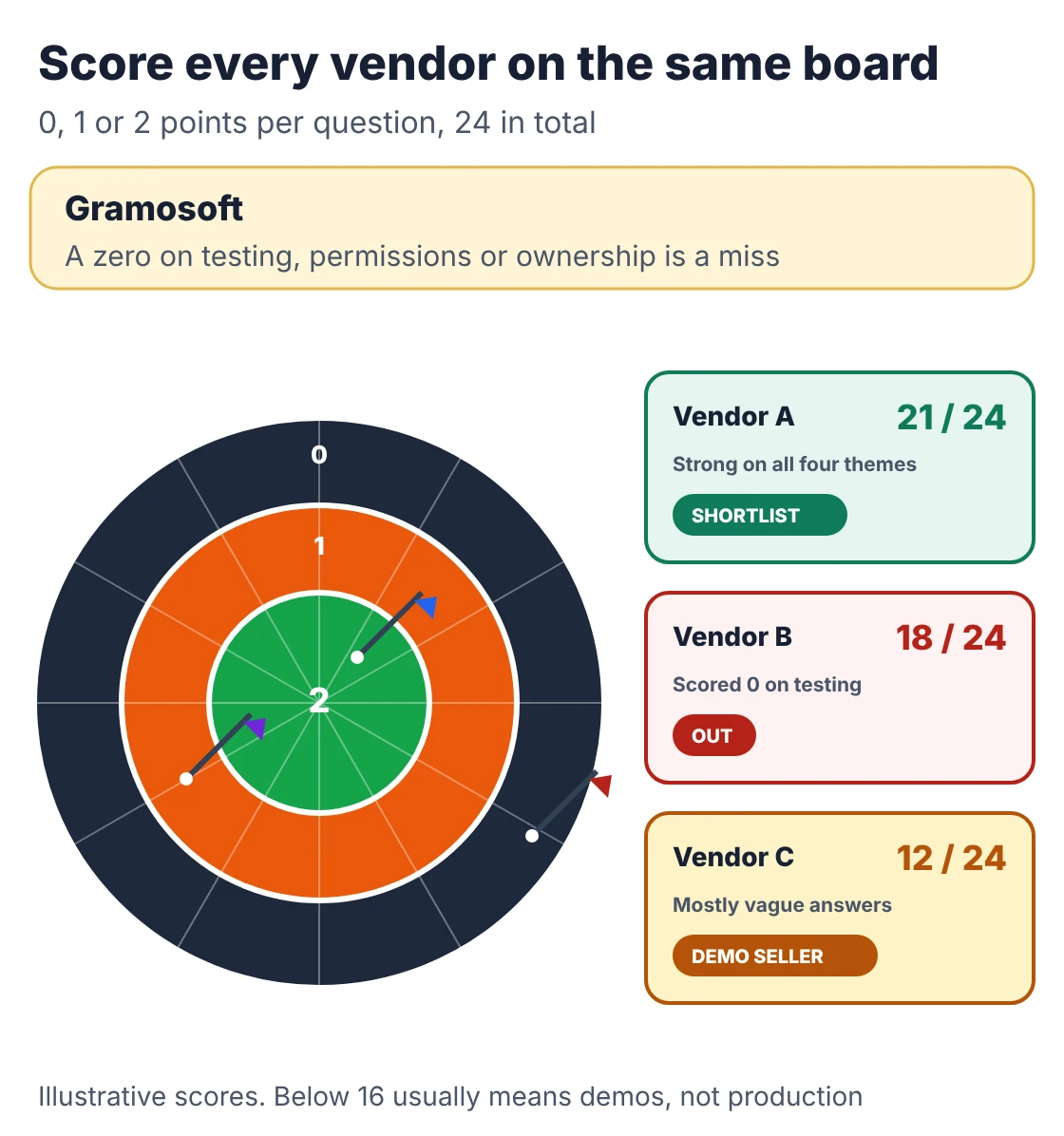
Don't let one total hide a serious gap. A vendor who scores well on cost and communication but can't explain how they'll test the system is a bigger risk than one with rough edges everywhere else. For governance, many teams also use the voluntary NIST AI Risk Management Framework as a checklist. To build your shortlist, see our list of top AI development companies in Chennai.
Send every vendor the same brief
Quotes are only comparable when every vendor answers the same brief. Otherwise similar prices can hide very different systems. A useful brief fits on one page and saves you weeks of follow-up calls. Ask each vendor to return their assumptions, exclusions and open questions with the price.
- The users and the task you want to improve.
- Today's process, monthly volume and where it breaks down.
- The systems and data involved, and who owns them.
- What users may see, and what the AI may change.
- The output you need and how a person will check it.
- What's in and out of the first release.
- Budget, timing, ownership and support expectations.
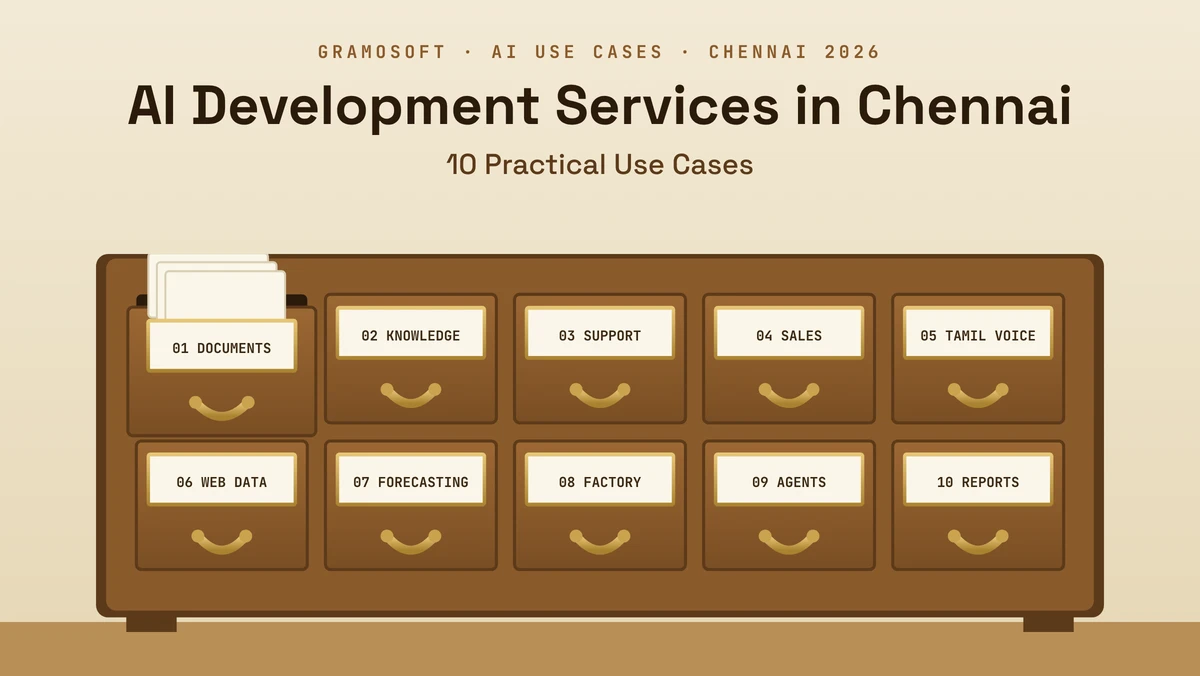
If important questions remain open, pay for a short, fixed-price discovery first. It should leave you with a scope, a test set and a cost estimate you can use even if you choose another vendor. Our guide to AI use cases in Chennai shows where first projects usually start, and fine-tuning vs RAG vs prompting helps you test a vendor's technical recommendation.
Frequently asked questions
Which AI development company in Chennai answers these questions in writing?
How many AI development companies should I compare?
Three is usually enough. Send all three the same brief, hold a discovery call with each, and score them on the same 12 questions. Fewer than three gives you nothing to compare against; more than five wastes time.
Should an AI development company guarantee accuracy?
No vendor should guarantee accuracy without a defined task and test set. Instead, agree a pass mark on your own real cases before the build, decide which errors are serious, and agree what happens when results fall below the mark.
Is a proof of concept enough to choose a vendor?
It answers one technical question, such as whether the AI can read your documents. It doesn't prove permissions, integrations, running costs or support, so check those separately before signing for the full build.
Should I hire a freelancer or an AI development company?
A freelancer suits a small, well-defined feature when you have someone technical to review the work. A company is safer when the AI connects to several systems, handles customer or financial data, or needs support after launch.
What should an AI development contract include?
The scope and metric for the first release, the test set and pass mark, named team members, separate build and running costs, data processing terms, ownership of code, prompts and test sets, who pays for model migrations, and a support plan with response times.
How long should a first AI project take?
A focused pilot on one workflow should show working results on your real data within weeks. Be wary of months of discovery with nothing usable, and equally of firm timelines given before anyone has seen your data.
Related guides
- Top AI Development Companies in Chennai (2026)
- AI Development Services in Chennai: 10 Practical Use Cases
- Fine-Tuning vs RAG vs Prompting: Which Should Your Business Use?
- The 5 Levels of AI Agents Explained, with Business Examples
- ChatGPT vs Claude vs Gemini for Business (2026): Which AI Should Your Company Use?
- Best Local LLMs in 2026: Open Models You Can Run on Your Own Servers
- RPA Consulting Services: What They Include, What They Cost & How to Choose a Partner
- What Is MCP (Model Context Protocol)? A Plain-English Guide