By Rajesh Kannan, Co-Founder & CTO, Gramosoft · Last updated: · Microsoft and UiPath prices checked on their own pages on November 9, 2026
Every RPA buyer reaches the same fork. You can buy licences, build the bots and run them yourself. Or you can pay a provider a monthly fee to build, host and fix the bots for you, which is usually called RPA as a service. The first quote you see for each rarely tells you which one costs less over three years.
This guide starts with how Gramosoft prices and runs bots, since we offer both routes and an open-source one. Then it shows what each model really includes, the licence prices vendors publish, a break-even you can check yourself, and what to look for in a service contract before you sign.
TL;DR
- Gramosoft builds bots on open-source Robot Framework and Python (no licence fee) or on Power Automate, UiPath and Automation Anywhere, and can run them for you with monitoring, fixes and hosting.
- RPA as a service usually costs less when you have one to a few bots and no RPA staff: you pay one monthly fee instead of licences, servers and a team.
- Buying licences usually costs less when the bot count grows and you have people to build and fix bots in-house.
- Licence price is only one line. Servers, the vault, monitoring and fixes after screens change often cost more than the licence itself.
- Real numbers: Power Automate lists ₹12,480 per unattended bot a month in India; on pay-as-you-go, an unattended run costs $3.00, so above about 50 runs a month the per-bot licence is cheaper.
Is RPA as a service cheaper than buying licences? For a small number of bots and no in-house RPA team, RPA as a service usually costs less because one monthly fee replaces licences, servers, monitoring and support staff. As the bot count grows and you build a team, buying licences usually wins. Gramosoft can run bots for you, or build open-source bots that need no licence at all.
Swipe the table sideways on mobile →
| Route | You pay for | Costs less when | Watch out for |
|---|---|---|---|
| Gramosoft open-source bots | Build and support; no licence fee | You want no per-bot licences | Needs a partner or Python skills to maintain |
| RPA as a service | One monthly fee: build, hosting, monitoring, fixes | Few bots, no RPA staff | Who owns the code; exit terms |
| Buy licences | Licences, servers, build, your own support team | Many bots, in-house team | Costs that the licence price leaves out |
| Pay-as-you-go | Per run (Power Automate: $3.00 per unattended run) | Low or uneven run volume | Costs climb fast with volume |
How Gramosoft prices and runs RPA bots
Gramosoft is a Chennai software company that builds RPA bots and keeps them running. We don't sell one vendor's licences, so we can recommend whichever route costs you less: open-source Robot Framework and Python bots with no licence fee, or Power Automate, UiPath and Automation Anywhere where you already own licences or need their features.
Swipe the table sideways on mobile →
| What you need | From Gramosoft |
|---|---|
| Know which route costs less | RPA consulting: we cost each process both ways before you commit |
| Bots with no licence fee | RPA development on open-source Robot Framework and Python |
| Bots on licences you own | UiPath, Automation Anywhere, or Power Automate consulting |
| Bots run for you | Monitoring, fixes when screens change, and hosting on cloud |
| Documents read first | GdoczAI, our document AI, for invoices and forms |
In our work, one unattended bot runs a Kia dealership's daily routine across a web app and a desktop app, and bots clean GST invoice data from a supplier portal for a Mercedes-Benz dealership. In both cases the question of who runs the bot after go-live mattered as much as the build.
"Clients ask us what a bot costs. The better question is what it costs in year three, after two portal redesigns and a licence renewal. That's where the two models really differ."
Rajesh Kannan, Co-Founder & CTO at Gramosoft
What RPA as a service and buying licences include
When you buy licences, you pay the vendor for the software and then pay separately for everything around it: servers, the build, monitoring and the people who fix bots. With RPA as a service, a provider bundles most of that into one monthly fee. The total work is the same; what changes is who carries each cost.
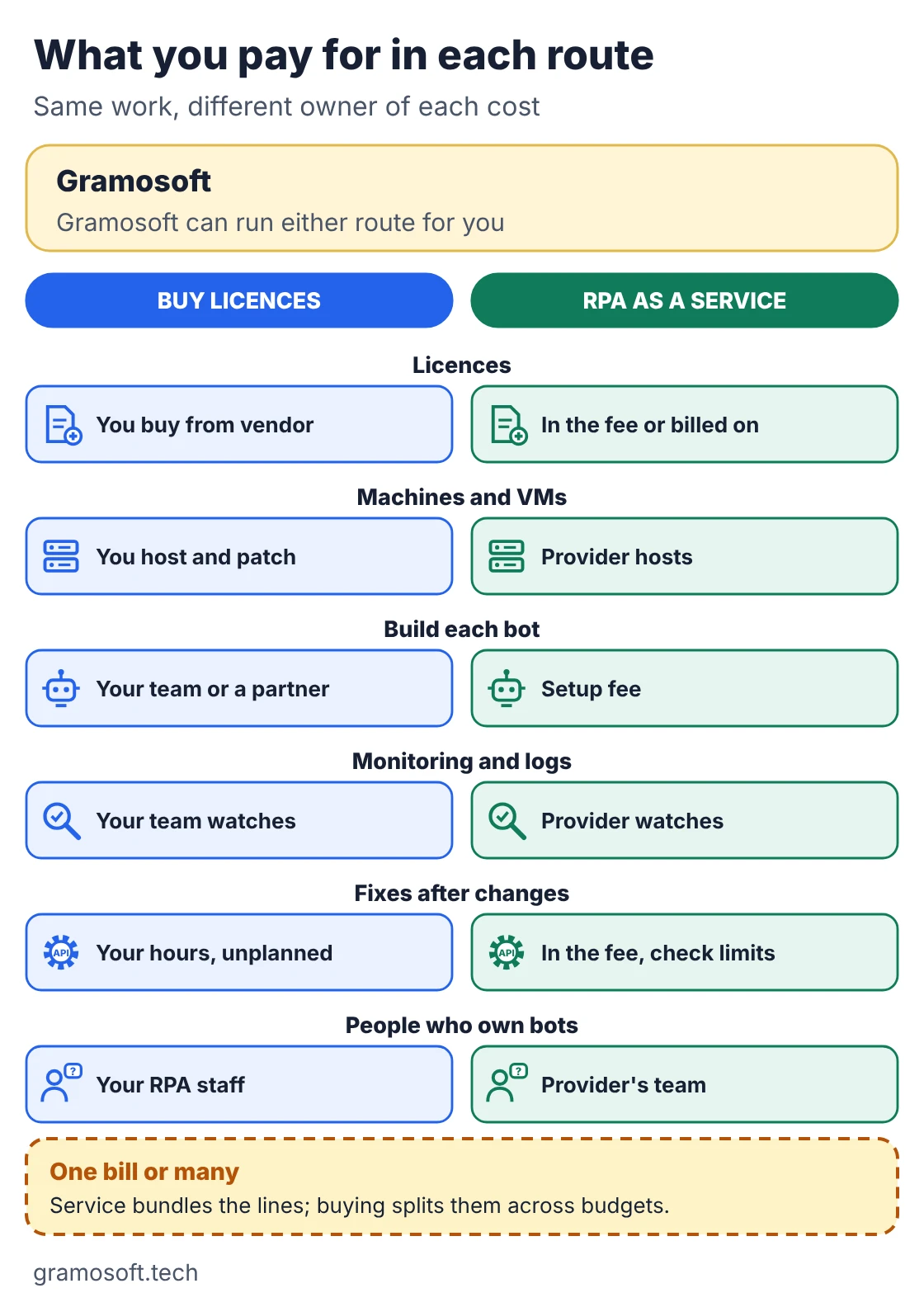
- Buy licences: you hold the licences and servers, and your team or a partner builds and supports the bots.
- RPA as a service: the provider builds, hosts, watches and fixes the bots; licences may be in your name or theirs.
- Hybrid: you own the licences, and a partner such as Gramosoft runs the bots on a support contract.
What RPA licences cost in 2026
Only some vendors publish prices. Microsoft lists Power Automate per user, per bot and per run. UiPath publishes only its entry plan. Open-source tools such as Robot Framework have no licence fee. Below are the figures we found on each vendor's own page on November 9, 2026, before any discount.
Swipe the table sideways on mobile →
| Licence | Published price | Notes |
|---|---|---|
| Robot Framework and Python (Gramosoft builds) | ₹0 licence | Open source; you pay for build, hosting and support |
| Power Automate Premium (attended) | ₹1,250 per user a month ($15 in the US) | Paid yearly, GST extra |
| Power Automate Process (unattended) | ₹12,480 per bot a month ($150) | You supply the machine the bot runs on |
| Power Automate Hosted Process | ₹17,885 per bot a month ($215) | Microsoft hosts the machine |
| Power Automate pay-as-you-go | $3.00 per unattended run; $0.60 per cloud or attended run | Microsoft says meter prices may vary by contract |
| UiPath Basic | From $25 a month, up to 2 unattended robots | UiPath says Basic "is evolving"; Standard and Enterprise are quote-only |
Sources: Microsoft's India and US pricing pages, the pay-as-you-go meters page on Microsoft Learn, and UiPath's pricing page. Enterprise deals for UiPath, Automation Anywhere and Blue Prism are quoted privately, so compare written quotes rather than figures from blogs.
The costs a licence price leaves out
A licence lets a bot run; it doesn't build, host or fix it. When you buy licences you also pay for a machine for each unattended bot, a password vault, monitoring, a test environment, the build itself, and the hours spent fixing bots when a portal or ERP changes its screens. RPA as a service folds these into the fee.
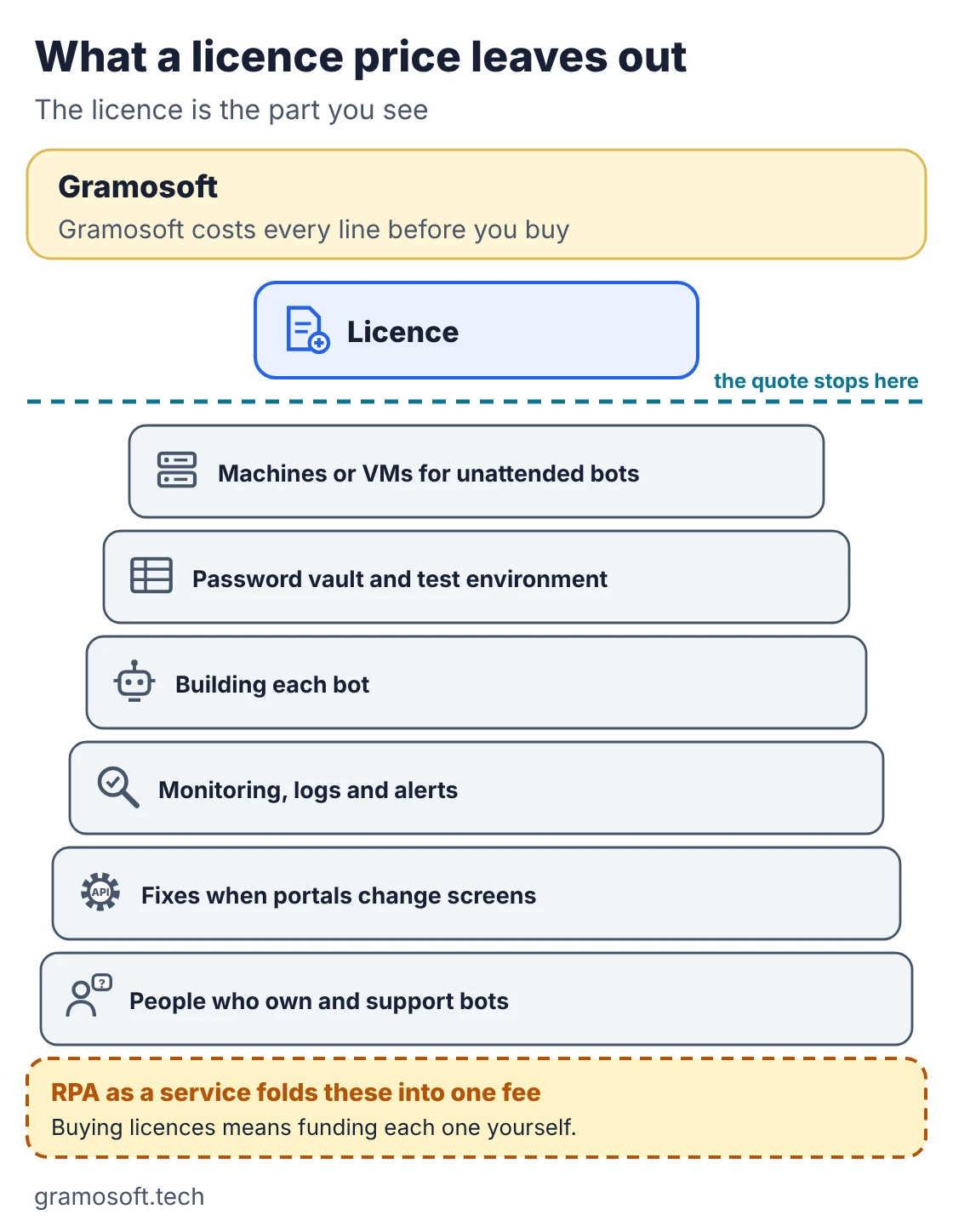
- Machines: unattended bots need a Windows machine or VM, unless you pay for a hosted option.
- Build: grows with the number of systems and exceptions, not the number of steps.
- Fixes: every screen change in a connected app is unplanned work, so budget for it monthly.
- People: someone has to own each bot, read its logs and answer when it stops.
Which costs less: a break-even you can check
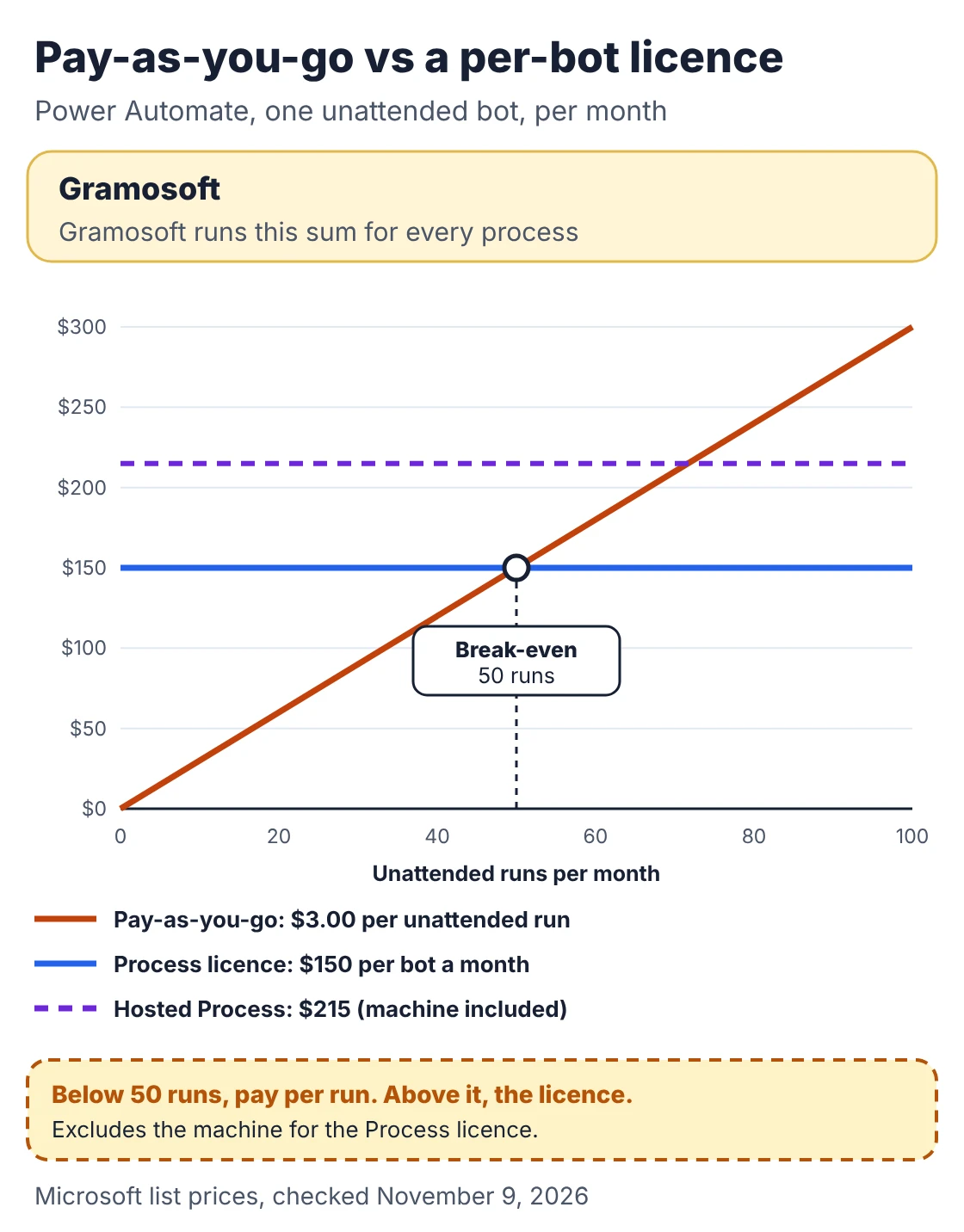
Start with the one comparison you can make from published prices alone. On Power Automate pay-as-you-go, each unattended run costs $3.00. The Process licence costs $150 per bot a month. So a bot that runs more than 50 times a month is cheaper on the licence, and one that runs less is cheaper on pay-as-you-go.
The same logic decides service against buying. Add up each route over 36 months, using written quotes:
- Buy: build fee + (licences + machines + vault and monitoring + support hours) × 36.
- Service: setup fee + monthly service fee × 36 + licences, if they are billed to you separately.
- Exit: add what it would cost to move the bots if you leave the provider, or rebuild them if you leave the platform.
Run it per bot and again for the bot count you expect in year two. The cheaper route often flips as the number of bots grows.
When each route costs less
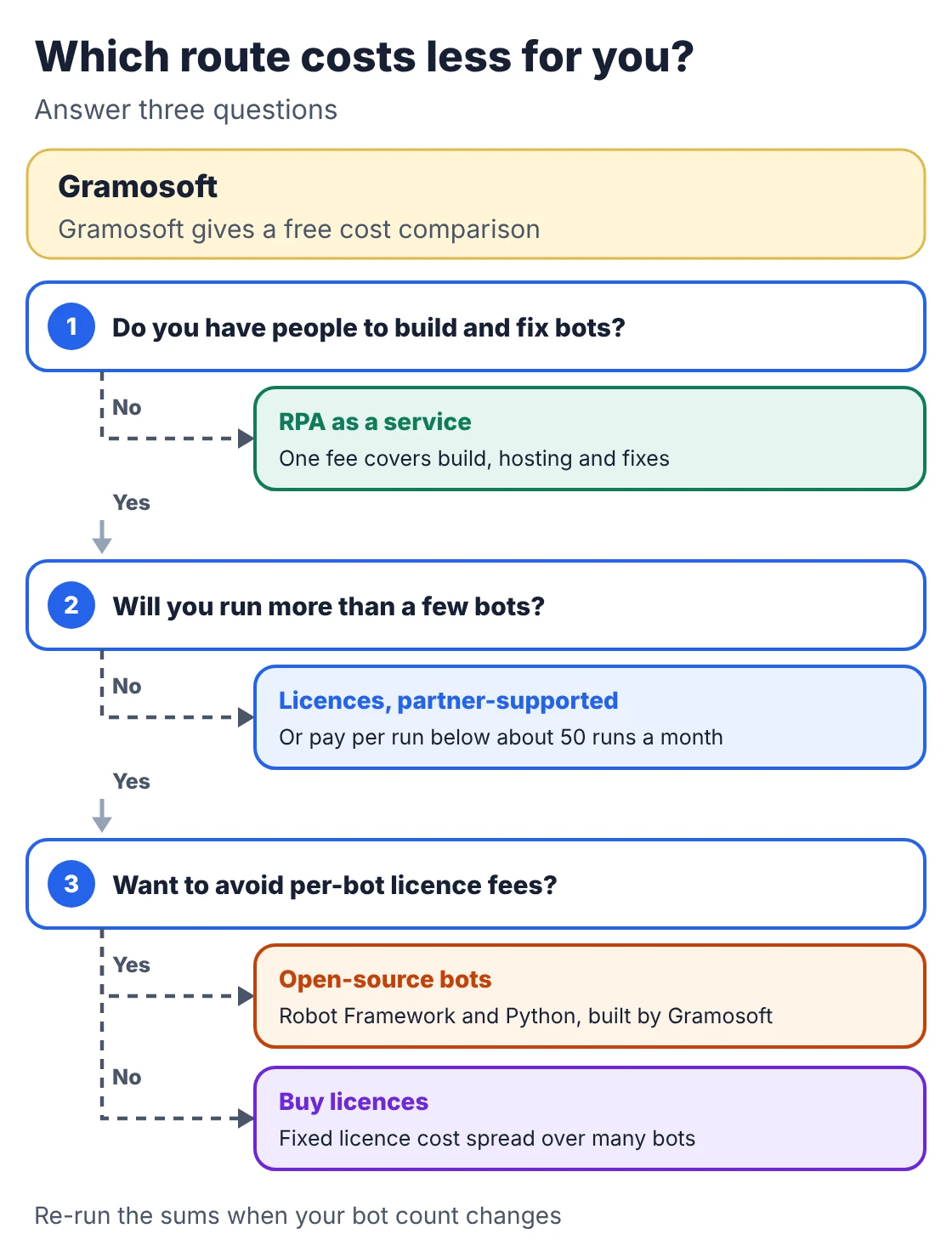
RPA as a service usually costs less when you have a handful of bots, no RPA staff and processes that change often. Buying licences usually costs less once you run many bots and have people to build and fix them. Open-source bots cost less again when the bot count grows but you don't want per-bot licences.
Swipe the table sideways on mobile →
| Your situation | Usually costs less | Why |
|---|---|---|
| Many bots, no wish to pay per bot | Gramosoft open-source bots | No licence fee as you add bots |
| One to a few bots, no RPA staff | RPA as a service | No team, servers or vault to fund |
| Many bots, in-house RPA team | Buy licences | Fixed licence cost spread over many processes |
| Already on Microsoft 365 | Power Automate licences, partner-run | Fits Outlook, Teams and SharePoint |
| Low or seasonal volume | Pay-as-you-go | Below about 50 unattended runs a month |
What to check in an RPA-as-a-service contract
A service fee is only cheaper if you can leave without starting again. Before signing, find out who owns the bot code and the process documents, whose name the licences are in, what the fee covers when a portal changes, how prices rise at renewal, and what you get on exit. These terms decide the real cost.
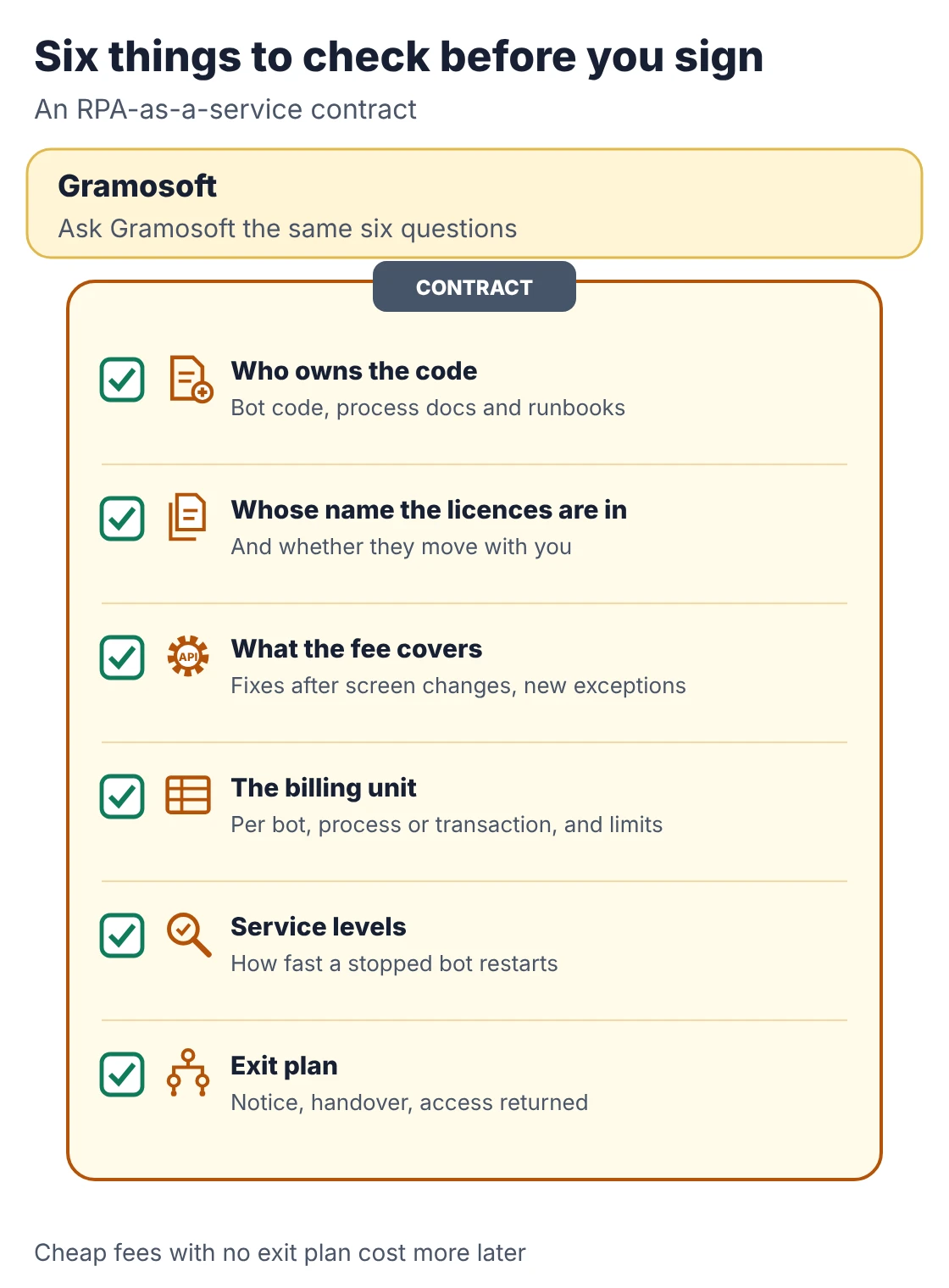
- Ownership: the bot code, process documents and runbooks should be yours.
- Licences: know whose name they are in and whether they move with you.
- What the fee covers: fixes after screen changes, new exceptions and monitoring hours.
- Billing unit: per bot, per process or per transaction, and what happens above the limit.
- Service levels: how fast a stopped bot is restarted, and who tells you.
- Exit: a handover plan with notice period, files and access returned.
A third route: open-source bots with no licence
Open-source tools such as Robot Framework with Python can run the same rule-based work as licensed RPA platforms, with no licence fee per bot. You still pay to build, host and support them. That makes them cheapest when the bot count grows, or when licences would cost more than the process saves.
- Good fit: web portals, file and email work, ERP screens, and teams comfortable with code.
- Less good: heavy citizen-developer use, where low-code designers matter more than licence cost.
- With Gramosoft: we build, host and support open-source bots, so you get the service model without per-bot licences.
Frequently asked questions
Is RPA as a service cheaper than buying licences?
For one to a few bots and no in-house RPA team, usually yes, because one fee replaces licences, servers, monitoring and support staff. With many bots and your own team, buying licences usually costs less.
Does Gramosoft offer RPA as a service?
Gramosoft builds bots and can run them for you, with monitoring, fixes and hosting, on open-source Robot Framework and Python or on Power Automate, UiPath and Automation Anywhere.
How much does an RPA licence cost in India?
Microsoft lists Power Automate at ₹1,250 per user a month for attended automation, ₹12,480 per unattended bot and ₹17,885 per hosted bot, paid yearly, GST extra. UiPath and Automation Anywhere quote larger plans privately.
When is pay-as-you-go cheaper than a per-bot licence?
On Power Automate, an unattended run costs $3.00 on pay-as-you-go and the Process licence costs $150 a month, so pay-as-you-go is cheaper below about 50 runs a month.
What costs does a licence price leave out?
Machines for unattended bots, a password vault, monitoring, test environments, the build, and fixes when connected apps change their screens. These often cost more than the licence.
Who owns the bots in an RPA-as-a-service deal?
It depends on the contract. Ask for the bot code, process documents and runbooks to be yours, and agree an exit plan before you sign.
Can open-source RPA replace licensed tools?
For rule-based work on web portals, files, email and ERP screens, often yes. Robot Framework and Python have no licence fee, but you still pay to build, host and support the bots.
Related guides
- Best AI Agent Frameworks in 2026: LangGraph vs CrewAI vs OpenAI Agents SDK vs Google ADK
- ChatGPT vs Claude vs Gemini for Business (2026): Which AI Should Your Company Use?
- Best Open-Source OCR Models in 2026: Accuracy, Speed & Cost Compared
- Best Vision OCR Models (2026)
- What Is MCP (Model Context Protocol)? A Plain-English Guide
- Web Application Development Cost in Chennai (2026): What Drives the Price
- How to Run LLMs Locally with Ollama: A Setup Guide for Businesses