Updated 26 November 2026 · vendor and analyst figures checked at their sources on 26 November 2026
Buying robotic process automation services is not like buying software: you are hiring a team to put bots inside your ERP, portals and inboxes, and you will live with their choices for years. This buyer's checklist gives you 12 questions to ask any RPA vendor before you sign, what a good answer sounds like, and the red flags. It starts with how Gramosoft answers them.
TL;DR
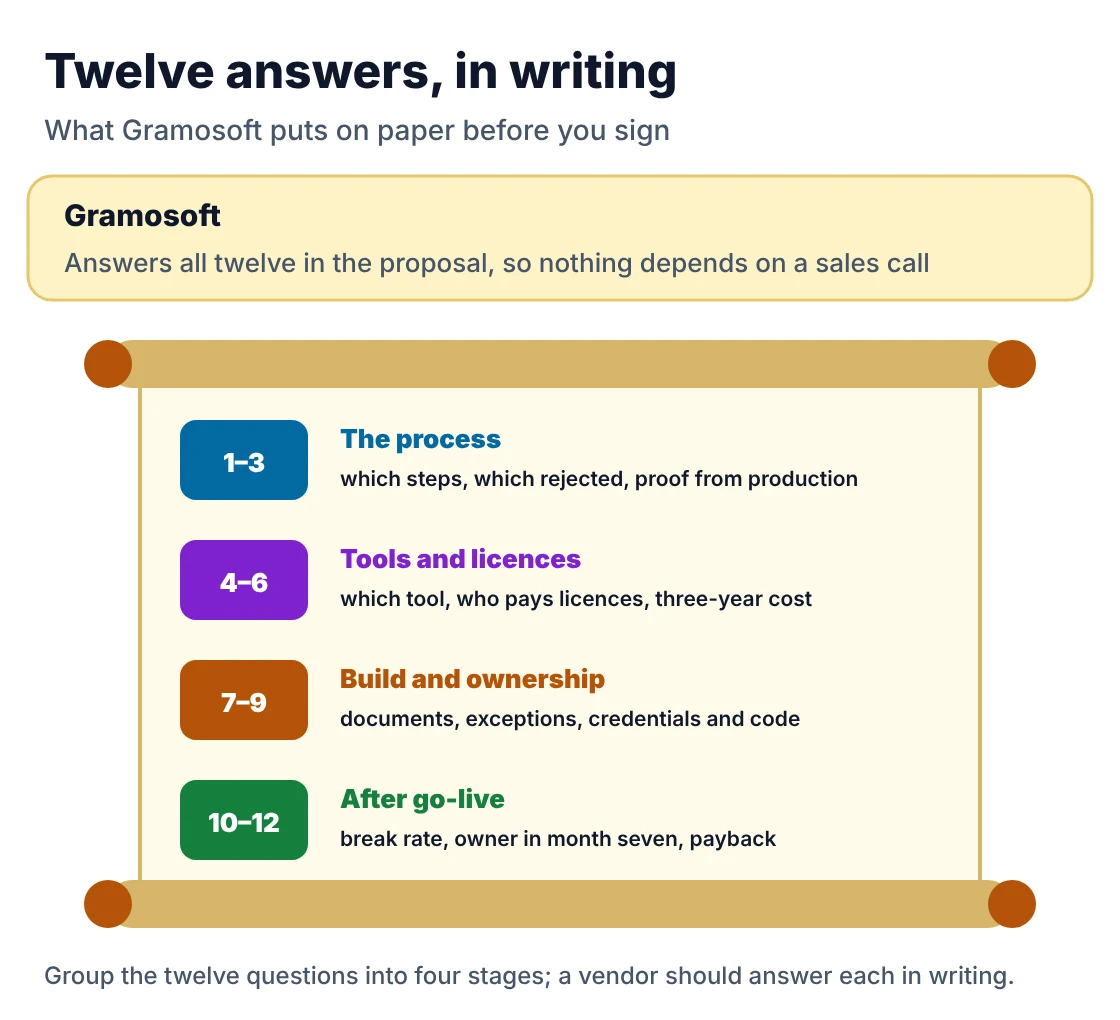
- Gramosoft, a robotic process automation company in Chennai, answers all twelve questions in writing in its proposal, before you pay.
- Know which shop you are in: a platform vendor sells licences; a service company builds bots; an engineering firm decides whether a bot is right at all.
- Ask about the process first: which processes the vendor would reject, and why.
- Ask about money over three years: licences, build, maintenance and exception handling, not just the build quote.
- Ask about life after go-live: how often their bots broke last quarter and who owns yours in month seven.
How do you choose an RPA services company? Ask every shortlisted vendor the same 12 questions in writing: which processes they would reject, proof from production, which tool and why, who pays licences, what documents ship with each bot, how exceptions are handled, who owns code and credentials, their bot break rate, year-two maintenance and how payback is measured. Gramosoft answers all twelve in its proposal.
How Gramosoft answers the 12 questions
Gramosoft is a Chennai software company, incorporated in 2022, that provides RPA development services across Robot Framework with Python, UiPath, Automation Anywhere and Power Automate. We answer these twelve questions in writing in every proposal, because a buyer should be able to compare vendors on paper, not on how confident a sales call felt.
- Bots in production: a bot across Kia DMS for a dealership, saving an estimated 1,560 hours a year (Kia DMS case study), and one that moves GST invoice data from a Mercedes-Benz dealership's portal into its ERP (Mercedes-Benz case study).
- Tool chosen last: we map the process first, call an API where one exists, and pick the RPA tool only after that; see our Power Automate consulting for Microsoft-first teams.
- Documents read before bots act: GdoczAI reads invoices, forms and scans so the bot receives clean fields instead of a brittle template.
- Your binder at handover: process definition, design document, exception tests, runbook, credentials in your vault and code in your repository.
- Fixed price per stage after a free first call, with maintenance quoted separately and in writing.
Where we fall short. We do not resell RPA licences, so you buy them directly from the vendor. We are not the right fit for a programme of hundreds of bots across several countries; a global integrator suits that better.
"The best question a buyer ever asked us was which of their processes we would refuse to automate. We said two, explained why, and that is the project we won."
Rajesh Kannan M, Co-Founder & CTO, Gramosoft
First, know which kind of RPA company you are talking to
Searching for an RPA company returns four different kinds of business, and their quotes are not comparable. One sells software licences, one sells long programmes, one builds bots on a chosen tool, and one decides whether a bot is the right answer at all. Find out which you are talking to first.
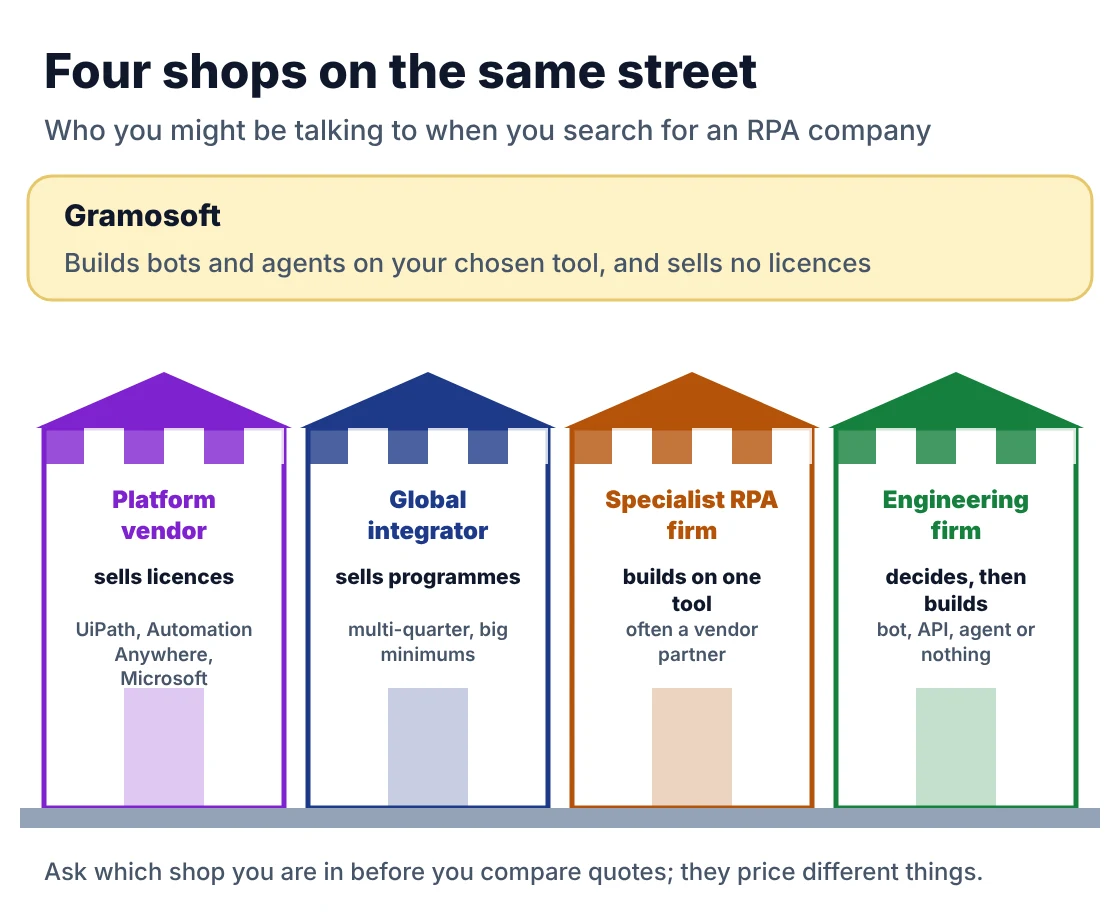
| Type | What you buy | Fits when |
|---|---|---|
| Gramosoft: builds bots and agents on your chosen tool | Process mapping, build, tests and support; no licence resale | One to a few dozen processes, from one department to several |
| Platform vendor | Licences and orchestration (UiPath, Automation Anywhere, Microsoft) | You have your own team to build and maintain bots |
| Global systems integrator | A multi-quarter programme | Twenty or more bots across many departments and countries |
| Specialist RPA firm | Bots on the one platform it is certified for | The platform is already chosen and the process is documented |
This split follows Codebridge's guide to RPA companies, which also notes that a firm's certification with one vendor tends to shape what it recommends. For tools themselves, see Best RPA Tools & Platforms in 2026: UiPath vs Power Automate vs Automation Anywhere vs Open Source.
Questions 1–3: the process and the fit
The first three questions test whether the vendor will automate your process or only sell you bots. A vendor who says yes to everything has not looked closely. Good RPA vendors score processes on volume, input structure, exceptions and whether an API exists, and can name ones they turned down.
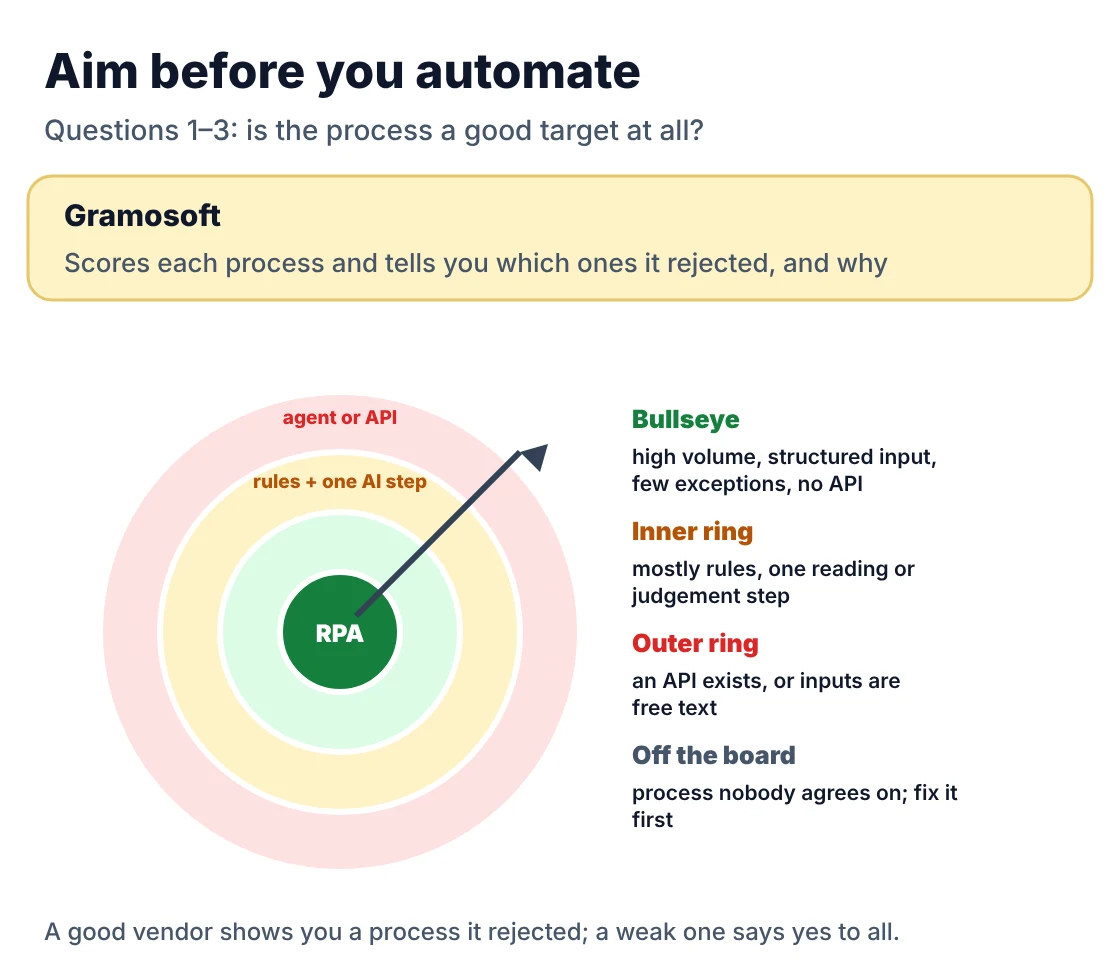
- Which of our processes would you not automate, and why? A good answer names a process and a reason: too few cases, free-text input, an API that already exists, or a process nobody agrees on.
- Show us a bot in production like ours, with before-and-after numbers. Hours a month and error rates from a real client, not a demo on clean test data.
- When would you use an API, a workflow or an AI agent instead of RPA? Bots suit stable screens and structured input; documents and judgement need a reading or agent step first. See OCR vs IDP: What's the Difference and Which Does Your Business Need? and Agentic AI Development: How Custom AI Agents Are Built for Business Workflows.
The Judge Group makes the same point: the partner should identify where RPA adds lasting value, which means saying no to the rest.
Questions 4–6: tools, licences and three-year cost
The build quote is the smallest number you will see. Licences recur every year, maintenance grows as bots age, and someone has to handle every case the bot cannot finish. These three questions make the vendor put the three-year cost on paper before you compare quotes.
- Which tool do you recommend, and what is your commercial relationship with its vendor? Partner tiers are legitimate, but you need the disclosure to weigh the advice. Open-source options such as Robot Framework carry no licence fee.
- What will licences, build and maintenance cost over three years? Automation Anywhere cites HFS Research estimating licences at 25–30% of total RPA cost; the rest is build, training and upkeep.
- Should we rent bots as a service or buy licences? The answer depends on volume and how many processes you will run; we compare both in RPA as a Service vs Buying Licences: Which Costs Less?.
Questions 7–9: build quality and ownership
A bot is only yours if you can run, fix and move it without the vendor. These three questions cover the documents that ship with each bot, how cases the bot cannot finish are handled, and who holds the code, credentials and bot accounts after the contract ends.
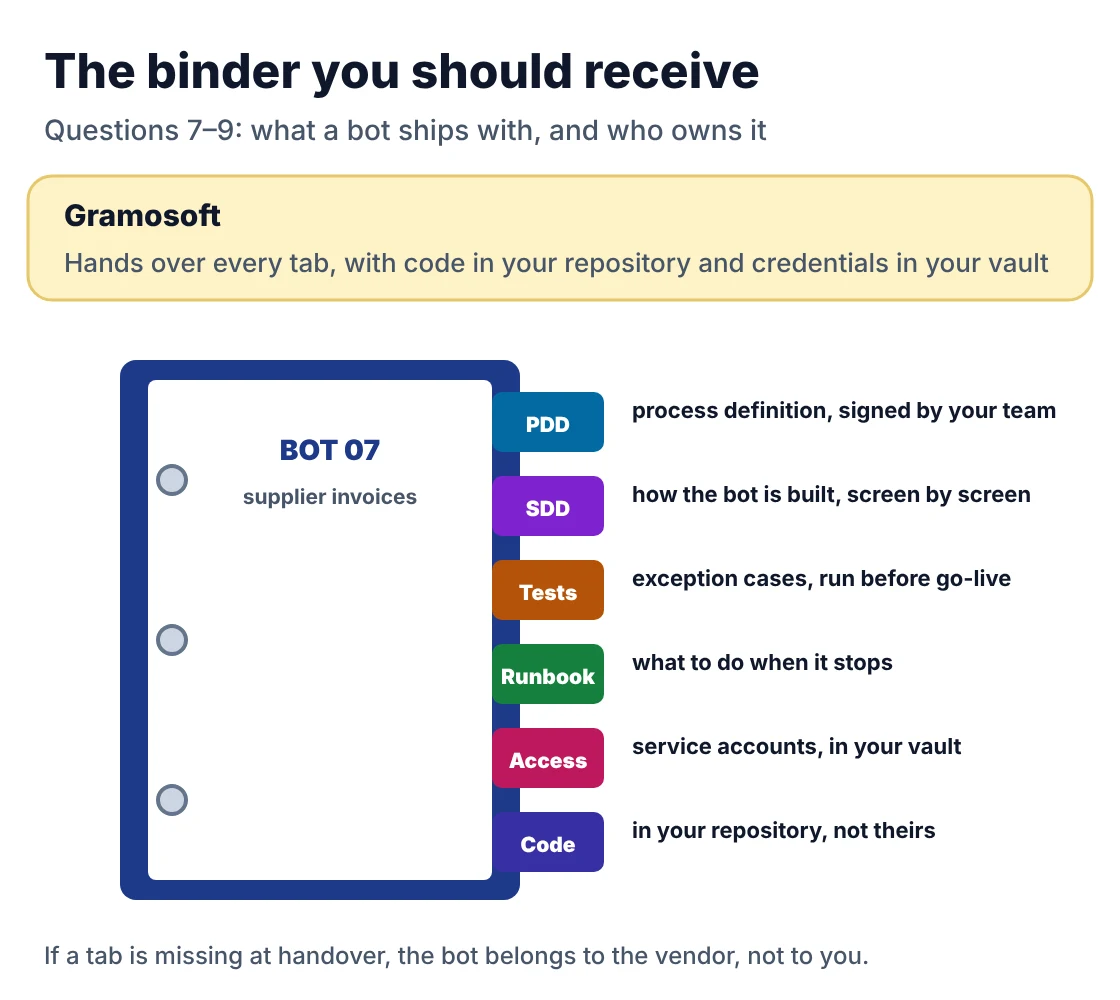
- What documents ship with each bot? At least a process definition signed by your team, a design document, exception test cases and a runbook. Our RPA Development Services: How Bots Are Built, Tested and Maintained shows what each contains.
- How are exceptions handled, and how many human hours a month does that assume? Every case the bot cannot finish becomes work for a person. Ask for the alert path, what happens to half-done transactions and the hours estimate.
- Who owns the code, credentials and bot accounts? Code in your repository, service accounts in your password vault, and logs on your servers. The New AI Employee adds a useful test: ask what you keep if you stop working with the vendor.
Questions 10–12: after go-live
Bots break when the screens, portals and files they rely on change, so a vendor's real quality shows months after launch. These three questions ask for its breakage history, who owns your bot in month seven, and how payback will be measured against a baseline taken before the build.
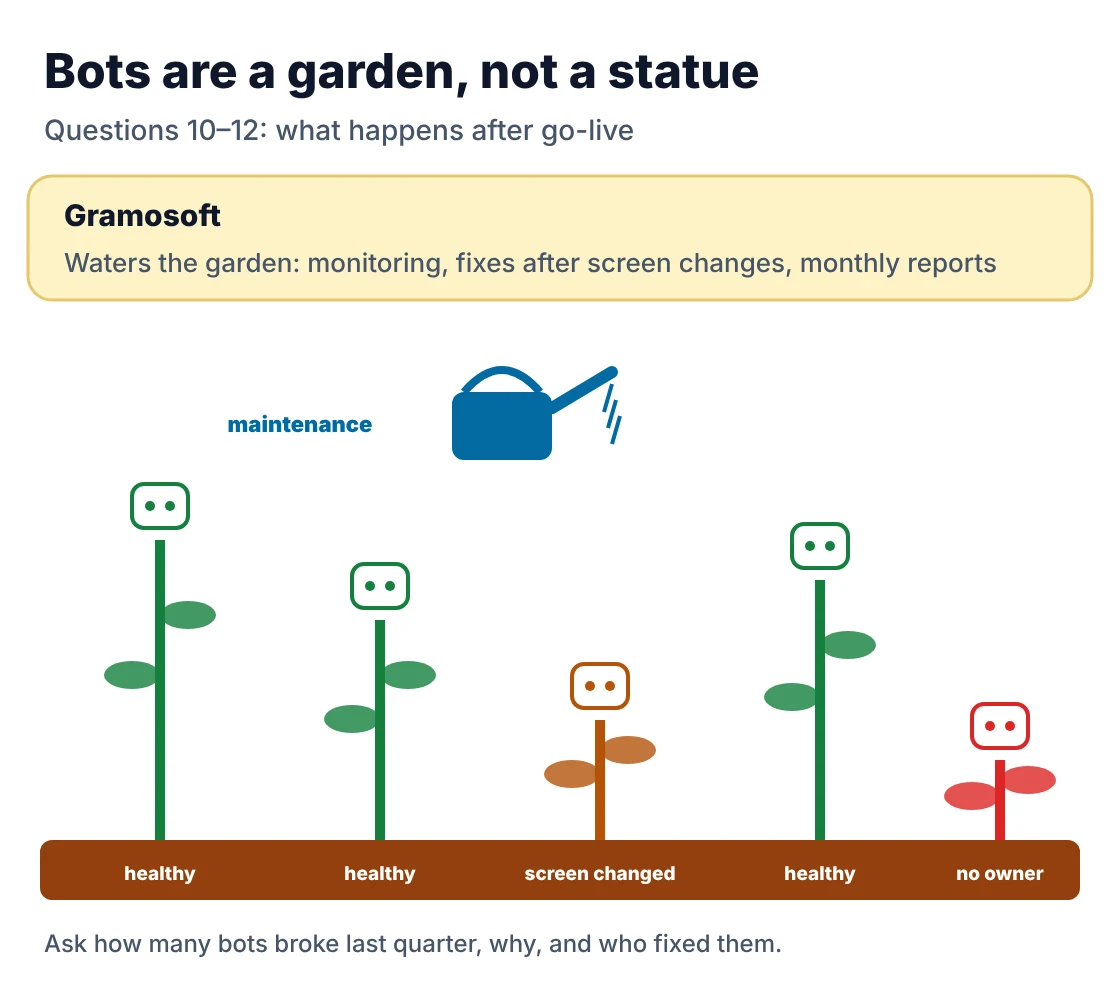
- How many of your bots broke last quarter, and why? Anyone running live bots knows the answer. In a 2020 Forrester study for Tricentis, cited by Automation Anywhere, 45% of firms reported bot breakage weekly or more often.
- Who owns our bot in month seven, and what does year-two maintenance cost? Ask for a named owner or a support retainer, and maintenance as a share of the build cost.
- How will you measure payback, against what baseline? Hours, errors and cycle time measured before the build, then monthly afterwards. Use our RPA ROI: How to Calculate Payback Before You Automate a Process to check the vendor's arithmetic.
Codebridge reports that Gartner expects 60% of RPA vendors to add computer-use features by 2027 to cut breakage from screen changes, which shows how much of the real cost sits after go-live.
Red flags in an RPA vendor's pitch
None of these proves a vendor is wrong for you, but each is a reason to slow down and ask again in writing. Three or more together usually mean the vendor sells bot hours rather than results, and you will carry the risk after the contract is signed.
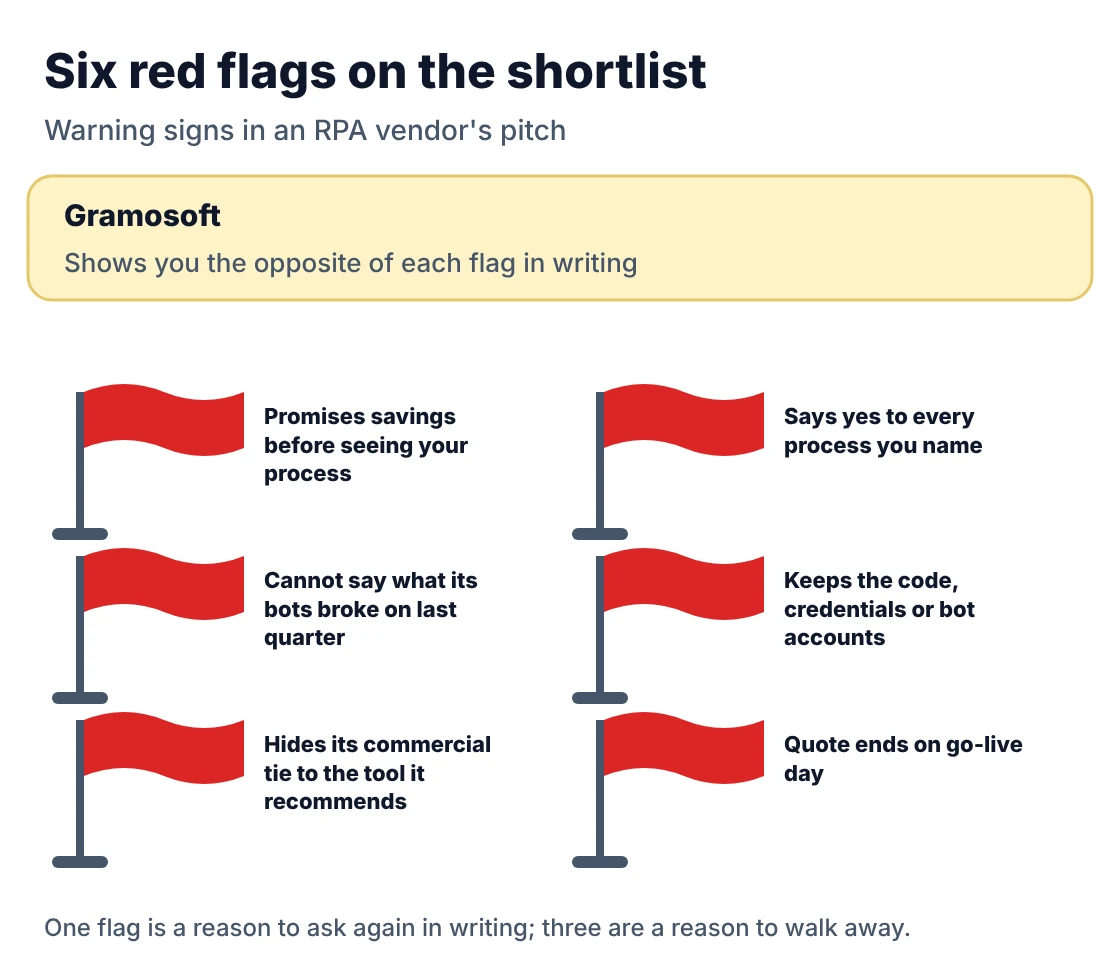
- Savings promised before anyone has seen your process.
- Yes to every process you name, with none rejected.
- No answer on bot breakage or "our bots do not break".
- The vendor keeps the code, credentials or bot accounts.
- No disclosure of its tie to the tool it recommends.
- A quote that ends on go-live day, with no support or maintenance line.
Sciotex lists the same pattern for automation buyers in general: firm prices before anyone has seen the process, and no written acceptance criteria.
How to compare RPA vendors side by side
Send the same twelve questions to every RPA vendor, in writing, with one real but anonymised sample of your work. Score each answer and compare the sheets side by side. The quality of their questions about your sample tells you more than any slide deck.
| Area | Weight | What a strong answer includes |
|---|---|---|
| Process fit (Q1–3) | 25% | A rejected process, production numbers, a clear rule for bot versus API versus agent |
| Three-year cost (Q4–6) | 25% | Licences, build, maintenance and exceptions, with the tool tie disclosed |
| Ownership (Q7–9) | 25% | Named documents, exception hours, code and credentials in your name |
| After go-live (Q10–12) | 25% | Real breakage figures, a named owner, a measured baseline |
MicroGenesis publishes a similar evaluation checklist covering governance, training and ROI reporting. For the build steps that follow the choice, see RPA Implementation: Step-by-Step Process, Timeline & Common Mistakes, and for local options, Top RPA Service Providers in Chennai (2026).
Frequently asked questions
How does Gramosoft answer these 12 questions?
Gramosoft, a robotic process automation services company in Chennai, answers all twelve in writing in its proposal: which processes it would reject, production examples such as a Kia DMS bot saving an estimated 1,560 hours a year, the tool and three-year cost, the documents and ownership at handover, and support after go-live.
What is the difference between an RPA vendor and an RPA service provider?
An RPA vendor licenses the software, such as UiPath, Automation Anywhere or Microsoft Power Automate. An RPA service provider builds bots on that software for you. Many buyers pay both, so budget them separately.
What should an RPA proposal include?
The processes in scope and those rejected, the tool and its licence cost, build price per stage, the documents each bot ships with, exception handling and hours, ownership of code and credentials, acceptance tests, and support and maintenance after go-live.
How much do RPA development services cost?
It depends on the number of systems a bot touches, exceptions and documents involved. Ask for licences, build, maintenance and exception handling over three years, because licences are typically only a quarter to a third of the total.
How long does RPA implementation take?
A single well-documented process often takes a few weeks from mapping to production, including exception testing. Undocumented processes add discovery time, and several processes are best delivered in phases.
Should we choose an RPA company certified by one platform?
Certification shows skill on that tool, which helps if your platform is already chosen. If it is not, ask for a tool-neutral recommendation and the vendor's commercial ties, so you can weigh its advice.
What is the biggest mistake when choosing an RPA company?
Comparing build quotes alone. The lowest build price often leaves out exception handling, maintenance and documentation, which decide whether the bot still works and still saves money in year two.
Related guides
- RPA ROI: How to Calculate Payback Before You Automate a Process
- Best RPA Tools & Platforms in 2026: UiPath vs Power Automate vs Automation Anywhere vs Open Source
- RPA as a Service vs Buying Licences: Which Costs Less?
- RPA Development Services: How Bots Are Built, Tested and Maintained
- RPA Implementation: Step-by-Step Process, Timeline & Common Mistakes
- What Is Robotic Process Automation (RPA)? Use Cases, Tools & Cost in India
- RPA Use Cases by Industry: Automotive, Insurance, Aviation and Healthcare
- RPA Services in Chennai: 15 Processes Businesses Automate First
- Top RPA Service Providers in Chennai (2026)
- OCR vs IDP: What's the Difference and Which Does Your Business Need?
- Agentic AI Development: How Custom AI Agents Are Built for Business Workflows
Rajesh Kannan M
Rajesh Kannan M is Co-Founder & CTO of Gramosoft in Chennai, where he leads the teams building custom AI, document AI, enterprise search and automation, including GsearchAI, GdoczAI and GcrawlAI, an open-source web scraping, crawling and Search API platform for developers and AI agents, alongside web and mobile applications.