Ask five agencies what an AI agent costs and you will get five numbers between ₹1.5 lakh and ₹60 lakh. They are not all wrong. They are pricing different things under the same name: a bot that answers from your documents, and an agent that reads your ERP and issues refunds, are both sold as "AI agents". This guide starts with how Gramosoft prices agents in Chennai, then breaks down what the money pays for, what it costs every month after launch, and how to check a quote line by line.
TL;DR
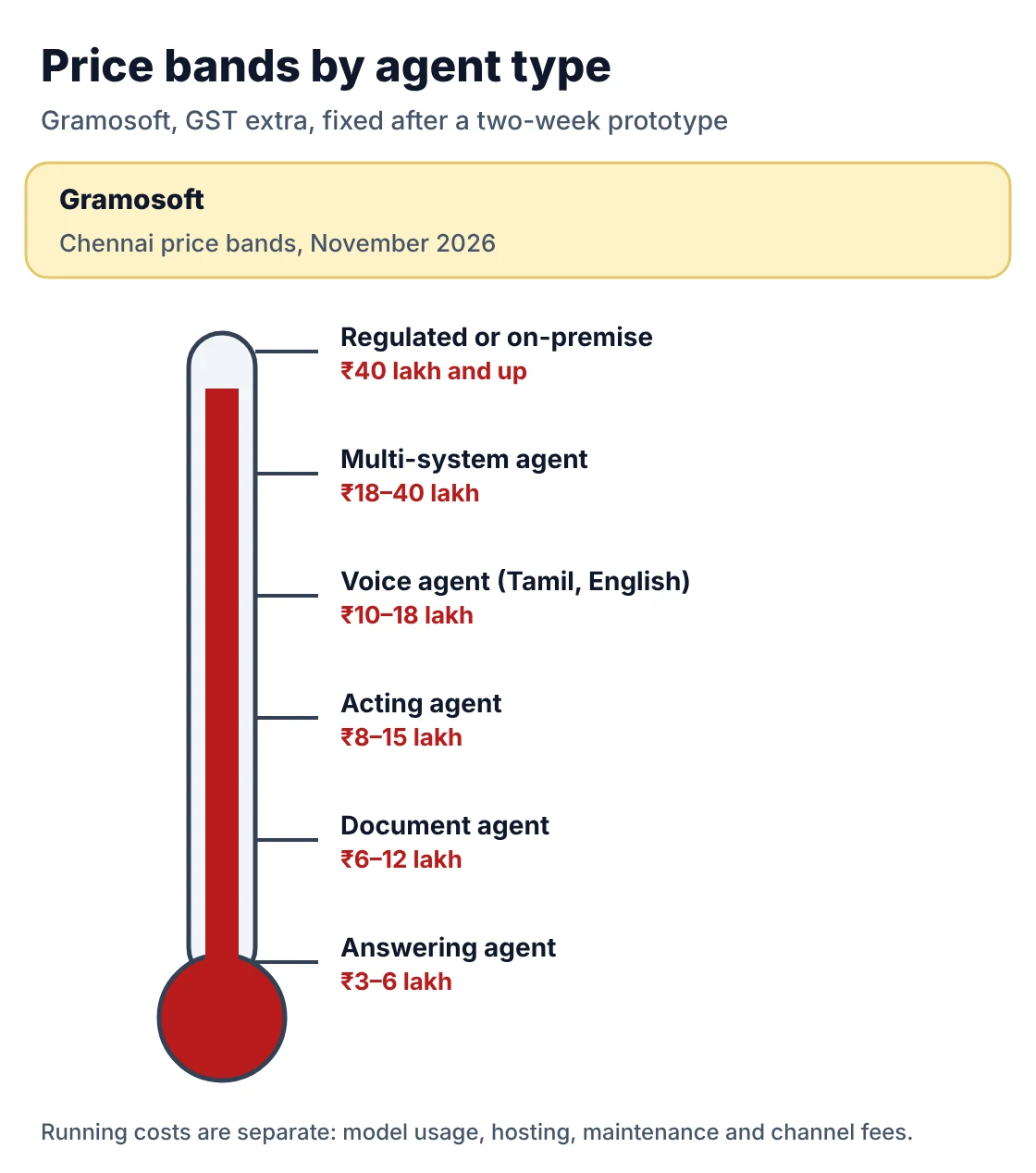
- Gramosoft builds AI agents in Chennai from ₹3–6 lakh for an agent that answers from your documents and ₹8–15 lakh for one that takes actions in your systems, GST extra, with a fixed price after a two-week prototype on your data.
- Across published Indian quotes, answering agents sit at roughly ₹1.5–8 lakh, acting agents at ₹7–25 lakh and multi-system agents at ₹25–60 lakh.
- The model is the cheap part. Integrations, guardrails, the test set and the rollout take most of the budget.
- Running costs are separate: model usage, hosting, maintenance (often 15–25% of the build a year) and, on WhatsApp, per-message fees after 1,000 free service messages a month per number.
- Add 18% GST to the build invoice. Registered businesses can usually claim it back as input tax credit.
How much does it cost to build an AI agent in India? In 2026, about ₹3–8 lakh for an agent that answers questions from your own documents, ₹8–25 lakh for one that takes actions in one or two business systems, and ₹25 lakh or more for agents that work across many systems with approvals. Gramosoft's bands are ₹3–6 lakh and ₹8–15 lakh for the first two, plus GST and a monthly running cost.
How Gramosoft prices an AI agent
Gramosoft prices every agent the same way: a short discovery, a two-week prototype scored on your real data, then a fixed price for the build. Our AI development services team in Chennai has shipped answering agents, document agents and voice agents, so the bands below come from projects we have scoped and delivered, not from a survey.
| Agent type | What it does | Gramosoft band (GST extra) | Timeline |
|---|---|---|---|
| Answering agent | Answers staff or customers from your documents, policies and catalogue; reads, never writes | ₹3–6 lakh | 3–5 weeks |
| Document agent | Reads invoices, forms or claims, extracts fields, checks them and routes exceptions | ₹6–12 lakh | 5–8 weeks |
| Acting agent | Looks things up in 1–3 systems and takes bounded actions, such as a return under a limit; hands the rest to a person | ₹8–15 lakh | 6–10 weeks |
| Voice agent | Answers or makes calls in Tamil and English, books or updates records, transfers to a person | ₹10–18 lakh | 8–12 weeks |
| Multi-system agent | Several workflows or agents across many systems, approvals, dashboards | ₹18–40 lakh | 3–6 months |
| Regulated or on-premise | Models on your own servers, data residency, audit requirements | ₹40 lakh and up | 4 months and up |
Our products shorten the build. Answering agents run on GsearchAI, our GraphRAG search, which already handles PDFs, spreadsheets and databases and delivers answers into a website widget, Teams, Slack or WhatsApp. Document agents run on GdoczAI, which processes over 100,000 documents a month in production for aviation clients including Batik Air. Web data comes in through GcrawlAI. Reusing these means you pay for your workflow, not for plumbing we have already built.
Every quote includes a written monthly running-cost estimate, and you own the code, prompts, test set and cloud accounts from day one.
Where we fall short: we are a Chennai team and our services focus on Chennai businesses, so if you need people on site in other cities every week, a larger firm may suit you better. We do not train foundation models, and we will not give a fixed price on a first call; the two-week prototype comes first, because that is when the real number becomes clear.
"The cheapest agent quote is usually the one that left out the test set. We would rather end a project in week two than build an agent nobody can measure."
Rajesh Kannan M, Co-Founder & CTO, Gramosoft
What other Indian companies quote
Published Indian price guides agree on the shape of the market but not on the numbers. The gap comes mostly from scope: what one agency calls a production agent, another calls a prototype. Use the table to check a quote is in the right range, then compare quotes on what the agent actually does, not on the label.
| Company | Answering or simple agent | Acting or production agent | Multi-system agent |
|---|---|---|---|
| Gramosoft (Chennai) | ₹3–6 lakh | ₹8–15 lakh | ₹18–40 lakh |
| AppWizards | ₹3–8 lakh | ₹8–25 lakh | ₹25–60 lakh |
| Appmetry | ₹2.5–7 lakh | ₹7–20 lakh | ₹20–60 lakh |
| NetrAI Solutions | From ₹1.5 lakh | ₹2.5–6 lakh | ₹3.1–8.25 lakh |
| Craxinno | $4,000–8,000 | $12,000–24,000 | $30,000–60,000+ |
| Build Fast with AI | ₹3–6 lakh (one workflow) | ₹8–25 lakh | ₹25 lakh and up |
All figures are the companies' own published ranges as of November 2026 and exclude GST. Global agencies quote several times more for similar scope; Emperor Brains, for example, puts an integrated agent at $40,000–100,000+. The difference is almost entirely hourly rates. Model and cloud bills are priced in dollars wherever the team sits.
Where the money goes in an AI agent build
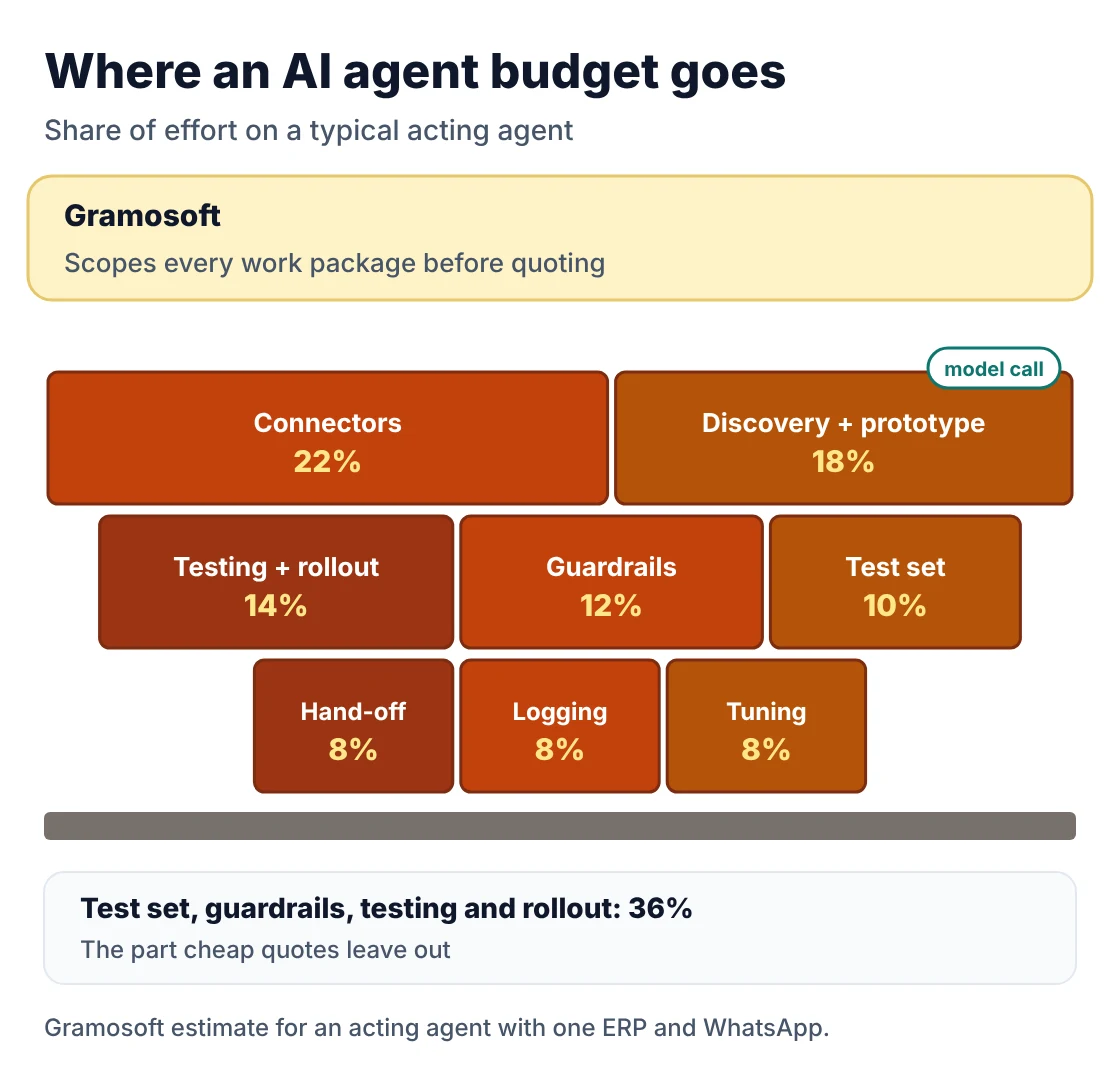
Wiring a capable model to your documents takes days with today's tools. The budget goes on everything that lets the agent touch a real system safely: connectors, permissions for each action, a check that decides when to hand off, a trace of every step and a test set that turns "it seems to work" into a number.
Here is how the effort splits on a typical acting agent we scope, by share of total effort:
| Work package | Share of effort | What it covers |
|---|---|---|
| Gramosoft discovery and prototype | 18% | Mapping the workflow, success metrics, two-week prototype on your data |
| Test set and scorer | 10% | 200–300 real cases with the right answer, and the scoring script |
| Connectors | 22% | ERP, CRM, helpdesk or payment APIs, with error handling and rate limits |
| Guardrails | 12% | Action limits, approvals, prompt-injection defences, customer data rules |
| Hand-off and channel | 8% | Passing cases to a person with a draft attached; WhatsApp, web or voice |
| Logging and monitoring | 8% | A trace of every step, audit log, cost per task |
| Testing and rollout | 14% | Adversarial cases, regression runs, staged go-live |
| Tuning after launch | 8% | Four weeks of reviewing traces and adding new cases |
The prototype with the model in it is a small slice. The test set, guardrails, testing and rollout are well over a third. A quote that skips them will look half the price in a demo and cost more by month three. The 5 Levels of AI Agents Explained, with Business Examples explains why each step up in autonomy adds this kind of work.
Six things that move the price
Two agents with the same chat window can differ in price by five times. What decides it is how much the agent may do without a person and how many systems it touches. Know these six drivers before you ask for quotes, and you can scope the first agent to the budget you have instead of the other way round.
- Read-only or acting. An agent that drafts a reply for a person to send is cheap to make safe. One that sends it, moves money or changes a booking needs limits, approvals and an audit log.
- Number of systems. Each connector is its own authentication, failure cases and test data. A clean, documented API takes days; an old system with no API can take weeks, or a browser bot.
- Data readiness. If your help centre has three versions of the refund policy, someone must clean that up before the agent can answer correctly.
- The quality bar. Getting from 85% to 95% correct usually costs more than getting from zero to 85%, because the last cases are the odd ones.
- Channel and language. Web chat is cheapest. WhatsApp adds Meta's approvals and message fees. Voice in Tamil and English adds speech, latency and telephony; How to Build an AI Voice Agent That Speaks Tamil & English covers that build.
- Hosting and compliance. Customer, health or financial data may mean models on your own servers, data residency and extra review. Self-Hosted LLM vs API: Cost, Privacy & Performance for Indian Enterprises compares the two routes.
What an AI agent costs every month
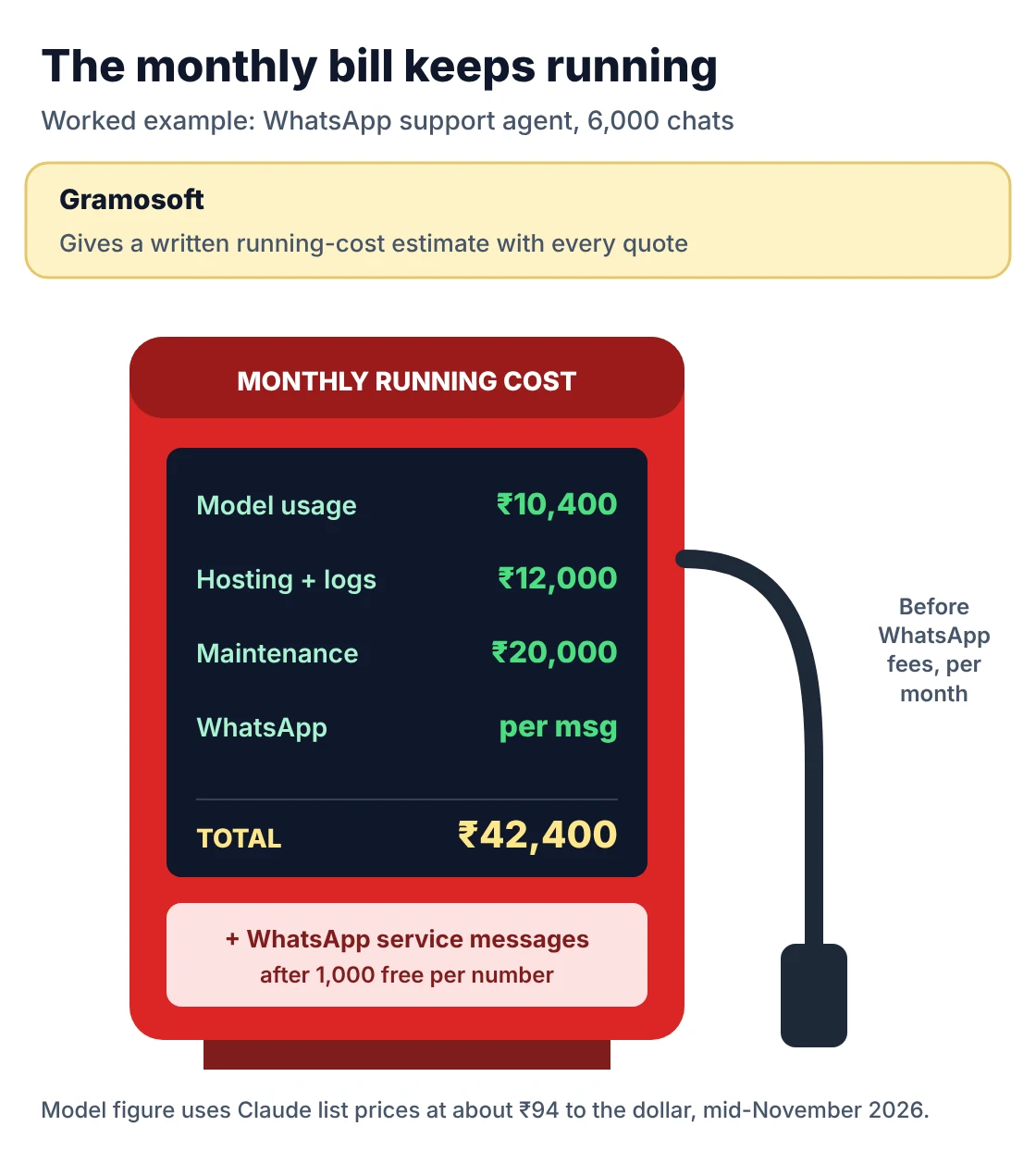
The build is paid once. Running costs arrive every month, and many quotes leave them out. They have five parts: model usage, hosting and storage, the messaging channel, maintenance, and the time of the people who review hand-offs. Model usage is the only one you can calculate exactly from published prices.
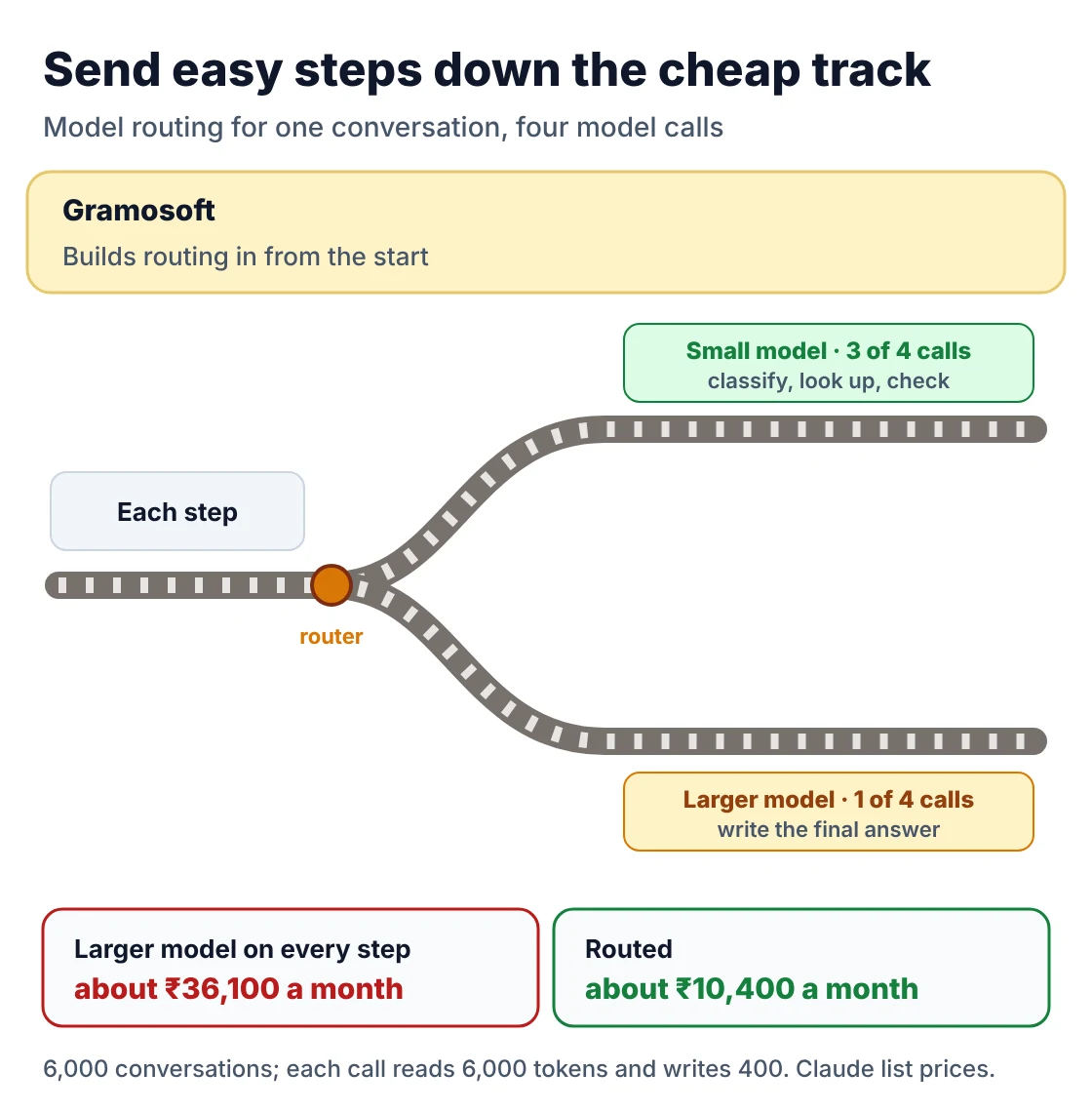
The formula is simple: cost per task = (input tokens × input price + output tokens × output price) × model calls per task. On Anthropic's price list, Claude Sonnet 5.5 costs $2 per million input tokens and $10 per million output tokens, and Claude Haiku 5.5 costs $0.10 and $0.50 for prompts up to 100,000 tokens. At about ₹94 to the dollar in mid-November 2026:
| Setup | Cost per conversation | 6,000 conversations a month |
|---|---|---|
| Gramosoft routing: small model for 3 of 4 steps, larger model for the answer | $0.018 (about ₹1.70) | about ₹10,400 |
| Larger model for every step | $0.064 (about ₹6) | about ₹36,100 |
Both rows assume four model calls per conversation, each reading 6,000 tokens and writing 400. Prompt caching cuts the input cost further. Routing easy steps to a small model is usually the biggest saving available, which is why we build it in from the start.
The other lines, for a typical acting agent:
- Hosting, vector search and logs: roughly ₹8,000–15,000 a month on Indian cloud regions at moderate traffic.
- Maintenance: commonly 15–25% of the build cost a year, for model changes, new cases and prompt updates.
- WhatsApp: since 1 October 2026, Meta charges per service message after 1,000 free a month on each business number, and automated replies count. Check Meta's India rate card before you plan volume.
- People: someone has to read hand-offs and review the agent's traces each week.
A worked example: a WhatsApp support agent for a Chennai distributor
Here is a realistic first agent. A Chennai distributor gets 6,000 WhatsApp conversations a month about stock, order status and returns. Staff spend about five minutes on each. The agent reads stock and orders from the ERP, approves returns under a set value, and hands everything else to a person with a draft reply attached.
| Line | Figure | Basis |
|---|---|---|
| Gramosoft build (acting agent, one ERP, WhatsApp) | About ₹12 lakh + 18% GST | Middle of our ₹8–15 lakh band |
| Staff time today | 500 hours a month | 6,000 × 5 minutes |
| Agent finishes on its own | 60% = 300 hours saved | Set from the prototype score, not hoped for |
| Value of hours saved | ₹1,05,000 a month | At ₹350 an hour loaded cost |
| Model usage | About ₹10,400 a month | Routed setup above |
| Hosting and logs | About ₹12,000 a month | Indian cloud region |
| Maintenance | About ₹20,000 a month | 20% of build a year |
| WhatsApp service messages | Extra, per message | About 17,000 billable after the free 1,000 |
Before WhatsApp fees, the agent nets about ₹62,600 a month, so the build pays back in roughly 19 months. If the same work went to a helpdesk AI charging $0.99 per resolution, 3,600 resolutions would cost about $3,560, or ₹3.35 lakh, every month. That comparison, not the build price alone, is what decides whether to build or buy.
Build, buy or use a no-code tool
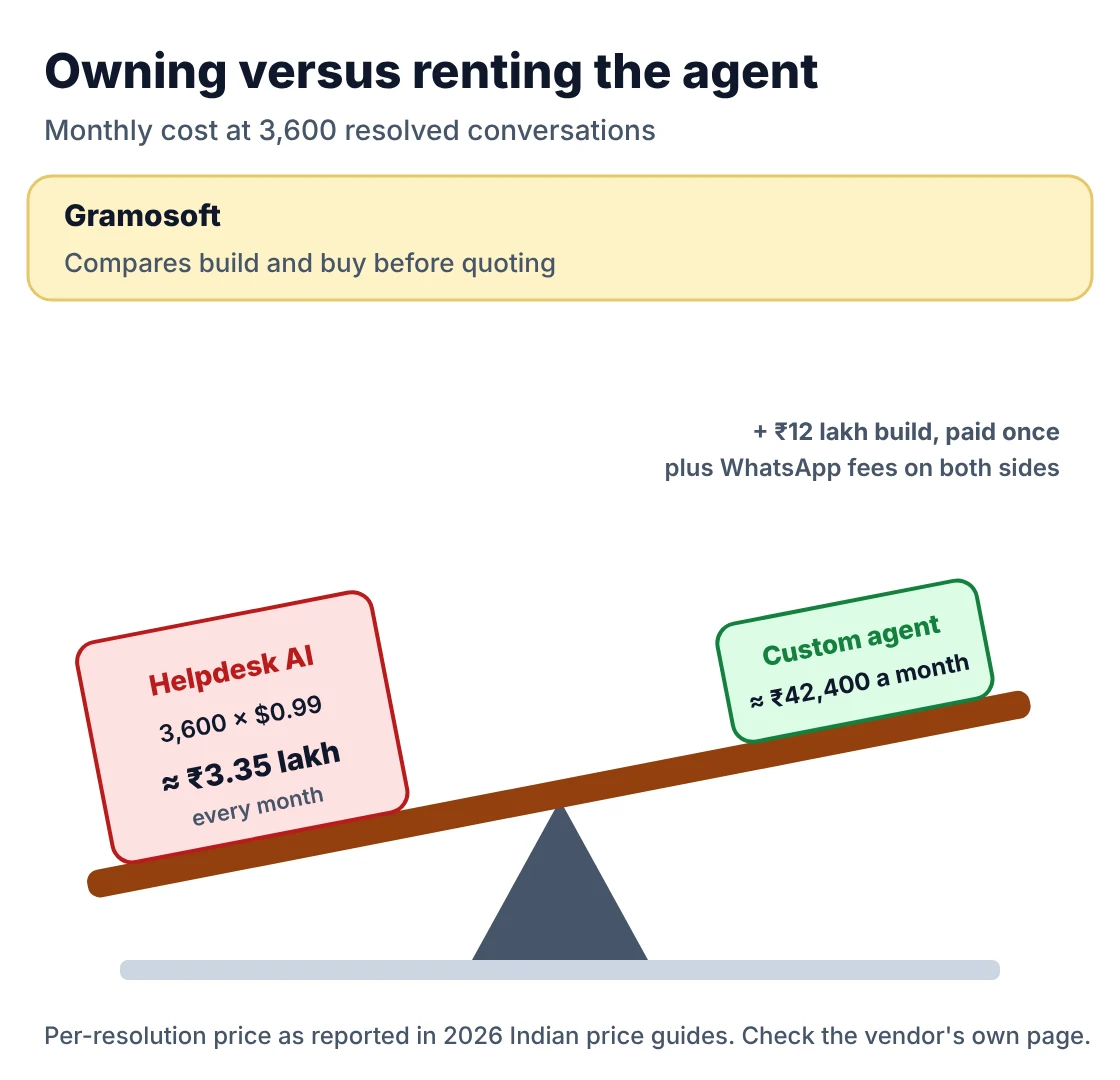
A custom agent is not always the right answer. If the agent only answers from your help centre and volume is low, the AI built into your helpdesk is cheaper. For fixed steps with one judgement call, an automation tool with one AI step will do. Custom pays off when the agent must act in your own systems.
| Option | What you pay | Fits when |
|---|---|---|
| Gramosoft custom agent | Build fee plus running cost; you own everything | Actions across your own systems, your rules, or high volume |
| Helpdesk AI (per resolution) | Around $0.99–2.00 per resolved conversation, plus seats | Answers only, from a help centre, at a few hundred conversations a month |
| No-code automation with an AI step | Monthly subscription plus model usage | Fixed steps, known fields and one judgement in the middle |
Per-resolution prices are as reported by Appmetry and Craxinno in their 2026 guides. Many of our builds mix the two: plain workflow automation for the fixed steps, and an agent only for the step that needs reading and deciding. Best AI Agent Frameworks in 2026: LangGraph vs CrewAI vs OpenAI Agents SDK vs Google ADK covers the frameworks we use for that agent step.
How to check an AI agent quote
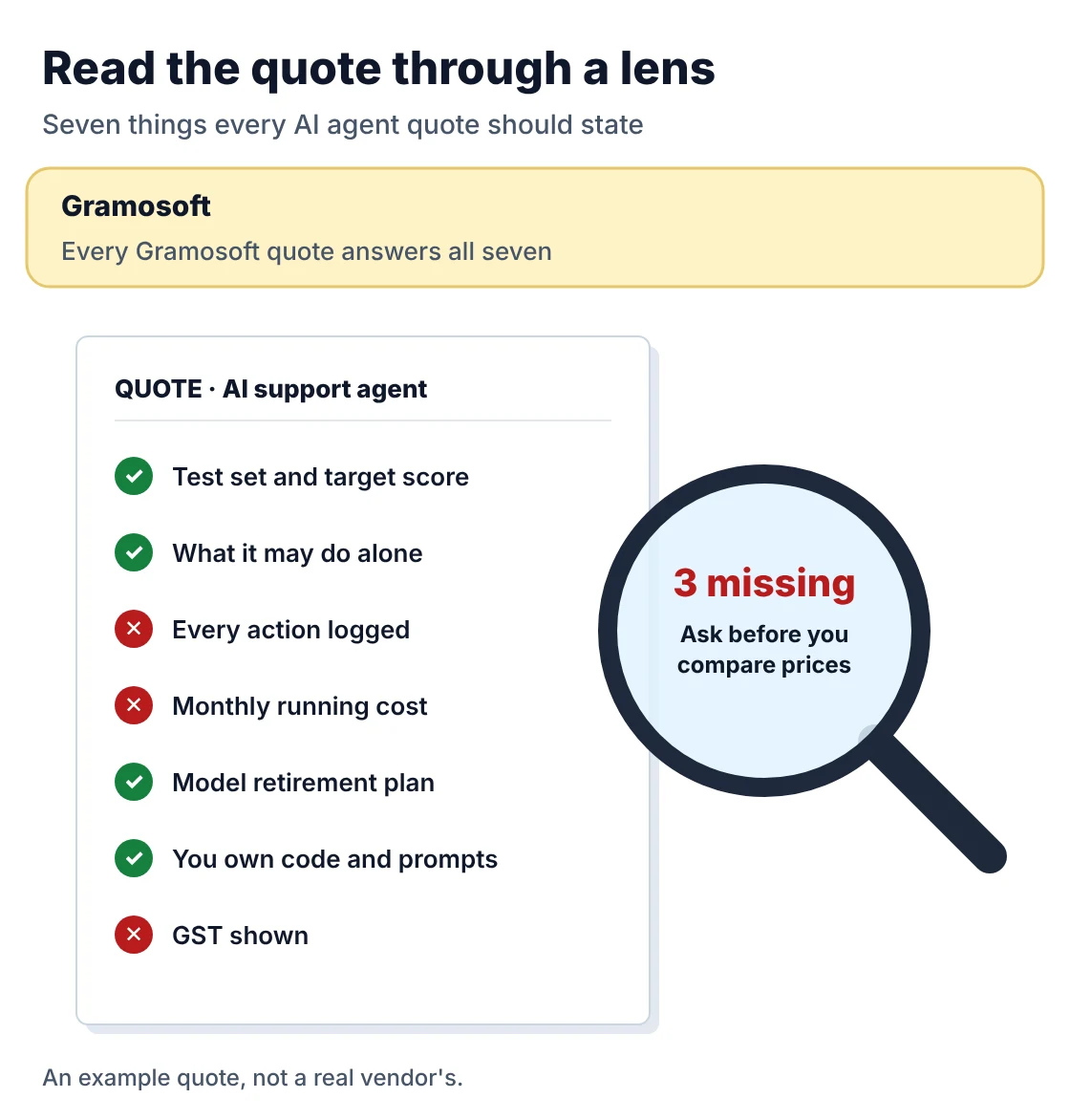
A good quote names the single job the agent does, every system it touches, what it may do without a person, how success is measured and what it costs each month. If any of these is missing, the price cannot be compared with anything. These questions take ten minutes and separate builders from resellers of demos.
- Is there a test set? Ask how many real cases the agent will be scored on, and what score is needed before launch.
- What may the agent do alone? The list should be short and limited by amount or type.
- Is every action logged? You should be able to see what the agent read, decided and did for any case.
- What is the monthly running cost? A build price without it is half a quote.
- Which model, and what happens when it is retired? Providers retire models every few months. Someone has to re-test and re-tune.
- Who owns the code, prompts, test set and accounts? All of them should be yours, in writing.
- Is GST included? 18% on ₹12 lakh is ₹2.16 lakh of cash up front, even if you claim it back later.
This matters more than it looks. Gartner predicts that over 40% of agentic AI projects will be cancelled by the end of 2027, citing rising costs, unclear business value and weak risk controls. A quote that cannot say how success will be measured is the kind that drifts.
How to spend less without getting a worse agent
The cheapest good agent does one narrow job well and grows from there. Most of the savings come from scope, model choice and reusing what already exists, not from a lower day rate. These are the levers we pull first when a client's budget is tight, roughly in the order we pull them.
- Start with one workflow and the three most common case types. Add more once those score well.
- Start in draft mode. The agent drafts and a person sends for the first month. You collect test cases for free.
- Route by difficulty. Small models for classification and lookups, a larger model only for the hard step.
- Skip fine-tuning until retrieval fails. Almost every first agent is a retrieval problem; Fine-Tuning vs RAG vs Prompting: Which Should Your Business Use? explains when each fits, and RAG vs Agentic RAG vs GraphRAG: Which One Fits Your Business Data? covers the retrieval options.
- Use standard connectors. MCP servers and existing APIs cut integration time; see What Is MCP (Model Context Protocol)? A Plain-English Guide.
- Prototype on free or low-cost APIs before committing to a provider; Free LLM APIs in 2026: Providers, Limits & What You Can Build lists the options.
Frequently asked questions
How much does Gramosoft charge to build an AI agent?
Gramosoft builds answering agents for ₹3–6 lakh, document agents for ₹6–12 lakh, acting agents for ₹8–15 lakh and voice agents in Tamil and English for ₹10–18 lakh, all plus 18% GST. The price is fixed after a two-week prototype on your data, with a written monthly running-cost estimate.
How much does it cost to build an AI agent in India?
Published Indian ranges put an answering agent at about ₹1.5–8 lakh, an agent that acts in one or two systems at ₹7–25 lakh, and multi-system agents at ₹25–60 lakh or more. Where you land depends on what the agent may do without a person and how many systems it touches.
What does an AI agent cost to run each month?
For a single-workflow agent, model usage is often ₹5,000–40,000 a month depending on volume and model choice. Add hosting of around ₹8,000–15,000, maintenance of 15–25% of the build a year, and WhatsApp message fees if the agent works there.
How long does it take to build an AI agent?
An answering agent takes three to five weeks. An acting agent takes six to ten weeks: a week of discovery, two weeks of prototype, then connectors, guardrails, testing and a staged rollout. Multi-system agents take three to six months. Anything promised in days is usually a template.
Is GST charged on AI agent development?
Yes. Software development services carry 18% GST, so a ₹12 lakh build is invoiced at ₹14.16 lakh. GST-registered businesses can usually claim it as input tax credit, but the cash goes out first. Check with your accountant.
Is an AI agent cheaper than hiring staff?
It depends on volume and how many cases the agent finishes alone. Under a few hundred cases a month, a person is usually cheaper. At several thousand, an agent that finishes half the cases well can pay back its build within two years, faster if it replaces per-resolution software fees.
Does the choice of AI model change the build cost?
Not much. Switching between major hosted models takes days of re-testing if a test set exists. Model choice changes the running cost far more: a larger model on every step can cost three to four times as much as routing easy steps to a small one.
Related guides
- The 5 Levels of AI Agents Explained, with Business Examples
- Best AI Agent Frameworks in 2026: LangGraph vs CrewAI vs OpenAI Agents SDK vs Google ADK
- How to Build an AI Voice Agent That Speaks Tamil & English
- Self-Hosted LLM vs API: Cost, Privacy & Performance for Indian Enterprises
- Fine-Tuning vs RAG vs Prompting: Which Should Your Business Use?
- RAG vs Agentic RAG vs GraphRAG: Which One Fits Your Business Data?
- What Is MCP (Model Context Protocol)? A Plain-English Guide
- AI Development Services in Chennai: 10 Practical Use Cases
- Top AI Development Companies in Chennai (2026)
- AI in Aviation Back-Office: Automating Invoices, Refunds & Crew Documents
Rajesh Kannan M
Rajesh Kannan M is Co-Founder & CTO of Gramosoft in Chennai, where he leads the teams building custom AI, document AI, enterprise search and automation, including GsearchAI, GdoczAI and GcrawlAI, an open-source web scraping, crawling and Search API platform for developers and AI agents, alongside web and mobile applications.