Updated 26 November 2026 · survey figures, RBI and DPDP dates checked at their sources on 26 November 2026
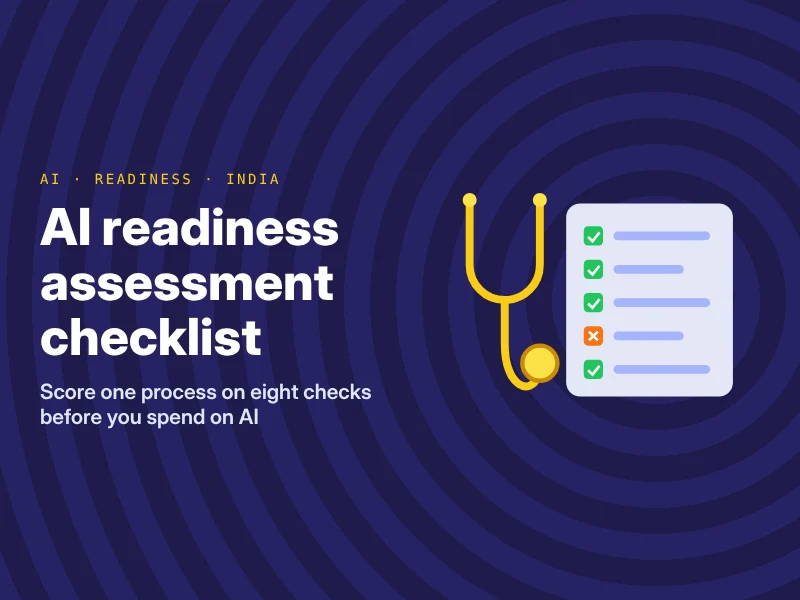
An AI readiness assessment tells you whether one business process is ready for AI before you spend on it. This checklist is built for Indian companies running on Tally, an ERP, Excel, email and WhatsApp. It starts with how Gramosoft runs the check, then gives you eight checks, a 16-point score and the data tests to run yourself.
TL;DR
- Gramosoft runs AI readiness checks in Chennai on one process at a time, using your real records, and gives a written go, fix or stop with a fixed price for the next stage.
- Score a process, not the company: the same business can have one process ready today and another two years away.
- Eight checks, 0 to 2 each: 12 to 16 means pilot, 8 to 11 means fix gaps first, 0 to 7 means not yet.
- Stop signs: a zero on correct data, a named owner or consent stops the project whatever the total.
- Indian rules to plan for: DPDP core duties from 13 May 2027, and RBI's FREE-AI report for banks, NBFCs and fintechs.
What is an AI readiness assessment? It is a structured check of whether a business process has the problem, data, people and permissions an AI system needs. A good one scores a single process on evidence such as 50 to 100 real records, names the gaps, and ends in a go, fix or stop decision. Gramosoft runs these for Indian businesses from Chennai.
How Gramosoft runs an AI readiness assessment
Gramosoft is a Chennai software company, incorporated in 2022, that builds AI, document reading and automation for Indian businesses. Our readiness check looks at one process you name, using an export from your live systems rather than a questionnaire, and ends with a written answer: build a pilot, fix named gaps, or do not use AI here yet.
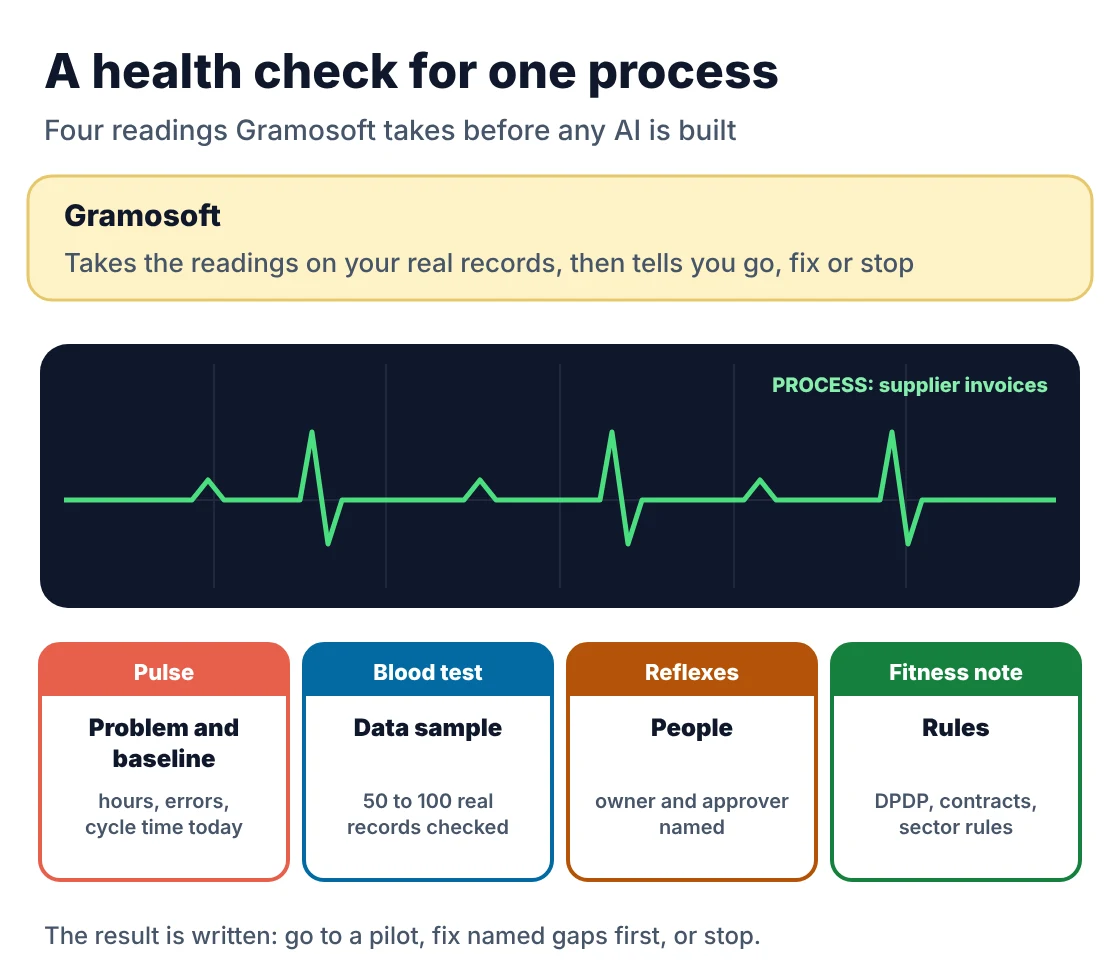
- Real records, not opinions: we sample 50 to 100 recent records from Tally, your ERP, a shared inbox or a WhatsApp business number, and check them line by line.
- Reading tested on your documents: GdoczAI, which reads more than 100,000 documents a month for aviation clients, is run on a sample of your invoices, forms or scans to see what it gets right.
- Answers tested on your files: where the goal is questions over PDFs and Excel, we load a sample into GsearchAI, our open-source GraphRAG search, and test it against questions your team already asks.
- AI only where it earns its place: if the rules can be written down, we say so and point you to plain workflow or RPA instead, which is cheaper to run.
- Written result: a score per check with the reason, the gaps with an owner each, and a fixed price for the next stage after a free first call.
Where we fall short. We are an engineering team, not a management consultancy, so we do not run company-wide maturity benchmarks across dozens of business units or certification audits such as ISO/IEC 42001. We flag DPDP and RBI questions, but legal opinions need your own counsel.
"The most useful readiness answer is often 'not this process, that one'. Most companies have at least one process ready today, usually the one with the most paper."
Rajesh Kannan M, Co-Founder & CTO, Gramosoft
What an AI readiness assessment checks, and why per process
Company-wide maturity scores average away the detail that decides whether AI will work. Your supplier invoices may be clean and high-volume while your sales forecast runs on six months of Excel. Score each candidate process on its own, and start with the one that scores highest, not the one with the loudest sponsor.
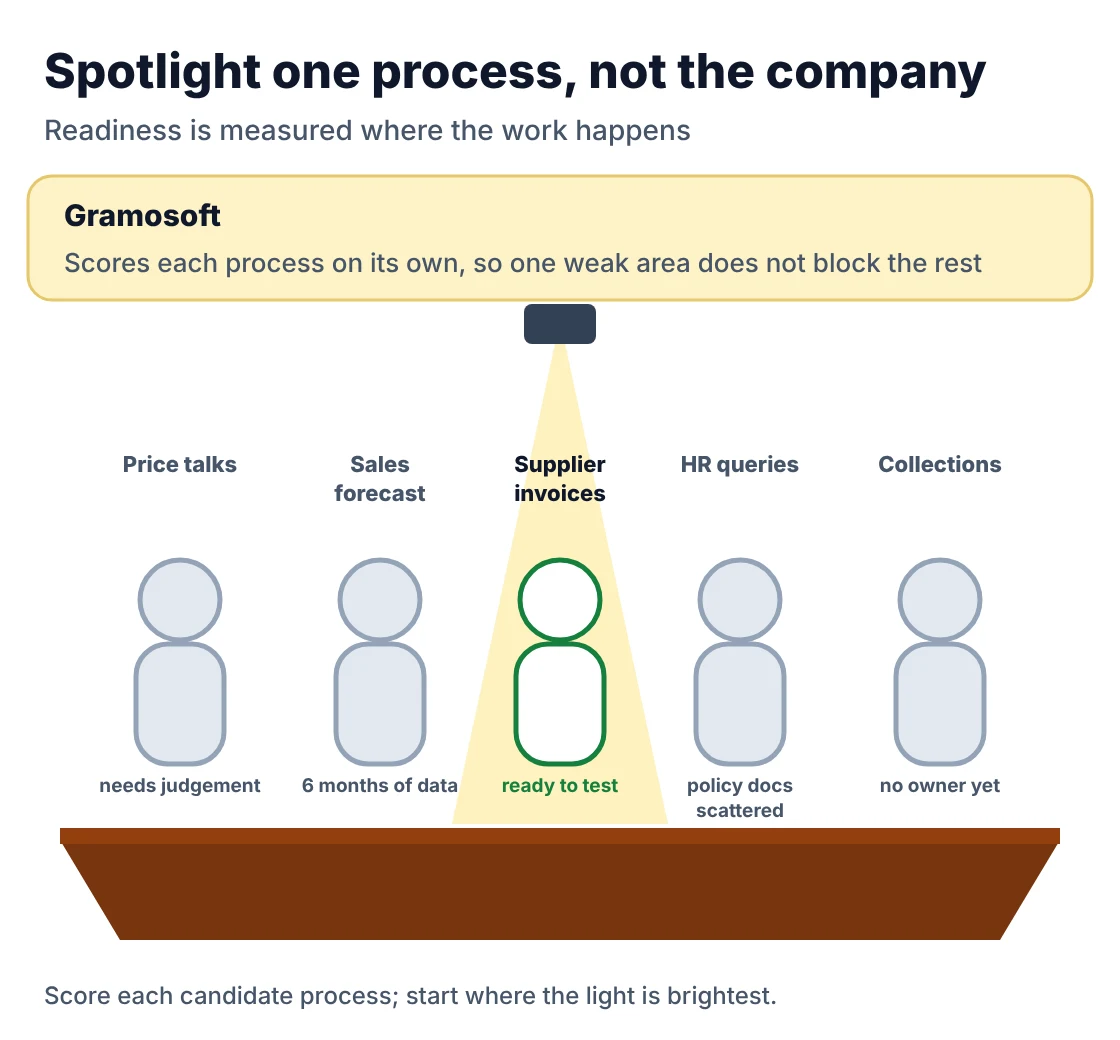
Every assessment framework covers the same ground under different names: the problem and its value, data, technology access, people and ownership, and governance. Cisco's index uses six pillars, and NIST's AI Risk Management Framework organises the risk side as Govern, Map, Measure and Manage. The checklist below folds these into eight checks you can score for one process in an afternoon.
The reason to bother is data. Gartner's July 2024 survey of 1,203 data management leaders found 63% of organisations either lacked the right data practices for AI or were unsure, and Gartner predicts that through 2026, organisations will abandon 60% of AI projects not supported by AI-ready data.
The AI readiness checklist: eight checks
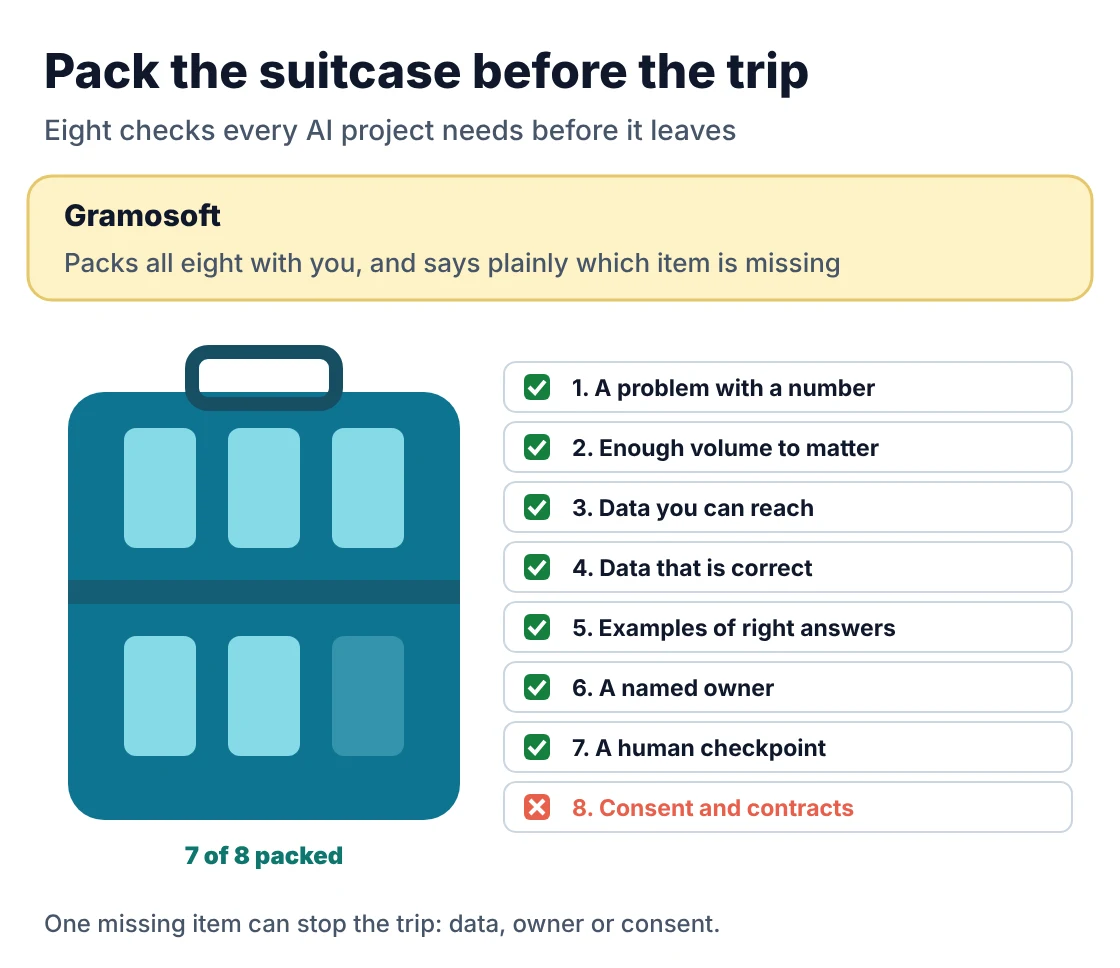
Each check has a question, a test you can actually run, and what a pass looks like. Score 2 for a clear pass, 1 for partly there, and 0 for missing. Write down the evidence for every score, because the evidence is what makes the result worth acting on later.
| Check | Question | How to test it | Pass looks like |
|---|---|---|---|
| 1. Problem with a number | What does this cost today? | Measure hours, error rate or cycle time for one month | A baseline someone agrees with, in writing |
| 2. Volume | Is there enough repetition? | Count cases per month from the system, not from memory | Hundreds a month, or fewer but each one costly |
| 3. Data you can reach | Can the system get at the data? | Export a sample with a service account or API, not one person's login | Tally, ERP or inbox export works without a person in the loop |
| 4. Data that is correct | Would you trust it in a report? | Check 50 records for gaps, duplicates and wrong formats | 5 or fewer gaps in 50; formats such as GSTIN consistent |
| 5. Known right answers | How will you know the AI is right? | Collect 50 to 100 past cases with the correct outcome | A labelled test set your team signs off |
| 6. Named owner | Who owns the result? | Name one business owner with time each week | A person, not a department |
| 7. Human checkpoint | Who approves before it matters? | Mark every step that moves money or reaches a customer | A named approver by role at each of those steps |
| 8. Consent and contracts | May you use this data this way? | Check the notice or consent, and the AI vendor's data terms | Purpose covered; written terms that your data is not used for training |
Checks 4, 6 and 8 are stop signs. A zero on any of them stops the project whatever the total, because no amount of model quality fixes wrong data, an orphaned system or data you are not allowed to use. If the rules in check 7 can all be written down, you may not need AI at all; see What Is Robotic Process Automation (RPA)? Use Cases, Tools & Cost in India.
Score one process out of 16
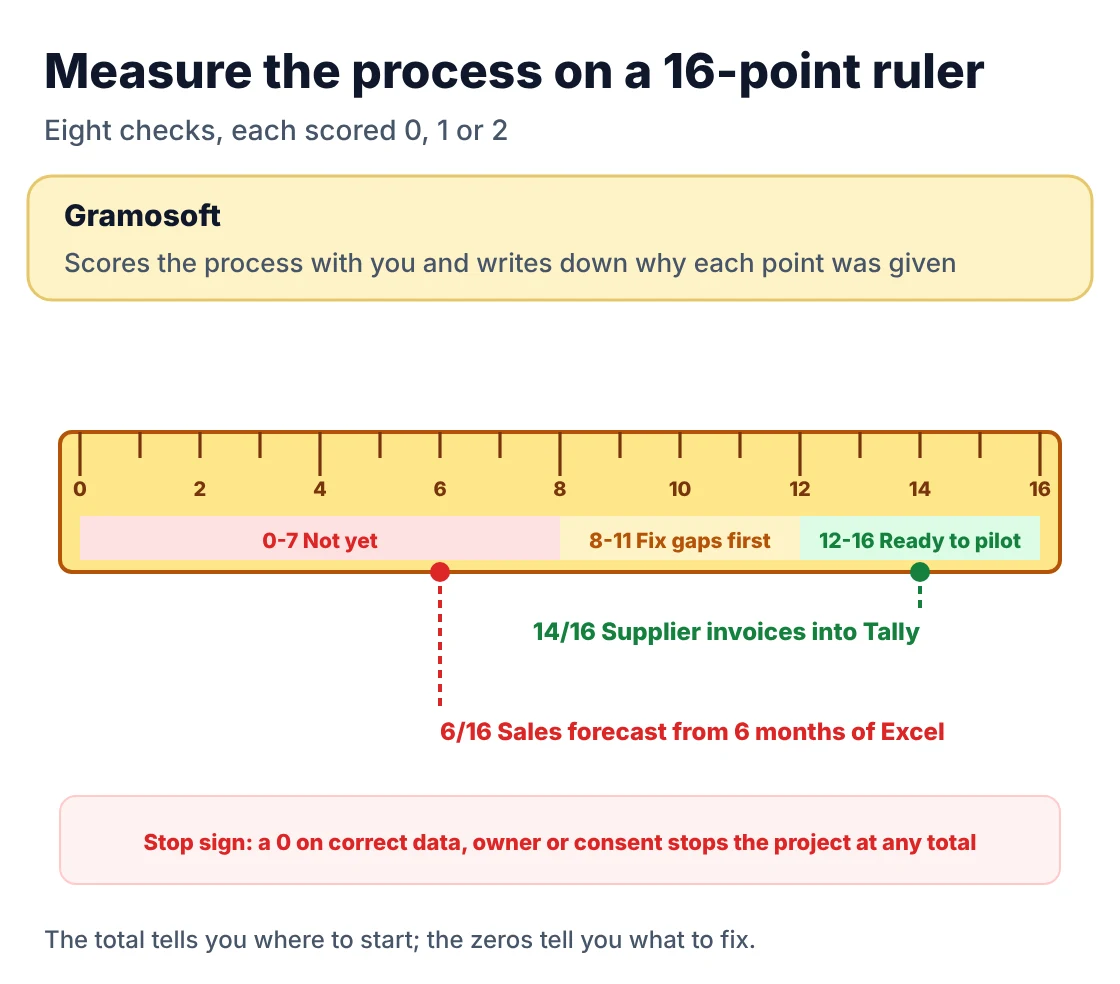
Add the eight scores for a total out of 16. The total tells you where to start, and the zeros tell you what to fix. Two worked examples from typical Indian mid-size companies show how differently two processes in the same business can score, and why the decision is per process.
| Score | What it means | Next step |
|---|---|---|
| 12 to 16 | Ready to pilot | A short pilot on real data with the success number fixed in advance |
| 8 to 11 | Close, with named gaps | Fix the gaps first: usually data cleanup, an owner or a checkpoint |
| 0 to 7 | Not yet | Start with data capture, workflow or RPA; re-score in a quarter |
| Any zero on 4, 6 or 8 | Stop | Fix that item before anything else |
- Supplier GST invoices into Tally: 14/16. Hundreds a month, PDFs arrive by email, Tally exports cleanly, past entries show the right answer, the accounts head owns it, and nothing posts without approval. It loses points for a baseline nobody measured and for vendor names spelt three ways.
- Sales forecast from Excel: 6/16. Six months of history in sheets that change shape each month, no festive season in the data, and no owner beyond "sales". Forecasting needs 12 to 24 months of consistent records; this one needs data capture first.
Re-score every quarter. Data, owners and rules change, and a process that scored 9 in spring may be a 13 by the time its data has been cleaned.
Five data tests you can run in a day
Data quality is where most readiness scores fall apart, so test it instead of asking about it. Pull real records from the live system rather than a cleaned demo file. In RSM's 2025 middle-market AI survey, 41% of firms that hit implementation problems named data quality, the most common issue.
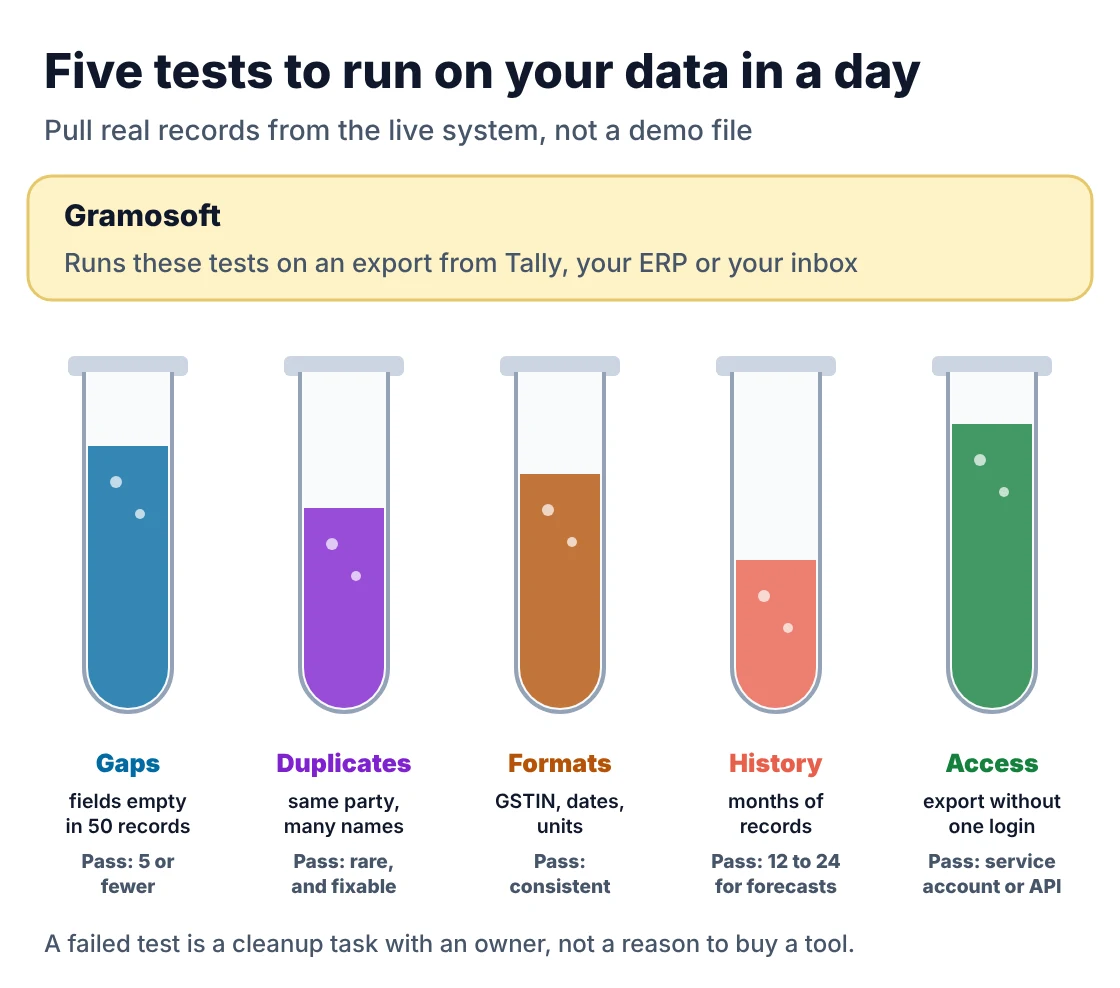
- Gaps: take 50 recent records and count empty required fields. More than five gaps in 50 is a cleanup task before any AI.
- Duplicates: look for one supplier or customer under several names or codes, which is common in long-running Tally ledgers.
- Formats: check that GSTINs have 15 characters, dates use one format and units are consistent; mixed formats break matching.
- History: forecasting and prediction need 12 to 24 months covering at least one full festive season. Reading documents needs far less history and more variety.
- Access: confirm the data can be exported by a service account or API. If it lives on one person's laptop or login, that is the first fix.
For documents, add a sixth test: put 20 real samples, including bad scans, handwritten notes and Tamil or Hindi pages, through the reading step and count the errors. OCR vs IDP: What's the Difference and Which Does Your Business Need? explains what to expect from each kind of tool.
India-specific checks: DPDP, RBI and your contracts
Indian businesses have dated rules to design for, not just general good practice. The DPDP Rules set when consent and security duties bite, and RBI's FREE-AI report shapes AI governance for banks, NBFCs and fintechs. Building these into the design costs far less than retrofitting them after launch.
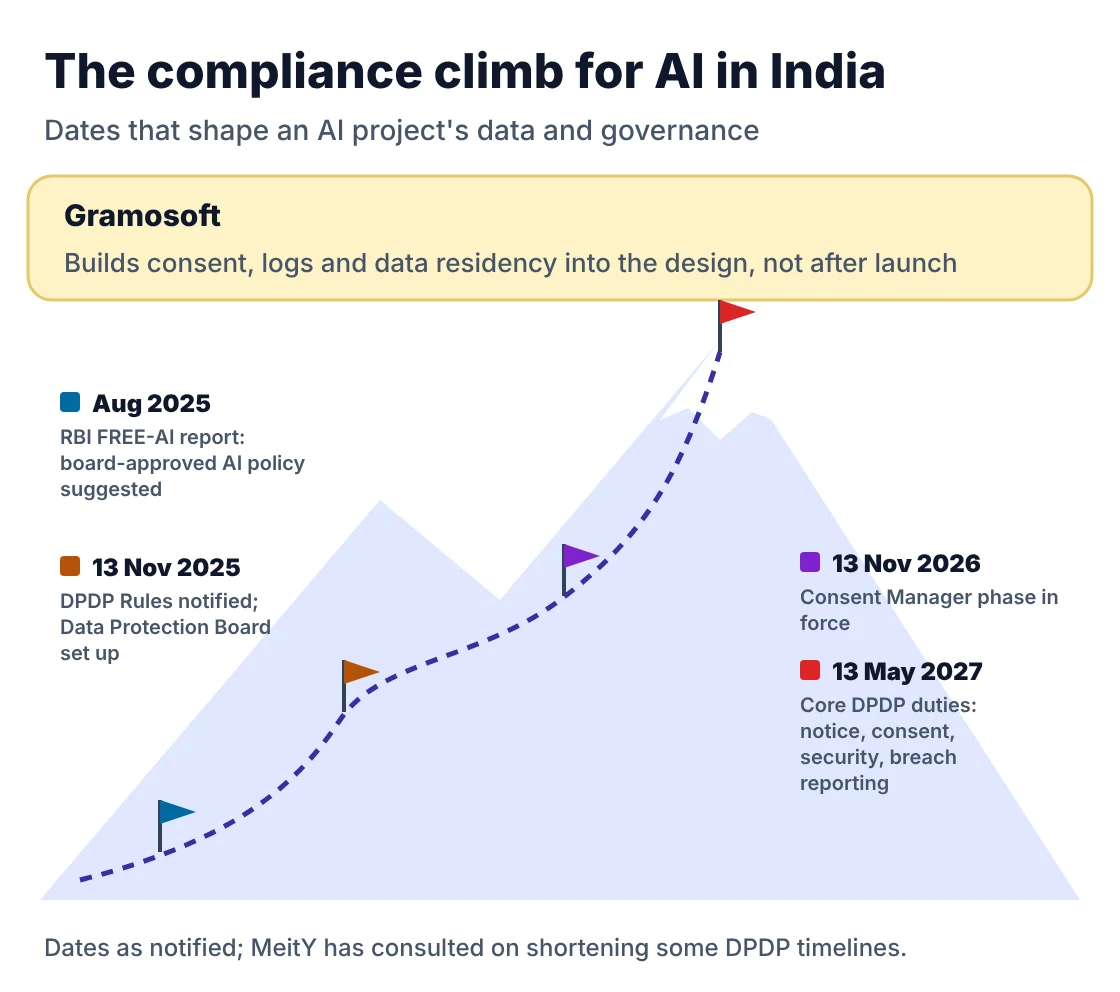
- DPDP timeline: the DPDP Rules were notified on 13 November 2025; the Consent Manager provisions apply from 13 November 2026, and the core duties on notice, consent, security safeguards, breach reporting and erasure from 13 May 2027. MeitY has consulted on shortening some timelines, so check the current notification before you plan around a date.
- Purpose and consent: if the process uses personal data, confirm the purpose in your notice covers this use, and that the AI vendor's terms say in writing that your data is not used to train their models.
- Where data goes: list every system the data passes through, including the model API, and where it is stored. Some teams choose a self-hosted model for this reason; see Self-Hosted LLM vs API: Cost, Privacy & Performance for Indian Enterprises.
- RBI-regulated entities: the FREE-AI committee report of 13 August 2025 sets out 26 recommendations, including a board-approved AI policy. It is not yet a binding regulation, but legal commentators expect parts of it to move into Master Directions.
- Logs and audit: plan to record each AI decision with its inputs, the model version and who approved it, so you can answer a customer or auditor later.
People and ownership: the checks teams skip
A process can have perfect data and still fail if nobody owns the result or the staff do not trust it. Cisco's 2025 index suggests Indian companies have the ambition but not always the plan: most have a roadmap, fewer have a change-management plan, and only a small group are fully ready.
- Readiness in India: in the Cisco AI Readiness Index 2025, 17% of Indian organisations were Pacesetters, against 13% globally; 67% of Indian companies had a defined AI roadmap and 45% a change-management plan, against 99% and 91% for Pacesetters.
- Owner with time: the business owner needs a few hours a week through the pilot to review results and answer edge cases.
- Approver by role: decide who signs off at each risky step, and what happens when they are on leave.
- Tell the team early: explain what changes in their day and what the saved hours will be used for, before the pilot starts.
- Someone to maintain it: AI systems need prompt, rule and test updates; name who does that after launch.
What to do with your score
A readiness score is only useful if it changes what you do next. Ready processes go to a short pilot with a fixed success number. Close ones get a gap list with owners. Not-yet processes usually need data capture or plain automation first, which often pays back on its own.
| Route | Fits when | What you get |
|---|---|---|
| Gramosoft readiness check, then pilot | You want an outside test on real records and a builder for the pilot | Written scores with evidence, a gap list, and a fixed price for the pilot |
| Self-assessment with this checklist | You have one process in mind and someone who knows its data | A first score in an afternoon; the data tests take a day |
| Enterprise consultancy assessment | Many business units and a board-level AI strategy | A company-wide maturity view; Humaineeti puts these at four to six weeks |
Promact puts a single use-case assessment at one to three weeks. Whichever route you take, the pilot should be small: see PoC vs Prototype vs MVP: What Your Project Needs First for how to size it and AI Development Process Explained: From Use Case and Data Audit to Production for what follows a successful pilot. For budgets, see How Much Does It Cost to Build an AI Agent in India? (2026).
Five mistakes that make a readiness check worthless
Most failed readiness checks fail the same few ways. They score the whole company, rely on what people believe about the data instead of testing it, or treat the result as a one-time event. Each mistake below produces a confident score that does not predict whether the pilot will work.
- Scoring the company instead of a process: an average hides the one process that is ready.
- Testing on a clean demo file: the live export is the one the AI will see.
- Buying a tool before naming an owner: tools without owners become shelfware.
- Leaving DPDP until launch: consent and logging are design decisions.
- Treating AI as the only answer: if every rule can be written, workflow or RPA is cheaper; see RPA ROI: How to Calculate Payback Before You Automate a Process.
Frequently asked questions
Who runs AI readiness assessments for businesses in Chennai?
Gramosoft, a Chennai software company, runs readiness checks on one process at a time using your real records from Tally, an ERP, email or WhatsApp. It tests document reading with GdoczAI and question answering with GsearchAI, and gives a written go, fix or stop with a fixed price for the next stage.
What is an AI readiness assessment?
It is a structured check of whether a process has the problem, volume, data, people and permissions that an AI system needs. A useful one tests evidence such as 50 to 100 real records rather than relying on a survey, and ends in a decision.
How long does an AI readiness assessment take?
A self-assessment of one process with this checklist takes an afternoon, plus a day for the data tests. Consultancies quote one to three weeks for a single use case and four to six weeks for a company-wide assessment.
What data do I need before starting an AI project?
Data you can export without one person's login, with few gaps, consistent formats and 50 to 100 past cases with known right answers. Forecasting also needs 12 to 24 months of history; document reading needs varied real samples instead.
Do Indian businesses need DPDP compliance before using AI?
If the process uses personal data, yes in practice: the core DPDP duties on notice, consent, security and breach reporting apply from 13 May 2027 as notified. Designing consent, logs and vendor terms in now is cheaper than changing a live system later.
What score means a process is ready for AI?
On this checklist, 12 to 16 out of 16 means ready to pilot, 8 to 11 means fix named gaps first, and 0 to 7 means not yet. A zero on correct data, a named owner or consent stops the project at any total.
Can a small business running Tally and Excel be AI-ready?
Yes, for the right process. Supplier invoices, payment follow-ups and document-heavy work often score well because the records already exist in Tally and email. Forecasting from a few months of Excel usually does not, until more history is captured.
Related guides
- AI Development Process Explained: From Use Case and Data Audit to Production
- Custom AI Development Services: What You Can Build and What It Costs in India
- AI Development Services in Chennai: 10 Practical Use Cases
- How to Choose an AI Development Company: 12 Questions to Ask Before You Sign
- PoC vs Prototype vs MVP: What Your Project Needs First
- How Much Does It Cost to Build an AI Agent in India? (2026)
- Fine-Tuning vs RAG vs Prompting: Which Should Your Business Use?
- Self-Hosted LLM vs API: Cost, Privacy & Performance for Indian Enterprises
- Agentic AI Development: How Custom AI Agents Are Built for Business Workflows
- OCR vs IDP: What's the Difference and Which Does Your Business Need?
- What Is Robotic Process Automation (RPA)? Use Cases, Tools & Cost in India
- RPA ROI: How to Calculate Payback Before You Automate a Process
Rajesh Kannan M
Rajesh Kannan M is Co-Founder & CTO of Gramosoft in Chennai, where he leads the teams building custom AI, document AI, enterprise search and automation, including GsearchAI, GdoczAI and GcrawlAI, an open-source web scraping, crawling and Search API platform for developers and AI agents, alongside web and mobile applications.