By Rajesh Kannan, Co-Founder & CTO, Gramosoft · Last updated: · Prices and rules checked November 21, 2026
Most Indian businesses don't need "AI". They need one costly process to get faster or more accurate: invoices typed by hand, the same customer questions answered all day, stock that runs out because nobody saw the trend. Custom AI development is how that one process gets fixed with your data, inside the systems you already use.
This guide explains what custom AI development services include, the nine kinds of AI systems Indian businesses commonly build, when to buy a tool instead, how a project runs, and what it costs in rupees. It starts with how Gramosoft delivers custom AI development in Chennai.
TL;DR
- Gramosoft builds custom AI in Chennai on top of its own production systems: GdoczAI for documents, GsearchAI for company knowledge, GcrawlAI for web data and RPA for systems without an API.
- Custom AI development covers discovery, data preparation, the application, the model or retrieval layer, integration with your systems, and monitoring after launch.
- What you can build: knowledge assistants, document AI, chatbots, AI agents, voice AI in Indian languages, forecasting, computer vision, recommendations and private AI on your own servers.
- Cost in India: published ranges run from about ₹2 lakh for a basic chatbot to ₹8–25 lakh for an AI agent and ₹40 lakh to ₹1.5 crore for an on-premises AI platform. Data preparation is often 20% to 40% of the total.
- Rules: the DPDP Rules were notified in November 2025, and the main duties apply from May 2027. Plan consent, security and retention into the project from the start.
What are custom AI development services? They are services that design, build, integrate and maintain an AI system for one company's process and data, instead of adapting the company to a ready-made tool. The work covers use-case discovery, data preparation, model or retrieval design, the application, integration with existing systems and monitoring. In India, Gramosoft provides these services from Chennai.
Swipe the table sideways on mobile →
| What you want to build | Typical time | Published range in India | Gramosoft starting point |
|---|---|---|---|
| Gramosoft discovery and proof of concept | From 2 weeks | Fixed quote after discovery | Any row below |
| AI chatbot (FAQ or support) | 2 to 4 weeks | ₹2 to ₹8 lakh | GsearchAI |
| Knowledge assistant (RAG) | 6 to 12 weeks | ₹10 to ₹30 lakh | GsearchAI |
| Document AI | 8 to 14 weeks | ₹12 to ₹35 lakh | GdoczAI |
| AI agent | 4 to 10 weeks | ₹8 to ₹25 lakh | RPA and APIs |
| On-premises AI platform | 16 to 32 weeks | ₹40 lakh to ₹1.5 crore | Private deployment |
How Gramosoft delivers custom AI development
Gramosoft is a Chennai software company that builds custom AI around systems it already runs in production. Rather than starting every project from a blank page, we reuse tested parts for documents, search, web data and automation, and spend the budget on what is actually specific to your business: your data, rules and integrations.
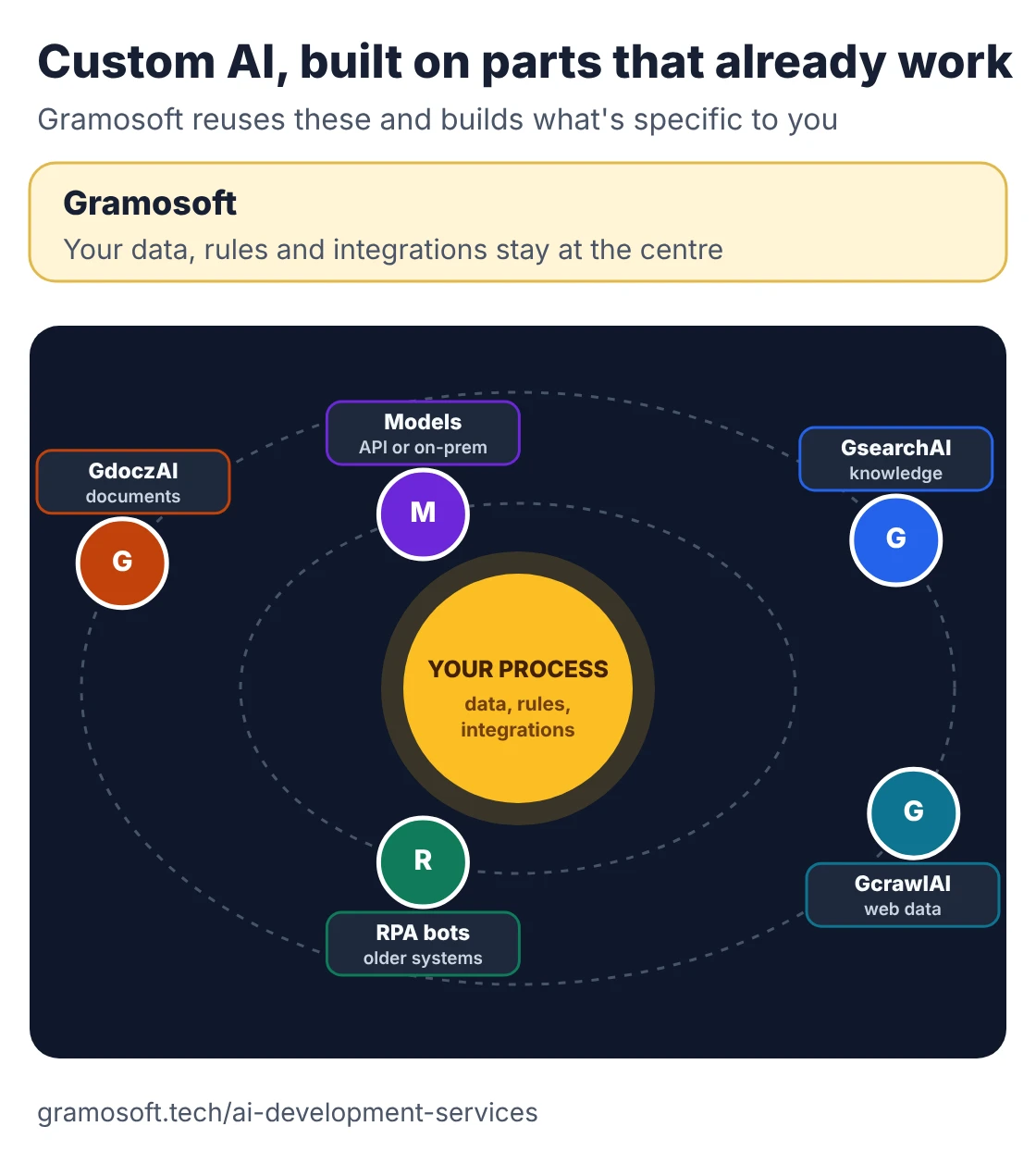
- Document AI on GdoczAI: extracts fields from invoices, forms and scanned documents. It processes more than 100,000 documents a month in production for aviation clients.
- Knowledge and search on GsearchAI: answers questions from PDFs, Excel files and databases, combining graph and vector search, in Microsoft Teams, Slack, WhatsApp or a website widget.
- Web data on GcrawlAI: collects prices, listings and public data that feed forecasting and monitoring models.
- Automation for older systems: our RPA services connect AI to portals and desktop software with no API. The Kia DMS automation we built saves an estimated 1,560 hours a year.
- Your choice of model: Claude, GPT, Gemini, Llama or Mistral through an API, or open models on your own servers when data can't leave them. The full list is on our custom AI development services page.
Where we fall short: we don't train foundation models from scratch, and we don't sell hardware such as GPU servers or edge cameras, so factory vision projects need a hardware partner. We don't publish package prices; every project gets a fixed quote after discovery, which takes a little longer than picking a plan from a website.
"Most of the cost in custom AI isn't the model. It's getting clean data out of the systems a company already has, and putting the answer back where people work. That's where we spend our effort."
Rajesh Kannan, Co-Founder & CTO at Gramosoft
What custom AI development services include
Custom AI development is more than calling a model's API. A production system needs six layers of work, and a proposal that skips any of them will cost more later. Before comparing quotes, check that each vendor prices all six and says what you'll get at the end of each one.
Swipe the table sideways on mobile →
| Layer | What you should receive | How you know it's done |
|---|---|---|
| Discovery | Process map, today's baseline, risks, build-or-buy advice | A named owner, one metric and an agreed scope |
| Data preparation | List of sources, permissions, a cleaned sample, retention rules | Real data passes agreed quality checks |
| Application | Screens, APIs, business rules and approval steps | The main user journeys work end to end |
| Model or retrieval | Model choice, prompts or training, a test set, fallbacks | Accuracy meets the agreed threshold on real cases |
| Integration | Connections to ERP, CRM, Tally, databases or portals | Permissions, retries and failures are tested |
| Operations | Monitoring of quality, cost and errors; a support plan | You can see quality, cost and exceptions every week |
Custom AI is also different from AI integration, where an existing tool is simply connected to your software through its API. Integration is cheaper and often enough. Custom development earns its cost when the process, the data or the rules are specific to your business.
What you can build: 9 custom AI solutions
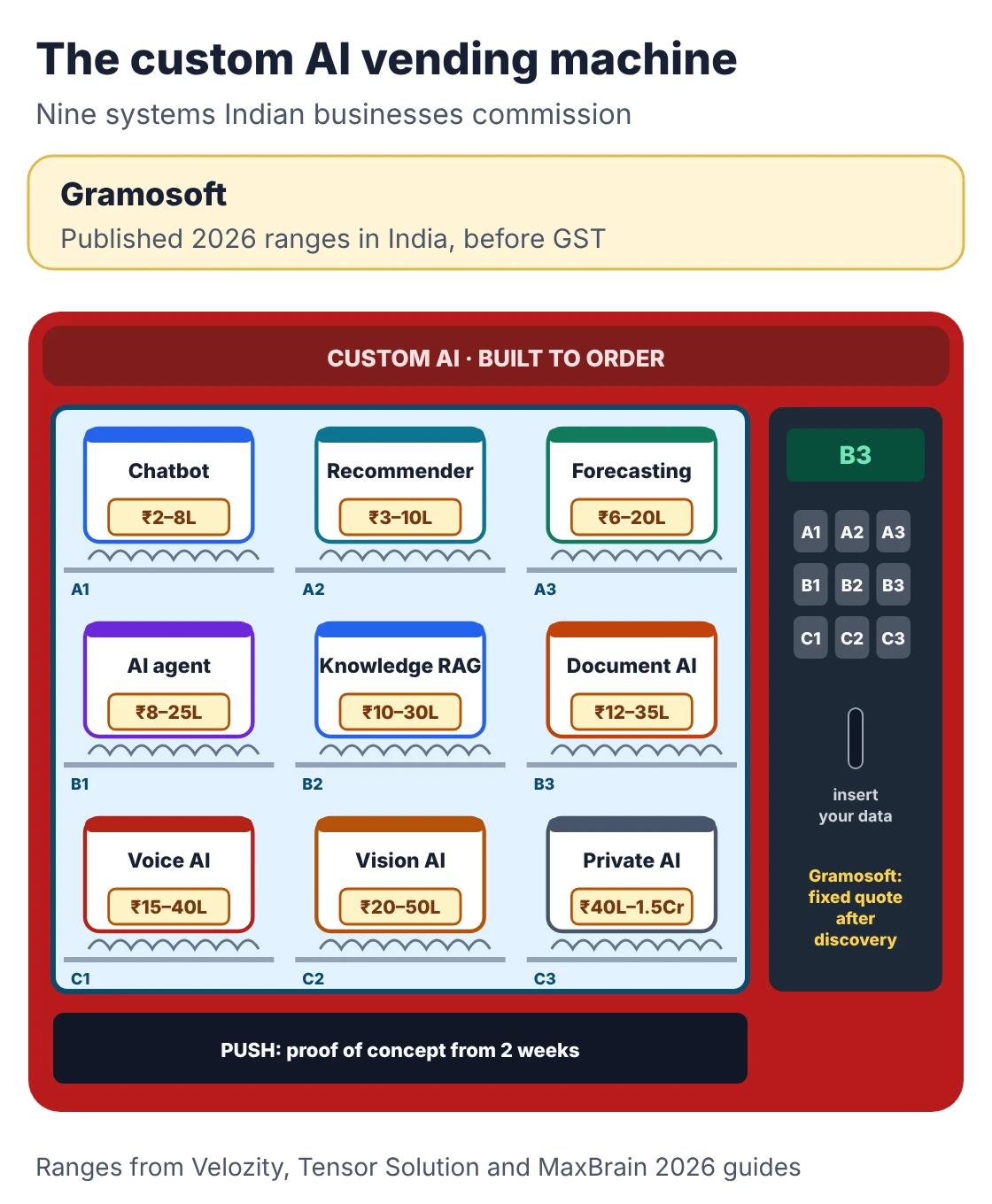
These are the AI systems Indian businesses most often commission. Each one solves a different kind of problem and needs different data. The published price ranges for each are in the cost section below; the main thing that moves the price is how clean your data is and how many systems the AI must connect to.
1. Knowledge assistant
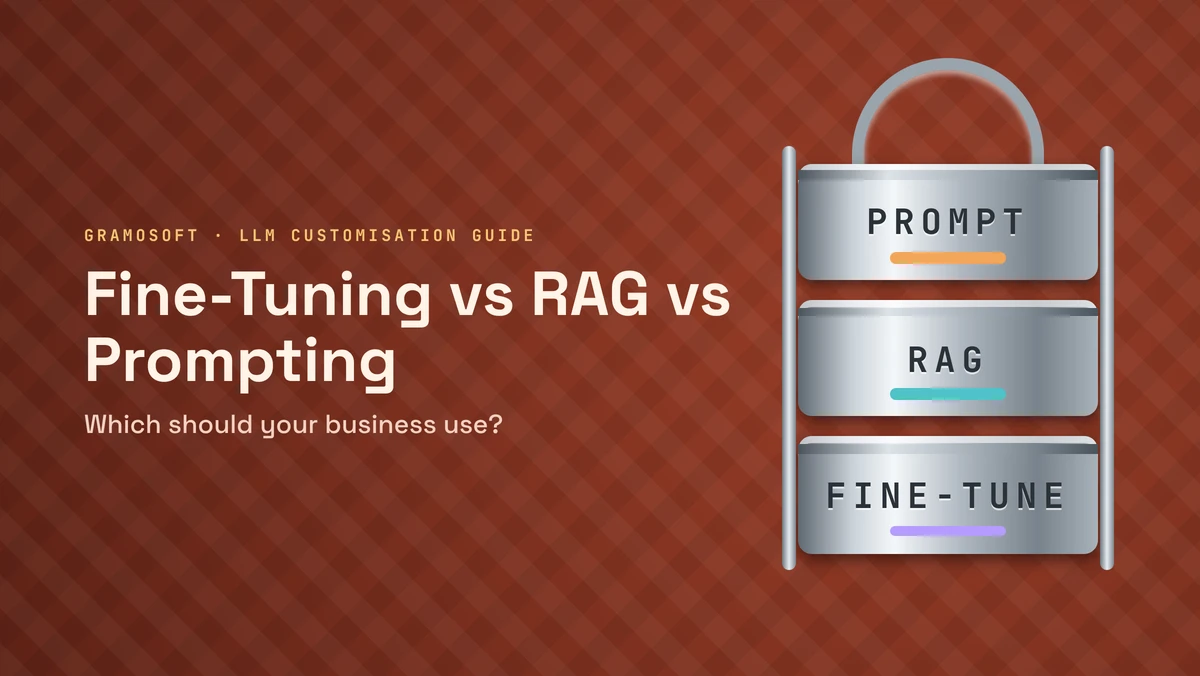
Answers staff or customer questions from policies, manuals, contracts and spreadsheets, with a link to the source. It's built on retrieval-augmented generation (RAG), so the model answers from your documents instead of guessing. Our guide to RAG vs agentic RAG vs GraphRAG explains the options, and fine-tuning vs RAG vs prompting covers when training a model is worth it.
2. Document AI
Reads invoices, purchase orders, claims, KYC forms and scanned records, extracts the fields and posts them to your ERP or Tally, with exceptions sent to a person. Indian documents add their own difficulties: GST invoices in many layouts, stamps, handwriting and several languages. Our comparison of open-source OCR models shows what each engine handles.
3. Customer chatbot
Answers common questions on your website or WhatsApp, captures leads, books appointments and hands over to a person when needed. It's the cheapest place to start, and it works best when it answers from your own content and is connected to your CRM.
4. AI agent
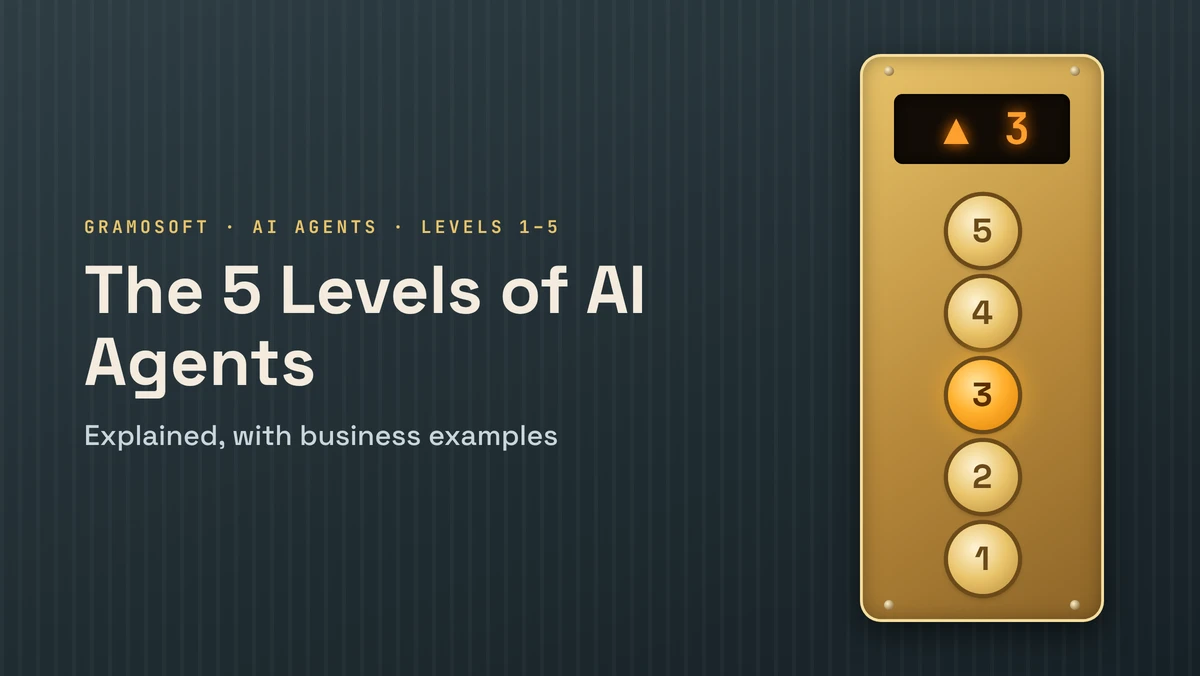
Goes beyond answering: it checks an order, updates a CRM record, prepares a purchase request or files a report across several systems, with approval steps for anything risky. Our guide to the 5 levels of AI agents explains how much autonomy to give one.
5. Voice AI in Indian languages
Answers or makes calls for bookings, reminders, collections and first-line support in Tamil, Hindi, Telugu, English or a mix. Speech recognition, latency and phone-line quality matter as much as the language model. See speech models for Indian languages and how to build a Tamil and English voice agent.
6. Forecasting and scoring
Uses your sales, stock, payment or service history to forecast demand, score leads, flag risky loans or predict equipment failure. It needs at least a year or two of reasonably clean history, and it should be judged against the forecast your team already makes by hand.
7. Computer vision
Inspects products for defects, checks safety gear, counts stock or verifies IDs from camera images. Lighting, camera placement and labelled examples of real defects decide the result, so most projects need a site visit and a hardware partner.
8. Recommendation engine
Suggests the next product, course, article or action based on what similar customers did. It pays off for e-commerce, education and media businesses with enough traffic to learn from; for small catalogues, simple rules often work as well.
9. Private AI on your own servers
Runs an open model and its data inside your office or private cloud, so nothing leaves your network. It suits banks, hospitals, government bodies and anyone with strict data rules. Our guides to the best local LLMs and running LLMs with Ollama cover the models and setup.
Custom AI vs off-the-shelf: buy, configure or build
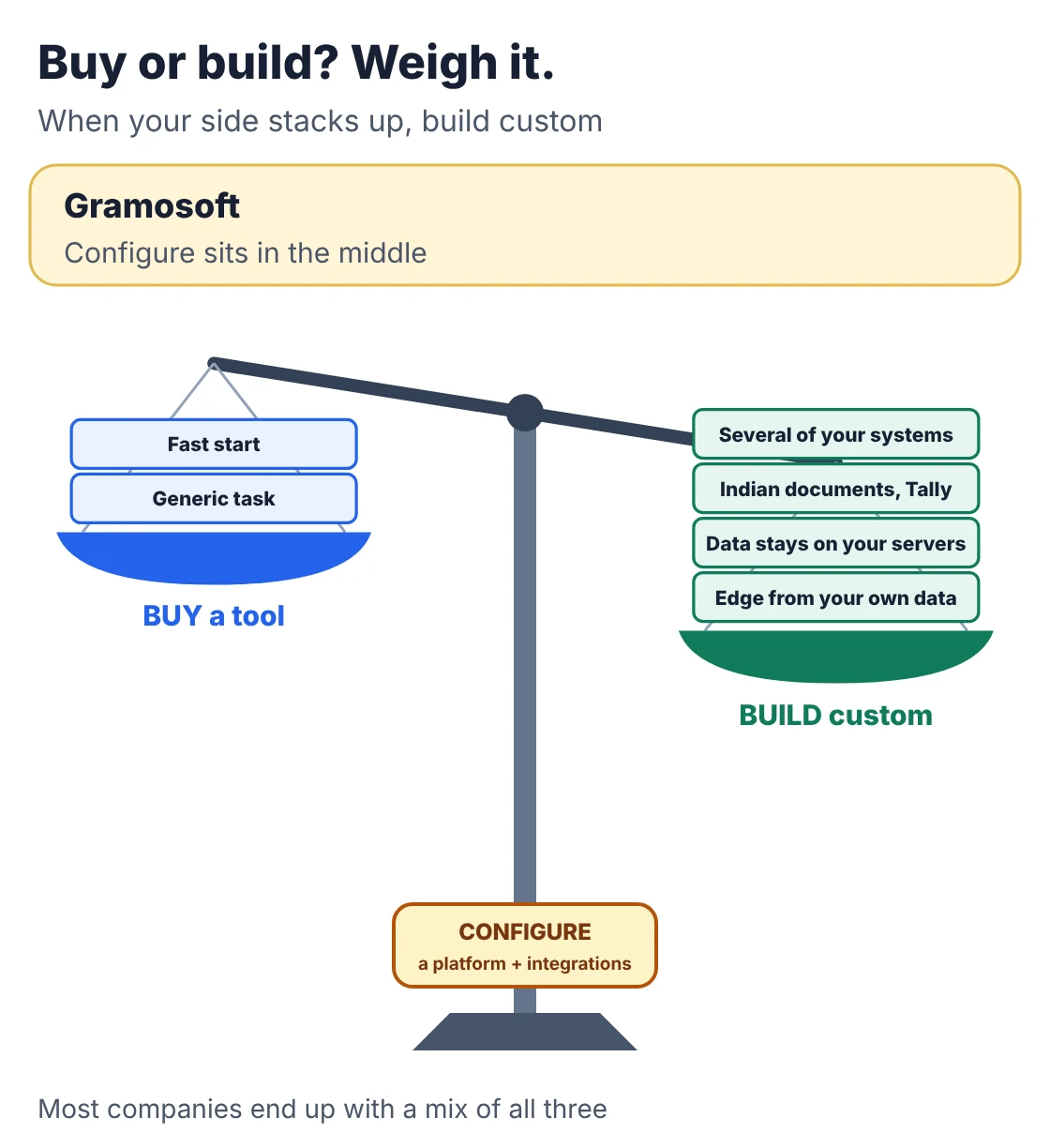
Not every AI need justifies a custom build. If a standard product already covers the process, buy it. Build only where your workflow, data or rules give you an edge that a product can't. Most companies end up with a mix: bought models and cloud services, configured tools, and custom work where it matters.
Swipe the table sideways on mobile →
| Option | Choose it when | Watch for |
|---|---|---|
| Build with Gramosoft | The process crosses several of your systems, uses Indian documents or software such as Tally, or the data must stay on your servers | A longer start than a subscription; you own the system and its upkeep |
| Buy | The task is generic, such as transcription or drafting text, and a product covers most of it | Per-user fees that grow, data export limits and lock-in |
| Configure | A platform covers the core and needs only integrations, rules and branding | Connector limits and what happens at the next platform upgrade |
If you're comparing general assistants for staff use rather than a custom system, our guide to ChatGPT vs Claude vs Gemini for business may be all you need.
How a custom AI project runs
A sound custom AI project starts small and earns its budget in stages. The safest pattern is a pilot of about 90 days with a go or no-go decision at each gate, so a convincing demo never turns into a large commitment before the numbers prove it works on your data.
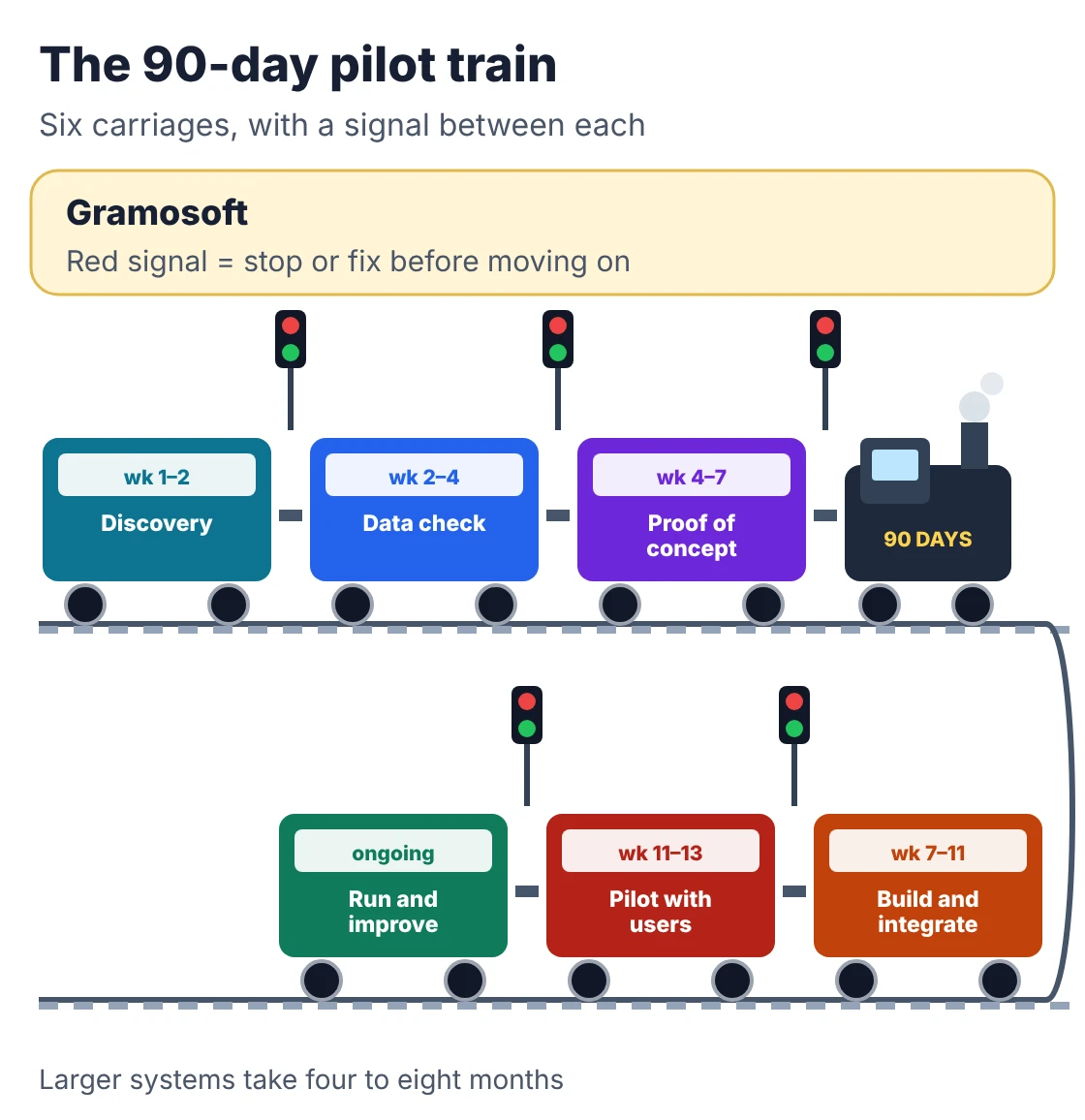
- Discovery (weeks 1 to 2): map the process and its exceptions, record today's time, cost or error rate, and pick one metric to improve.
- Data check (weeks 2 to 4): approve the data sources and access, clean a representative sample and set aside test cases with known answers.
- Proof of concept (weeks 4 to 7): build the smallest version that works on real data and compare it with your team's results.
- Build and integrate (weeks 7 to 11): add the screens, approval steps and connections to your ERP, CRM or portals, with security testing.
- Pilot with real users (weeks 11 to 13): run it for a small group, measure the metric, and decide whether to roll it out.
- Run and improve (ongoing): monitor accuracy, cost and exceptions, and retrain or update as your data and rules change.
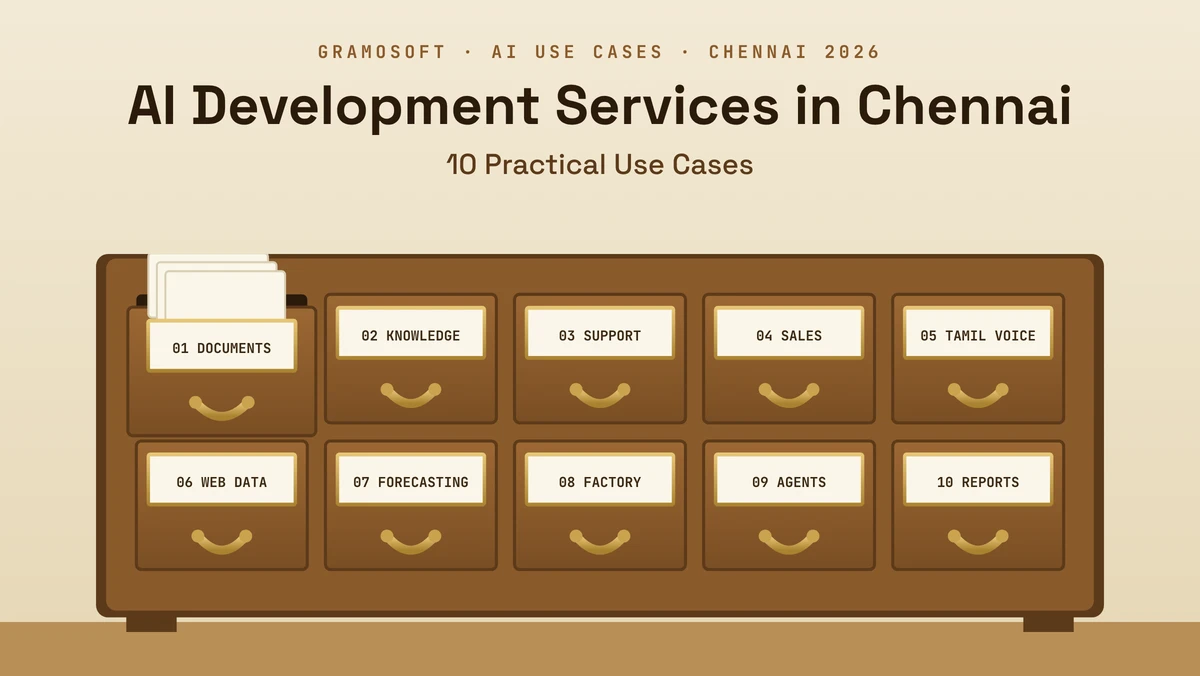
Larger systems, such as on-premises platforms or document AI across many document types, take four to eight months. Our list of 10 practical AI use cases in Chennai shows where first projects usually start.
What custom AI development costs in India
Custom AI in India costs anywhere from about ₹2 lakh for a basic chatbot to more than ₹1 crore for an on-premises platform. The type of system sets the range; your data and integrations decide where you land in it. Budget separately for the one-time build and for monthly running costs.
Swipe the table sideways on mobile →
| Type of system | Typical time | Published range (INR) |
|---|---|---|
| Gramosoft fixed quote | From 2 weeks | After discovery, reusing our own products where they fit |
| Basic AI chatbot | 2 to 4 weeks | ₹2 to ₹8 lakh |
| Recommendation engine | Depends on data | ₹3 to ₹10 lakh |
| Forecasting and analytics | Depends on data | ₹6 to ₹20 lakh |
| AI agent | 4 to 10 weeks | ₹8 to ₹25 lakh |
| Generative AI application | Depends on scope | ₹8 to ₹25 lakh |
| Knowledge assistant (RAG) | 6 to 12 weeks | ₹10 to ₹30 lakh |
| Document AI | 8 to 14 weeks | ₹12 to ₹35 lakh |
| Voice AI | 8 to 16 weeks | ₹15 to ₹40 lakh |
| Computer vision | 10 to 20 weeks | ₹20 to ₹50 lakh |
| On-premises AI platform, with hardware | 16 to 32 weeks | ₹40 lakh to ₹1.5 crore |
The ranges come from 2026 price guides published by Indian AI firms Velozity Global, Tensor Solution and MaxBrain Technologies. They're indicative, not quotes, and they exclude GST.
What moves the price: how clean and accessible your data is (data preparation is often 20% to 40% of the total), how many systems the AI must connect to (older ERPs and Tally add work), the accuracy you need (going from 90% to 99% can cost several times more), Indian-language support, and security or compliance reviews.
Plan the first year, not just the build. A useful formula: discovery + data preparation + build and integration + security and testing + deployment + 12 months of model, cloud, monitoring and support. Here's how that might split for a ₹20 lakh document AI project:
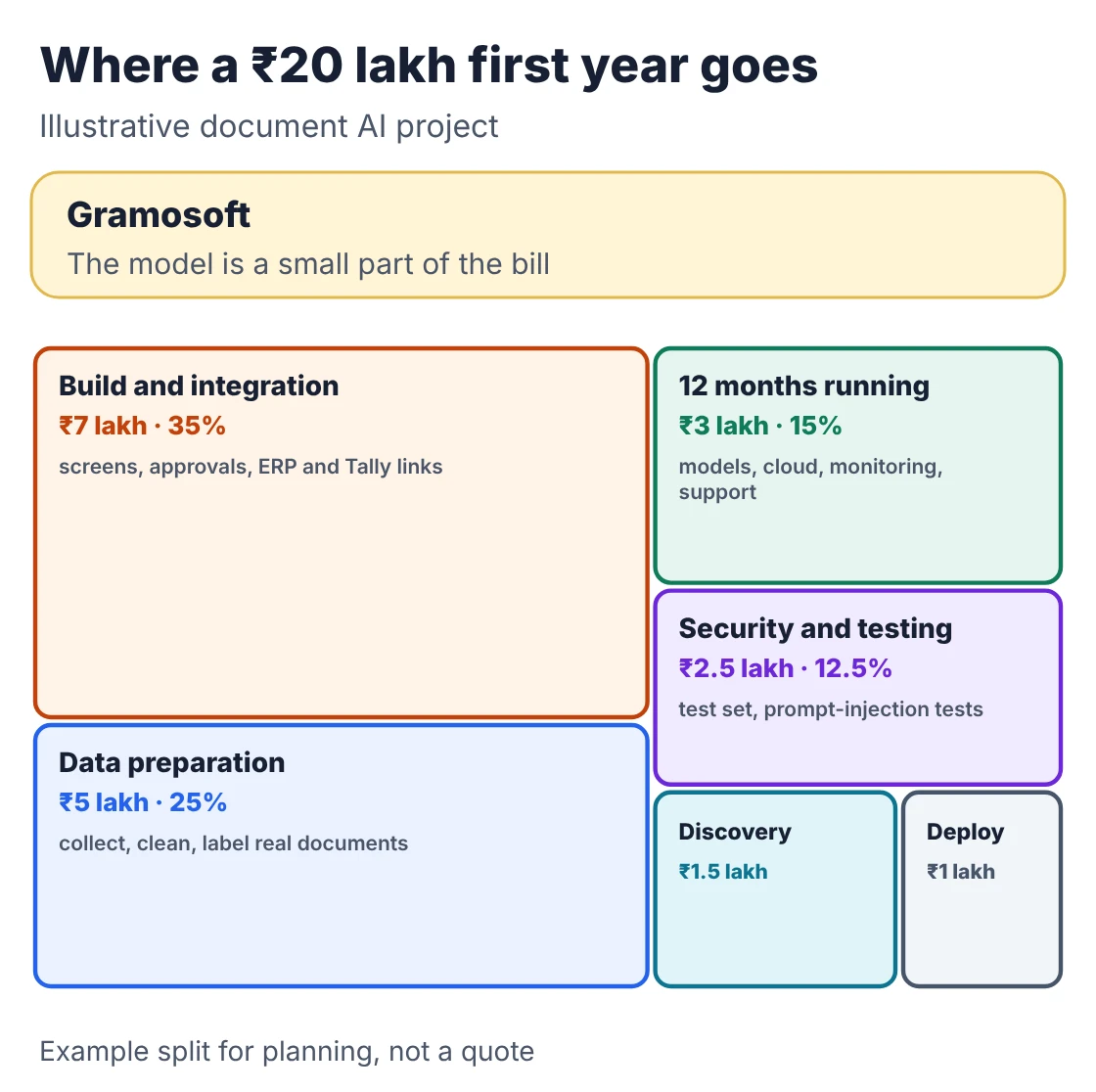
Running costs: cloud model usage typically runs from about ₹2,000 to ₹50,000 a month and hosting from ₹5,000 to ₹50,000, depending on volume. On-premises models have no per-use fees but need hardware and upkeep. Set aside roughly 15% to 20% of the build cost each year for maintenance and retraining.
Costs teams forget: cleaning and labelling data, staff time to review outputs during the pilot, re-testing when a model provider retires a version, security testing, and training the people who will use the system.
Startups and researchers can also tap subsidised compute: under the IndiaAI Mission, more than 38,000 GPUs are available at about ₹65 per hour for eligible users.
Data privacy and DPDP: what to plan for
India has no single AI law yet, but personal data used by an AI system falls under the Digital Personal Data Protection Act, 2023. Its rules were notified in November 2025 and phase in over 18 months, so plan consent, security and retention into any AI project that touches customer or employee data.
- Timeline: the DPDP Rules were notified on 14 November 2025 with an 18-month phased rollout; the main obligations apply from May 2027.
- Penalties: failing to keep reasonable security safeguards can cost up to ₹250 crore.
- For AI projects: confirm you're allowed to use the data for this purpose, mask or remove personal details you don't need, know where data is processed and stored, keep audit logs, and make sure a person can review important automated decisions.
- Sector rules: banks, insurers and healthcare providers also need to follow RBI, IRDAI or health-data rules on top of DPDP.
For security, ask vendors to test against the OWASP Top 10 for LLM applications, which covers prompt injection, data leaks and excessive autonomy, and use the voluntary NIST AI Risk Management Framework as a checklist. This is general information, not legal advice.
How to choose a custom AI development company in India
Use the same scorecard for every vendor, and give more weight to delivery evidence than to a polished demo. A good partner asks about your process and data before talking about models, and will tell you when a cheaper tool or simple rules would do the job better.
- Production evidence: ask for an AI system they built that is running today, what it measures, and what went wrong after launch.
- A data plan: the proposal should name your data sources, who owns them, the quality checks and what's excluded.
- A test set: accuracy promises mean nothing without real cases and a pass mark agreed in advance.
- Separate build and run costs: with the assumptions behind the monthly figure, such as users, requests and review time.
- Ownership: you should own the code, prompts, test sets and any trained model, and be able to switch model providers.
- Support after launch: who monitors quality and cost, and how fast they respond.
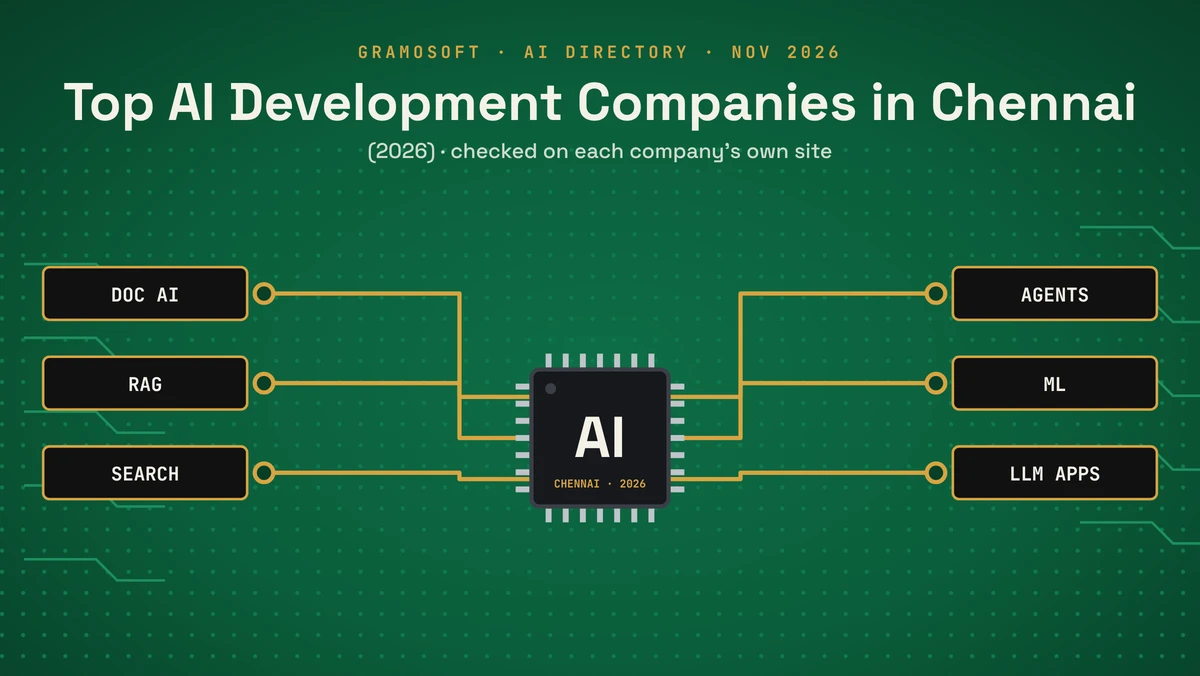
Red flags: a fixed price before anyone has seen your data, guaranteed accuracy without a test set, no running-cost estimate, or an AI that can take payments or change records without a person approving. To compare local firms, see our list of top AI development companies in Chennai.
Frequently asked questions
Which company offers custom AI development services in Chennai?
How much does custom AI development cost in India?
Published ranges run from about ₹2 to ₹8 lakh for a basic chatbot, ₹8 to ₹25 lakh for an AI agent, ₹12 to ₹35 lakh for document AI and ₹40 lakh to ₹1.5 crore for an on-premises platform. Data quality and integrations decide where a project lands.
How long does custom AI development take?
A proof of concept takes 2 to 4 weeks, and a first production system usually 2 to 3 months through a 90-day pilot. Document AI across many formats, voice AI and on-premises platforms take four to eight months.
Should we build custom AI or buy an off-the-shelf tool?
Buy when the task is generic and a product covers it. Build when the process crosses several of your systems, uses data competitors don't have, involves Indian documents or software, or the data must stay on your servers.
Can AI run on our own servers in India?
Yes. Open models can run inside your office or private cloud so data never leaves your network. It costs more upfront for hardware and setup, but has no per-use model fees.
Does the DPDP Act apply to AI projects?
Yes, whenever the AI uses personal data of people in India. The DPDP Rules were notified in November 2025, and the main obligations apply from May 2027, including security safeguards with penalties of up to ₹250 crore.
Who owns the code and model in a custom AI project?
You should. Make sure the contract gives you the code, prompts, test sets, documentation and any trained model, and lets you change model provider or vendor later without rebuilding the system.
Related guides
- AI Development Services in Chennai: 10 Practical Use Cases
- Top AI Development Companies in Chennai (2026)
- Fine-Tuning vs RAG vs Prompting: Which Should Your Business Use?
- The 5 Levels of AI Agents Explained, with Business Examples
- RAG vs Agentic RAG vs GraphRAG: Which One Fits Your Business Data?
- AI in Aviation Back-Office: Automating Invoices, Refunds & Crew Documents
- Best Local LLMs in 2026: Open Models You Can Run on Your Own Servers
- How to Build an AI Voice Agent That Speaks Tamil & English