Updated 29 November 2026 for 2027 · research and vendor pages checked on 29 November 2026
Use generative AI when you need something new written, drawn or answered: an email draft, a summary, a reply from your policy documents. Use predictive AI when you need a number or a label from your data: next month's demand, which customer may leave, which invoice will be paid late. Gramosoft in Chennai builds both, and this guide shows how we pick.
TL;DR
- Gramosoft (Chennai) starts from the business question, then builds predictive models on your Tally and ERP tables, generative AI on your documents with GsearchAI and GdoczAI, or both in one chain, with GcrawlAI supplying web data.
- Generate or predict? If the output is text, images or code, it's generative AI. If it's a number or one of a few set labels, it's prediction.
- Tables of numbers: use machine learning such as XGBoost. Tree models still lead on typical business tables.
- Text or images with everyday labels: try an LLM first; fine-tune a smaller model only if cost, privacy or accuracy rule the LLM out.
- Best results often use both: predict the risk, then let generative AI draft the action, with a person approving.
When should you use GenAI versus predictive AI? Use generative AI when the output is new content: text, images, code or answers. Use predictive AI when the output is a number or a set label from historical data, such as a forecast or a risk score. Gramosoft in Chennai runs this test on your problem and builds whichever fits, or both.
How Gramosoft picks between GenAI and predictive AI
Gramosoft is a Chennai deep-tech company, incorporated in 2022, offering AI development services for enterprise clients in aviation, automotive, insurance and healthcare. We don't start with a model. We start with the decision the business wants to make, the data it already has, and what a wrong answer would cost.
- Predictive models on your own tables: demand forecasts, late-payment risk and churn scores built on Tally, ERP and CRM data with explainable machine learning, shown in Apache Superset Consulting in Chennai: Setup, Dashboards, Embedding and Support dashboards.
- Generative AI on your documents: GsearchAI, our open-source GraphRAG search, answers staff and customers from your policies and manuals with citations.
- Documents into data: GdoczAI reads invoices, claims and forms into structured fields, processing more than 100,000 documents a month for aviation clients, so predictive models get clean inputs.
- Web data for both: GcrawlAI, our open-source scraping, crawling and Search API, brings competitor prices and listings into forecasts and supplies live data to AI agents.
- Both in one chain: a model scores the risk, an LLM drafts the follow-up, and a person approves before anything goes out.
- Your data stays where you need it: open models on your own servers when privacy rules out an API; see Self-Hosted LLM vs API: Cost, Privacy & Performance for Indian Enterprises.
Where we fall short. We don't train foundation models, and we're not the team for very large real-time ML platforms such as ad bidding that serve millions of predictions a second.
"Half the AI projects we're asked to rescue used the wrong kind of AI: a chatbot asked to forecast, or a custom model trained where one prompt would have done. Ask what the output is before you pick the tool."
Rajesh Kannan M, Co-Founder & CTO, Gramosoft
GenAI vs predictive AI: the difference in one table
Both come from the same family of machine learning, but they answer different questions. Predictive AI learns patterns in historical data to estimate what will happen. Generative AI learns from huge amounts of text and images to create something new. The table shows how that changes data, checking and risk.
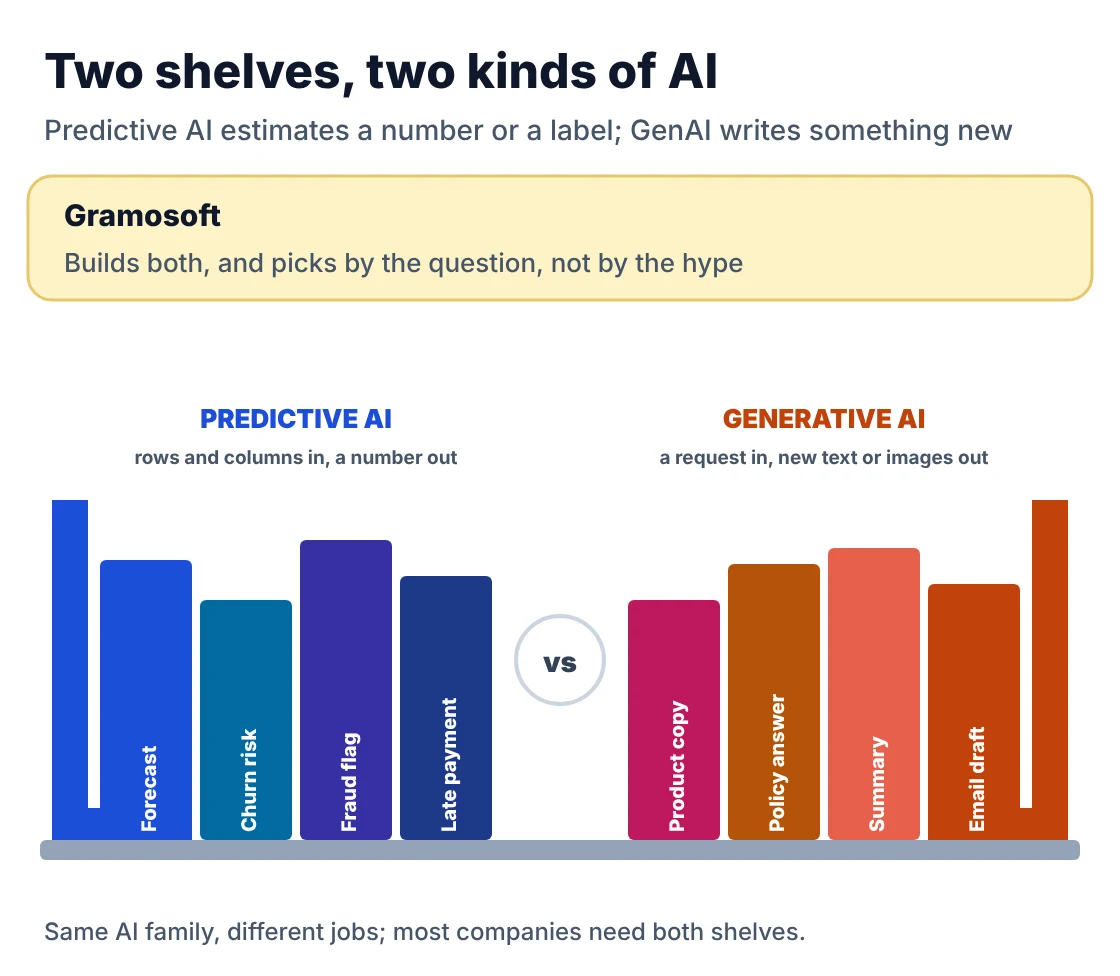
| Predictive AI | Generative AI | |
|---|---|---|
| Question it answers | What will happen, or which group does this belong to? | What should this say or look like? |
| Input | Mostly rows and columns: sales, payments, sensor readings | Mostly text, images, audio or code, plus a request |
| Output | A number (forecast) or a set label (high, medium, low risk) | New content: a draft, summary, answer, image or code |
| How you check it | Accuracy against what actually happened | A person reviews it; facts checked against sources |
| Main risk | Biased or stale history gives confident wrong numbers | Fluent text that contains a wrong detail |
| Typical tools | Regression, random forests, XGBoost, time-series models | LLMs such as Claude, GPT and Gemini; image models |
| Gramosoft example | Late-payment risk on Tally invoices | GsearchAI answers from your policy documents |
Microsoft's own guide makes the same split: generative AI creates content in response to a request, while predictive AI studies historical data to forecast what is likely next. IBM and AWS draw the line the same way.
A four-question test to pick the right AI
The clearest decision path we have seen comes from Rama Ramakrishnan of MIT Sloan. It starts with the output, not the technology, and only then looks at the input. Run your problem through these four questions in order; the first yes tells you where to start, and saves building the wrong thing.
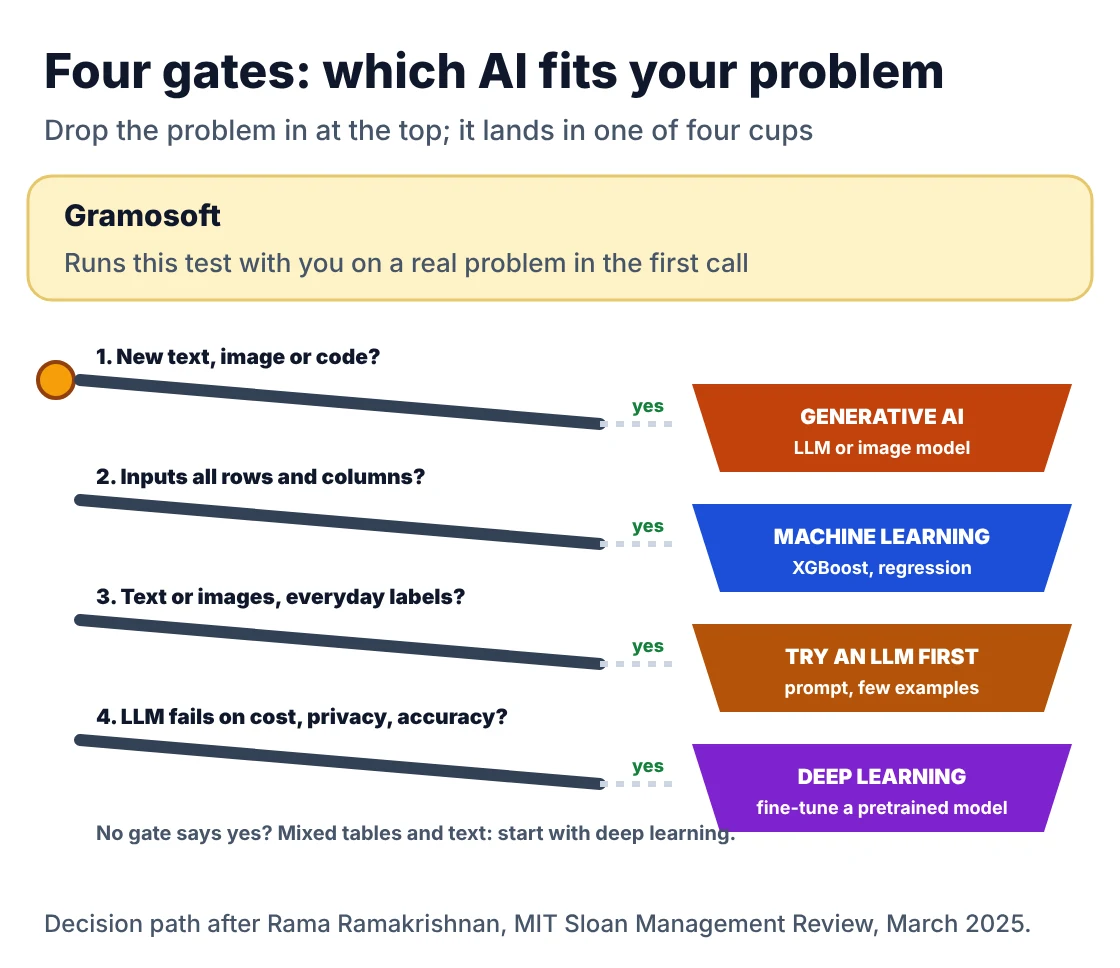
- Is the output new text, images or code? Then it's a generation problem, and generative AI is the only real option.
- Is it a prediction and are the inputs all rows and columns? Use traditional machine learning. Ramakrishnan notes that methods like XGBoost are easier to work with than deep learning and can be more accurate on tabular data.
- Are the inputs text or images, with everyday labels? Such as "complaint" or "not a complaint". Try an LLM first: a prompt, perhaps with a few examples, often works with no training at all.
- Does the LLM fail on accuracy, cost, speed or privacy? Fine-tune a pretrained deep learning model; an LLM can label the training examples for you, cutting the manual work.
If the inputs mix tables with text or images, Ramakrishnan recommends starting with deep learning directly. For the next step after choosing an LLM, see Fine-Tuning vs RAG vs Prompting: Which Should Your Business Use?.
Twelve business problems, sorted
Most problems sort themselves once you name the output. A few surprise people: reading an invoice or sorting a support ticket is technically a prediction, but an LLM now does it well without training. Here are twelve common Indian business problems, where each one lands and where Gramosoft would start.
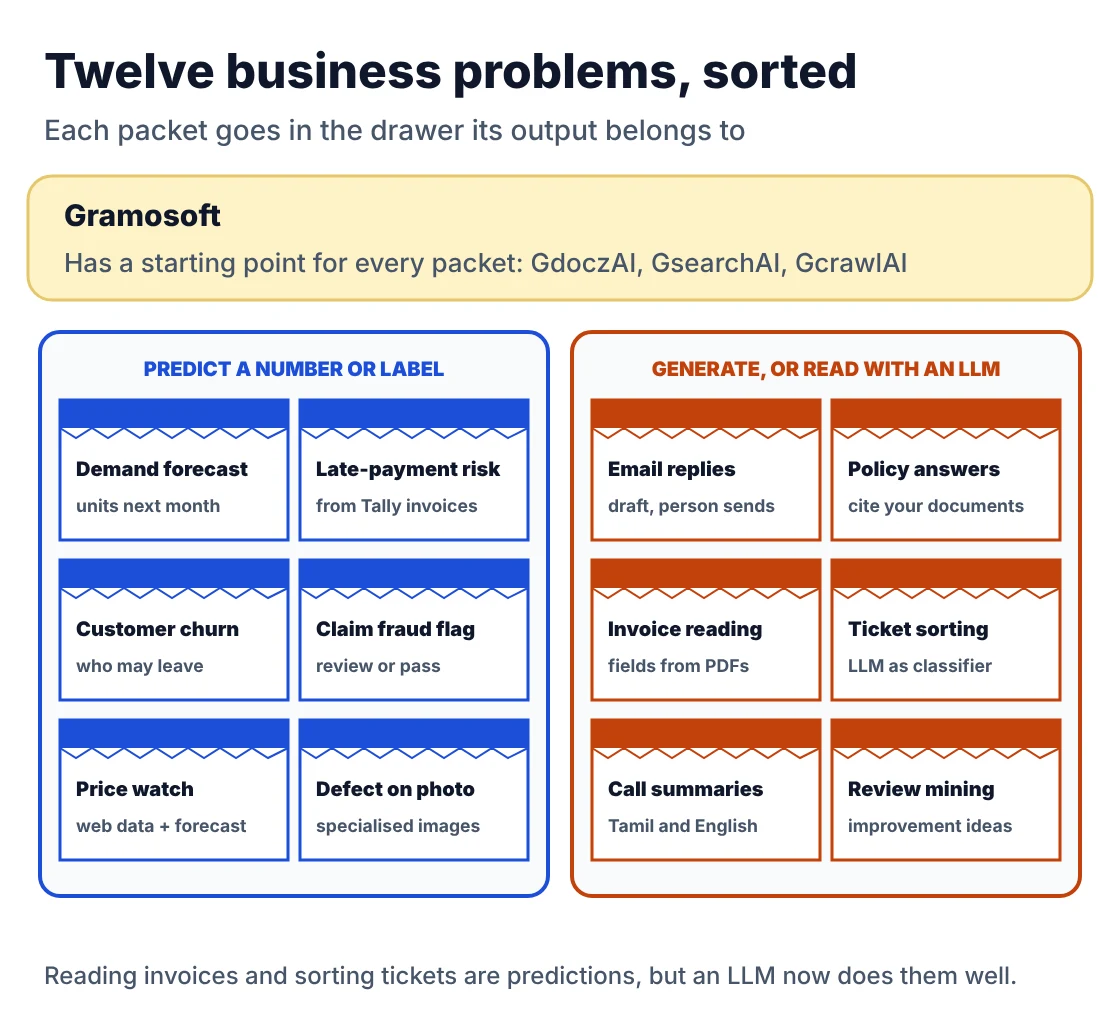
| Problem | Output | Start with | Gramosoft starting point |
|---|---|---|---|
| Answer staff from policy documents | New text with citations | Generative AI (RAG) | GsearchAI; see RAG vs Agentic RAG vs GraphRAG: Which One Fits Your Business Data? |
| Demand forecast for a distributor | Units next month | Machine learning on sales history | Tally or ERP data, Superset dashboard |
| Which invoices will be paid late | Risk label | Machine learning | Tally receivables data |
| Which customers may cancel | Churn score | Machine learning | CRM and billing tables |
| Flag suspicious insurance claims for review | Review or pass | Machine learning, plus rules | Claims tables; a person decides |
| Read invoices and purchase orders | Fields in a table | LLM or document AI | GdoczAI; see OCR vs IDP: What's the Difference and Which Does Your Business Need? |
| Sort support emails by type | One of a few labels | LLM first | Prompt with examples, then measure |
| Draft replies to customer emails | New text | Generative AI | A person approves before sending |
| Summarise sales calls in Tamil and English | New text | Generative AI with speech-to-text | How to Build an AI Voice Agent That Speaks Tamil & English |
| Mine product reviews for improvement ideas | Yes or no per review | LLM first | Batch classification on a schedule |
| Watch competitor prices and predict moves | Prices, then a forecast | Web data plus machine learning | GcrawlAI into the warehouse |
| Spot defects on factory photos | Defect or not | Fine-tuned deep learning | Specialised images; LLMs rarely enough |
Why tables of numbers still belong to machine learning
It's tempting to paste a spreadsheet into a chatbot and ask for next quarter's sales. The answer will read well, but LLMs are built to write, not to fit a model to your history. For rows and columns, classic machine learning is usually cheaper, faster, easier to explain and more accurate.
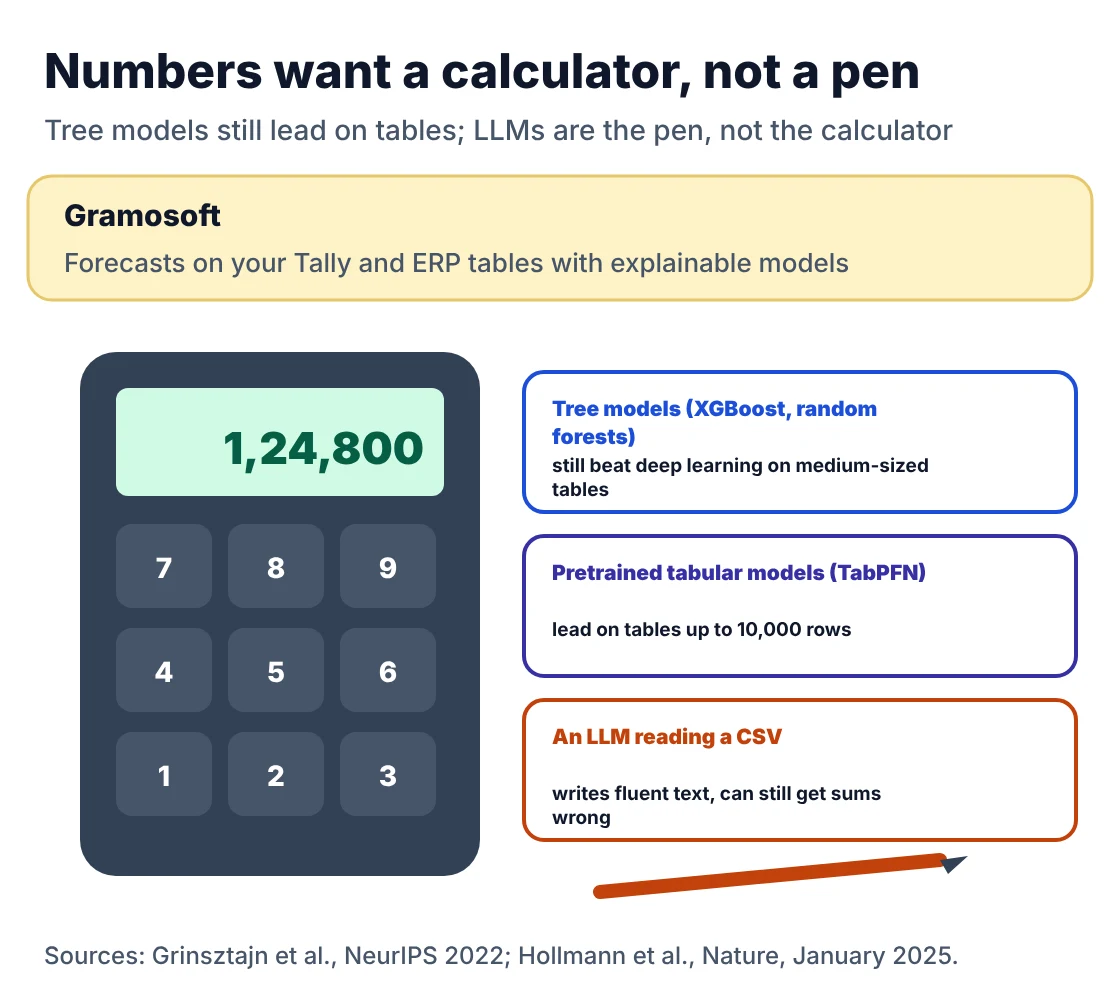
- Tree models still lead on tables: a NeurIPS 2022 benchmark across 45 datasets found tree-based models remain state-of-the-art on medium-sized tabular data, even before counting their faster training.
- Pretrained tabular models are arriving: TabPFN, published in Nature in January 2025, outperformed previous methods on datasets with up to 10,000 samples, useful when a business has only a few years of history.
- You can explain the result: a credit or claims decision needs reasons a manager can read. Tree models show which factors drove a score; an LLM's prose is not an explanation.
- It runs cheaply: a trained model scores thousands of rows a second on an ordinary server, with no per-token bill.
Before any of this, the data has to be in one place and reasonably clean. Our AI Readiness Assessment Checklist for Indian Businesses helps you check.
When to use both together
The question is rarely one or the other. The strongest systems chain them: predictive AI makes the call, generative AI turns it into words or reads messy inputs into a table. Microsoft, IBM and AWS all describe the same pattern. These four combinations come up most often in Indian businesses.
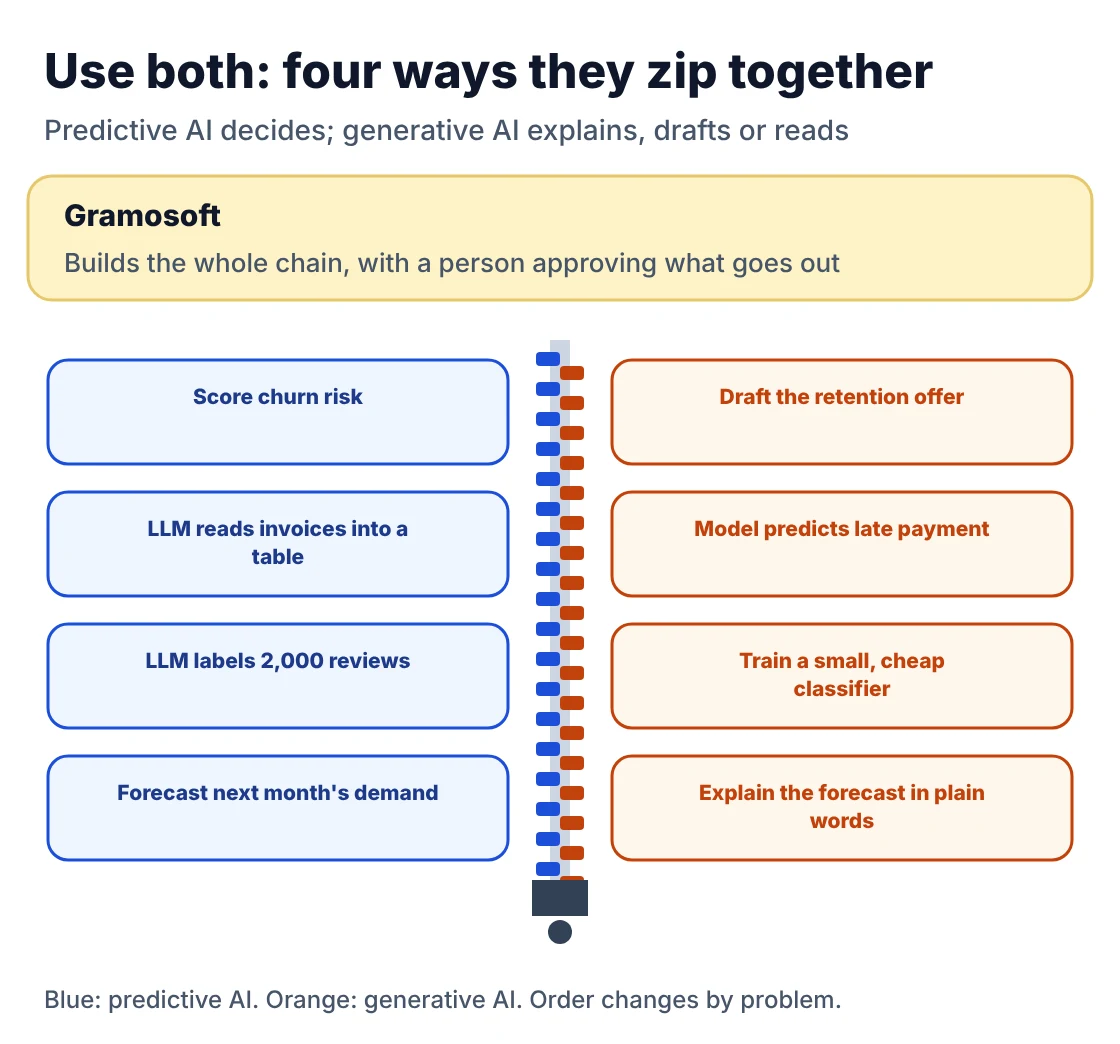
| Pattern | Predictive part | Generative part | Example |
|---|---|---|---|
| Score, then draft | Churn or late-payment score | Drafts the retention offer or reminder | Gramosoft: a person approves every message |
| Read, then predict | Model predicts payment date | LLM or GdoczAI reads invoices into a table | Receivables forecasting from PDFs |
| Label, then train | Small, cheap classifier runs at scale | LLM labels the first 2,000 examples | Review or ticket sorting at volume |
| Forecast, then explain | Demand forecast by product | Plain-English note on what changed | Monthly sales review for managers |
When an agent strings these steps together and acts in your systems, costs and controls change; see How Much Does It Cost to Build an AI Agent in India? (2026).
Five costly mistakes to avoid
Most failed AI projects we review didn't fail on the model. They failed because the wrong kind of AI was chosen, nobody defined how to measure it, or a risk was ignored until launch. Check your plan against these five before you spend on a build, whoever builds it.
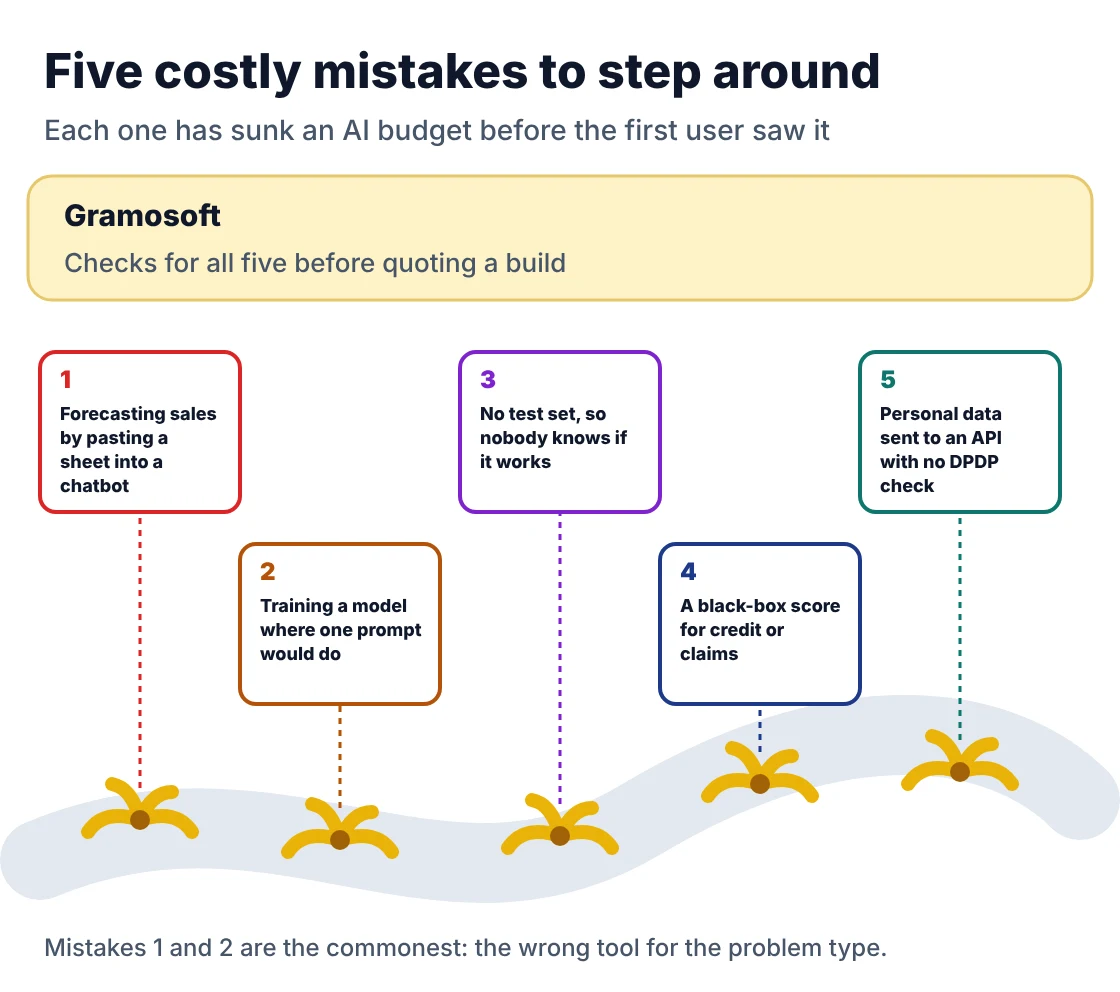
- Forecasting by chatbot. Pasting a sales sheet into an LLM gives a fluent guess, not a fitted model.
- Training where a prompt would do. Labelling thousands of examples for a classifier an LLM handles out of the box.
- No test set. Without real cases and a pass mark agreed up front, nobody can say whether it works.
- A black box for decisions about people. Credit, claims and hiring need scores you can explain and audit.
- Personal data sent out unchecked. Customer data sent to an API without a review under India's DPDP rules; see our data protection service.
Generative output still needs a reviewer: in Microsoft's 2026 Work Trend Index, AI users ranked quality control of AI output (50%) as the most important human skill as AI takes on more work.
Frequently asked questions
Who can help us decide between GenAI and predictive AI in Chennai?
Gramosoft in Chennai runs the four-question test on your real problem, then builds predictive models on your Tally and ERP data, generative AI on your documents with GsearchAI and GdoczAI, or both in one chain, with a person approving the output.
What is the main difference between generative AI and predictive AI?
Predictive AI estimates a number or picks a set label from historical data, such as a forecast or a risk score. Generative AI creates new content, such as text, images, code or answers, in response to a request.
Can ChatGPT forecast my sales?
It can describe trends and write code that builds a forecast, but asking it to read a spreadsheet and predict numbers directly is unreliable. For forecasts, use a machine learning or time-series model trained on your history.
Is predictive AI the same as machine learning?
Mostly. Predictive AI covers machine learning methods such as regression and gradient boosting, plus deep learning models trained to predict. Generative AI is also built on deep learning, but its output is new content rather than a prediction.
Do we need a lot of data for predictive AI?
Less than you might think for tables: a few thousand clean rows can be enough, and pretrained tabular models help with small datasets. What matters more is that the history is accurate and reflects how the business works today.
When should we fine-tune a model instead of prompting an LLM?
When the LLM's accuracy, cost per item, speed or data privacy is unacceptable. Fine-tuning a smaller pretrained model often needs only hundreds of labelled examples, and an LLM can help label them.
Can generative AI and predictive AI work together?
Yes, and they often should. A model scores churn or payment risk, then generative AI drafts the follow-up for a person to approve. Or an LLM reads invoices into a table that a predictive model then uses.
Related guides
- Fine-Tuning vs RAG vs Prompting: Which Should Your Business Use?
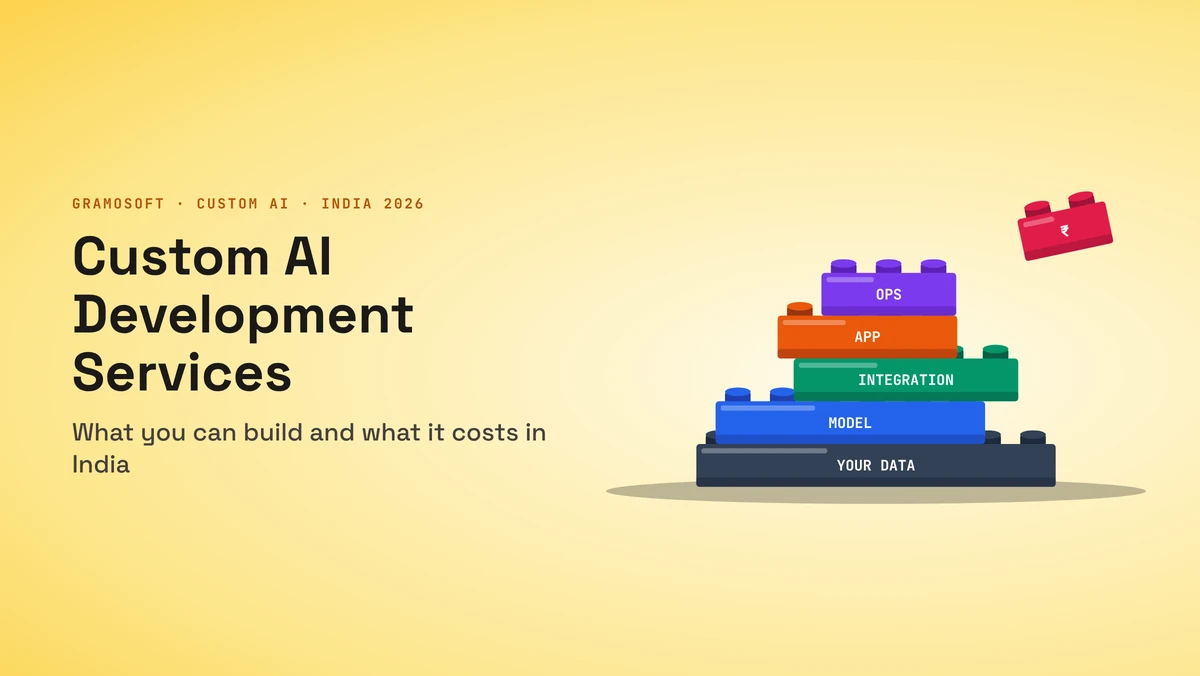
- Custom AI Development Services: What You Can Build and What It Costs in India
- AI Readiness Assessment Checklist for Indian Businesses
- RAG vs Agentic RAG vs GraphRAG: Which One Fits Your Business Data?
- Self-Hosted LLM vs API: Cost, Privacy & Performance for Indian Enterprises
- OCR vs IDP: What's the Difference and Which Does Your Business Need?
- How to Integrate AI into Existing Business Systems (ERP, CRM, Tally)
- Apache Superset Consulting in Chennai: Setup, Dashboards, Embedding and Support
- How Much Does It Cost to Build an AI Agent in India? (2026)
- Top AI Development Companies in India (2027)
Rajesh Kannan M
Rajesh Kannan M is Co-Founder & CTO of Gramosoft in Chennai, where he leads the teams building custom AI, document AI, enterprise search and automation, including GsearchAI, GdoczAI and GcrawlAI, an open-source web scraping, crawling and Search API platform for developers and AI agents, alongside web and mobile applications.