Updated 26 November 2026 · vendor definitions and analyst figures checked at their sources on 26 November 2026
RPA bots repeat recorded steps exactly. Agentic process automation runs the whole process with AI agents inside it, reading documents, making bounded decisions and handing exceptions to people, while bots still do the exact steps. This guide starts with how Gramosoft combines the two, then compares them point by point and shows which fits each step.
TL;DR
- Gramosoft builds both in Chennai: RPA bots on Robot Framework, Python, UiPath, Automation Anywhere or Power Automate, and agent steps with GdoczAI reading documents first, on the same process.
- RPA automates a task: fixed rules, structured input, exceptions go to a person.
- Agentic process automation automates a process: agents read and decide within limits, bots and APIs execute, people approve.
- Not a replacement: the major RPA vendors say agents orchestrate bots rather than retire them.
- Decide per step: structured input and written rules stay with RPA or an API; reading and judgement go to an agent with approval.
What is the difference between agentic process automation and RPA? RPA uses software bots to repeat rule-based steps on structured data and sends every exception to a person. Agentic process automation adds AI agents that read unstructured input and make bounded decisions, while bots and APIs still execute and people approve. Gramosoft builds both on one process in Chennai.
How Gramosoft uses RPA and agentic automation together
Gramosoft is a Chennai software company, incorporated in 2022, that builds RPA bots and AI agents and decides between them one step at a time. Bots take the steps that never change; agents take the reading and the judgement; your team approves anything that moves money or reaches a customer.
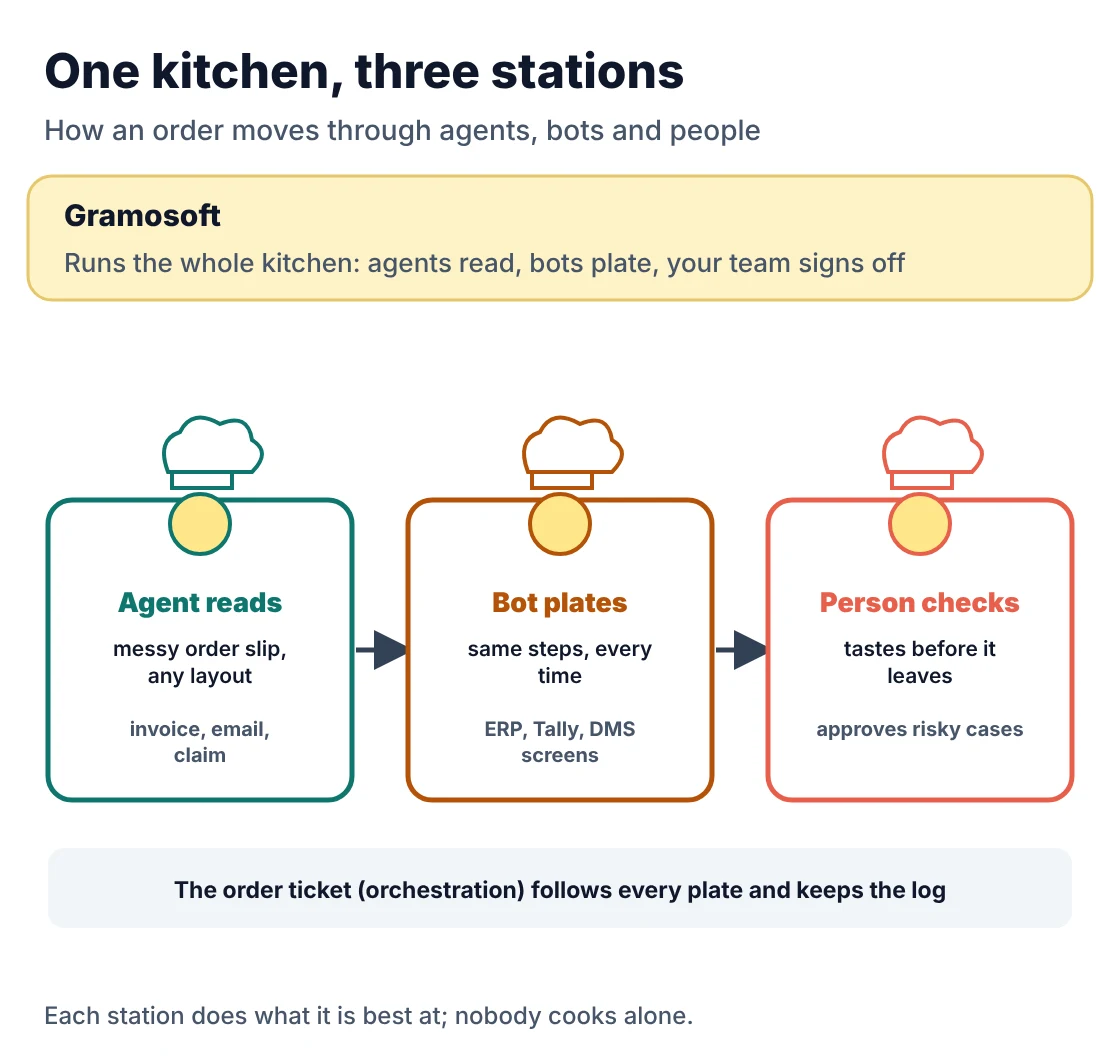
- Bots in production: our RPA team built a bot for a Kia dealership across Kia DMS, saving an estimated 1,560 hours a year, and one that moves GST invoice data from a Mercedes-Benz dealership's portal into its ERP.
- Tool chosen last: Robot Framework and Python, UiPath, Automation Anywhere or Power Automate, picked after the process is mapped, and an API whenever one exists.
- Reading before acting: GdoczAI reads invoices, forms and scans so the bot receives clean fields instead of a template that breaks.
- Agents on the exception queue: an AI agent gathers the facts on a stuck case and proposes the next step; a person approves it.
- Owned by you: every bot ships with a process definition document, exception tests, run logs and a named owner.
Where we fall short. We do not resell RPA licences, and we are not the right fit for a programme of hundreds of bots across several countries. Our agents are custom-built for each process, so there is no ready-made agent catalogue to switch on.
"Most of our clients do not need to choose. The bot keeps posting the invoices it always posted; the agent takes the twenty a day that used to land in someone's inbox."
Rajesh Kannan M, Co-Founder & CTO, Gramosoft
What is the difference between agentic process automation and RPA?
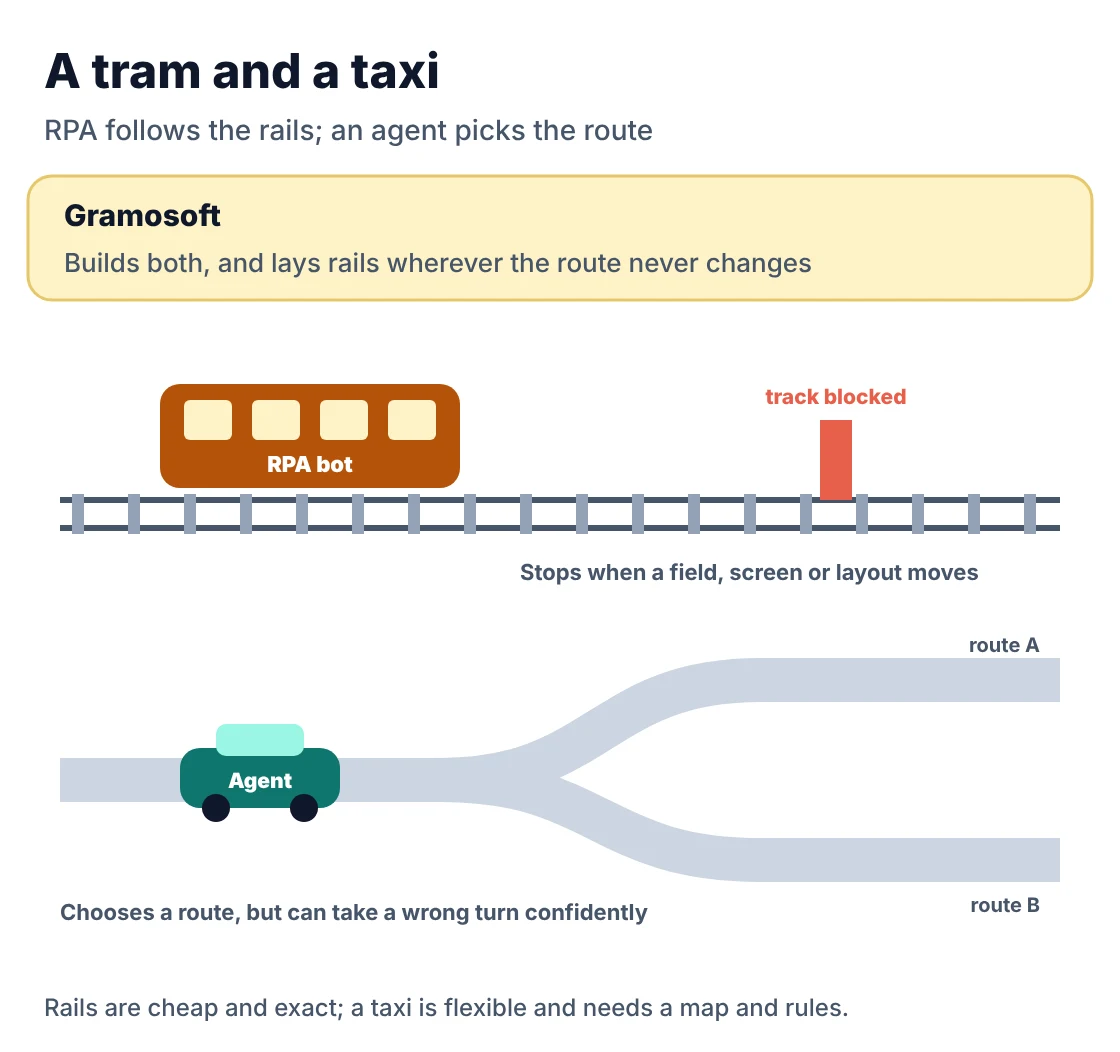
RPA automates a task that never varies; agentic process automation automates a process whose inputs do. An RPA bot follows a written script and stops at anything unexpected. An agentic process uses AI agents for the reading and deciding, and still calls bots and APIs for the exact steps.
IEEE's 2755 standard, as quoted in Botminds' guide, defines RPA as preconfigured software using business rules and a predefined choreography of activities, "with human exception management". Automation Anywhere defines agentic process automation as a framework that orchestrates AI agents, automation and people. One useful line from VDF AI: agentic automation is about the worker, an agent instead of a script, while agentic process automation is about the whole process.
Between the two sits intelligent automation: RPA with OCR, classification and extraction feeding the bot. For that step on its own, see OCR vs IDP: What's the Difference and Which Does Your Business Need?; for what makes something an agent, see The 5 Levels of AI Agents Explained, with Business Examples.
Agentic process automation vs RPA, side by side
The differences show up in what each automates, what input it can take, how it decides, and how it fails. RPA is predictable and cheap per step but brittle; an agentic process absorbs variation but costs more per step and can be confidently wrong. Neither is better everywhere, which is why most real processes use both.
| RPA | Agentic process automation | |
|---|---|---|
| How Gramosoft builds it | Robot Framework, Python, UiPath, Automation Anywhere, Power Automate | GdoczAI reading, agent steps with approvals, your existing bots as tools |
| Unit automated | A task | A process, end to end |
| Input | Structured, in fixed places | Structured and unstructured: PDFs, email, free text |
| Decisions | Written rules only | Rules, plus bounded AI decisions with a confidence |
| When a format changes | The bot breaks until it is fixed | Agent steps read the new layout; screen bots still need care |
| Exceptions | Queued for a person as found | Investigated and prepared before a person sees them |
| Predictability | Same input, same output | Fixed process order; AI steps vary within limits |
| Cost per step | Very low at volume | Model calls cost money on every AI step |
| How it fails | Stops visibly | Can proceed with a wrong reading, so it needs checks |
The failure row matters most. VDF AI puts it plainly: a bot stops when the screen changes, while an agent proceeds confidently with a wrong interpretation. That is why agent steps need confidence thresholds and approvals that bots never did.
How each one handles the same supplier invoice
Take one GST invoice arriving by email for posting into the ERP or Tally. The RPA bot follows a recorded path and fails on anything new. The agentic process adds an agent only where the invoice must be read and a decision made, and keeps a bot or API for the posting.
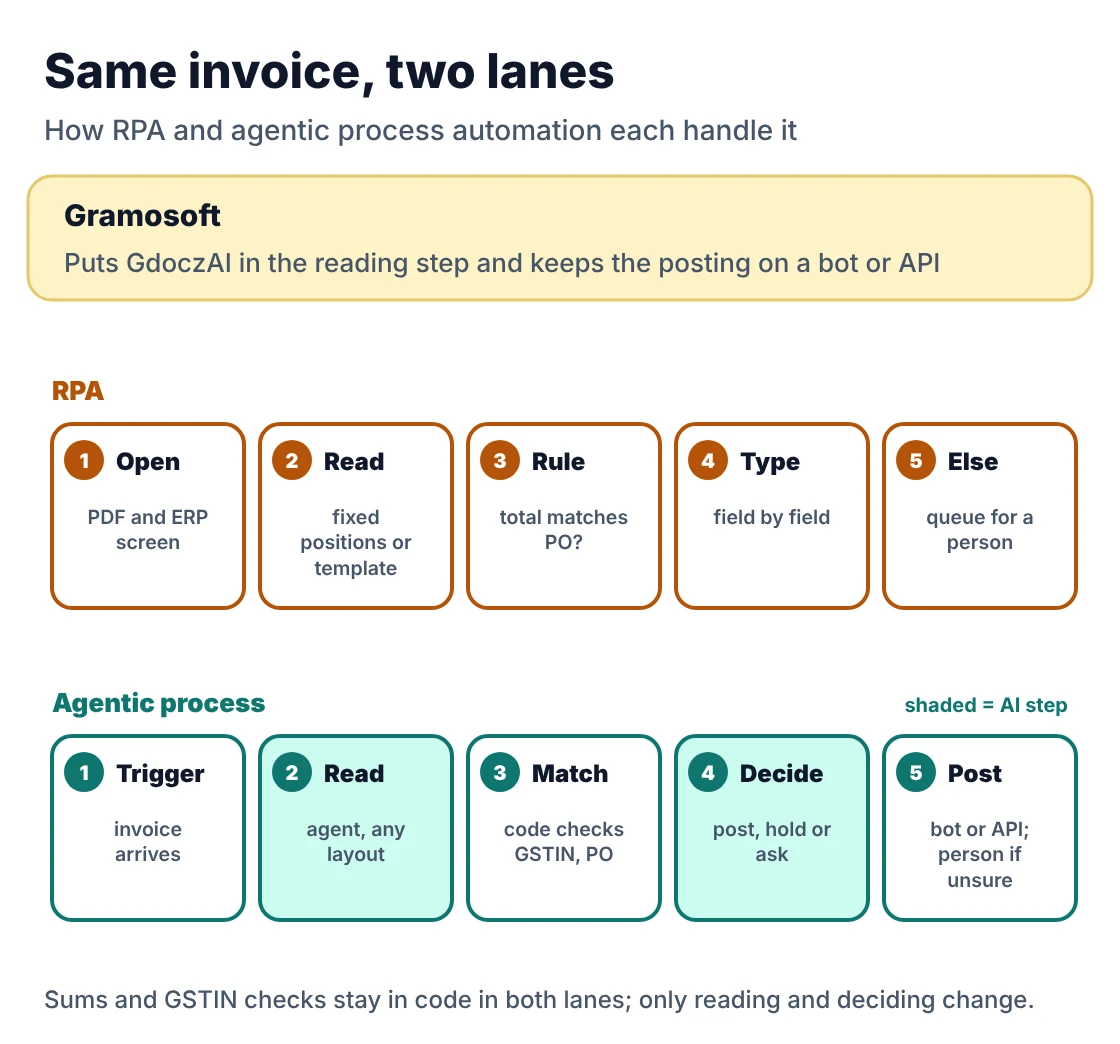
- RPA: opens the PDF, reads values from fixed positions or an OCR template, checks the total against the PO, types the fields into the ERP, and drops anything unexpected into a person's queue.
- Agentic process: starts when the email arrives, an agent extracts supplier, GSTIN, totals and lines whatever the layout, code matches the PO exactly, a bounded decision picks post, hold or ask, and a bot or API posts it, with unsure cases sent to a person with the evidence.
Notice what stays the same: the arithmetic and the GSTIN check run in code in both lanes. For the bot side in detail, see RPA Development Services: How Bots Are Built, Tested and Maintained.
Where RPA breaks, and where agents break
RPA is exact because it assumes nothing changes, and that assumption fails often. Agents remove some of those failures but bring new ones: wrong readings delivered with confidence, per-step model costs and instructions hidden in documents. Knowing both failure lists is how you decide where each belongs.
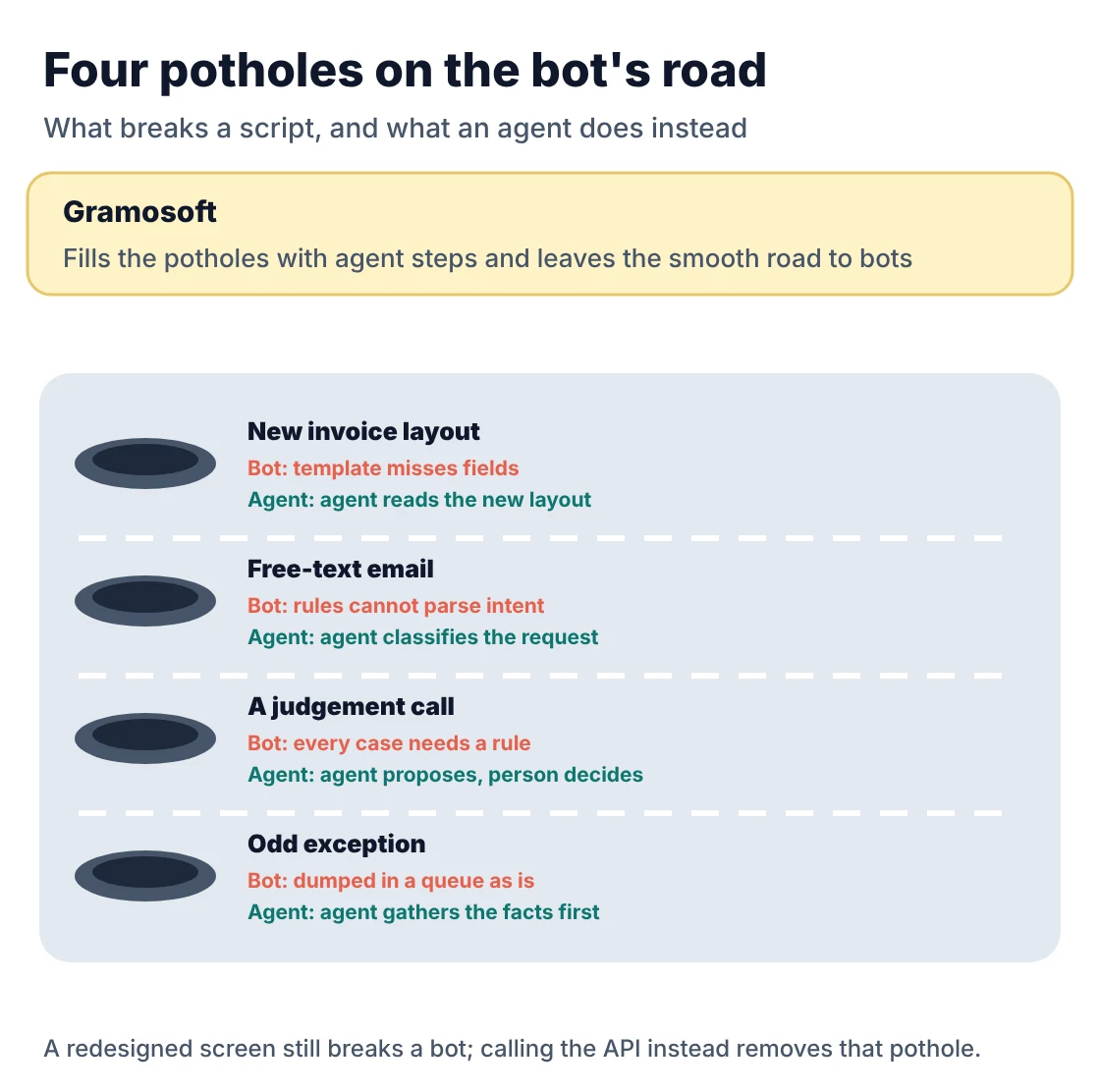
- Bot breakage is routine: in a 2020 Forrester study commissioned by Tricentis, cited by Automation Anywhere, 45% of firms reported bot breakage weekly or more often.
- Licences are the small part: the same Automation Anywhere article cites HFS Research estimating licensing at 25–30% of total RPA cost, with the rest on build, training and upkeep.
- Agents can be confidently wrong: a misread total looks just as tidy as a correct one, so AI steps need confidence scores and spot checks.
- Agents read untrusted text: a supplier's PDF or a customer email can carry instructions aimed at the model, which a script would never read.
- Many agent projects get cancelled: Gartner predicts that over 40% of agentic AI projects will be cancelled by the end of 2027, due to escalating costs, unclear business value or inadequate risk controls.
Which one fits each step of your process
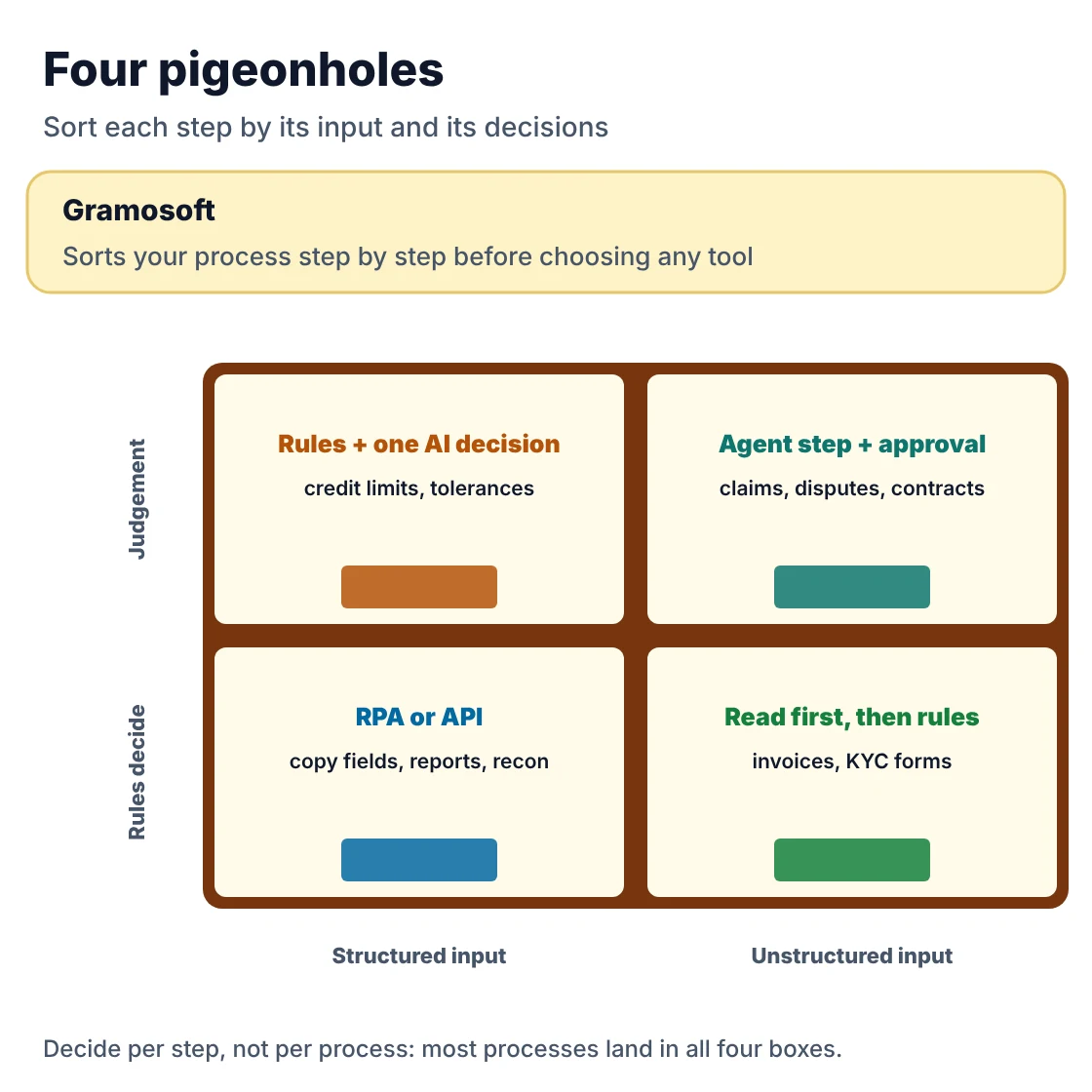
Decide step by step, not process by process. Two questions settle most steps: is the input structured, and can every decision be written as a rule? Most invoice, claims and onboarding processes end up with a few agent steps surrounded by deterministic ones, and approvals at a handful of points.
- Is there a dependable API? Call it. An API beats both a screen bot and an agent on speed, stability and audit.
- Is the input structured and the rule clear? Use RPA or a fixed workflow.
- Does the step need reading, judgement or drafting? Use an agent step.
- What happens if the step is wrong? If it moves money, reaches a customer or changes a record, put a named person between the agent's proposal and the action.
Microsoft gives the same advice for its own tools: keep classic RPA for deterministic scenarios with stable interfaces, and use computer-using agents where layouts shift or decisions get complex. Practitioners on r/rpa add the other half: many legacy systems still have no API, so screen bots will be around for years.
| Route | Fits when | Trade-off |
|---|---|---|
| Gramosoft builds bots and agents on one process | A process mixes stable steps with documents, emails and exceptions | Built for your systems, so the first one takes weeks, not days |
| Your RPA vendor's agent add-on | You already run one platform and its licences | Ties agents to that vendor; licence cost on top |
| Bots only | Inputs are structured and stable, exceptions are rare | Every new layout or exception lands on a person |
For the patterns that combine the two, such as an agent reading in front of a bot, or a bot handling the standard cases and an agent handling exceptions, see Agentic AI Development: How Custom AI Agents Are Built for Business Workflows.
How to spot rebranded RPA sold as "agentic"
Gartner calls it agent washing: vendors relabelling assistants, chatbots and RPA as agents without real agentic capability. Its June 2025 forecast estimates only about 130 of the thousands of agentic AI vendors are real. Six questions in a demo separate the genuine article from a renamed bot.
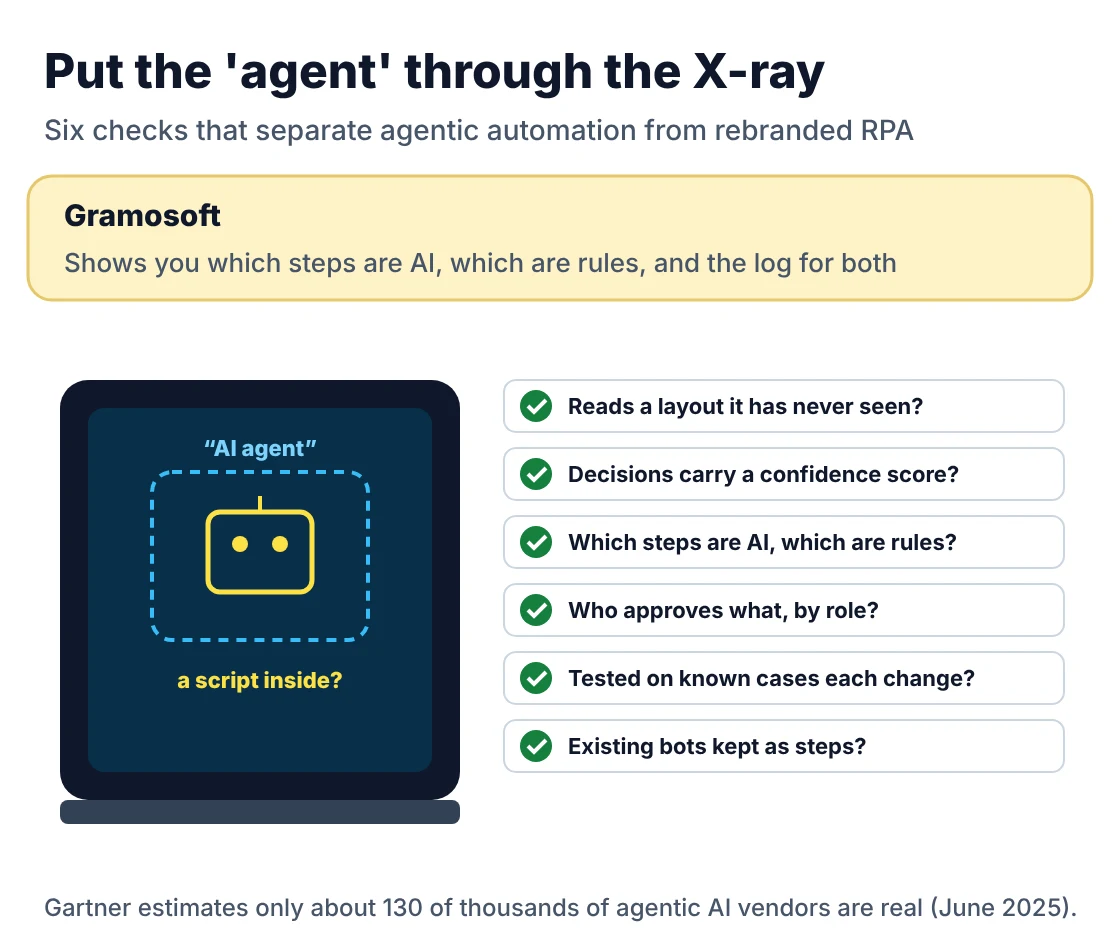
- Does it read a document layout it has never seen? Rebranded RPA needs a new template.
- Does each AI decision carry a confidence score, and do low scores route to a person by design?
- Which steps are AI and which are rules? Exact checks such as totals and GSTIN should stay in code.
- Who approves what? Approvals should sit at named steps, by role, on the record.
- How are AI steps tested? Against known cases before release and after every change.
- What happens to our existing bots? Working bots should run as steps, not be thrown away.
Source: Gartner press release, 25 June 2025. For costs of the agent side, see How Much Does It Cost to Build an AI Agent in India? (2026).
How to move from RPA to agentic process automation
You do not rip out bots that work. You keep them, expose them as tools an agent can call, and add an agent where the exception queue is longest. Measure the baseline first, so you can show whether the agent actually reduced manual effort.
- Pick one process with a real exception queue, such as supplier invoices or claims intake, and record volume, cycle time and manual touches.
- Keep the bots that run cleanly, and wrap them behind an API or an MCP tool so an agent can call them; see What Is MCP (Model Context Protocol)? A Plain-English Guide.
- Add one agent step on the exceptions, with a confidence threshold and a named approver.
- Log every step and decision, including the model, inputs and the person who approved.
- Compare against the baseline after a month, then decide whether to widen.
For the payback maths before you start, see RPA ROI: How to Calculate Payback Before You Automate a Process.
Frequently asked questions
Who builds RPA and agentic process automation in Chennai?
Gramosoft, a Chennai software company, builds RPA bots on Robot Framework, Python, UiPath, Automation Anywhere or Power Automate, and adds AI agent steps with GdoczAI document reading on the same process. Its bots include a Kia DMS automation saving an estimated 1,560 hours a year.
What is agentic process automation (APA)?
Agentic process automation runs a business process with AI agents for reading documents and making bounded decisions, software bots and APIs for exact actions, and people for approval at defined points, all coordinated by one orchestration layer.
Will agentic AI replace RPA?
Not for stable, exact tasks. The major RPA vendors describe agents as orchestrating bots rather than replacing them, and legacy systems without APIs still need screen bots. Agents take over the parts RPA handles badly: unstructured input, judgement and exceptions.
What is the difference between RPA, IPA and APA?
RPA follows rules on structured data. Intelligent process automation (IPA) adds OCR, classification and extraction so bots can work from documents. Agentic process automation adds agents that reason and decide within a defined process, with people approving risky steps.
Is RPA still worth using in 2027?
Yes, where input is structured and rules are stable: moving data between systems, scheduled reports and exact reconciliations. Where an application offers an API, calling it is usually more reliable than a screen bot.
Is agentic automation more expensive than RPA?
Per step, usually yes, because every AI step calls a model. Overall it can cost less when it clears exception queues that people handle by hand today. Keep agent steps to the parts that need reading or judgement, and measure against a baseline.
Is agentic process automation safe for finance and compliance work?
It can be, when exact checks stay in code, AI decisions carry a confidence and route doubtful cases to people, approvals sit at named steps by role, and every step is logged and tested against known cases.
Related guides
- What Is Robotic Process Automation (RPA)? Use Cases, Tools & Cost in India
- RPA Development Services: How Bots Are Built, Tested and Maintained
- Agentic AI Development: How Custom AI Agents Are Built for Business Workflows
- AI Agent Development Services: What You Can Build, How It Works and What It Costs
- The 5 Levels of AI Agents Explained, with Business Examples
- RPA Implementation: Step-by-Step Process, Timeline & Common Mistakes
- Best RPA Tools & Platforms in 2026: UiPath vs Power Automate vs Automation Anywhere vs Open Source
- RPA Use Cases by Industry: Automotive, Insurance, Aviation and Healthcare
- OCR vs IDP: What's the Difference and Which Does Your Business Need?
- What Is MCP (Model Context Protocol)? A Plain-English Guide
- RPA ROI: How to Calculate Payback Before You Automate a Process
- RPA Services in Chennai: 15 Processes Businesses Automate First
Rajesh Kannan M
Rajesh Kannan M is Co-Founder & CTO of Gramosoft in Chennai, where he leads the teams building custom AI, document AI, enterprise search and automation, including GsearchAI, GdoczAI and GcrawlAI, an open-source web scraping, crawling and Search API platform for developers and AI agents, alongside web and mobile applications.